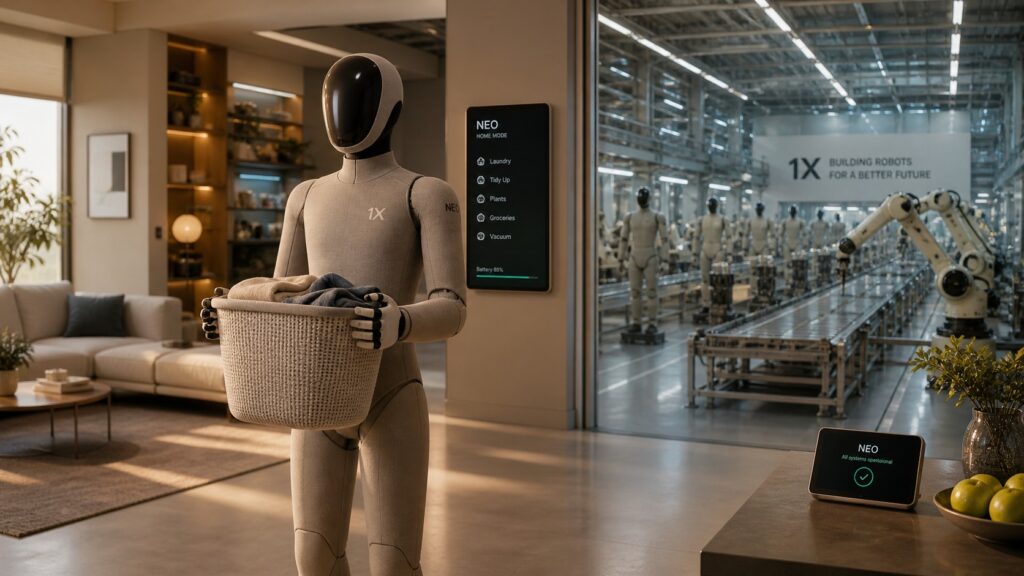
OpenAI-backed 1X Technologies just opened a California factory with one wild goal: put a humanoid robot in your living room. Here’s everything you need to know.
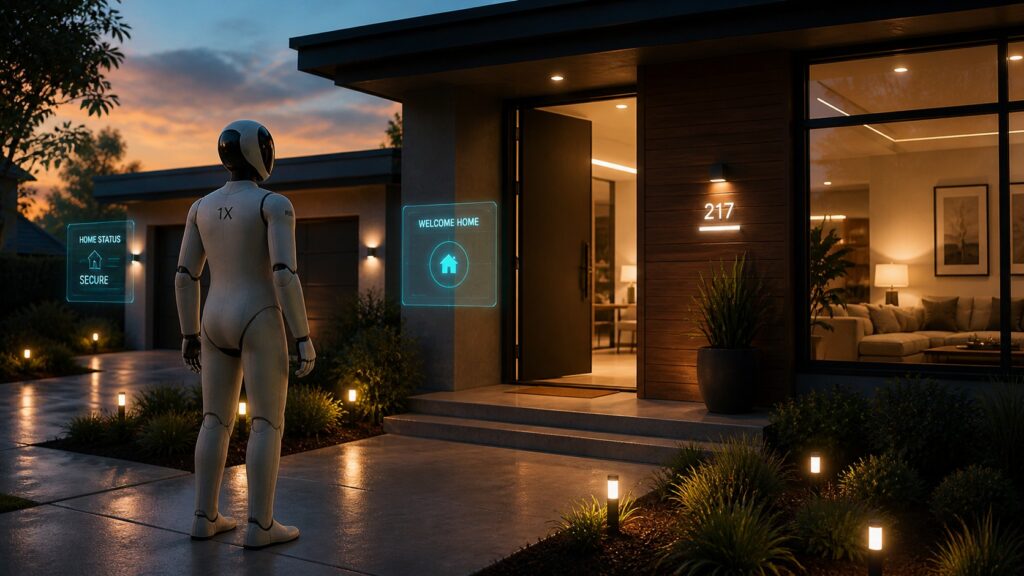
A Factory Built for the Future — Right Now
Something big just happened in Hayward, California. And no, it’s not another tech campus or a data center. It’s a 58,000-square-foot factory that could change the way you live at home.
1X Technologies, the Norway-founded, OpenAI-backed robotics company, officially opened its first U.S. manufacturing facility on April 30, 2026. The goal? Build 10,000 humanoid robots in year one. Then scale to 100,000 units annually by the end of 2027.
That’s not a typo. One hundred thousand humanoid robots. Per year.
The company describes the Hayward plant as the first vertically integrated humanoid robot factory in the United States. More than 200 employees currently work there, and that number is growing fast. The factory is already humming — and the robots rolling off the line are headed for real homes, not just research labs.
“This is more than just a factory opening,” said 1X CEO and founder Bernt Børnich. “It’s proof that the future of humanoid robotics is being built right here in the U.S.”
Bold words. But 1X is backing them up with action.
Meet NEO — Your Future Roommate
So what exactly is 1X building? Meet NEO, the humanoid robot that went viral last year and sold out its entire first-year production run in just five days.
NEO stands 5 feet 6 inches tall. It weighs 66 pounds. It comes in three colors — Tan, Gray, and Dark Brown. And it’s designed to live with you, not just work near you.
This isn’t your typical stiff, clunky industrial robot. NEO features a soft body made of 3D Lattice Polymer and tendon-driven actuators that make it quiet, lightweight, and — crucially — safe to be around. No sharp edges, no pinch points. No terrifying metal skeleton. It can carry up to 55 pounds and lift 154 pounds, which means it can handle most household tasks without breaking a sweat.
NEO has four microphones, three speakers, and fish-eye cameras for vision. It runs on Nvidia’s Jetson Thor chip and uses Nvidia’s Isaac simulation framework for training. It has a four-hour battery life. When it runs low, it walks itself to its charging port. No reminders needed.
The robot learns household tasks through embodied AI — meaning it gets smarter by actually doing things in the real world. You can also teach it new skills yourself using a VR headset and controllers. And yes, it can hold a conversation. Børnich has compared that feature to ChatGPT.
Want one? You have two options. Buy it outright for $20,000 with Early Access priority delivery in 2026. Or subscribe for $499 per month. Either way, first shipments are expected this year, though 1X has been refreshingly honest: “Some of you will get your NEO this year, some will get them later.”
The Unboxing Experience Is Part of the Product
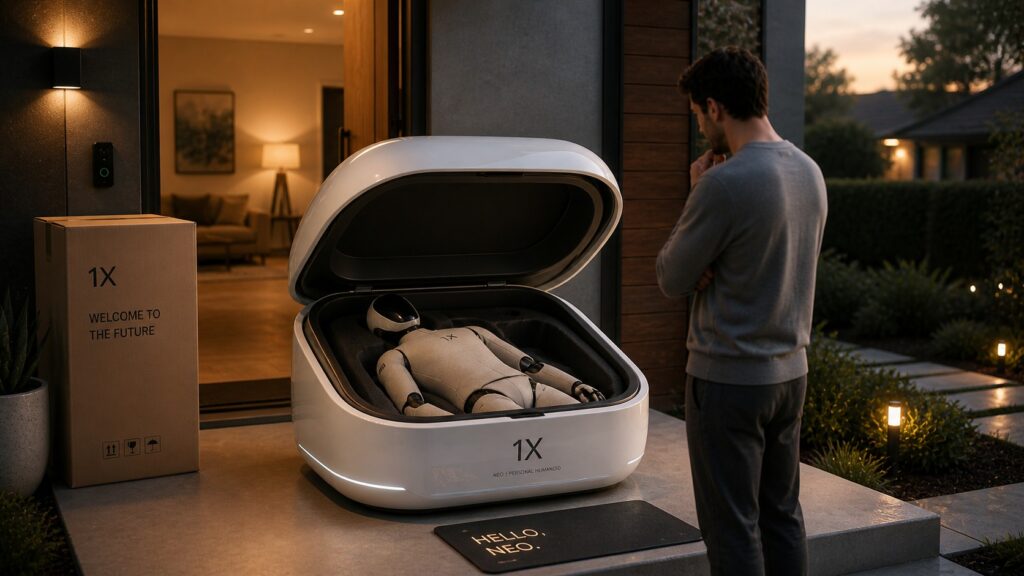
Here’s something most robotics companies don’t think about: how does a 66-pound humanoid robot actually show up at your door?
1X is thinking about it. Hard.
Humanoids Daily reported that just before the factory announcement, 1X CEO Bernt Børnich teased a video of NEO sitting inside a sleek, rounded delivery capsule. The pod looks like something out of a sci-fi film — or a very large AirPods case, as Bloomberg described it.
Dar Sleeper, 1X’s Head of Design (and VP of Product and Marketing), explained the thinking behind it. “Making humanoids is one thing,” Sleeper said. “Making a humanoid into a consumer product takes engineering to extreme limits.”
The company has spent serious time designing what it calls “beautiful accessories and features” to answer the practical question of how a robot safely arrives at your home. This focus on the ownership experience — the unboxing, the setup, the day-to-day feel — sets 1X apart from competitors who are still laser-focused on demos and press releases.
Børnich’s teaser caption said it all: “Robot abundance, one NEO at a time.”
Built in America, From the Ground Up
One of the most interesting things about 1X’s factory isn’t just what it makes — it’s how it makes it.
According to Yahoo Finance, 1X takes a deeply vertically integrated approach to manufacturing. The company builds its own motors, batteries, electronics, copper coils, transmission systems, soft goods, and sensors — all in-house. That’s rare in any industry, let alone robotics.
“The level of vertical integration here is unmatched, not just in the humanoid space, but in the hard tech space,” Sleeper told Bloomberg.
Why does this matter? Speed. When NEO collects real-world data from customers, 1X can analyze it and push hardware updates faster than any company relying on outside suppliers. The feedback loop is tight. The iteration cycle is fast. And in a field where the technology is evolving weekly, that’s a massive competitive advantage.
Sleeper also took a shot at industry critics who claim America can’t manufacture robotics components at scale. “1X has the cheapest and most performant actuators in the world by orders of magnitude,” he said on social media. “And we’re an American company manufacturing our actuators in-house.”
The Hayward facility is just the beginning. A larger plant is already under construction in San Carlos, California. When both facilities are running at full capacity, 1X expects to hit that 100,000-unit annual target by end of 2027.
Robots Building Robots — Eventually
Here’s where things get really interesting.
Inside the Hayward factory, NEO units are already working. Not building other NEOs yet — but getting there. Right now, they’re stocking parts for assembly technicians, performing basic warehousing and logistics operations, and collecting real-world data that feeds back into their own training.
USA Today reported that the robots are expected to take on greater roles in the coming months, including facility security. Long term, 1X envisions NEO handling everything from household chores to building other robots, supporting chip fabs, and powering data centers.
“Long term, the possibilities are near limitless,” the company said.
Børnich himself believes humanoids will reach a critical mass in society in as little as two years. “We need a lot of skilled labor in the U.S. to be able to really ramp up manufacturing the way we want,” he said. “And there’s likely going to be more of these machines than there are people.”
The final assembly process is also worth noting. Each NEO gets mounted to a spine, then performs what Sleeper calls “morning stretches” — squats and yoga poses — to check movement and quality. Then it gets wrapped in a soft, clothing-like fabric exterior. The whole thing ships in that giant white protective capsule.
The Competition Is Coming — Fast
Let’s be real: 1X isn’t the only player in this game. The humanoid robotics race is heating up, and it’s getting crowded.
Tesla is the elephant in the room. Elon Musk’s long-stated goal is to price Optimus below $20,000 — the exact same price point as NEO’s Early Access tier. Tesla’s Shanghai Gigafactory is gearing up for humanoid production, with internal targets of one million units per year that haven’t been publicly confirmed.
Figure AI just announced its BotQ facility in California has scaled to produce one Figure 03 robot per hour. That’s a serious manufacturing milestone. Figure is currently focused on industrial data collection and autonomous warehouse operations, but the consumer market is clearly in its sights.
Then there’s China. Unitree, Agibot, UBTECH, Fourier Intelligence — the list goes on. China’s central and local governments have identified humanoid robots as a strategic technology, pouring in subsidies and policy support. The country accounted for the majority of the 13,000 humanoid units shipped worldwide last year.
Europe is also building. Germany’s Neura Robotics has scaled to over 600 employees and raised €120 million in early 2025. Its founder has said he sees Tesla as his only real competitor.
1X’s answer to all of this? American-made, vertically integrated, consumer-first. It’s a different bet than everyone else is making.
The Big Question Nobody Can Answer Yet
Here’s the honest truth. Every humanoid robot company faces the same unsolved problem: can these machines actually handle the messy, unpredictable reality of a real home?
NEO’s launch video showed it taking out the trash, watering plants, and dancing. Charming. But a Wall Street Journal video showed it struggling to load a dishwasher — and being operated by a remote human agent, not autonomously.
1X knows this. Børnich has been unusually transparent about it. “It’s incredibly important to be very honest and transparent about what is the current state of things,” he said. “We don’t want to overpromise on what we can deliver.”
The company’s strategy is to ship and iterate. Get NEOs into real homes. Collect real data. Fix real problems. The vertically integrated factory was designed specifically to enable rapid hardware updates as feedback rolls in.
Whether that iteration speed is fast enough — whether NEO can close the gap between polished demo and messy Tuesday morning — is the real bet behind the entire factory.
What This Means for You
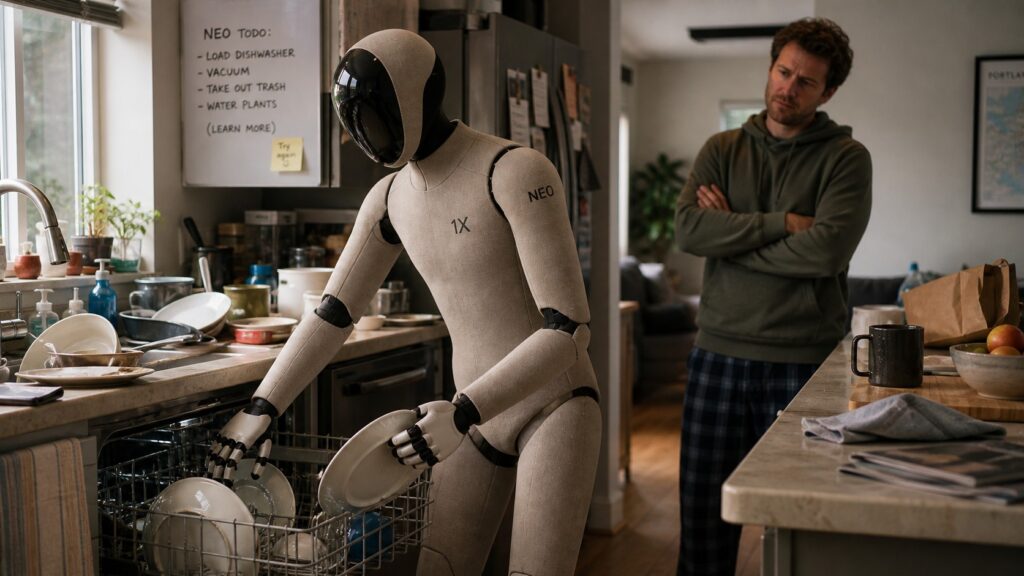
So should you put down $20,000 for a robot roommate?
That depends on your risk tolerance and your enthusiasm for being an early adopter. The first-year production run is already sold out. If you want in, you’re looking at the subscription model or waiting for the next production batch.
What’s clear is that 1X is serious. The factory is real. The robots are coming off the line. The delivery capsule is designed. The company has $123.5 million in funding, a partnership with private equity firm EQT to deploy 10,000 units to enterprise clients, and a CEO who genuinely believes humanoids will be everywhere within two years.
The age of the home humanoid robot isn’t a distant sci-fi fantasy anymore. It’s a 58,000-square-foot factory in Hayward, California, running three shifts a day.
Your future roommate is almost ready.
Sources
- The Next Web — OpenAI-backed 1X opens California factory targeting 10,000 home humanoid robots in year one
- USA Today — NEO humanoid robot company plans to release 100,000 units by late 2027
- Humanoids Daily — The Robot in the Box: 1X Teases NEO Delivery Logistics as Humanoid Production War Heats Up
- Forbes — 1X Kicks Off Full-Scale Production of Humanoid Robot NEO
- Yahoo Finance / Bloomberg — Humanoid Maker 1X Opens New US Factory, Plans to Build 10,000 Home Robots in First Year
The Kingy Brief
Get future Kingy Brief editions.
Source-checked AI changes, original tests and one practical thing to try.
Free · Choose your subjects · Double opt-in · Unsubscribe anytime
Regular sending is paused; no restart date is set.