Last updated: July 30, 2026
Last verified: July 30, 2026
TL;DR: Gemini Robotics 2 is Google DeepMind’s new three-model robotics stack. It adds whole-body humanoid control, longer task planning, multi-robot coordination and faster on-device adaptation. The technical progress is real, but the strongest evidence still comes from Google’s controlled demonstrations and internal evaluations. Multi-finger dexterity is inconsistent, the action models remain restricted, and Google’s own safety report says its tests do not replace certified hardware and functional-safety systems.
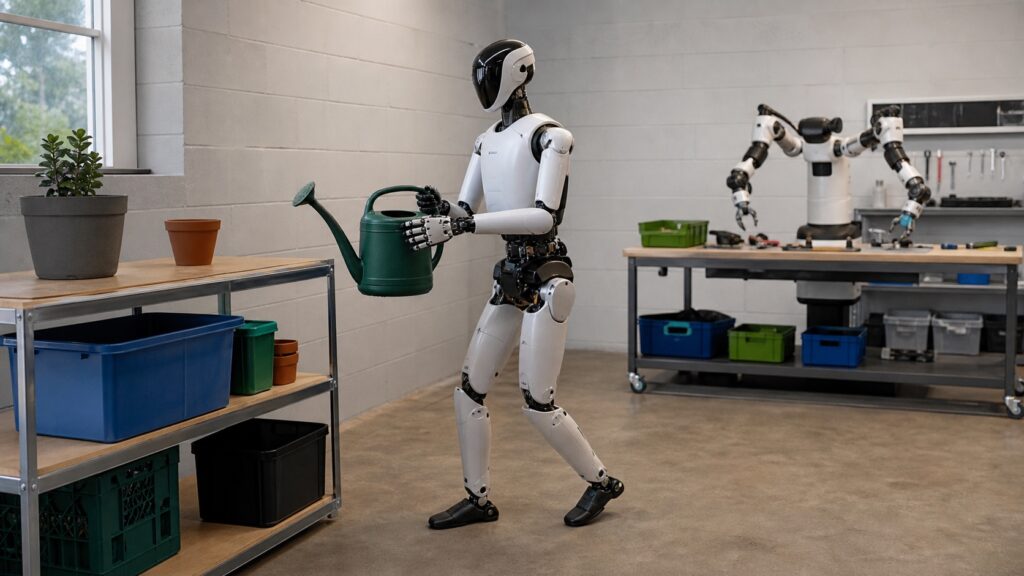
Google DeepMind has pushed Gemini Robotics 2 beyond tabletop manipulation. In its flagship demonstration, Apptronik’s Apollo 2 walks to a watering can, grasps it, carries it across a room and lowers it onto a bottom shelf. The sequence forces locomotion, balance, perception and manipulation to work together.
A separate reasoning model plans longer jobs, monitors failures and coordinates different robots. The release still rests on controlled demonstrations: Google says motion speed needs work, multi-finger success falls to 32% on one task, the action models remain restricted, and no independent group has reproduced the results.
What you need to know
- This is a three-model release. Gemini Robotics 2 handles physical action, Gemini Robotics ER 2 handles reasoning and orchestration, and Gemini Robotics On-Device 2 runs locally on supported robot hardware.
- Whole-body control is the headline advance. The VLA can coordinate walking, reaching, bending and object manipulation on a full humanoid.
- Dexterity remains uneven. Google reports 92% success for unscrewing a bulb, but only 32% to 44% on several other five-finger tasks.
- Developers can use the reasoning model now. Gemini Robotics ER 2 is in public preview through the Gemini API and Google AI Studio. The action and on-device models remain limited to early-access or trusted partners.
- Safer reasoning does not equal a certified robot system. Google’s safety report explicitly excludes the functional-safety architecture needed for compliant deployment.
What Google announced
Gemini Robotics 2 is better understood as a software stack than as a single robot model.
At the bottom sits a vision-language-action model, or VLA. A VLA receives camera images, language instructions and robot state, then produces numerical actions that move joints, grippers or hands. It is the layer that turns “put the watering can in the green bin” into physical motion.
Above it sits Gemini Robotics ER 2, an embodied-reasoning model. It observes the scene, interprets the user’s goal, breaks the work into steps, calls robot-control tools and decides whether each step succeeded. Google describes it as the high-level brain, while the VLA handles motor execution.
The third model, Gemini Robotics On-Device 2, is designed for local inference. It trades some of the scale and breadth of a cloud model for lower latency, offline operation and faster adaptation to a new robot body.
| Model | Main job | Inputs and outputs | Deployment | Availability |
|---|---|---|---|---|
| Gemini Robotics 2 | Whole-body and dexterous motor control | Vision and language in; robot actions out | Robot and partner systems | Early-access partners |
| Gemini Robotics ER 2 | Planning, spatial and temporal reasoning, tool orchestration and progress tracking | Text, image, video and audio in; text or tool calls out | Gemini API, AI Studio and enterprise platform | Public preview; enterprise platform is private preview |
| Gemini Robotics On-Device 2 | Local bi-arm manipulation and rapid embodiment adaptation | Text, images and robot proprioception in; numerical actions out | Local robot hardware | Trusted testers |
The separation matters. A high-level model can reason over minutes, use tools and communicate with people without directly generating every motor command. The VLA can focus on the faster control loop. It resembles a manager-and-operator arrangement, except both layers are statistical models and both can fail.
Gemini Robotics 2 brings whole-body control to humanoids
Previous Gemini Robotics releases demonstrated upper-body and tabletop tasks. Gemini Robotics 2 extends the action model into a humanoid’s legs, torso, arms and hands.
In Google’s Apollo 2 demonstration, the robot receives a natural-language instruction to move a watering can to a green bin on a bottom shelf. It walks to the table, grasps the can, turns, takes several steps, lowers its body and places the object in the requested location.
Each part is difficult on its own. Walking shifts the robot’s centre of mass. Carrying an object changes the load. Reaching for a low shelf reduces the margin for balance errors. Perception must stay aligned with the robot as its cameras move. The grasp must survive the walk, and the final placement must be accurate enough to avoid striking the shelf or dropping the can.
Google says one Gemini Robotics 2 checkpoint controlled three different configurations in its evaluation: Apollo 2 with SharpaWave hands, Apollo 2 with Inspire hands and Franka Duo with Robotiq grippers. That is evidence for broader embodiment transfer than a policy trained for one fixed arm.
It is not evidence that a humanoid can now work a full shift. Google acknowledges that motion speed needs to improve, and the launch material does not publish long-duration reliability, intervention frequency, energy use, recovery time or deployment cost. Those measurements will matter more than a polished task video when buyers evaluate real operations.
Dexterity improves, but the task-to-task spread is large
Hands are where many humanoid demonstrations stop looking effortless. A five-finger hand has more ways to grasp an object, but also more joints to coordinate and more opportunities for contact to go wrong.
Gemini Robotics 2 controls the five-fingered, 22-degree-of-freedom SharpaWave hand on Apollo 2. Google shows it tying a bag, working with a dustpan, handling a ziplock seal and screwing or unscrewing a bulb. It also controls standard two-finger grippers on a Franka Duo for packing, kitting and insertion tasks.
The Google-reported success rates tell a mixed story:
| Google-reported task | Robot or end effector | Success rate |
|---|---|---|
| Screw bulb | Apollo 2 with Sharpa hands | 36% |
| Unscrew bulb | Apollo 2 with Sharpa hands | 92% |
| Tie trash bag | Apollo 2 with Sharpa hands | 44% |
| Dustpan | Apollo 2 with Sharpa hands | 32% |
| Ziplock | Apollo 2 with Sharpa hands | 40% |
| General pick and place | Franka Duo with grippers | 74.2% |
| Diverse tool kitting | Franka Duo with grippers | 78.9% |
| Precise insertion | Franka Duo with grippers | 89.6% |
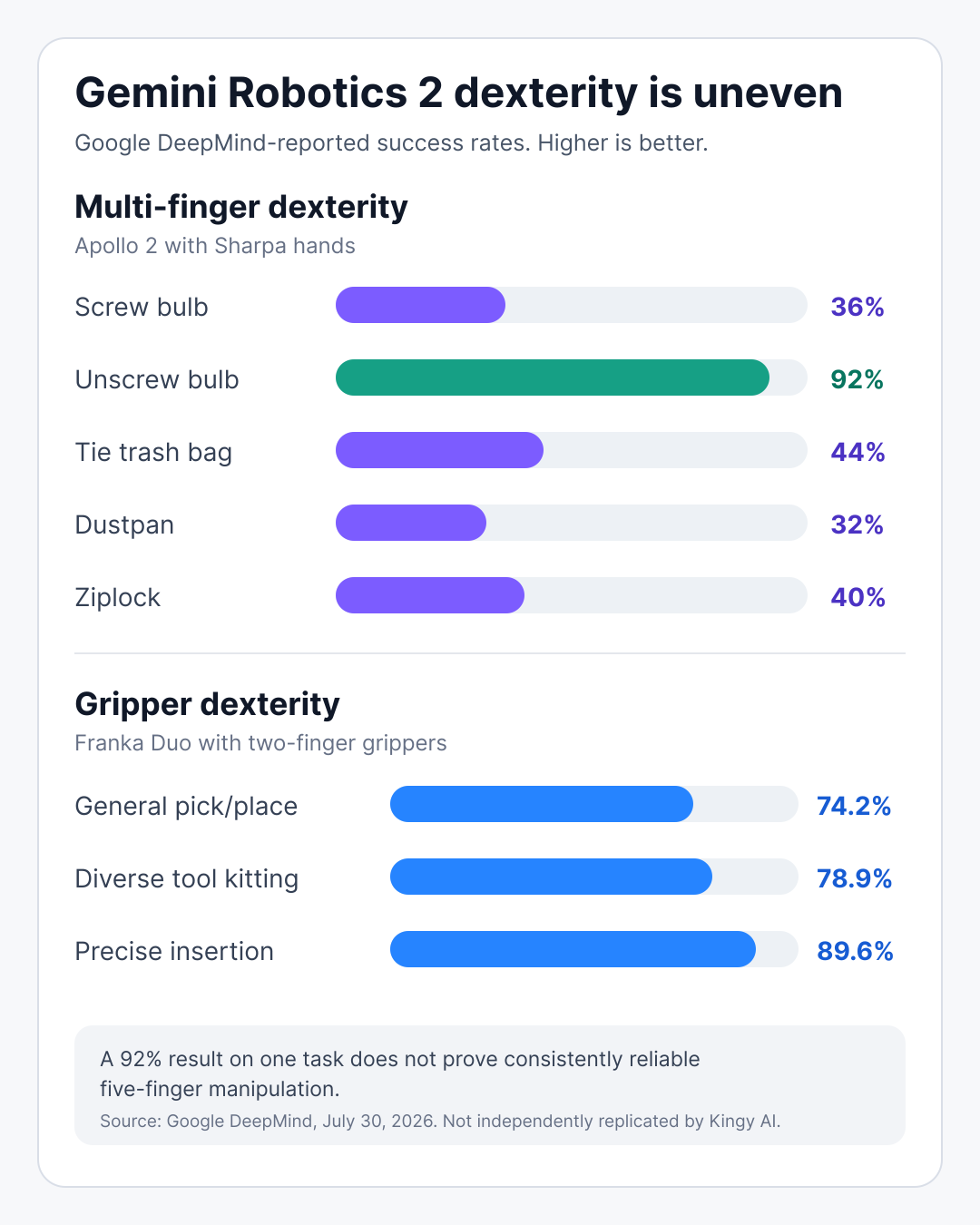
The 92% unscrewing result is impressive. It should not erase the four multi-finger results between 32% and 44%. A household or industrial workflow cannot assume that success on one familiar manipulation transfers to every object, grip or contact pattern.
The gripper results are more consistent, which fits a familiar robotics tradeoff. Two-finger grippers have less versatility than human-shaped hands, but fewer degrees of freedom can make control easier. A specialised gripper may remain the better commercial choice when the work is narrow and uptime matters.
Kingy AI did not run these tasks or inspect the evaluation episodes. Google says the bars average multiple tasks within a skill category, but the launch post does not provide enough episode-level detail to calculate deployment reliability.
Gemini Robotics ER 2 handles the longer job
The action model moves the robot. Gemini Robotics ER 2 decides what the robot should do next.
The model is based on Gemini 3.5 Flash and accepts interleaved text, images, video and audio. Its model card lists a 128,000-token context window and up to 64,000 output tokens. Developers can expose a VLA, navigation system, robot API or other control interface as a callable tool.
This lets the reasoning model:
- interpret a natural-language goal;
- inspect live camera or audio input;
- divide the goal into subtasks;
- call a robot-control tool;
- monitor whether the action worked;
- retry or change the plan after a failure;
- ask a person for clarification;
- coordinate a handoff to another robot.
Google says the new system can manage sequences lasting several minutes and involving hundreds of decisions. The streaming endpoint uses the Gemini Live API so ER 2 can process continuous input and issue function calls without pausing the robot for a long “think” step.
Google demonstrates that orchestration with Boston Dynamics Spot. ER 2 handles a spoken request, then calls Spot’s navigation and manipulation APIs to fetch an object. This shows that the reasoning layer is not tied to one humanoid body, although the demo still depends on pre-existing robot APIs and lower-level control software.
Temporal intelligence helps a robot know when to stop
A robot can execute the correct motion and still fail the job if it cannot tell when the task is complete. Pouring, tightening, folding and packing all have stopping conditions that change with the scene.
Gemini Robotics ER 2 adds two video-understanding functions:
Progress classification assigns each video frame to one of five completion ranges, from 0–20% through 80–100%. Google reports 57.4% accuracy. That is better than the comparison models in Google’s chart, but it also means progress classification remains far from dependable enough to serve as the only completion signal.
Moment finding identifies the video frame where a key event occurred, such as the instant a container becomes full. Google reports 91.3% accuracy and a 0.96-second mean absolute distance from the reference moment. The company also claims four-times execution speed and lower compute than larger comparison models, although it does not publish enough cost detail in the launch post to turn that claim into a complete deployment comparison.
These features could reduce cascading errors in long workflows. If the model knows that a bag was not tied correctly, it can retry that step instead of moving on and compounding the mistake.
Multi-robot collaboration is orchestration, not a robot hive mind
Gemini Robotics ER 2 can coordinate work between different robot forms through a shared reasoning layer. Google demonstrates an Apollo 2 humanoid working with a Franka Duo system.
The practical case is strong. A humanoid can navigate spaces designed for people, while a fixed or wheeled manipulator may be faster and more stable at a bench. One model can assign tasks according to each machine’s capabilities and track the handoff.
That could matter in:
- warehouses where mobile robots bring totes to fixed packing stations;
- factories that combine humanoids with precision manipulators;
- laboratories where robots divide transport and bench work;
- maintenance sites where one platform navigates and another handles tools;
- hazardous environments where several specialised machines share one plan.
The current evidence is a controlled demonstration, not open-ended teamwork. Real fleets will still need identity, permissions, shared maps, scheduling, collision avoidance, network resilience and clear recovery rules when one robot fails.
On-Device 2 targets latency and fast adaptation
Cloud reasoning is useful, but a robot cannot always wait for a round trip to a data centre. Connectivity can disappear, video can be expensive to transmit, and motor decisions may need to arrive within milliseconds.
Gemini Robotics On-Device 2 runs locally and outputs numerical robot actions. Google says it can adapt to a new bi-arm embodiment with a few hours of data, typically fewer than 200 examples. The launch shows adaptation across Dexmate, SO101 and Trossen platforms with different shapes, sensors and degrees of freedom.
Its model card adds boundaries that the announcement’s headline does not. On-Device 2 is based on Gemini Robotics 1.5 technology and on-device Gemma models. It was developed mainly for standing bi-arm manipulation, and Google says it has limited ability to generalise to out-of-distribution tasks or control high-degree-of-freedom robots.
That makes it a promising base model, not a universal drop-in controller. A team still needs embodiment-specific data, integration work, validation and safety controls.
What developers can access now
The easiest part of the stack to try is the reasoning model.
| Access route | Model | Status on July 30, 2026 |
|---|---|---|
| Google AI Studio | Gemini Robotics ER 2 Preview | Available |
| Gemini API |
gemini-robotics-er-2-preview
|
Public preview |
| Gemini Live API |
gemini-robotics-er-2-streaming-preview
|
Public preview |
| Gemini Enterprise Agent Platform | Gemini Robotics ER 2 | Private preview |
| Early-access partner programme | Gemini Robotics 2 VLA | Restricted |
| Trusted tester programme | Gemini Robotics On-Device 2 | Restricted |
The standard and streaming ER 2 endpoints accept text, image, video and audio. The standard model supports structured output, function calling, code execution and Google Search grounding. The streaming endpoint supports bidirectional Live API sessions and function calling.
Google’s pricing page lists a free tier for both ER 2 preview endpoints. Paid standard pricing is $2 per million input tokens and $10 per million output tokens. Standard batch pricing is $1 per million input tokens and $5 per million output tokens. Video-heavy robotics applications can consume tokens quickly, so an API price is only one part of total system cost.
Google’s developer terms also call out privacy obligations. Robotics deployments may collect identifiable voices and images, so operators must notify people, obtain the required consent and minimise collection where practical.
Google’s safety results are encouraging—and incomplete
Google introduced ASIMOV-Agentic, a benchmark for the reasoning layer that sits between a human instruction and a robot’s action model. It tests whether the agent can:
- refuse an instruction that violates operating constraints;
- detect that a requested action is infeasible;
- avoid passing an unsafe call to the VLA;
- monitor hardware or human-proximity events;
- call a stop tool;
- ask a person to clarify ambiguous instructions;
- admit when a scene is too obscured to interpret safely.
Google’s 18-page safety report contains more useful caution than the launch summary. Text-only safety classification reached at least 96% across the frontier models Google tested, but performance varied more when constraints had to be grounded into coordinates or executable tool calls.
Human-proximity testing also exposed a difficult tradeoff. Configurations with fewer than 5% unnecessary stops missed more than 40% of genuine proximity hazards. Reducing missed hazards toward 10–15% caused unnecessary stops 15–25% of the time. No model reached the ideal low-error region on both measures.
In a separate Apollo 2 lab test, Google reports 99% human-detection accuracy and 96% reliability in moving to a safe pose. Those are company-run lab results, not a safety certification.
The report states that traditional safeguards such as emergency stops, barriers, speed limits and force limits remain essential. It also says the evaluation does not cover certified hardware components, redundancy or real-time system guarantees. The On-Device 2 model card similarly recommends low-level collision-free motion planning, balance and force control, and hardware-specific functional safety.
There is a good reason for that separation. A reasoning model can request a stop, but a certified safety controller must make sure the machine stops within a defined time and distance even if the AI, network or main computer fails.
Independent research published before ER 2 reinforces the need for caution. The RoboAbstention study found that Gemini Robotics ER 1.6 abstained on only 16.5% of more than 6,000 ambiguous, infeasible or unsupported instructions under its default setup. Defensive prompting improved the result sharply, but no approach solved the problem. That study does not evaluate ER 2, so it cannot be used as a score for the new model. It does show why Google’s new focus on uncertainty and escalation matters.
How Gemini Robotics 2 changes the previous stack
| Area | Gemini Robotics 1.5 / ER 1.6 | Gemini Robotics 2 / ER 2 |
|---|---|---|
| Physical control | Mainly upper-body and tabletop manipulation | Full humanoid control plus bi-arm manipulation |
| Task horizon | Multi-step planning | Longer sequences lasting several minutes |
| Video understanding | Spatial reasoning and task observation | Progress classification and frame-level moment finding |
| Fleet behaviour | Individual robot orchestration | Handoffs between different robots |
| Embodiment adaptation | Motion transfer across supported platforms | New bi-arm adaptation in hours with fewer than 200 examples |
| Safety focus | Semantic safety and spatial awareness | Agentic constraint enforcement, uncertainty escalation and stop-tool orchestration |
The upgrade is broader than “better hands.” Google is connecting perception, long-horizon planning, motor control and fleet orchestration into one family.
What this release means for physical AI
Gemini Robotics 2 strengthens the idea that robot intelligence can become more portable than robot hardware. If one VLA checkpoint can work across several embodiments, and one reasoning layer can call tools across many robot types, manufacturers do not need to build every behaviour stack from zero.
That could shift value toward model providers, data pipelines and shared control interfaces. Robot companies would still own critical hardware, sensors, actuators and safety systems, but a reusable intelligence layer could shorten the path from a capable machine to a useful application.
The release also sharpens the competition around robot platforms. Nvidia is building its own physical-AI stack around Jetson, Isaac and GR00T; Mistral recently introduced Robostral Navigate for language-guided robot navigation; and humanoid developers are racing to make bodies cheaper and easier to train. Kingy AI’s AI robots tracker shows how fragmented the current market remains.
Google’s advantage is the breadth of the Gemini layer: multimodal perception, reasoning, tool use, streaming and now physical action. Its weakness is access. A developer can experiment with ER 2 today, but cannot download the core VLA or On-Device 2 and deploy it freely across arbitrary hardware.
Kingy verdict
Verdict: Watch closely; test the reasoning model, but do not mistake the demos for deployment proof.
Gemini Robotics 2 is one of Google DeepMind’s most consequential robotics releases because it joins whole-body motion, dexterous manipulation, temporal reasoning and multi-robot orchestration in one stack. The Apollo 2 demonstration is a real step beyond a robot arm moving objects on a table.
The numbers keep the story grounded. Five-finger task success ranges from 32% to 92%. Progress classification reaches 57.4%. Google’s safety benchmark exposes a tradeoff between missed hazards and unnecessary stops, while its model cards warn against safety-critical use.
For robotics developers, Gemini Robotics ER 2 is the actionable part: it is documented, priced and available through the API. The VLA and On-Device models remain research and partner technology. The next proof point is not a more dramatic video. It is independent evaluation, longer deployments and evidence that the system can perform useful work repeatedly without constant intervention.
FAQ
What is Gemini Robotics 2?
Gemini Robotics 2 is Google DeepMind’s latest robotics model family. It combines a vision-language-action model for whole-body robot control, an embodied-reasoning model for planning and orchestration, and an on-device action model for local manipulation.
How is Gemini Robotics ER 2 different from Gemini Robotics 2?
Gemini Robotics ER 2 is the high-level reasoning layer. It understands instructions, analyses video, plans tasks and calls robot tools. Gemini Robotics 2 is the lower-level VLA that converts vision and language into motor actions.
Can developers access Gemini Robotics 2?
Developers can use Gemini Robotics ER 2 in preview through Google AI Studio and the Gemini API. The main Gemini Robotics 2 VLA is limited to early-access partners, and Gemini Robotics On-Device 2 is available to trusted testers.
Which robots can Gemini Robotics 2 control?
Google demonstrates Gemini Robotics 2 on Apptronik Apollo 2 humanoids and Franka Duo bi-arm systems. On-Device 2 was adapted to Dexmate, SO101 and Trossen platforms. Support for a demonstration platform does not mean every configuration is commercially supported.
Is Gemini Robotics 2 safe around people?
Google reports improved human-proximity detection, safety-tool calling and safe-pose behaviour in controlled tests. Its safety report says these AI evaluations do not replace certified hardware, emergency stops, redundancy, real-time guarantees or application-specific risk assessment.
Official sources
- Google DeepMind: Gemini Robotics 2 launch and reported dexterity results
- Google: Gemini Robotics ER 2 developer announcement and evaluations
- Gemini Robotics ER 2 model card
- Gemini Robotics On-Device 2 model card
- Gemini Robotics 2 safety evaluations
- Gemini API robotics documentation
- Gemini API pricing
- ASIMOV-Agentic benchmark
- RoboAbstention independent research
- Axios: Google updates its AI software for robots
Related Kingy AI coverage
- Mistral’s Robostral Navigate uses one RGB camera to guide robots
- Nvidia and Unitree’s humanoid robot reference platform
- Silicon Valley’s push into physical AI and robotics
- Kingy AI robots tracker
The Kingy Brief
Get the next Kingy Brief.
Source-checked AI changes, original tests and one practical thing to try.
Free · Choose your subjects · Double opt-in · Unsubscribe anytime