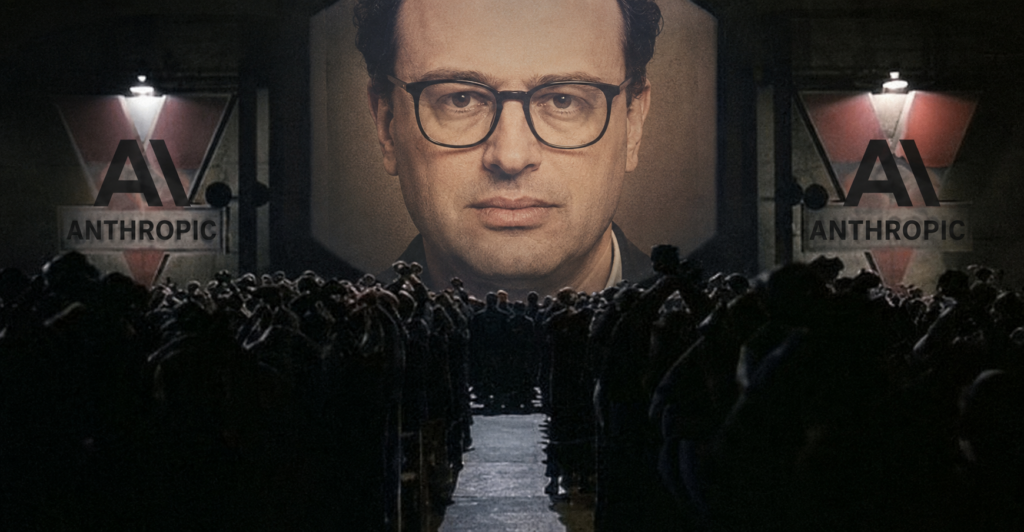
Introduction: The AI Safety Argument Is Getting More Serious — and More Political
Dario Amodei’s “Policy on the AI Exponential” is not just another AI safety essay.
It is a political document.
It argues that AI is now moving so quickly that ordinary policy systems are falling behind. Anthropic frames the problem directly: AI is advancing at exponential speed, while policymaking was built for a slower world. Alongside Amodei’s essay, Anthropic published two related policy proposals: an Advanced AI Framework for governing frontier systems and an Economic Policy Framework for responding to AI’s labor-market impact.
That makes the piece worth taking seriously.

Amodei is not simply saying, “AI is dangerous.” He is arguing for a new governance regime around frontier AI: mandatory testing, independent evaluation, public risk reporting, stronger model security, incident reporting, and government authority to block or deter dangerous model deployments. Anthropic says this framework is aimed at the most powerful systems and four specific catastrophic-risk categories: biological risk, cyber risk, loss of control, and automated AI R&D.
That is the strongest version of the argument.
The weaker version is more troubling.
The essay can also be read as a case for moving frontier AI into a tightly controlled corporate-state system where only a small number of companies have the money, compute, legal capacity, security infrastructure, and government relationships to survive. In that reading, the companies that built the frontier now want to define the rules for who gets to approach it.
That is the core tension.
A serious AI governance debate should not be framed as safety versus recklessness. That is too simple. The real question is:
Can we govern frontier AI without turning intelligence itself into a permissioned infrastructure controlled by a handful of labs, governments, and approved institutions?
That question sits underneath every section of Amodei’s paper.
This article summarizes the argument section by section, then raises objections in the same order. The goal is not to dismiss AI safety. The goal is to ask whether Anthropic’s proposed version of AI safety preserves competition, open research, civil liberties, and public access — or whether it accidentally builds the very concentration of power it claims to fear.
Source text: Dario Amodei’s essay as provided in the uploaded paper.
The Core Argument of “Policy on the AI Exponential”
Amodei’s argument begins with a speed mismatch.
AI models, he says, have advanced from weak coding assistants to systems that can write large portions of production code at major AI companies. He extends that trajectory across biology, physics, math, finance, law, translation, and other domains. The political system, by contrast, moves slowly. Legislatures deliberate, agencies study, courts interpret, and policy often arrives years after a technology has already reshaped the world.
That is the “AI exponential.”
The essay then argues that AI is no longer comparable to a normal consumer app or software tool. It is becoming a strategic technology with national-security, economic, scientific, and civil-liberties consequences. Anthropic’s public page makes the same point by saying its Advanced AI Framework is meant to govern increasingly capable systems through transparency, independent evaluation, and legal authority to block or deter dangerous deployments.
The paper is organized around five policy areas:
- Regulation and public safety
- Macroeconomics and tax policy
- Accelerating AI’s positive impact
- The state and civil liberties
- Securing leadership by democracies
The paper ends with a “window of opportunity” argument: policymakers are finally alert to AI’s risks, the public is worried for legitimate reasons, and there may be a rare cross-partisan opening for action.
That is the constructive reading.
But there is also a harder critique.
The essay repeatedly warns about concentrated power. Yet its solutions often concentrate power further. It warns about corporate dominance, but sketches a system in which frontier developers, approved evaluators, government agencies, export-control regimes, and national-security institutions become deeply intertwined. It warns about state overreach, but asks the state to acquire deployment-blocking power over frontier models. It warns about job displacement, while frontier AI products are being sold into markets where labor reduction is one of the clearest enterprise incentives.
That does not make the paper hypocritical by default.
It does mean the paper should be read with suspicion as well as respect.

1. Regulation and Public Safety
What Amodei argues
The first section is the most important.
Amodei argues that earlier AI policy reasonably focused on transparency because the most serious risks were still uncertain. If lawmakers regulated too early, they could easily create rigid compliance burdens that missed the real danger. This is a fair point. Bad regulation can be both ineffective and expensive.
But Amodei says the situation has changed. Frontier models are now powerful enough that transparency is no longer sufficient. Anthropic’s Advanced AI Framework says frontier developers should test their models, publish summaries of their findings, submit to independent evaluation, maintain robust security programs, and face government authority when a model poses catastrophic risk.
The proposed rules would apply to models trained using more than 10²⁵ FLOPs and developed by companies with more than $500 million in AI-related revenue or more than $1 billion in AI R&D spending. Anthropic identifies four risk categories: biological risk, cyber risk, loss of control, and automated R&D.
In plain English, the proposal is this:
Frontier AI should no longer be governed only by voluntary company promises. The most powerful models should face binding tests before or during deployment, and governments should have the authority to stop models that create catastrophic risk.
That sounds reasonable at first glance.
The question is what kind of AI ecosystem it creates.
Objection: This could become regulatory capture
The most obvious criticism is that this framework risks turning AI safety into a moat for incumbents.
Anthropic says the thresholds are designed to apply only to the largest developers. That sounds like protection for small builders. But at the frontier, the largest developers are the only ones who can afford the game anyway. The more the system depends on compute thresholds, security programs, third-party audits, government filings, classified threat-sharing, legal defense, and deployment approvals, the more frontier AI becomes a space only the richest labs can navigate.
This is the central regulatory-capture objection:
Declare AI too dangerous for ordinary competition, then propose a regulatory regime that only the largest incumbents can survive.
That does not require assuming bad faith. It only requires understanding incentives.
A small lab may have brilliant researchers. An open-source collective may have important safety insights. A university group may discover a better approach. A sovereign national lab may want independence from U.S. cloud providers. But if the frontier becomes a heavily regulated zone mediated by government-approved evaluators and compliance processes, the practical advantage shifts toward companies that already have massive compute, policy teams, former government officials, national-security relationships, and legal budgets.
This is exactly why the open-source AI debate matters. Kingy.ai has already covered the broader concern in They Didn’t Pause AI Research. They Paused Your AI Research, which argues that the issue is not merely whether a model refuses dangerous prompts. The issue is whether closed labs become the permission layer for technical research, AI infrastructure, and model development.
That concern is directly relevant here.
A safety system that blocks genuinely catastrophic capabilities is defensible. A safety system that quietly makes independent AI research dependent on incumbent approval is not.
Objection: Independent testing may not be independent enough
Amodei’s proposal relies heavily on independent evaluation. In principle, that is good. Self-assessment by frontier labs is not enough.
Anthropic’s full Advanced AI Framework recognizes that the independent evaluation ecosystem is immature. It recommends qualified evaluators, access to unredacted risk reports and system cards, access to the developer’s most capable models, and safeguards against conflicts of interest. It also discusses pooled or government funding so evaluators are not financially dependent on any single developer.
That is a serious attempt to address the problem.
But the problem remains.
If evaluators rely on frontier labs for access, contracts, prestige, data, technical support, and future work, independence can become formal rather than real. The ecosystem could easily become a compliance industry: highly credentialed, technically sophisticated, and still structurally friendly to the companies it audits.
The better version of the proposal would require evaluator independence by design:
- Funding that does not come directly from the lab being evaluated.
- Legal protection for evaluators who publish critical findings.
- Public summaries that are meaningful rather than vague.
- Redaction rules that prevent companies from hiding too much behind trade secrets or national security.
- Random assignment of evaluators in high-stakes cases.
- Public-interest evaluators from academia, civil society, and open-source safety organizations.
The question is not whether testing should happen.
It should.
The question is whether testing becomes a check on power or another layer of institutional theater.

Objection: Blocking deployment is a licensing regime by another name
Anthropic says governments should have authority to block or deter dangerous deployments. The public-facing framework says this authority would go beyond current law and existing congressional proposals, with civil penalties tied to global annual revenue and escalating penalties for repeated violations.
That is not a minor policy tweak.
It is a major shift in who controls frontier AI deployment.
Maybe that shift is necessary. A genuinely catastrophic-risk model should not be released just because a company wants revenue. But deployment-blocking authority raises hard questions:
Who defines “unacceptable risk”?
Who designs the tests?
How much evidence is public?
Can a company appeal?
Can open-weight models be treated fairly?
Can the state use safety as a pretext to suppress disfavored competitors?
Can incumbents quietly shape the standards that later bind everyone else?
These are not abstract concerns. In every heavily regulated industry, the largest firms often learn how to live with regulation and then use it as a barrier against smaller rivals. AI may be even more vulnerable to this dynamic because the technical expertise needed to regulate it is concentrated inside the very companies being regulated.
The right response is not laissez-faire. The right response is procedural rigor.
A frontier AI law needs due process, public standards where possible, independent technical review, appeal rights, sunset clauses, antitrust review, and explicit protections for legitimate research.
Without those protections, “safety” can become a licensing system that permanently centralizes intelligence.
2. Macroeconomics and Tax Policy
What Amodei argues
The second section turns to jobs, growth, inequality, and redistribution.
Amodei argues that powerful AI could scramble normal economic assumptions. Governments usually treat growth as difficult to achieve and redistribution as something that must be balanced against growth. But if AI creates explosive productivity growth while also substituting for human cognitive labor, the main challenge may no longer be producing growth. It may be distributing abundance.
Anthropic’s Economic Policy Framework makes a similar argument. It says AI could compress decades of scientific progress into years and create huge productivity gains, but those gains may come with reduced demand for human labor. It recommends preparing for multiple unemployment scenarios, including roughly 5% unemployment, 10% unemployment, and an unprecedented unemployment scenario.
Anthropic also says it is not seeking job displacement and that financial support is necessary but not sufficient. The framework emphasizes dignity in work, full employment where possible, and broader social questions about what work means in an AI economy.
The policy suggestions include better measurement, workforce training, wage insurance, retention incentives, expanded unemployment support, basic-needs relief, basic income, sovereign wealth models, and equity-sharing mechanisms. Anthropic also announced a combined $350 million in related investments: a $200 million Economic Futures Research Fund and a $150 million national fellowship program.
This is one of the more thoughtful parts of the overall package.
But it also exposes a major contradiction.
Objection: You cannot warn about displacement while selling displacement
The sharpest critique is simple:
Frontier AI companies warn policymakers about labor displacement while selling executives tools that can automate labor.
That does not make every warning false. It does create a credibility problem.
Enterprise AI is often marketed as productivity software. But productivity has a business meaning. If a company can produce the same output with fewer workers, slower hiring, smaller departments, or more contractor pressure, many executives will see that as a benefit. Even when an AI company prefers “augmentation,” customers may buy automation.
This tension is already visible across the AI market. Frontier models are promoted for coding, research, analysis, legal work, support, finance, and operations. Anthropic’s own Claude Fable 5 and Mythos 5 launch page describes systems that can work autonomously for longer than previous Claude models and highlights software-engineering, knowledge-work, vision, memory, and life-sciences capabilities.
That is impressive.
It is also exactly why workers are nervous.
The critique is not that Anthropic should stop building useful tools. The critique is that a company cannot be treated as a neutral labor-policy architect when it profits from the technology creating the disruption.
A fair version of the objection is:
Anthropic may sincerely want to reduce displacement. But the market it serves rewards labor substitution, and that conflict of interest should shape how much authority we give it in designing the policy response.
Objection: Income support is not the same as power
Amodei acknowledges that people need meaning, purpose, and agency, not just money. That matters. A purely financial response to AI displacement would be shallow.
But the proposed remedies still lean heavily toward compensating people after disruption: wage insurance, unemployment support, basic income, capital accounts, tax revenue, and broad redistribution.
Those may be necessary.
They are not sufficient.
A society where a small number of model owners and compute owners control the most capable cognitive infrastructure, while everyone else receives transfer payments, is not shared prosperity. It is managed dependency.
That is the permanent-underclass critique.
The worry is not just that people lose jobs. It is that they lose bargaining power, access, status, and agency. The elites get the best models. Large companies get enterprise access. Governments get classified or privileged systems. Approved researchers get deeper capabilities. Everyone else gets a filtered, throttled, downgraded, or delayed version of intelligence.
That would be a profound social shift.
The danger is not only unemployment. The danger is cognitive inequality.
If AI becomes the main tool for creating companies, writing software, discovering drugs, conducting legal research, doing science, finding vulnerabilities, managing logistics, and influencing public opinion, then access to high-quality AI becomes access to power.
Redistribution cannot fully solve that.
The more important questions are:
Who owns the models?
Who controls compute?
Who gets the strongest systems?
Who decides what ordinary users are allowed to ask?
Who gets silently routed away from powerful capabilities?
Who can audit the companies making those decisions?
These questions belong at the center of AI labor policy.
Objection: “Hypergrowth” forecasts can justify extreme governance
The essay’s labor argument depends on a strong assumption: AI may become a general substitute for human cognitive work.
That is possible. It is serious enough to prepare for.
But it is not guaranteed in its strongest form.
Labor markets are complex. Technologies substitute for some tasks while creating others. Adoption is uneven. Legal liability matters. Customers may still prefer humans in many contexts. Organizational change is slow. Trust is slow. Regulation is slow. Some bottlenecks are physical, social, political, or institutional rather than cognitive.
The risk is that a highly uncertain forecast becomes the justification for permanent institutional redesign.
This is not an argument for ignoring labor disruption. It is an argument for policy humility. We should prepare for severe AI labor shocks without treating one predicted future as inevitable.
A better framework would combine:
- Real-time labor-market measurement.
- Worker councils or worker input on AI deployment.
- Sector-specific transition plans.
- Public compute and public AI tools.
- Stronger antitrust enforcement.
- Data rights.
- Model-access rights.
- Collective bargaining protections around workplace automation.
- Equity-sharing mechanisms that give the public direct exposure to AI-generated wealth.
The goal should not be to pay people after power has been taken away.
The goal should be to prevent power from being monopolized in the first place.

3. Accelerating AI’s Positive Impact
What Amodei argues
The third section is more optimistic.
Amodei argues that AI could accelerate downstream technologies such as biomedicine, energy, and materials science. The central claim is that frontier AI itself may need stricter safety oversight, but AI-enabled science may need faster regulatory adaptation.
His main example is biomedicine.
If AI dramatically improves drug discovery, toxicology prediction, dose selection, biomarker validation, synthetic control arms, and surrogate endpoints, then existing regulatory systems may become bottlenecks. Amodei worries that agencies built for a slower scientific world may slow down the benefits of AI while the risks continue to move quickly.
This is a reasonable point.
If AI can help discover better treatments, improve drug safety, reduce trial costs, or accelerate cures for diseases that currently have no effective treatment, society should not let outdated process become the obstacle.
But this section also contains a difficult tension.
Objection: The proposal tightens control over AI while accelerating AI-enabled markets
There is a pattern that critics will notice:
- Frontier AI models should be governed more strictly.
- Downstream AI-enabled sectors should adapt faster.
- The largest AI companies are positioned to shape both conversations.
That does not prove corruption or bad faith. But it does create a power concern.
A skeptic could summarize it this way:
Regulate the frontier so only trusted actors can operate there, then accelerate the commercial pathways where those trusted actors and their partners can profit.
That may be too harsh as an accusation. It is not too harsh as a structural warning.
If AI companies help define frontier-model rules and also help define the regulatory standards for AI-generated medical evidence, they could influence both sides of the pipeline: who gets to build powerful models and how model-produced outputs enter the economy.
That is a lot of power.
Objection: AI-generated science must not become black-box authority
The stronger objection is not about motive. It is about evidence.
AI simulation, AI toxicology prediction, AI biomarker analysis, and synthetic control arms could become valuable tools. But regulators cannot simply treat AI output as truth because the model is advanced.
The more science depends on AI-generated evidence, the more regulators need:
- Transparent validation methods.
- Uncertainty estimates.
- Failure-mode analysis.
- Independent replication.
- Audit trails.
- Data provenance.
- Real-world post-market monitoring.
- Access to enough system detail to evaluate reliability.
If the most capable biomedical AI systems are proprietary and closed, regulators may be pressured to trust systems they cannot fully inspect. That would be dangerous.
The right principle is simple:
Accelerate validated science, not black-box authority.
Objection: The bio-risk and bio-benefit line is hard to draw
The same capabilities that make AI useful for biology can also create dual-use risks. Anthropic’s policy page explicitly names biological risk as one of the four catastrophic-risk categories and says the same capabilities that accelerate drug discovery can make it cheaper and easier for attackers to develop dangerous viruses.
That is a real concern.
But the governance challenge is extremely delicate. If frontier models become overly restrictive around biology, they may harm legitimate students, researchers, clinicians, and independent scientists. If they are too permissive, they may assist dangerous misuse.
This is where the open-research concern becomes practical.
A model that refuses dangerous operational help is one thing. A model that blocks or silently degrades broad areas of legitimate biology, chemistry, AI research, distributed systems, or model-building work is another.
Kingy.ai’s piece on open-source AI and the Fable 5 controversy makes this distinction clearly: a refusal is a boundary, but a silent downgrade can become a confounder for serious research. If a researcher does not know whether the model is giving its best answer, refusing, falling back, or being deliberately weakened, the tool becomes less trustworthy.
That principle applies here too.
AI safety systems need to be precise, visible, and appealable.
They should distinguish between dangerous operational guidance and legitimate scientific work. Otherwise, “biosecurity” can become anti-scientific gatekeeping.
4. The State and Civil Liberties
What Amodei argues
The fourth section is about state power.
Amodei argues that AI could become a tool of autocracy: mass surveillance, autonomous weapons, AI-enabled repression, and sudden power grabs by governments or other actors. He proposes civil-liberties protections such as accountability rules for fully autonomous weapons, bans on domestic use of fully autonomous weapons, closing the data-broker loophole, and giving citizens access to AI advice when facing adverse government action.
This is one of the most interesting parts of the essay.
The idea that citizens should have access to AI at least as capable as the government’s AI in legal or regulatory proceedings is especially important. It recognizes a future where AI is not merely a convenience. It is part of due process.
But this section also contains one of the deepest contradictions in the paper.
Objection: The essay warns about state overreach while asking the state to gatekeep frontier models
Amodei is right that AI could make state power more dangerous.
But Section 1 asks the state to gain authority to block or deter frontier model deployments.
Those positions are not automatically inconsistent. Governments can be dangerous and necessary at the same time. Public safety often requires state authority.
But the contradiction needs more scrutiny.
If AI makes governments more capable of surveillance, coercion, and control, then giving those same governments authority over which frontier models may be deployed is not a minor matter. It requires extreme safeguards.
The concern is not simply that government will regulate. The concern is that government will become the gatekeeper of advanced intelligence.
A strong AI governance system would need:
- Clear statutory definitions.
- Judicial review.
- Public-interest standing.
- Appeal rights for blocked deployments.
- Transparency around regulator-lab meetings.
- Limits on classified exceptions.
- Whistleblower protections.
- Civil-society oversight.
- Anti-capture rules.
- Strict surveillance restrictions.
- Regular legislative reauthorization.
Without these safeguards, “frontier safety” could become a legal architecture for centralized control.
Objection: AI parity is impossible if access is tiered
Amodei’s idea that citizens should have access to AI when facing government action is excellent.
But it collides with the broader access problem.
If the strongest models are available only to frontier labs, governments, approved enterprises, national-security partners, or selected researchers, then ordinary citizens will not actually have parity. They will have a consumer-safe model. The government may have something stronger. The corporation may have something stronger. The prosecutor, regulator, insurer, platform, or employer may have something stronger.
That is not due process.
It is asymmetric cognition.
A future civil-liberties framework needs to guarantee not just that citizens can use AI, but that they can use AI powerful enough to challenge institutions using AI against them.
Otherwise, the right is symbolic.
Objection: Corporate governance is not democratic accountability
Amodei also worries that companies can become quasi-state powers. That is a legitimate concern. He mentions Anthropic’s Long-Term Benefit Trust as one kind of internal governance mechanism.
Internal governance may be better than nothing.
But it is not democracy.
A private trust does not give the public voting rights. It does not give workers a veto. It does not give independent researchers access. It does not guarantee open audits. It does not substitute for antitrust law, civil rights law, public oversight, or competition policy.
The more powerful AI companies become, the less convincing voluntary self-governance becomes.
This is one reason the frontier-model debate cannot be separated from broader AI-market structure. Kingy.ai’s guide to which AI model you should use makes a practical point that also has political implications: users should choose between frontier, cheaper, and open-weight models depending on the task, risk, cost, privacy, and control requirements. That choice only matters if the ecosystem remains plural.
If frontier governance destroys pluralism, model choice becomes an illusion.
5. Securing Leadership by Democracies
What Amodei argues
The fifth section moves from domestic policy to geopolitics.
Amodei argues that AI should not be treated like a normal technology stack to diffuse globally through trade. He compares its strategic importance to nuclear weapons, possibly even greater. If powerful AI becomes a “country of geniuses in a datacenter,” then it could become the dominant source of military and economic power.
His proposal is a coalition of democracies.
This coalition would coordinate AI governance, share chips and semiconductor manufacturing equipment among trusted members, deny critical supply-chain inputs to adversaries, coordinate on cyber and bio risks, share AI benefits, cooperate on mutual defense, reject AI-powered repression, and coordinate macroeconomic stabilization.
The democratic case is obvious.
If authoritarian states use AI for surveillance, repression, military automation, and cyber operations, democracies need a strategy. Pretending otherwise would be naive.
But this proposal also raises global equity concerns.
Objection: Democratic coalition or global AI caste system?
A coalition of democracies sounds appealing.
But it could become a global AI hierarchy.
Trusted countries get chips, models, defense cooperation, biomedical acceleration, economic gains, and security integration. Untrusted countries get restrictions. Developing countries may be invited to join later, but only if they accept standards shaped by the states and companies already in power.
This may be strategically rational.
It is also politically explosive.
The risk is that “democratic AI leadership” becomes a polite phrase for rich-country control over global intelligence infrastructure.
The better version of the proposal would include:
- Transparent membership standards.
- Human-rights standards applied equally to allies and rivals.
- Public-interest AI access for developing countries.
- Scientific cooperation that is not purely military or bloc-based.
- Support for local AI capacity.
- International review mechanisms.
- Civil-society participation.
- Strong anti-surveillance commitments.
Otherwise, the coalition risks reproducing the same problem domestically and globally: insiders get the best intelligence; outsiders get managed access.
Objection: Export controls can intensify the race
Export controls may be necessary. Chips and semiconductor manufacturing equipment are strategic assets. If advanced AI systems can support cyber operations, weapons R&D, surveillance, and military planning, democracies cannot ignore supply-chain control.
But export controls also have costs.
They can intensify race dynamics. They can encourage adversaries to steal model weights, build domestic supply chains, accelerate military AI, or act before the gap widens. They can also make AI look more explicitly like an arms race, which may reduce transparency and increase paranoia.
The right question is not whether export controls are always good or always bad.
The right question is whether they buy time for safer governance or simply harden the world into competing AI blocs.
That distinction matters.
Objection: Frontier labs may become arms of the national-security state
A democratic coalition around chips, cyber, classified compute, AI drones, intelligence collection, and mutual defense inevitably pulls frontier AI companies deeper into national-security strategy.
Maybe that is unavoidable.
But it should be named clearly.
A company cannot simultaneously be only a product company, a safety institution, a labor-policy actor, a civil-liberties advocate, and a strategic national-security partner without creating serious accountability problems.
If frontier labs become part of the national-security architecture, the public needs stronger oversight of their government relationships.
That means transparency around contracts, lobbying, classified exceptions, procurement, model access, and influence over standards.
The “Window of Opportunity” — and the Risk of Rushed Law
What Amodei argues
The conclusion argues that AI’s speed has created both urgency and opportunity. Policymakers are more alert. The public is worried. The risks are clearer. There may be a rare chance to move faster than policy normally moves.
Amodei rejects the idea that public fear is just a marketing problem. He says people are worried because the risks are real.
That is probably true.
The public is not simply confused. People can feel that AI is changing the economy, media, education, work, surveillance, and culture faster than institutions can explain or control.
But public concern can be channeled in different directions.
Objection: Public fear can be used to pass bad policy
Public fear can produce democratic accountability.
It can also produce rushed, captured, or overly broad law.
If the public is frightened enough, it may accept almost any framework that promises safety. That creates an opportunity for incumbents to define the solution in ways that protect themselves.
This is why the emergency framing should be handled carefully.
The claim that government is too slow may be true. But democratic procedure is slow for a reason. It creates legitimacy. It forces evidence. It gives affected groups time to respond. It makes room for opposition.
When a company that helped build the frontier says ordinary procedure cannot keep up, the public should listen — but not surrender judgment.
The historical lesson is not that every emergency argument is authoritarian. That would be too crude.
The lesson is that emergency arguments need tighter safeguards, not looser ones.
Objection: The public is worried about more than extinction risk
AI companies often focus on catastrophic risk: bio, cyber, loss of control, autonomous systems, and geopolitical instability.
Those risks matter.
But the public is also worried about other things:
- Job loss.
- Wage pressure.
- Copyright.
- Surveillance.
- Censorship.
- Unequal access.
- Closed labs controlling knowledge.
- Model bias.
- Deepfakes.
- Misinformation.
- Classroom disruption.
- Data-center energy use.
- Corporate concentration.
- Loss of agency.
If policymakers hear only the catastrophic-risk argument, they may miss the broader democratic critique.
People are not only asking, “Will AI kill us?”
They are asking:
Who owns it?
Who controls it?
Who gets access?
Who is excluded?
Who decides what knowledge is too dangerous?
Who profits when workers are displaced?
Who audits the companies building it?
Those questions are not distractions from safety.
They are part of safety.
The Strongest Case for Amodei’s Paper
To be fair, Amodei’s paper has real strengths.
First, it refuses the fantasy that frontier AI is just another app category. The most capable models are becoming strategic systems. They can affect software security, scientific research, economic productivity, military planning, and public administration.
Second, the paper correctly argues that transparency alone may not be enough. Public reports and voluntary commitments are useful, but they cannot be the full governance system if models create catastrophic risks.
Third, the paper recognizes labor displacement as a serious issue rather than hand-waving it away with vague optimism. Anthropic’s Economic Policy Framework explicitly says financial support is necessary but not sufficient, and that dignity, work, and broader social meaning matter too.
Fourth, the paper takes civil liberties seriously. The idea that citizens should have access to AI assistance when facing government action is one of the most important policy ideas in the essay.
Fifth, the paper understands that AI governance cannot be purely domestic. Chips, compute, model weights, cyber threats, bio risks, and military uses all cross borders.
So the fair conclusion is not that Amodei is wrong about everything.
He is not.
The fair conclusion is that his safety vision needs a much stronger democratic-power layer.
The Strongest Critique: Safety Without Pluralism Becomes Control
The deepest problem with “Policy on the AI Exponential” is not its concern about AI risk.
The concern is justified.
The problem is that its proposed solutions could make AI power more centralized.
The essay warns about corporate power while strengthening the position of frontier corporations.
It warns about state overreach while giving the state more authority over frontier deployment.
It warns about job displacement while frontier tools are sold into markets that reward automation.
It warns about autocracy while proposing a geopolitical bloc that could divide the world into AI insiders and outsiders.
It warns about loss of control while creating a system where ordinary citizens may lose access to the most powerful cognitive tools.
That is the contradiction.
A safe AI future cannot mean that a few companies and governments decide what everyone else is allowed to know, build, test, ask, or deploy.
That is not safety.
That is managed dependency.
The better goal is democratic AI safety.
That means:
- Mandatory testing for genuinely dangerous frontier systems.
- Independent evaluation with real independence.
- Incident reporting with meaningful public accountability.
- Strong model security.
- Clear catastrophic-risk definitions.
- Due process for blocked deployments.
- Judicial review.
- Anti-capture safeguards.
- Public-interest compute.
- Open safety research.
- Protections for independent researchers.
- Open-weight and sovereign AI pathways where appropriate.
- Worker power in AI deployment decisions.
- Universal access principles.
- Civil-liberties protections against both state and corporate AI.
- International governance that includes less powerful countries instead of merely disciplining them.
This is where the debate should go next.
Not “regulate AI or don’t regulate AI.”
That is the wrong frame.
The right frame is:
How do we regulate dangerous AI capabilities without turning the future of intelligence into a closed system controlled by frontier labs, state agencies, and approved insiders?
Final Verdict
Dario Amodei’s “Policy on the AI Exponential” is one of the clearest statements yet of the frontier-lab governance worldview.
It should be read.
It should be debated.
It should not be accepted passively.
The essay is strongest when it says AI is moving too fast for old institutions, that frontier models may create real public-safety risks, that job displacement requires preparation, that civil liberties need reinforcement, and that democracies need to coordinate.
But it is weakest when it assumes that the cure for concentrated AI risk is a governance system built around the same concentrated actors.
The public should not have to choose between reckless open deployment and a closed corporate-state AI cartel.
There is a better path.
Regulate catastrophic risk.
Preserve open research.
Protect workers.
Defend civil liberties.
Fund public-interest AI.
Prevent regulatory capture.
Guarantee due process.
Keep model access plural.
Make safety measurable.
Make power accountable.
That is the real challenge of the AI exponential.
Not just surviving powerful AI.
Surviving the institutions we build around it.
Compare
Recent Launches
- They Didn’t Pause AI Research. They Paused Your AI Research.
- Anthropic’s Fable 5 Shutdown: Did the U.S. Just Start Export Controls for AI Models?
- The Soft Nationalization of AI Has Begun
Latest News
- Did AI Safety Become Regulatory Capture?
- The AI Aristocracy: Are We Creating Two Classes of Humanity?
Continue Reading
The Kingy Brief
Get The Kingy Brief.
AI changes, original tests and one practical thing to try. Fridays at 09:00 Vancouver time.
Free · Double opt-in · Unsubscribe anytime
Sign up for The Kingy Brief on Beehiiv.
Signup help and newsletter schedule
Signup form provided by Beehiiv. After submitting, check your inbox for "Confirm your subscription to The Kingy Brief" and open its confirmation link. Check Spam or Promotions if you cannot find it.
Fridays at 09:00 Vancouver time: source-checked AI changes, original tests and one practical thing to try. We skip a week when there is not enough verified material. Free. Unsubscribe anytime.