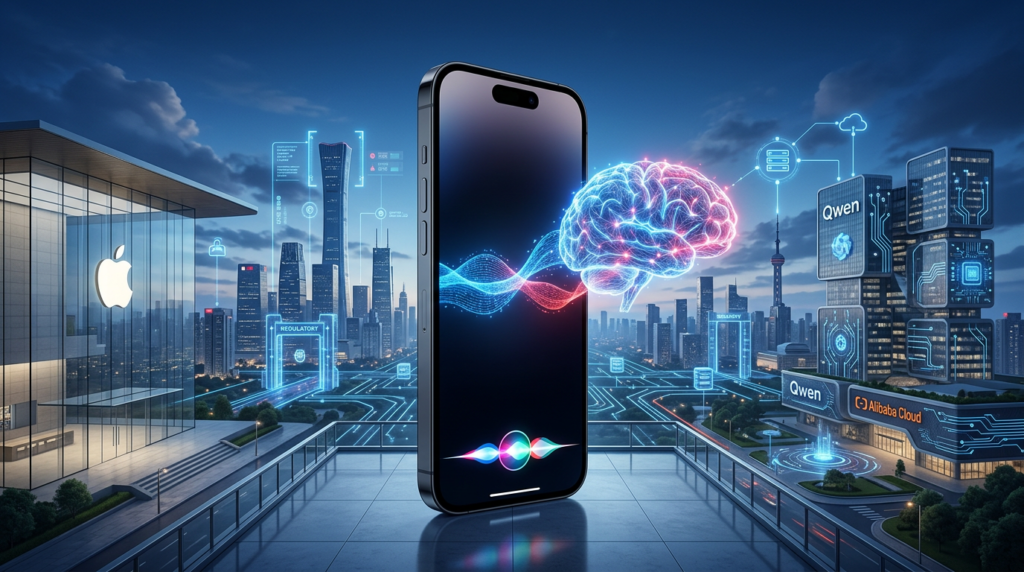
Apple’s AI Strategy Takes a Sharp Turn
Apple has spent years selling one wonderfully simple idea: wherever you buy an iPhone, you get an iPhone. The software may follow local rules, of course, but the larger experience remains recognizably Apple.
Artificial intelligence is cracking that uniformity.
Apple has reportedly trained a large language model specifically for China with assistance from Alibaba. According to three unnamed sources cited by Reuters, Apple developed the model in partnership with the Chinese technology giant instead of relying entirely on an outside model.
That represents a meaningful change. Apple had previously planned to use locally developed systems to deliver generative AI features in China, where American services such as OpenAI’s ChatGPT and Anthropic’s Claude are unavailable.
Now, Apple appears to want more control over the machinery under the hood.
The company has not publicly confirmed the model, and Alibaba has not commented on the latest report. Still, the development fits a much broader campaign. Apple wants to launch Apple Intelligence in mainland China, satisfy Beijing’s regulations, and catch local smartphone makers that already treat AI as a headline feature.
In other words, this is not merely another partnership announcement. It is Apple trying to thread a very expensive needle—one made of regulation, technology, privacy, geopolitics, and fierce competition.
No pressure, then.
Reuters and The Verge reported that the China-specific model could give Apple greater control over the AI experience on its devices.
China Will Not Accept Apple Intelligence as Is
Apple cannot simply copy its international AI setup, paste it into Chinese iPhones, and call it a productive afternoon.
China requires public-facing large language models and generative AI services to undergo registration and regulatory review. Foreign technology companies also face strict rules governing data, content, and online services.
That makes Apple’s usual international AI partners difficult—or impossible—to use in mainland China. ChatGPT and Claude are unavailable there. Google’s Gemini cannot simply fill the same role it may play in other markets.
Apple therefore needs a separate route.
In July 2026, China’s Cyberspace Administration registered Apple Intelligence for use on iPhones. That cleared a major regulatory obstacle, although registration did not instantly switch on every feature. No firm public release date accompanied the announcement.
The approved arrangement was expected to incorporate Alibaba’s Qwen models. Apple was also working with Baidu on features designed for Chinese users.
The newer custom-model report adds another layer. Apple may now combine its own China-trained model with technology from Alibaba and Baidu. However, the companies have not explained which model will handle which task.
That unanswered question matters. A model might process routine requests locally, route complex prompts to another service, or support only specific tools. Until Apple publishes the architecture, any detailed diagram would contain more guesswork than circuitry.
What we do know is simpler: Apple Intelligence in China will use a distinctly Chinese technology stack.
Alibaba Helped Apple Build Instead of Merely Borrow
Apple’s relationship with Alibaba originally looked fairly straightforward. Alibaba would provide Qwen, Apple would integrate it, and Chinese iPhone users would finally receive AI features that customers elsewhere had already started using.
The latest reporting complicates that picture—in an interesting way.
Rather than placing Qwen behind an Apple interface and stopping there, Apple reportedly trained its own China-specific large language model with Alibaba’s support. Reuters described this as a departure from Apple’s earlier reliance on third-party models for the market.
That does not mean Apple has abandoned Qwen. Quite the opposite.
Alibaba previously said Qwen would become part of Apple Intelligence on compatible versions of iOS, iPadOS, macOS, and visionOS in China. The custom model and Qwen could therefore serve different purposes inside the same platform.
Apple might use its model for tightly integrated system functions while calling Qwen for more expansive requests. Baidu could supply search-related or other specialized capabilities. That is a plausible interpretation of the reporting, not a confirmed technical blueprint.
The distinction also explains why calling this a complete surrender of Apple’s AI independence goes too far. Apple appears to be reclaiming some control by training a model of its own. At the same time, it still needs Chinese partners to build, approve, and operate a compliant service.
Independence, meet interdependence. Try not to make the seating arrangement awkward.
The Qwen Guide That Briefly Escaped
Before reports of Apple’s custom model emerged, the company offered a revealing glimpse of its China strategy—and then quickly pulled the curtain shut.
Apple Support briefly published a Chinese-language guide explaining how eligible Mac users could connect Alibaba’s Qwen service to Siri and Writing Tools. The instructions applied to Macs rather than iPhones or iPads.
According to AppleInsider, the document disappeared soon afterward. Apple Support reportedly said it had not received notice that the Qwen integration had officially launched in mainland China.
The guide still revealed several useful details.
Users would have needed a compatible Mac running macOS 26.6 or later. They would activate the extension, sign in to a Qwen account, and choose when to use the service. Qwen could then provide more detailed answers through Siri, analyze documents and photographs, and help Writing Tools generate text or images from descriptions.
The document also reportedly said Alibaba could not use submitted material to train or improve its models.
Why did Apple remove the page? Nobody has provided a definitive explanation. It could have appeared ahead of schedule, conflicted with the rollout plan, or required further regulatory coordination.
Whatever happened, the page behaved like a movie trailer uploaded before the studio finished the film. It vanished, but plenty of people saw it.
Siri Will Speak With a Different Brain in China

For users, this story ultimately comes down to a deceptively simple question: What happens after someone asks Siri for help?
Outside China, Apple combines on-device processing, its own models, cloud infrastructure, and selected external services. More demanding requests may move beyond the device when users permit that handoff.
China will require a different arrangement.
The withdrawn Mac guide indicated that users could send certain requests from Siri and Writing Tools to Qwen. These could include questions demanding fuller answers, document or photo analysis, and the creation of text or images.
The new report suggests Apple’s custom model will also sit somewhere inside that experience. Yet its precise job remains unclear. Apple has not said whether it will run on devices, operate through Chinese cloud infrastructure, supervise requests sent to Qwen, or specialize in particular features.
That ambiguity should stop us from describing “Chinese Siri” as one chatbot wearing an Apple badge. The final system may function more like a relay team.
One model could understand the user’s intent. Another might generate an answer. A separate component could conduct search or analyze an image. Apple’s software would then assemble the result into something that feels seamless.
At least, that is the goal. When several models, companies, operating systems, and regulators share the kitchen, serving one smooth bowl of AI soup becomes quite the recipe.
The Privacy Question Needs a Careful Answer
Privacy forms one of the biggest unanswered questions surrounding Apple Intelligence in China.
In many international markets, Apple emphasizes on-device processing and Private Cloud Compute. The company designed that system to handle more demanding requests without giving Apple unrestricted access to user data. Its partnerships can also include dedicated infrastructure and privacy conditions.
The Chinese implementation may work differently.
9to5Mac raised concerns because Mac users would need a Qwen account and must sign in before using the extension. The publication argued that China’s legal environment makes equivalent privacy safeguards unlikely.
However, that conclusion remains an inference—not a confirmed disclosure that Alibaba or Chinese authorities automatically receive every interaction.
The withdrawn Apple guide reportedly included one concrete safeguard: Alibaba could not use the material supplied through the integration to train or improve its models. That is significant, but it does not answer everything.
Apple has not publicly explained where China-based requests will run, how long service providers may retain them, which entities can access operational records, or whether Private Cloud Compute will play any role. It also has not detailed how its custom model changes the data flow.
Until Apple releases those answers, both absolute reassurance and absolute panic would outrun the evidence. The sensible position sits in the middle: the safeguards may differ, and users deserve a precise explanation before the feature arrives.
Apple Needs AI to Compete in China
Apple’s urgency becomes easier to understand when you look beyond model architecture and toward the shop floor.
China remains one of Apple’s most important overseas markets. It is also brutally competitive.
Domestic companies such as Huawei, Xiaomi, Oppo, Vivo, and Honor have rolled AI features into their devices and marketing campaigns. They can work directly with Chinese model developers, move within the local regulatory system, and build services around regional platforms.
Apple has had to watch from the lobby.
The delayed arrival of Apple Intelligence created a visible feature gap. Even consumers who do not use generative AI every day can compare specification sheets, demonstrations, and advertisements. When rival phones offer built-in assistants, writing tools, image creation, and document analysis, an iPhone without comparable functions can look oddly incomplete.
The pressure also extends to computers. Reuters reported that Apple’s mainland China Mac shipments fell 9 percent year over year during the first quarter of 2026, leaving it with roughly 9 percent of the PC market. Lenovo held about 31 percent, while Huawei reached approximately 16 percent.
Connecting Qwen to Siri and Writing Tools would give Apple a locally compliant answer to Chinese AI PCs. Launching a broader China-specific intelligence system could help the company defend the entire ecosystem.
AI may not convince everyone to replace a phone. But lacking AI can certainly give shoppers one more reason to look elsewhere.
Is Apple Sacrificing Its Independence?
One of the supplied reports, THEWILL, frames Apple’s move as a sacrifice of AI independence. It is a punchy interpretation. It is also only half the story.
Yes, Apple must depend on Chinese companies and comply with rules that do not govern its AI services in the same way elsewhere. The company cannot deploy its preferred international stack unchanged. Alibaba and Baidu therefore gain roles that Apple might otherwise keep in-house or assign to different partners.
But training a proprietary China-focused model points toward more independence, not less.
Instead of handing the entire intelligence layer to Qwen, Apple could control more of the behavior, integration, and user experience. Alibaba’s involvement may provide local expertise, infrastructure, regulatory familiarity, or training assistance without necessarily owning the complete product.
The honest description is messier: Apple is trading global uniformity for local control.
That compromise is hardly new. International technology companies routinely adapt services to national laws. What makes this case unusual is the importance of AI. Models influence what devices can say, create, summarize, recommend, and refuse. Changing the model can change the personality and practical limits of the product.
So, yes, Apple is surrendering one kind of independence—the freedom to deploy one worldwide system. But it may be building another kind: more ownership of the AI that Chinese customers actually receive.
Alibaba Gets More Than a Famous Customer
Apple gains a route into China’s AI market. Alibaba gains something equally valuable: reach.
Qwen already stands as one of China’s best-known model families. Integration with Apple’s operating systems could place its technology inside iPhones, iPads, Macs, and Vision Pro devices without requiring users to live entirely inside Alibaba’s own applications.
That is a substantial distribution opportunity.
Alibaba chairman Joe Tsai confirmed the companies’ partnership in February 2025, saying Apple had evaluated multiple Chinese companies before choosing Alibaba. The relationship also gives Qwen an extraordinary global endorsement, even if the resulting service remains limited to China.
Investors noticed. Seeking Alpha, summarizing the Reuters report, highlighted the custom-model partnership and Apple’s progress through China’s regulatory process.
Still, Alibaba is not necessarily replacing Apple at the center of the experience. Apple owns the devices, operating systems, interfaces, and customer relationship. If everything works properly, users may interact with Siri and Writing Tools without thinking much about which model handled each request.
That invisibility can be powerful. The best infrastructure often disappears behind the product.
Alibaba may become the engine supplier whose name technology watchers know, while everyday customers simply press a button and ask Siri to summarize a document. Not flashy, perhaps—but neither is plumbing, and everyone notices when it is missing.
One Apple Brand, Multiple AI Realities
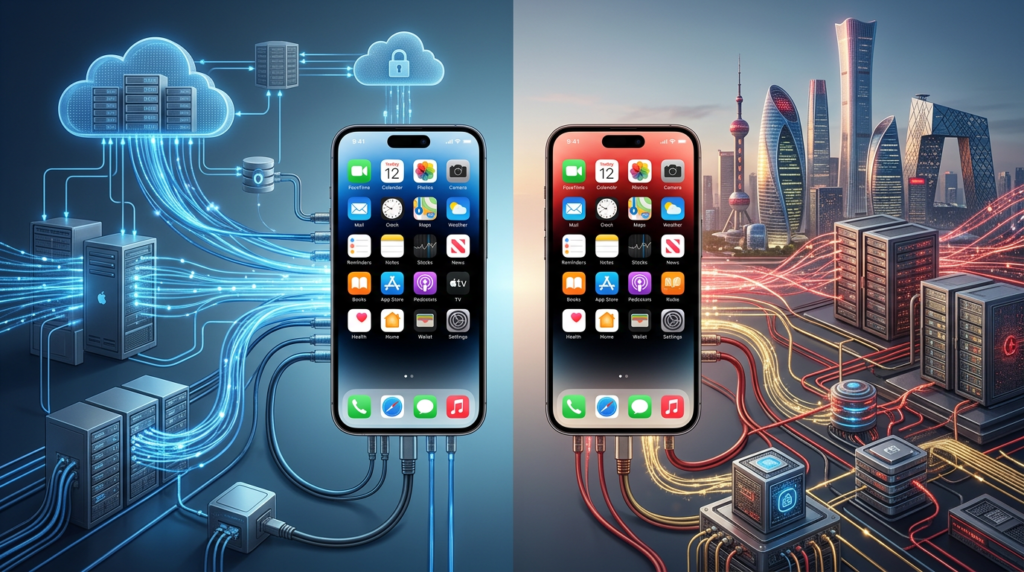
Apple’s China plan reveals where consumer AI may be heading: not toward one universal assistant, but toward regional versions shaped by different laws, partners, models, and infrastructure.
An iPhone sold in Manila, London, New York, and Beijing may look nearly identical. Its AI system may not.
The Chinese version could combine an Apple-trained model, Alibaba’s Qwen family, and Baidu technology. Other markets may rely on Apple’s own models, Private Cloud Compute, and separate external partners. Features, safeguards, response styles, and rollout dates could vary.
That creates a major engineering challenge. Apple must preserve a consistent interface while the machinery underneath changes dramatically. Developers may also need to consider whether AI-assisted features behave differently on devices used in mainland China.
The company has not yet provided enough information to judge how successfully it will manage those differences.
For now, several facts stand firm. China registered Apple Intelligence in July. Alibaba has said Qwen will be incorporated across Apple platforms in the country. Apple briefly published—and removed—a Mac guide to connecting Qwen. Reuters now reports that Apple trained a proprietary China-focused model with Alibaba’s help. A launch is expected in the coming months, but the exact timing and technical division of labor remain unclear.
Apple has found a possible path through China’s AI maze. Now it must prove that the path leads somewhere useful—and that Siri does not get lost on the way.
Sources
- The Verge — Apple trained its own AI model for China with help from Alibaba
- AppleInsider — Guide to Apple Intelligence using Qwen briefly appears for Apple users in China
- THEWILL — Apple Sacrifices AI Independence Just to Stay Alive in China
- 9to5Mac — Apple reveals how Siri AI features work in China
- Seeking Alpha — Apple partners with Alibaba on custom AI model for China
- Reuters — Apple trains its own AI model for China with Alibaba’s support
The Kingy Brief
Get future Kingy Brief editions.
Source-checked AI changes, original tests and one practical thing to try.
Free · Choose your subjects · Double opt-in · Unsubscribe anytime
Regular sending is paused; no restart date is set.