Trending on Kingy
Keep reading with the stories getting the most attention now.
A Heavyweight AI Model Comes Home
Alibaba’s Qwen team has released a model that could make local-AI enthusiasts rearrange their weekend plans and possibly their computer cooling systems.
Meet Qwen3.8-27B, a downloadable, open-weight artificial-intelligence model built for coding, research, professional work, visual analysis, and long-running agent tasks. It contains 27 billion language-model parameters and can process text, images, and video.
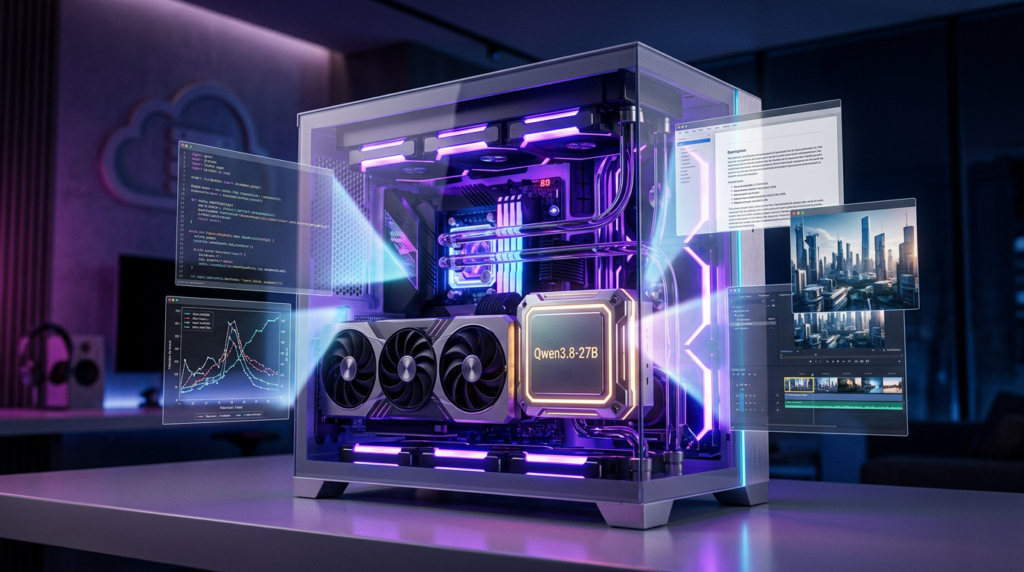
More importantly, users can run quantized versions on suitably powerful consumer hardware. That means private conversations, coding projects, documents, and images can remain on the user’s own machine instead of traveling to a cloud server.
The model arrives under the permissive Apache 2.0 license. Developers can modify it, integrate it into commercial products, fine-tune it, and redistribute derived versions while following the license terms.
That combination capability, local deployment, multimodal input, and a business-friendly license explains the early excitement.
Some coverage has described Qwen3.8-27B as a free local rival to Anthropic’s Claude Opus 4.6. That makes a terrific headline. It also requires a bucket of context.
Alibaba’s model does outperform Opus 4.6 Max on selected published benchmarks. It loses on others. Independent testing remains young because the weights only arrived in mid-August 2026.
Still, this is no sleepy incremental update. Qwen3.8-27B has kicked open the door, entered the local-AI clubhouse, and immediately started touching the thermostat.
What Exactly Is Qwen3.8-27B?
Qwen3.8-27B belongs to Alibaba’s Qwen3.8 family, but it should not be confused with Qwen3.8-Max.
Qwen3.8-Max is the giant cloud-oriented flagship. Qwen3.8-27B is the smaller, dense model designed for more practical deployment. “Smaller” remains relative, of course. A 27-billion-parameter neural network will not squeeze onto an elderly office laptop simply because you ask nicely.
According to its official model card, Qwen3.8-27B builds on the architectural foundation of Qwen3.5. Alibaba says it improves coding, research, professional work, agent execution, and long-horizon task completion.
It also supports flexible reasoning. Thinking mode runs by default, but users can disable it when they want faster, more direct answers. They can also adjust reasoning effort for harder problems.
This flexibility matters. Not every request deserves a philosophical expedition through 14,000 reasoning tokens. Sometimes you just want a regular expression, not a digital reenactment of The Odyssey.
The model can preserve reasoning context across a conversation, which could help with lengthy coding sessions and multi-stage projects. It also supports popular inference frameworks, including Transformers, vLLM, SGLang, and TokenSpeed.
Community-made versions already work with llama.cpp, Ollama, LM Studio, Jan, and several other local-AI tools. The ecosystem moved quickly. Very quickly.
A Clever Architecture Behind the Model
Qwen3.8-27B uses a dense hybrid-attention design rather than a mixture-of-experts architecture.
Its language model contains 64 layers and a hidden dimension of 5,120. Only 16 layers use full attention. The other 48 employ linear attention through Gated DeltaNet components, according to the official configuration and vLLM’s deployment recipe.
That mixture aims to balance quality, memory use, and long-context processing. Full attention helps the model examine relationships across tokens, but its memory cost rises sharply as the context grows. Linear attention can handle longer sequences more efficiently.
The model also includes multi-token prediction, or MTP. Traditional language models generally predict one token at a time. MTP can generate draft tokens that a compatible inference system verifies, potentially increasing output speed.
Potentially is the crucial word.
MTP performance depends on the workload, inference engine, hardware, settings, and how accurately the model predicts upcoming tokens. Early users have reported substantial speed improvements in some situations and little benefit or even slower overall execution in others.
Coding may benefit because code often contains predictable structures. Deep reasoning can behave differently because the model spends more time thinking before producing its visible answer.
Qwen3.8-27B also includes a dedicated vision encoder. It is not merely a text model wearing novelty glasses. It natively interprets visual inputs alongside language.
Alibaba’s Coding Numbers Demand Attention
Alibaba’s published benchmark results give local-AI fans plenty to talk about.
On SWE-bench Pro, a software-engineering benchmark based on repository-level problems, Qwen3.8-27B scored 61.7. Qwen3.6-27B scored 53.5, while the table lists Opus 4.6 Max at 53.4.
On QwenSWEBench, the new model reached 79.0. Qwen3.6-27B managed 49.3, while Opus 4.6 Max scored 63.8.
The improvement on DeepSWE 1.1 looks even larger. Qwen3.8-27B scored 42.2, compared with 13.3 for Qwen3.6-27B.
Those results suggest a serious generational jump. They also help explain why reviewers have described the model as unusually capable for its size.
However, Qwen3.8-27B did not sweep the table.
It scored 73.0 on Terminal Bench 2.1, below Opus 4.6 Max at 78.2. On NL2Repo-Bench, it achieved 42.3, while Opus reached 47.6.
Alibaba also disclosed important methodological details. Most models in its SWE-bench Pro comparison used the Claude Code harness, while the Opus number came from Anthropic’s officially reported result. Alibaba says it corrected problematic tasks and reevaluated the baseline models.
That makes the comparison informative, but not perfectly uniform. Benchmark numbers rarely arrive wearing identical laboratory coats.
The safest conclusion is straightforward: Qwen3.8-27B appears exceptionally competitive in coding for a locally deployable 27B model. It does not prove universal superiority over Opus.
“Rivals Opus” Needs a Footnote
Can Qwen3.8-27B rival Claude Opus 4.6? In selected tasks, apparently yes.
Can it replace Opus across every workflow? Nobody has established that.
Benchmarks measure specific abilities under controlled configurations. Real projects introduce messy repositories, incomplete instructions, broken dependencies, unusual tool chains, long conversations, and humans who change their minds halfway through a task. In other words, Tuesday.
Cloud models also run on infrastructure that providers tune aggressively. A local four-bit quantization may behave differently from the full-precision checkpoint used in a benchmark. Quantization reduces memory requirements by representing weights with fewer bits, but stronger compression can affect reasoning, factual accuracy, and instruction following.
The official scores still matter. A 27B model trading victories with a premium frontier model would have sounded fanciful not long ago.
But “Qwen wins several benchmarks” is more defensible than “Qwen has defeated Claude.” The former reflects published evidence. The latter hands the marketing department a trumpet and removes all adult supervision.
Independent comparisons should eventually tell us how reliably Qwen3.8-27B handles long coding sessions, tool use, visual tasks, multilingual work, and heavily quantized deployment.
For now, consider the Opus comparison a compelling signal not a final verdict carved into silicon.
The Model Can See Images and Video

Qwen3.8-27B is a native vision-language model. Users can send it photographs, screenshots, documents, scientific charts, diagrams, and video.
Alibaba says the model can understand material ranging from STEM diagrams to hour-scale videos. That opens the door to practical local workflows: examining interface screenshots, extracting information from documents, interpreting graphs, reviewing visual designs, or analyzing recorded material without uploading sensitive files.
Vendor-published multimodal results look promising.
Qwen3.8-27B scored 91.1 on OmniDocBench 1.5, which evaluates document intelligence. It reached 85.9 on RealWorldQA and 65.5 on ERQA. Alibaba’s table also reports strong performance on scientific-chart interpretation and general visual reasoning.
Again, these results need independent confirmation. Visual models can produce impressive demonstrations and then confidently misread a tiny label, reverse a spatial relationship, or invent an object that never appeared.
Early hands-on reviews have reported strong image-to-code and visual-analysis performance, alongside occasional inaccuracies. That is hardly unique to Qwen. Multimodal AI remains perfectly capable of looking directly at something and misunderstanding it with breathtaking confidence.
Local processing still offers a major benefit. Businesses and individuals can analyze private visual material without automatically sending it to an external API.
A Huge Context Window On Paper and in Memory
Qwen3.8-27B supports a native context length of 262,144 tokens. Users can extend it to approximately one million tokens with the appropriate configuration.
That sounds enormous because it is.
A large context window lets a model process longer codebases, documents, transcripts, research collections, and conversation histories. In theory, Qwen could examine an extensive project without repeatedly forgetting what happened 40 files ago.
Yet context capacity and practical context capacity are different beasts.
The vLLM documentation explains how operators can increase the maximum model length to roughly one million tokens. It also warns, through the required configuration, that memory becomes part of the decision.
The weights consume memory. The vision components consume memory. The inference engine needs working space. Then the key-value cache grows as the context expands.
Consequently, fitting a four-bit model on a 24GB graphics card does not guarantee that users can fill the entire native context window, let alone the extended one. Long prompts may force partial CPU offloading, smaller cache formats, reduced context limits, or lower-quality quantization.
The one-million-token figure is technically supported. It is not a promise that every gaming PC can casually swallow a library before lunch.
For many users, a smaller context setting will deliver a better balance of speed, memory use, and stability.
Can It Really Run on Consumer Hardware?
Yes with the right quantization and realistic expectations.
The full BF16 GGUF weighs approximately 54.7GB, according to Bartowski’s quantization repository. That exceeds the memory available on mainstream consumer graphics cards before users account for context caching and runtime overhead.
Quantization changes the equation.
The repository lists a Q4_K_M version at roughly 17.8GB. A smaller Q4_K_S version weighs about 15.6GB, while five-bit and six-bit options require more space. The eight-bit release weighs around 29.1GB.
A four-bit version can therefore fit inside a 24GB GPU under sensible conditions. Systems with shared memory, including sufficiently equipped Apple Silicon computers, may also run GGUF versions through compatible applications.
However, “the file fits” does not mean “every setting fits.”
Users still need memory for the KV cache, vision projector, inference software, and operating system. Long context windows can consume several additional gigabytes. Running other GPU-heavy applications simultaneously may produce an unscheduled lesson in memory allocation.
Machines with 16GB of available memory might load more aggressively compressed versions, but quality and speed could suffer. CPU offloading can help when GPU memory runs short, although output may slow considerably.
The practical sweet spot appears to be a 24GB-class GPU for four-bit deployment, while 32GB or more provides more breathing room.
That 206-Tokens-Per-Second Claim
Some early reports highlight speeds exceeding 200 tokens per second on an RTX 5090.
That figure may be achievable under a particular configuration. It should not become a universal speed label.
Throughput changes with quantization, context length, batch size, inference engine, speculative decoding settings, prompt length, reasoning mode, and task type. Prompt processing and token generation also produce different speed measurements.
A model might process an existing prompt extremely quickly but generate its answer more slowly. MTP can accelerate predictable output, particularly code, when its draft tokens prove accurate. It may offer less help during winding reasoning sequences.
Community reports illustrate the variation. Some users describe impressive GPU performance. Others report much slower CPU generation or heavy reasoning that consumes thousands of tokens before producing an answer.
One Hacker News contributor reported roughly four generated tokens per second for Qwen3.8-27B on a laptop CPU setup, compared with around 20 for a Qwen mixture-of-experts model. Another user reported excellent MTP acceptance. Someone else found that enabling MTP made the model slower for their workload.
None of these accounts contradicts the others. They tested different systems and tasks.
The honest performance answer is gloriously unmarketable: it depends.
Early Users See Brilliance and Some Meandering
The enormous Hacker News discussion surrounding the release offers a messy but useful look at early experiences.
Several users praised Qwen3.8-27B’s coding and reasoning. One reported that it solved a difficult private reasoning test that defeated other local models. Another described its image-to-HTML work as a major improvement over Qwen3.6.
Other testers noticed tradeoffs.
Some found the model verbose in thinking mode. It could consume far more reasoning tokens than alternatives before reaching an answer. Users also debated its memory efficiency, MTP performance, context requirements, and behavior under strong quantization.
These reports remain anecdotal. Private benchmarks cannot replace reproducible evaluations, and community configurations vary wildly. Still, the pattern matters.
Qwen3.8-27B appears capable of unusually deep work for its size, but that intelligence may carry a computational bill. The model can think longer to improve its answer. Longer thinking means more latency, more tokens, and sometimes more opportunities to wander into the metaphorical woods.
Users can reduce reasoning effort or disable thinking mode for simpler tasks. That control could make the model far more practical as a daily assistant.
The best setting will depend on the job. Debugging a stubborn repository deserves more thought than renaming 200 files. Hopefully.
Why This Release Matters
Qwen3.8-27B represents more than another model appearing on Hugging Face.
It shows how quickly advanced capabilities are moving from giant cloud systems toward hardware that individuals and smaller organizations can control. Users gain privacy, customization, predictable deployment, and freedom from per-token API charges.
Local operation is not literally free. Hardware costs money. Electricity remains stubbornly non-optional. Setup requires technical effort, and GPUs occasionally double as space heaters.
Nevertheless, an Apache-licensed model with strong coding, reasoning, multimodal, and agentic capabilities creates opportunities that closed cloud services cannot fully match. Developers can inspect their deployment, fine-tune the model, connect private tools, and keep sensitive information inside their own environment.
Qwen3.8-27B also pressures commercial providers. A compact downloadable model does not need to beat every frontier system to change the market. It only needs to perform well enough on a meaningful share of everyday work.
That appears to be the real story.
Alibaba has not placed Claude Opus inside a 24GB graphics card. It has released a powerful local model that can challenge much larger systems on selected tasks while offering privacy and control those services cannot provide.
The benchmarks look excellent. The architecture is ambitious. The early feedback is encouraging and wonderfully chaotic.
Now comes the less glamorous part: independent testing. Lots of it.
Sources
- Qwen — Official Qwen3.8-27B model card and benchmarks
- Qwen — Official Qwen3.8-27B ModelScope page
- vLLM — Qwen3.8-27B architecture and deployment recipe
- Bartowski — Qwen3.8-27B GGUF quantizations and file sizes
- Unsloth — Qwen3.8-27B GGUF deployment options
- Hacker News — Early Qwen3.8-27B user testing and discussion
- Geeky Gadgets — Qwen3.8-27B local AI review
- World of AI — Qwen3.8-27B local test
Publishing
The Kingy Brief
Source-checked AI launch and product intelligence. See the public archive for the latest edition and cadence.