We spent this week reading the fine print on sixteen AI products — every published rate limit, message cap, credit allowance and reset window we could trace to a vendor’s own documentation. Eighty-five limits in total. The point was to build a reference so you can look up what your ceiling actually is and when it lifts.
What we did not expect was that the gaps would be more interesting than the numbers.
Sort the surfaces and a gradient appears
We tagged every limit by how visible the number really is. Some are documented: the vendor publishes the figure on a public page. Some are console-only: the number is authoritative but you must log into your own account to see it. Some are observed: stated once in a changelog or support reply, absent from the reference docs. And some are undisclosed: the vendor has simply chosen not to publish a figure at all.
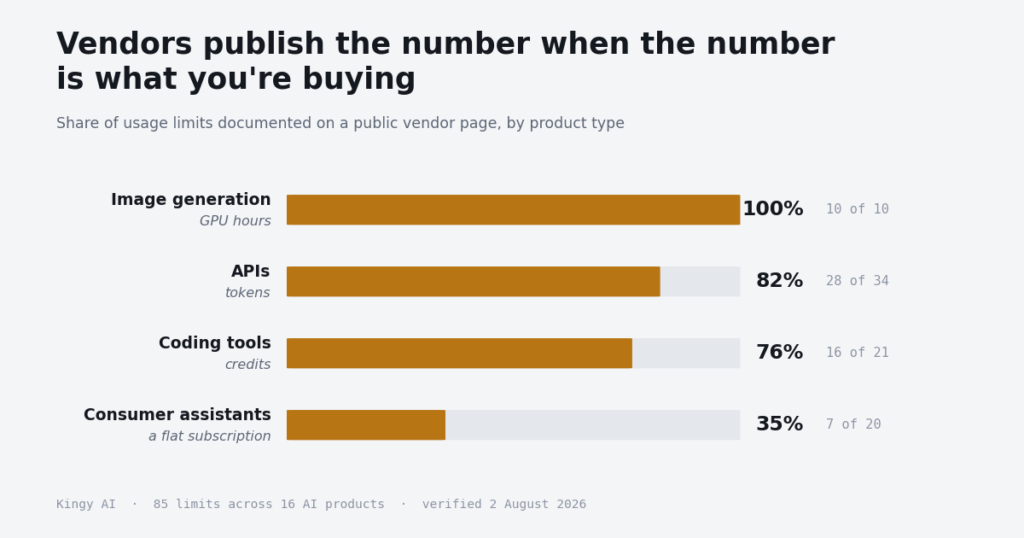
Then we sorted by product type. The result is not a muddle:
| Surface | Limits documented | What you are buying |
|---|---|---|
| Image generation (Midjourney) | 10 of 10 — 100% | GPU hours |
| APIs | 28 of 34 — 82% | Tokens |
| Coding tools | 16 of 21 — 76% | Credits |
| Consumer assistants | 7 of 20 — 35% | A flat subscription |
The pattern is consistent enough to state plainly: vendors publish the number when the number is the thing you are buying.
Midjourney sells GPU time by the hour, and documents every plan to the decimal — 3.3 hours on Basic, 15 on Standard, 30 on Pro, 60 on Mega, extra time at $4/hour. Anthropic sells API tokens and publishes a complete tier table: Opus 5 at 2,000,000 input tokens per minute on the Start tier, 5,000,000 on Build, 10,000,000 on Scale.
Now look at the same companies’ consumer products. Anthropic documents that Claude Pro has a five-hour window and a weekly cap; it does not publish how many messages fit in either. Google replaced Gemini’s old daily prompt counts with “compute” units it declines to quantify, telling you only that Pro gets four times the free tier of something it will not name. Cursor calls its allowance “generous included usage.”
The explanation is not conspiracy, it is incentive. When you buy a metered unit, the number is the product, and a vendor who hides it cannot sell it. When you buy a flat monthly subscription, the limit is not the product — it is a cost control on the vendor’s side of the ledger. Cost controls get described. They rarely get quantified.
Four vendors publish no figure at all
These are worth separating from “we could not find it.” In each case we checked the primary source and confirmed the absence:
- xAI publishes no rate limits for the Grok API. Per-token pricing, yes. Requests per minute, tokens per minute, tier structure — nothing. You discover your limit by hitting it.
- DeepSeek publishes concurrency only — 500 simultaneous connections on v4-pro, 2,500 on v4-flash — and no RPM or TPM figure anywhere. Unusual among major API providers.
- Replit’s pricing page never states when credits reset, or whether they roll over. For a plan sold on a credit allowance, that is the one number a buyer needs.
- Devin says its allowance “refreshes automatically on a daily and weekly basis” without a figure for any plan, and without saying which plan uses which cadence.
One more that is not an absence but a trap: Perplexity’s consumer Pro plan carries no monthly credit allocation at all. New accounts get a one-time 4,000-credit bonus that expires after thirty days. Enterprise Pro gets 500 credits a month; consumer Pro gets none. That is documented, clearly, on Perplexity’s own help page — and it is not what most people assume they are buying.
Three mechanics that cost people time
Some limits never reset. Anthropic’s API uses a token bucket: capacity refills continuously, second by second. There is no boundary to wait for. Waiting until the top of the hour achieves nothing — throttle your send rate and retry.
Rolling windows start when you do. ChatGPT’s three-hour and Claude’s five-hour windows are anchored to your first message, not to a wall clock. Two people who hit the same cap get different reset times.
You are often downgraded, not blocked. ChatGPT quietly drops you to a mini model at the cap. Copilot keeps working on an included model. You can spend an hour on degraded output without noticing you were throttled at all.
Why this needs maintaining, not just publishing
In the ten weeks before we built this, five vendors made breaking changes: Windsurf retired credits for daily and weekly quotas in March, Anthropic doubled Claude’s five-hour allowance on 6 May, Google replaced Gemini’s daily prompt counts at I/O later that month, OpenAI restated ChatGPT’s caps on 29 May, and GitHub moved Copilot to usage-based credits on 1 June. Windsurf has since been renamed outright — windsurf.com now redirects to Devin Desktop, which means every Windsurf credit figure still circulating describes a product that no longer exists under that name.
That churn is exactly why almost nobody maintains a reference like this, and exactly why one is worth having. Every figure on our page carries its own verification date and is marked stale after thirty days rather than presented as current.
The AI Limits & Quotas Reference is here, including a quota reset forecaster that tells you when your specific limit comes back in your own timezone — and which tells you honestly when there is no reset to wait for.