Your Claude subscription can now pay for Claude Code mode inside Amp. If you run it on your own machine, Amp says the runner is free. That does not make every Amp feature, model call or hosted workspace free.
Amp’s October 10 announcement adds a mode built on Anthropic’s Claude Agent SDK, with Amp’s collaboration and execution environment around it. For an existing Claude Pro or Max subscriber, the practical question is which parts draw on the Claude plan, which consume Amp usage, and which capabilities differ from native Claude Code.
Evidence note, October 10, 2026: This is a documentation-based analysis. Kingy has not completed a matched coding run in native Claude Code and Amp, or verified an account’s settled charges. The comparison protocol below is a proposed test; it has no measured winner.
Choose Claude Code mode before you start
The entry point is Mode > Claude Code when creating a thread. Amp asks you to link your Pro or Max subscription if needed. This changes the agent doing the work: the mode uses Anthropic’s Agent SDK, while Amp supplies features such as thread sharing, portals and multiplayer. It is useful to think of the subscription as paying for one supported execution path through the product.
The Dial documentation explicitly excludes Amp’s own modes and raw models from Claude-plan coverage. Choosing a Claude model in a different Amp mode does not establish that the call will draw on your subscription. Verify the mode, rather than inferring billing from a familiar model name.
| Path or feature | Documented billing boundary |
|---|---|
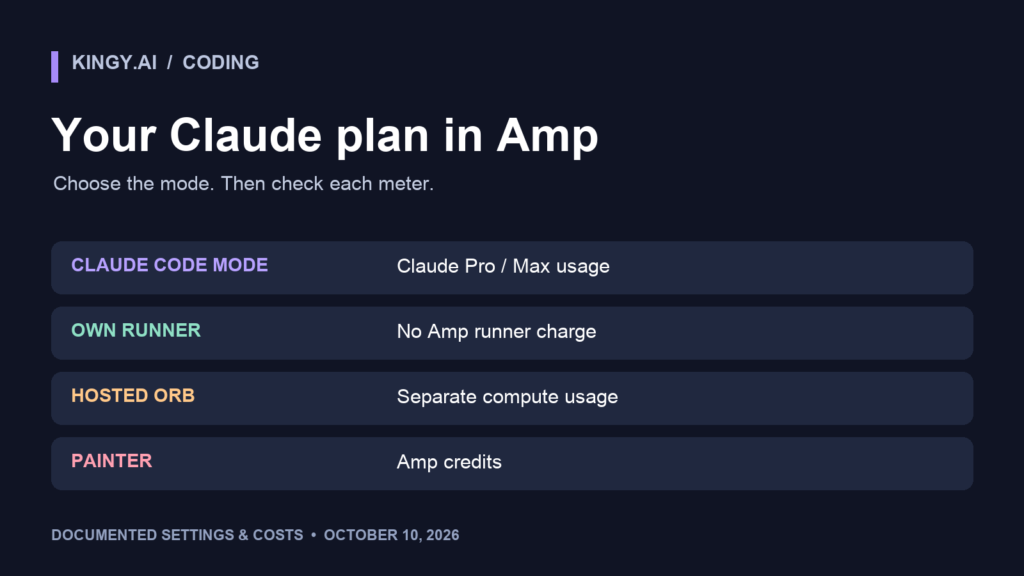
| Claude Code mode on your own runner | Claude usage draws on your plan; Amp says the runner is free. |
| Claude Code mode in a hosted orb | Claude plan plus separate orb usage, through Amp allowances or credits. |
| Painter image generation | Amp credits. |
| Amp’s own modes or raw models | Not covered by the Claude plan. |
| Oracle, Librarian and Illustrator in Claude Code mode | Excluded to avoid additional Amp-credit charges. |
A local runner still uses your computer, electricity, storage and network. “Free runner” describes Amp’s charge for that execution environment. It does not mean unlimited Claude capacity or zero total operating cost.
A hosted orb has its own meter
Amp’s pricing page separates agent usage from orb usage. Its free Hobby tier permits your own runners and pay-as-you-go orbs. Paid tiers include allowances, but the presence of an allowance does not turn hosted compute into a Claude subscription benefit.
The published standard orb rates range from $0.08 an hour for a1.tiny to $2.13 an hour for a1.3xlarge. A1.small is $0.17 an hour; a1.medium is $0.33. Enterprise prices can differ, and the largest size has eligibility restrictions. These are the dollar-denominated rates displayed by Amp, checked October 10.
Consider a hypothetical coding session that keeps a small orb billable for 30 minutes. At the standard rate, the orb component is 0.5 × $0.17 = $0.085, or 8.5 cents. A medium orb for the same period is $0.165. The Claude-plan usage is a separate part of that session. These calculations do not include tax, credits, included allowances or other tools, and they are not observed invoices.
Measure the billable interval, not just the time spent generating an answer. Amp bills orbs by the minute. Its documented automatic pause occurs five minutes after agent work ends or twenty minutes after the last interaction, whichever is later. Opening an unarchived thread or interacting with a portal can wake compute again. That matters if you spend twenty minutes inspecting a patch after the agent finishes.
A sensible cost record has separate columns for the existing Claude subscription, Claude usage consumed, orb minutes, Amp tool usage and new cash charges. A subscription payment already made should not be presented as a new charge caused by one test, but capacity consumed should not disappear from the comparison either.
Your runner must have its own working Claude login
According to Amp’s runner guide and its Claude-specific setup instructions, the local execution machine needs a Claude Code installation and an authenticated Claude account. Amp does not install Claude Code on that runner. The process uses the installation, settings and login of the user running it.
This distinction can explain a confusing setup failure. Linking a subscription in the web interface serves an orb; a runner uses the login on its own machine. A runner launched by a service manager can also have a different PATH from your terminal. Check installation and authentication in the environment that actually starts the runner.
Amp says it strips API-key, authentication-token and supported cloud-provider settings from Claude Code’s environment in this mode, so an API key is not a substitute for the required plan login. That is worth checking before a comparison: a native run billed through an API key and an Amp run drawing on subscription capacity would answer a different question.
The subscription still has limits
Anthropic’s Pro and Max help page says Claude and Claude Code share plan limits, including five-hour and weekly limits. A wrapper does not create a second independent pool. Other work done in Claude during a coding comparison can affect the remaining capacity.
The same page warns that native Claude Code can use an API key instead of subscription authentication. It also describes paid continuation options when limits are reached. Record how each run authenticated, whether a limit interrupted it, and whether extra usage was enabled. A patch that finishes only after switching to a different billing path is still a completed patch, but its cost belongs in the result.
Anthropic’s Agent SDK policy page supplies additional context. Its June 15 update paused previously announced SDK changes; its October 7 update says Agent SDK, claude -p and third-party app usage can still draw on subscription limits, while Max and Team plans also include monthly API credits for specified uses. Those credits and subscription limits are distinct mechanisms. Amp’s documented Pro/Max mode should not be assumed to support every other entitlement.
Amp changes some of the workflow
In Claude Code mode, Amp documents disabled plan mode, todo tooling and notebook editing. Teams whose normal task depends on one of those features should check that restriction before migrating. An agent completing a plain source-code fix says little about a notebook-heavy workflow.
Amp also documents that its runner starts Claude Code without permission prompts. Use a bounded checkout with only the files and credentials the task needs. For a test, a disposable copy of a small repository is more informative than giving either route a production working directory with unrelated secrets and unfinished work.
If the task should produce code only, explicitly prohibit Painter in the project instructions. The documented instruction is “Do not use the painter tool.” That avoids an image-generation tool introducing an extra meter into a coding-only comparison.
A fair same-task comparison needs a fixed starting point
Our proposed task is a small CSV import repair: preserve quoted commas, doubled quotes and CRLF records; reject malformed records with a useful error; keep the public interface unchanged. Prepare two fresh copies at the same commit. Give each route the same prompt, model, effort setting, repository instructions and acceptance tests.
Keep task completion separate from code volume. Completion means the imported records are correct, the malformed cases fail as specified, the existing checks pass, and a reviewer accepts the patch. Include cases withheld from the coding prompt. Count manual fixes and restarts, and record whether a disabled tool prevented progress.
| Measure | What to record |
|---|---|
| Completion | Acceptance outcomes, existing-check results, final diff and reviewer decision. |
| Restrictions | Unavailable tools, authentication failures, quota interruptions and manual intervention. |
| Time | Wall-clock task time and, separately, billable hosted-compute minutes. |
| Cost | Before/after usage records, Amp tool charges, orb charges and any paid continuation. |
Run more than one task and alternate the order. Otherwise the second run may benefit from a warm cache, different available capacity or a lesson learned while reviewing the first patch. One successful run can demonstrate that a setup works; it cannot establish a general productivity advantage.
How this changes our April OpenClaw coverage
Kingy’s April article on Anthropic and OpenClaw reported the restrictions announced at that time. It now carries a dated correction pointing to the later SDK policy updates and this Amp integration. The April events remain historical coverage.
For a current purchase or setup decision, use the current supported path and billing documentation. Amp’s announcement establishes a specific Pro/Max route through Claude Code mode; it does not establish that every third-party client, integration or Amp feature inherits the same coverage.
For an existing subscriber who wants Amp’s collaboration features, the least complicated first trial is Claude Code mode on a correctly authenticated personal runner, with Painter excluded and a small isolated coding task. Save the usage records before deciding whether the hosted orb is worth its separate cost.
The Kingy Brief
Get The Kingy Brief.
AI changes, original tests and one practical thing to try. Fridays at 09:00 Vancouver time.
Free · Double opt-in · Unsubscribe anytime
Signup help and newsletter schedule
Signup form provided by Beehiiv. After submitting, check your inbox for "Confirm your subscription to The Kingy Brief" and open its confirmation link. Check Spam or Promotions if you cannot find it.
Fridays at 09:00 Vancouver time: source-checked AI changes, original tests and one practical thing to try. The weekly restart begins October 9, 2026. We skip a week when there is not enough verified material. Free. Unsubscribe anytime.