Research and Cursor coding pilot checked October 12, 2026. List prices are US dollars before tax. The pilot used Cursor Pro, a continuing plan. New-bundle Canadian checkout totals and task charges remain untested.
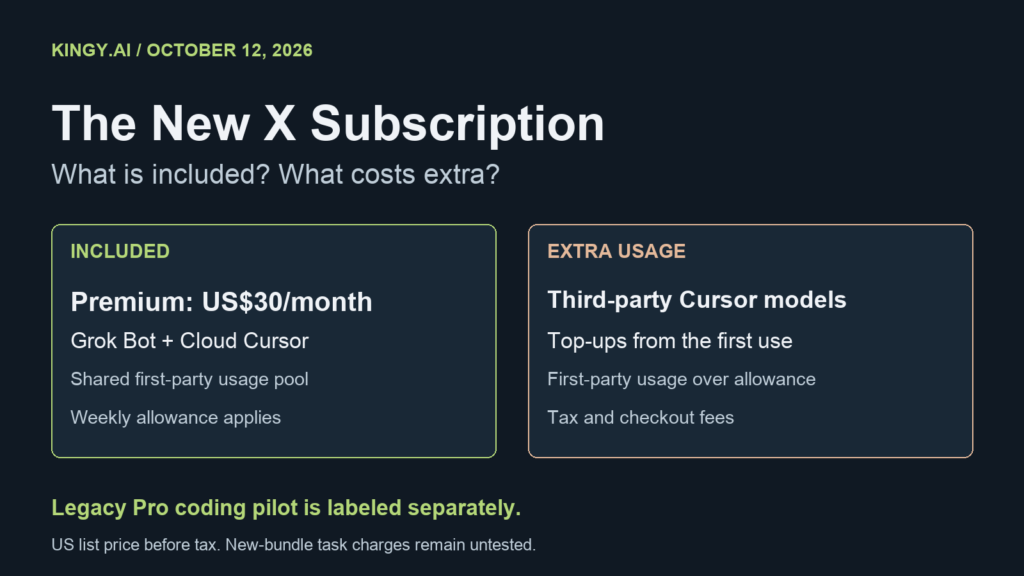
New Grok Bot customers now need The X Subscription Premium, listed at US$30 a month. The bundle combines Grok, Grok Bot, Cursor and X benefits, but the model you choose in Cursor changes what you pay. Claude and GPT usage is billed separately from the first use.
The official announcement starts new-customer access on October 12, with rollout over several days. Existing SuperGrok, Cursor and X Premium subscribers can continue their current plans. A switch option appears in billing settings as it becomes available. Existing Cursor subscribers keep their included third-party usage until they switch.
Which tier includes the work you want?
| Plan | Monthly list price | Included usage relative to Plus | Grok Bot |
|---|---|---|---|
| Free | $0 | Limited | No |
| Plus | $8 | Base | No |
| Premium | $30 | 4× | Yes |
| Super | $100 | 15× | Yes |
| Ultra | $200 | 50× | Yes |
The subscription pricing documentation also lists annual billing: $80 for Plus, $300 for Premium, $1,000 for Super and $2,000 for Ultra. An annual monthly equivalent is not a month-to-month checkout price. Tax can be added at checkout.
Premium includes Grok Bot and Cursor cloud agents and automations. Plus offers Cursor access but excludes Grok Bot. The current feature list distinguishes those tiers and flags third-party Cursor models as separately billed. Paying for a higher tier expands included usage; it does not turn Claude or GPT into included models.
What costs extra?
The allowance covers eligible first-party usage across Grok and Cursor. It resets weekly. Grok Bot, chat, image work and coding can therefore compete for the same capacity. Product usage rates differ, so “4×” does not mean four times as many successfully completed coding jobs. Usage limits.
Third-party Cursor models use prepaid Additional Usage credit from their first use. First-party work beyond the included weekly pool also uses top-up credits. A subscription fee, a prepaid deposit and the amount consumed by a task are three different numbers. Extra usage and top-ups.
For example, a top-up can leave unused credit after a short job. Reporting the entire deposit as that job’s model cost would overstate consumption. Reporting only consumption would omit the cash the buyer had to advance. A useful review records both.
The monthly Additional Usage cap, prepaid balance and Auto Top-up setting are separate controls. Adding credit does not raise the cap, and a spend alert does not stop work. Auto Top-up is optional. Check the account’s settings before starting a metered comparison. Spending controls.
Should an existing subscriber switch?
First compare the models you use with the allowance your current plan includes. A larger first-party pool can be useful for Grok-heavy work. Someone who regularly uses Claude or GPT in Cursor also needs to price that usage separately under the new subscription.
This is an editorial buying inference from the billing rules, not a measured claim that either plan costs less for your workload. The relevant comparison is the cost of acceptable output using your actual model mix.
Account unification is permanent. Personal and team accounts unify separately; some Enterprise arrangements need an account team or cannot switch yet. A personal X account must be connected for X benefits. Eligibility and account unification.
For supported switches, the old-plan refund is separate from the new checkout charge. Cursor subscriptions purchased through Apple need separate cancellation through Apple; the web switch cannot cancel or refund them. Check the billing channel before assuming consolidation eliminates another bill. Pricing and switch treatment.
The same coding task on a continuing Cursor Pro plan
We ran the same JavaScript cart-repair task using Grok 4.7 High and Claude Sonnet 5.5 High in Cursor 3.23.23 on October 12. The accessible paid account was Cursor Pro at US$20/month, so we kept that plan for the test. These are legacy-plan observations. We did not test The X Subscription Premium’s separately billed third-party usage.
Both runs used Cursor’s This Mac mode, separate fresh repositories, the same starter and prompt, and a 15-minute limit. The task required exact cent arithmetic, repeated-SKU consolidation, discount before tax, half-up rounding, input validation and input preservation. Only the cart module could change. The grading harness stayed outside both editable workspaces.
| Measurement | Grok 4.7 High | Claude Sonnet 5.5 High |
|---|---|---|
| First submitted artifact: fixed checks passed | 24/24 | 24/24 |
| Files changed | cart.mjs only | cart.mjs only |
| Operator repair prompts | 0 | 0 |
| Cursor’s displayed run time | 9 min 26 sec | 33 sec |
| Ledger total tokens | 357,280 | 119,083 |
| Ledger output tokens | 43,785 | 5,921 |
| Ledger cost classification | Included | Included |
| Observed additional cash charge | US$0 | US$0 |
The tests were our checks, rather than accepting the agents’ completion messages. They cover rounding, tax order, duplicate rows, invalid input, unchanged inputs and a large exact-arithmetic case. A deliberately broken starter passed only 5 of 24; a local reference passed all 24. Both submitted repairs then passed the unchanged harness.
Grok spent additional time checking large-value rounding. Claude reported correcting an error in its own inline test expectation for an empty cart before its final submission. We gave neither model a correction prompt, and did not change either submitted module ourselves.
The recorded token totals include cached reads and multiple calls. Both the usage export and model labels identify the requested configurations. The matching “High” labels do not guarantee equal compute budgets. Cursor’s displayed durations describe these task runs; they are not independently instrumented inference latency or a general speed benchmark.
An initial Grok setup attempt was interrupted after Cursor associated a nested test folder with the parent repository. We restarted in standalone repositories and kept the interrupted attempt in the accounting. It consumed 115,295 ledger tokens, also marked Included. Across that attempt and both completed runs, the export totaled 591,658 tokens. The final on-demand billing subtotal was US$0.00.
We purchased no credits, changed no plan and left on-demand usage off. The observed US$0 incremental charge therefore describes these runs on this Pro account. The subscription still costs money, and included usage has capacity value. We do not treat this result as free third-party usage on the new bundle.
For this small task, both artifacts met the fixed checks; Sonnet finished sooner and used fewer ledger tokens. One completed run per model does not establish an overall coding winner, a reliability rate, or the cheapest way to finish a different repository. Human review time and new-bundle top-up charges were not measured.
The Canadian payment we could verify
We inspected the test account’s paid Cursor Pro invoice and Stripe payment record. It showed:
| Item | Observed amount |
|---|---|
| Cursor Pro monthly subtotal | US$20.00 |
| GST — Canada, 5% | US$1.00 |
| PST — British Columbia, 7% | US$1.40 |
| Paid invoice total | US$22.40 |
| Actual card charge reported by Stripe | CA$33.25 |
Stripe displayed 1 USD = 1.4842 CAD, including a 4% conversion fee, for that October 12 payment. These are observed values from one account’s payment, not a quoted Canadian total for The X Subscription or a general exchange rate. Personal billing identifiers are omitted.
Count the subscription invoice once when evaluating both runs on the same account. Adding US$22.40 to each model arm would double-count one payment. We did not allocate the monthly subscription between these two tasks or unrelated work, so the table reports incremental task charges separately from the subscription invoice.
Before quoting a new-bundle buyer’s total
The X Subscription Premium’s published US$30/month is a pre-tax reference price. We did not verify its Canadian checkout, and will not apply the Pro invoice’s tax or conversion figures to a different plan or seller.
Check the actual account and checkout for country, currency, billing term, tax, mandatory fees, offers, Grok Bot and cloud-agent eligibility, and third-party credit requirements. If switching, record the new charge and old refund separately. Existing Pro access is not proof of Premium entitlement.
The main buying consequence is clear from the documented rules: a continuing Cursor subscriber can retain included third-party usage, while a new-bundle subscriber pays separately for those models from the first use. Our Pro pilot illustrates why those billing paths must be kept separate. The new bundle’s cost for these exact runs remains unknown.
For agent workflow context, see Kingy’s Grok Bot vs OpenAI Dots guide and OpenAI Dot, Grok Bot and Meta Muse comparison.
The Kingy Brief
Get The Kingy Brief.
AI changes, original tests and one practical thing to try. Fridays at 09:00 Vancouver time.
Free · Double opt-in · Unsubscribe anytime
Signup help and newsletter schedule
Signup form provided by Beehiiv. After submitting, check your inbox for "Confirm your subscription to The Kingy Brief" and open its confirmation link. Check Spam or Promotions if you cannot find it.
Fridays at 09:00 Vancouver time: source-checked AI changes, original tests and one practical thing to try. The weekly restart begins October 9, 2026. We skip a week when there is not enough verified material. Free. Unsubscribe anytime.