AI-generated research has reached a difficult and consequential stage: specialists now have to decide what to do with substantial mathematical arguments that a machine can produce before the wider scientific community has understood them.
OpenAI’s October 26 announcement claims advances in all-dimensional local smoothing, a refutation of the Exponential Time Hypothesis, and existence results for certain interacting four-dimensional quantum field theories. The company presents the output as raw research data. Public manuscripts and formalization notes make some claims inspectable; their correctness, interpretation and significance still require scrutiny.
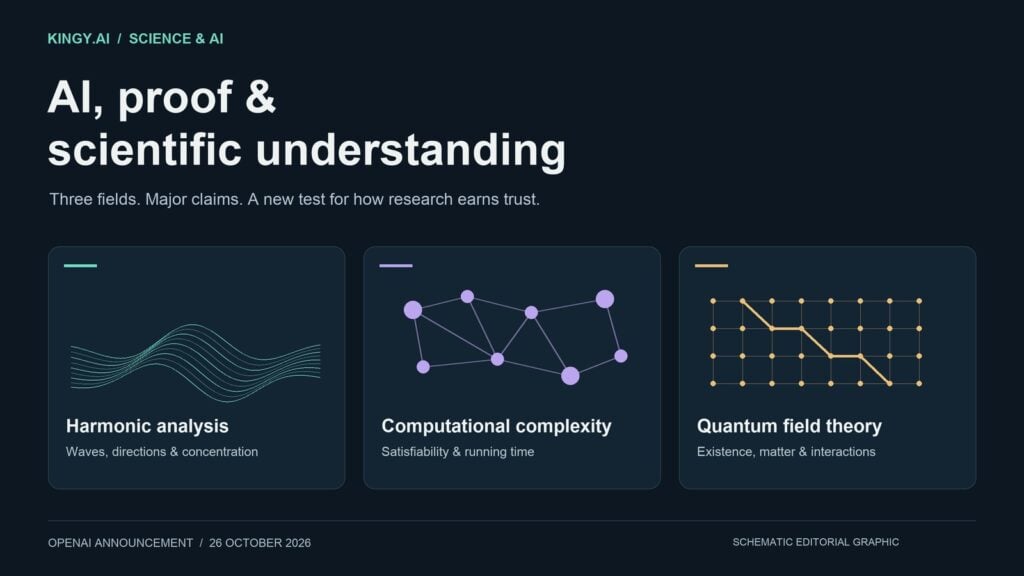
The strongest reason to pay attention is the kind of work involved. These claims concern relationships between waves and geometry, the computational difficulty of finding solutions, and the mathematical foundations of particle physics. If the results withstand scrutiny, their value would include new ways to reason about entire classes of problems.
There are different levels of evidence here. We examined public manuscripts, formalization scope notes and supporting documentation, and checked the scientific background. We did not independently rebuild the Lean proofs or certify the theorems. That distinction matters throughout this article.
Dan Roberts’s accompanying X post points readers to the same announcement. We could access its text only through a third-party mirror. Roberts is an OpenAI researcher, as his own website explains. His post is dissemination by someone inside the company, rather than an additional independent evaluation.
October 26 update: release timeline and review status
The October 26 repository release contains the public local-smoothing and ETH manuscripts and their Lean artifacts. This update records that release at a fixed source revision and separates the announcement date from the dates of the underlying work. All four claims below belong to the October 26 announcement covered here.
| Claim | Natural-language output | Lean formalization reported complete |
|---|---|---|
| ETH refutation | October 16 | October 17 |
| All-dimensional local smoothing | October 18 | October 19 |
| Pure Yang–Mills existence | September 9 | October 16 |
| QCD existence | September 18 | No separate completion date specified |
These are company-reported dates. The October 16 physics formalization date applies to Yang–Mills existence; OpenAI does not separately specify one for QCD or the Standard Model completion. The physics group is preparing its own writeup while withholding the AI-produced artifacts, according to the announcement.
The same release history records fixes to some Comparator configurations and improvements to some Lean formalizations. Readers comparing verification reports should check which repository version each report examined.
In the sources reviewed for this update, we did not locate a completed independent evaluation of these three headline claims. We did not run the Lean checking procedure.
Three results, with different evidence behind them
The two public research packages give readers something concrete to inspect. They contain statements, arguments and formalization documentation. A specialist can compare the advertised conclusion with the actual mathematics, investigate the dependencies and attempt to reproduce the checking procedure.
| Area | Central question | Evidence available to readers |
|---|---|---|
| Harmonic analysis | How strongly can waves concentrate, and what does that imply about geometry? | A local smoothing manuscript and Lean scope documentation. |
| Computational complexity | Must 3-SAT require exponential time in its number of variables? | An ETH manuscript and a formalization scope with a distinct quantitative bound. |
| Mathematical physics | Can interacting quantum fields be constructed with complete mathematical control? | The announcement and the established background problem; the new physics artifacts were unavailable for this review. |
These subjects have a useful feature in common. Their questions have precise meanings, even when their answers are extremely hard to find. A claimed algorithm can be evaluated against a running-time statement. A claimed theorem can be compared with a formal proposition. A claimed construction of a physical theory can be checked against specified mathematical requirements.
Precision creates an opportunity for AI research. It also creates an obligation for reporting. A small change in a theorem’s assumptions can separate a major advance from a different, narrower result. The rest of the article explains those assumptions because they determine the significance.
Local smoothing and the geometry of waves
Why a wave’s worst instant can be misleading
Imagine several ripples arriving at the same place. Their peaks can briefly reinforce one another, producing a larger disturbance than any one ripple would create alone. At another moment, the same waves may be spread out or may cancel in part. A description based only on the most concentrated instant can therefore look very different from one based on a stretch of time.
This illustration helps explain the local smoothing question. Mathematicians want to control the concentration of solutions to wave equations using information about the initial wave. They also want to know how much the control improves when they average over time.
The established two-dimensional result by Larry Guth, Hong Wang and Ruixiang Zhang concerns sharp local smoothing estimates for the wave equation in two spatial dimensions. Their paper appeared in Annals of Mathematics in 2020. The distinction between spatial dimension and time is useful: a wave evolving on a plane has two spatial dimensions, with time supplying a separate variable.
Moving to higher dimensions changes the possible arrangements of interacting waves. More directions mean more ways for wave packets to overlap. A proof that controls concentration in one dimension count may depend on geometry that no longer works in another. A result valid for every spatial dimension would therefore do more than add another case to a list.
To describe concentration, mathematicians use norms. A norm assigns a size to a function, but different norms emphasize different behavior. An average-sensitive norm may tolerate a very high peak if the peak occupies very little space or time. A norm that emphasizes large values penalizes that same peak more heavily.
Regularity describes another part of the problem. A wave with rapid fine-scale oscillations can be harder to control than a smooth wave of similar overall size. Sobolev norms incorporate this control of oscillation through derivatives or their frequency-space equivalents. In an estimate, the amount of regularity required is part of the result, rather than a technical decoration.
What the public statement covers
The published formalization scope describes Euclidean half-wave estimates in every dimension n ≥ 2, for 2 ≤ p < ∞. The initial-data Sobolev order is:
s = max(0, (n − 1)/2 − n/p) + ε
Here ε can be any positive number; at p = 2, the scope permits zero. It also lists Bochner–Riesz, spherical extension, square-function and Kakeya conclusions in specified ranges. These qualifications should remain attached to the claim. Arbitrarily small positive loss is different from a fully lossless endpoint, and Euclidean space is a specified setting.
The formula is useful even for readers who will never use it. It shows that “proving local smoothing” means identifying a quantitative threshold. Researchers care about how close the estimate gets to the boundary permitted by concentrated examples. A weaker estimate can still be useful, but it may fail to yield the consequences that make the sharp threshold important.
The October 25 manuscript claims the Euclidean local smoothing conjecture and derives further analysis and geometry results. Its proposed approach introduces auxiliary flows and an auxiliary partial differential equation into the argument. Those are mathematical devices for obtaining estimates. They should not be presented as newly discovered laws of nature. The paper’s restriction conclusions concern the interior of conjectured ranges, which also rules out an indiscriminate claim that every endpoint problem has been settled.
Why Kakeya is about dimension rather than ordinary volume
A Kakeya set contains a unit line segment in every direction. It is a deceptively simple requirement. One can slide the segments around, arrange substantial overlap and ask how small the resulting set can be.
Larry Guth’s survey of the Kakeya problem explains why the relevant notion of size requires care. Besicovitch constructions allow sets with the directional requirement and zero ordinary measure, as Terence Tao’s exposition makes explicit. The dimension conjecture concerns the more refined question of full dimension. Thin tubes around line segments let researchers translate directional geometry into quantitative overlap problems.
Ordinary volume and dimension answer different questions. Volume asks how much space a set occupies according to a familiar measure. Dimension probes how its structure behaves as the measurement scale changes. A set can occupy zero ordinary volume while still having the full ambient Hausdorff dimension. Treating those as interchangeable would make the claimed result sound as though it contradicted constructions that the theory already accommodates.
In three dimensions, Hong Wang and Joshua Zahl’s 2025 paper established that every Kakeya set has Hausdorff and Minkowski dimension three. That is an essential part of the history. Any new all-dimensional result should be understood alongside the human work that settled the three-dimensional case.
The connection with waves becomes easier to see when each segment is thickened into a narrow tube. A tube can represent a localized wave packet moving in a particular direction. Many differently directed tubes passing through a small region resemble many wave packets concentrating there. Estimates about one arrangement can supply information about the other.
This is why an advance in harmonic analysis can produce consequences in geometry without an unrelated second miracle. Different problems can encode a shared obstacle. Finding a useful representation of that obstacle can make several previously separate-looking questions move together.
What would make this result scientifically valuable
The first layer of value would be the statement itself: researchers could use the estimate as an input to later arguments. The second would be the method. If mathematicians can extract a reusable principle from the auxiliary construction, that principle might help with problems whose exact statements never appeared in the original manuscript.
Those are different kinds of progress. A large formal development can certify a particular conclusion while leaving its useful ideas difficult to locate. A shorter conceptual explanation might then become a major contribution because it tells other researchers which parts of the machinery can be adapted.
That possible next step deserves attention when evaluating AI-generated mathematics. Counting solved statements measures one output. Understanding why they are true, how their methods relate to earlier work and where they can be extended measures a different output. A scientific community needs both.
The Exponential Time Hypothesis and the limits of computation
Finding a solution, checking it and counting every solution
A Boolean variable has two values: true or false. A formula can combine variables with operations such as AND, OR and NOT. Satisfiability asks whether any assignment of those values makes the complete formula true.
Consider this small illustration:
(x OR y OR NOT z) AND (NOT x OR y OR w)
Each parenthesized expression is a clause. Every clause must be true, because the outer operation is AND. Such an AND of clauses is called conjunctive normal form, or CNF. In k-CNF, each clause has at most k literals, meaning variables or their negations. Setting y to true satisfies both clauses regardless of the other three variables. A solver could therefore find a valid assignment quickly in this particular example.
That example does not describe the worst case. Large formulas can contain constraints that interact in complicated ways. Assigning one variable can help one clause while making another harder to satisfy. Checking a complete proposed assignment is straightforward; finding one without already knowing it can be much harder.
The Clay Mathematics Institute’s description of P versus NP centers on the distinction between efficiently checking a proposed solution and efficiently finding one. The ETH question is more specific. It concerns how much time a particular kind of satisfiability problem requires as the number of variables grows.
There is also a stronger task than answering yes or no. A counting algorithm asks how many assignments satisfy the formula. In the illustration above, knowing that at least one assignment exists settles satisfiability, but it does not reveal the total. An exact count of zero means unsatisfiable; a positive exact count means satisfiable.
What “subexponential” means
The original work by Russell Impagliazzo and Ramamohan Paturi formulates exponential-time hypotheses for satisfiability. In the usual ETH framing, 3-SAT does not admit a subexponential-time algorithm in the number of variables. The hypothesis concerns a worst-case asymptotic limitation, rather than a statement that every practical instance is difficult. See their 2001 paper.
Three growth patterns help explain the issue. A polynomial such as n3 grows much more slowly, eventually, than an exponential such as 2n. A function such as 2√n sits between them: it is subexponential, yet it eventually grows faster than every fixed power of n.
The notation 2o(n) captures the relevant idea. Divide the exponent by n; the ratio tends to zero as n grows. For √n, that ratio is 1/√n. For a fixed positive multiple of n, it remains a positive constant.
These examples illustrate growth classes. They are not performance measurements or the running time claimed for the new algorithm. They explain why crossing from exponential to subexponential would alter a complexity-theory assumption even if the resulting procedure were still far too expensive for many real workloads.
It also explains why ETH and P versus NP cannot be collapsed into one headline. A subexponential algorithm may remain superpolynomial. Refuting ETH would therefore leave room for satisfiability to be outside polynomial time. The logical space between “requires a full exponential” and “has a polynomial algorithm” is enormous.
The manuscript and the Lean scope make different quantitative claims
The revised ETH manuscript claims a deterministic exact-counting algorithm for fixed-width k-CNF formulas, with polynomial space. For n variables and m clauses, its main time bound has a polynomial factor multiplied by an exponential whose exponent is bounded by a constant times n log log n / √log n, with constants allowed to depend on fixed k. A sparse-input bound is sharper. The paper uses algebraic counting methods and explicitly warns against transferring its conclusion to all NP problems through arbitrary polynomial reductions.
The public Lean scope describes a deterministic machine that exactly counts satisfying assignments on canonical encodings. It gives a polynomial input-length factor and an exponent bounded by a constant times n(log log n)2 / √log n, with polynomial visited tape space. The extra log log factor makes this a weaker quantitative bound than the revised manuscript’s main statement. It is still subexponential and therefore sufficient for the central ETH conclusion, if the formal development and its interpretation check out.
This difference is useful evidence of why readers should inspect formalization scope pages. “There is a Lean proof” does not tell us that every displayed equation, improvement or corollary in a companion paper has the same verification status. A formalization can establish the main qualitative breakthrough while covering a different numerical bound.
The fixed-width condition also matters. The theorem holds with k fixed while the number of variables grows. A dependence hidden in a constant can be acceptable under that convention and become decisive if k also grows. Reporting the result as an unrestricted algorithm for every possible Boolean formula would lose that distinction.
Why a false hypothesis would affect so much research
Complexity research often proceeds conditionally. A researcher may show that a fast algorithm for problem B would imply a fast algorithm for problem A. If A is believed to require a certain amount of time, this supplies evidence that B is hard too.
Impagliazzo, Paturi and Francis Zane studied the relationships between complete problems and subexponential complexity in their 2001 work. The size of a reduction is central. To preserve a fine-grained time statement, it is not enough that a transformation takes polynomial time; one must also track how much it enlarges the instance.
An illustrative reduction makes the problem visible. Suppose an input of size N becomes a satisfiability instance with N2 variables. Even a hypothetical SAT algorithm taking 2√n time would then take 2N on the transformed instance. Subexponential in the new variable count has become exponential in the original parameter.
That calculation is why a theorem about one problem’s asymptotic complexity cannot be sprayed across every NP-complete problem. The direction of the reduction, the chosen parameter and the encoding overhead all matter.
If ETH is false, an old theorem of the form “if ETH, then B has no algorithm of this kind” need not contain a mathematical error. The implication can remain valid while its premise no longer supplies a reason to believe the conclusion. Some conclusions may still hold for other reasons; others may invite new algorithmic attacks.
The scientific consequence would be a re-examination of where the evidence for hardness came from. Researchers would separate genuine lower bounds, consequences of other hypotheses and statements supported specifically by ETH. That is a substantial intellectual task even before anyone produces a faster piece of software.
What would turn a complexity advance into a useful tool
Asymptotic analysis asks what happens as inputs become arbitrarily large. A working solver has to run on finite machines and finite instances. The two perspectives complement one another, but neither substitutes for the other.
A new method can have better eventual growth and still lose on every input a current machine can handle. Hidden constants may be large. Polynomial factors may have high degrees. Exact arithmetic can be expensive. Memory movement, data representation and the structure of real inputs can dominate an implementation.
For a practical assessment, researchers would need an implementation, reproducible workloads, comparisons with strong baselines and an account of where the method wins or loses. A result about worst-case complexity would then acquire a second body of evidence about actual use.
There is a productive research opportunity between those stages. A theoretically impractical method can reveal a decomposition or invariant that inspires a practical heuristic. Conversely, a broad asymptotic improvement may have little immediate value for a specific workload. Neither outcome can be inferred from the theorem’s headline alone.
The immediate implication for AI is therefore about research capability and the possible revision of a scientific framework. Claims of instant universal optimization or broken encryption would require separate results and evidence.
Quantum field theory, existence and the mass gap
A theory can work extremely well before its foundations are complete
The Standard Model describes elementary particles and the strong, weak and electromagnetic interactions. Gravity sits outside it. Quantum chromodynamics, or QCD, describes the strong interaction involving quarks and gluons. This background is established physics, separate from the new announcement.
Quarks combine into hadrons, including protons and neutrons. Gluons participate in the strong interaction, and their own interactions make the theory particularly demanding. CERN’s explanation of partons and hadrons provides context for why observations involve composite particles and why relating the underlying description to measured outcomes is substantial work.
Here, four dimensions means four spacetime dimensions: three of space and one of time in the physical description. Gauge fields describe interactions within a symmetry-based framework; for the strong interaction, their quantum excitations are gluons. Quarks belong to the class of matter particles called fermions. Pure Yang–Mills theory retains the self-interacting gauge fields without quark matter fields. QCD includes quark fields too, as the Jaffe–Witten account explains. The existence questions are related, but they concern different mathematical objects.
These theories are interacting: the fields affect one another, rather than describing independent free waves. In QCD, asymptotic freedom means the interaction weakens at very short distances or high energies. At longer distances it becomes stronger. A rigorous construction must control the complete theory across scales, beyond the regime in which a short-distance approximation is sufficient.
A physical theory can generate successful calculations while still leaving mathematicians dissatisfied with how the complete object has been defined. Those are different standards. Experimental success concerns agreement with observations. Mathematical existence concerns whether the theory can be constructed under precise requirements without depending on uncontrolled steps.
To see the distinction, imagine a sequence of increasingly fine approximations to an object. Every approximation can be well-defined and useful. It does not follow automatically that the sequence converges, that its limit is unique or that the limit retains all the properties one wanted. The limiting argument can be the hardest part.
Michael Douglas’s Clay report on quantum Yang–Mills theory explains the challenge through lattice constructions and continuum limits. One has to obtain the appropriate continuum correlation functions and control the passage from regulated approximations to a theory satisfying mathematical axioms. This is why a rigorous existence theorem would be a foundational achievement even though physicists already use quantum field theories successfully.
What is disclosed, and what remains unavailable
OpenAI reports existence results for interacting four-dimensional quantum field theories, including QCD and a unified Standard Model completion. It reports Lean formalization of Yang–Mills existence, without extending that statement to every physics claim. David Gross leads a group including Douglas, Arthur Jaffe, Igor Klebanov and Nikita Nekrasov; the new artifacts are withheld while the group develops a writeup. These are the company’s disclosures, rather than findings independently established by this article.
That access limitation changes what can responsibly be said. A reader can study the established problem and understand why the claimed result would matter. A reader cannot yet perform the same inspection of the new argument that is possible for the public mathematics and computer science packages.
The involvement of experienced researchers is relevant to the review process. It does not supply a substitute for their eventual mathematical conclusions. A scientist agreeing to examine a claim and a scientist publicly certifying its correctness are different events.
The phrase “Standard Model completion” also requires restraint. A mathematically consistent construction of a proposed completion would establish properties of that construction. It would still require physical evidence to show that nature follows the proposed theory. Mathematical rigor cannot choose an empirically correct theory by itself.
Existence is one part of the Yang–Mills Millennium problem
The official Jaffe–Witten problem statement asks for a nontrivial quantum Yang–Mills theory on ℝ4, for every compact simple gauge group, with specified axiomatic properties and a positive mass gap. The gap means that the spectrum has no energies strictly between the vacuum and a positive threshold. Establishing existence and establishing this gap are distinct obligations.
Consequently, an existence claim alone cannot be reported as completion of the full Millennium Prize problem. It also does not settle quantum gravity. Readers interested in the wider status questions can use Kingy’s Millennium Prize reference, while treating this new release according to its own evidence.
The gap is easy to misunderstand because several ideas about mass appear in particle physics. Here the question concerns the energy spectrum of an interacting quantum theory. It is not interchangeable with a general claim that the Higgs mechanism has been explained, or that a new particle has been discovered.
The 2004 Nobel Prize in Physics recognized David Gross, David Politzer and Frank Wilczek for asymptotic freedom in the strong interaction. The Nobel explanation of fundamental forces connects that short-distance weakening with the wider theory of strong interactions. Connecting control at short distances with a complete theory across scales is a profound mathematical challenge.
The potential importance of a successful construction would include a firmer basis for later questions. Researchers could investigate properties of an explicitly controlled object rather than rely entirely on formal manipulations or approximations. That would create a clearer setting in which to ask what else follows, including questions that the existence proof itself does not answer.
What formal verification can establish
An argument must become an exact object
A mathematical argument in prose leaves much to the reader. The author may omit routine steps, rely on familiar conventions or refer to a standard result without reconstructing its proof. Expert readers can often fill those gaps. They can also miss a hidden assumption or disagree about whether a step is justified.
Lean works with formal statements and proof objects. Its documentation on propositions and proofs explains the relationship between a proposition and an object that proves it. Tactics help construct the proof, while the logical system gives the finished object a precise meaning.
This separation is especially valuable for AI output. A model can propose an elaborate chain of reasoning without being the final authority on whether the chain is valid. The candidate must survive checks outside the process that generated the persuasive explanation.
It changes the failure mode. A fluent paragraph can conceal a jump that a reader initially accepts. A formal proof has to supply the missing construction or invoke an existing declaration. That requirement can make errors easier to expose and successful work easier to reuse.
The statement and its assumptions still need inspection
A checker establishes a proposition within a formal environment. Human work remains necessary to determine whether that proposition faithfully represents the intended scientific claim.
For an illustrative example, an algorithm theorem might quantify over a restricted input class while a headline describes all inputs. A geometric theorem might concern Euclidean space while a summary silently extends it to arbitrary curved spaces. The formal proof could be correct and the summary still wrong.
Lean’s proof-validation documentation describes tools for inspecting assumptions and replaying proofs. Such procedures matter because the final theorem depends on its environment: declarations, imported results, definitions and axioms. Checking a final line without understanding those dependencies would provide an incomplete account of verification.
There is no need to treat every axiom as a suspicious shortcut. Standard foundations use explicit principles. Lean’s discussion of axioms and computation explains how additional principles affect logical and computational interpretation. The useful requirement is transparency about the assumptions actually used and whether they are appropriate to the claim.
The repository’s local smoothing and SAT comparator configurations identify separate challenge and solution modules. Lean’s validation documentation describes checking a supplied proof against its intended target. This also helps avoid a common reading mistake: a placeholder in a challenge template does not, by itself, demonstrate a missing proof in a separate solution. One must inspect the role of the file and run the relevant procedure.
Correctness, novelty and understanding are separate assessments
A proof can be valid while its conclusion was already known. It can be novel while its method is too opaque to adapt. It can establish a powerful abstract statement without producing an efficient implementation. Those possibilities show why scientific evaluation needs more than a single pass/fail label.
For these claims, at least five assessments matter: whether the formal proposition follows; whether it matches the intended problem; whether the result and methods are new; whether researchers can explain and extend the ideas; and, for a theory about nature, how the construction relates to empirical evidence.
Different specialists may contribute at each stage. A formal methods researcher might audit dependencies. A domain expert might identify a missing hypothesis in the translation. Another mathematician might replace a long argument with a clearer one. A physicist might identify which observable consequences remain to be calculated or tested.
That division of labor explains why an AI-generated proof does not finish the scientific process. It can make a demanding new input available to that process. The amount of subsequent work is part of the result’s real cost and part of its eventual value.
The disagreement over releasing AI research
Three approaches to access and interpretation
OpenAI uses public release for mathematics, public release with a group led by Russell Impagliazzo, Ramamohan Paturi and Ryan Williams for computer science, and group-led delayed disclosure for physics. It describes voluntary, unpaid, independent participation, without nondisclosure agreements, and seeks no academic credit for model discoveries. Its announcement separates recognition for human explanation from original discovery.
The repository history says the ETH group requested immediate public access to the materials. OpenAI’s announcement also records its agreement to fund a conference on the result’s implications and the group’s invitation to an open examination of the claim. The conference remains a commitment: that announcement gives no date or venue.
These choices affect who can contribute and when. An open package allows many groups to begin at once, but readers must organize the effort and navigate unfinished exposition. A selected group can concentrate expertise, while its early position can influence which explanations become the first authoritative accounts.
Neither arrangement makes the social questions disappear. Credit may attach to finding a result, writing an understandable proof, identifying prior work, constructing a library or opening a new application. If AI changes the relative difficulty of those tasks, communities will need ways to recognize the contributions that remain essential.
An independent advisory group has argued against appointed stewards
The Advisory Group on Mathematics and Artificial Intelligence, or AGMAI, published an October 25 statement recommending that labs avoid designating mathematicians to steward AI releases. It recognizes the value of early expert attention but argues that the disadvantages outweigh it: unequal access, reduced community agency, opaque selection and the use of researchers’ reputations to lend authority to a company’s announcement.
The timing is important. That statement predates the October 26 announcement; it should not be presented as a response to this specific release. The group also says its recommendations concern mathematics, so they cannot automatically be extended to every physics or computer science collaboration.
The disagreement is substantive. A company might view a designated group as a way to get difficult material understood responsibly. Other researchers might view the same selection as giving a small network a head start on questions that belong to a wider discipline. Both concerns can exist even when every participant acts in good faith.
AGMAI’s September 29 recommendations call for better citations and exposition, citable repositories outside company control, information about production methods, suitable formalization and support administered through independent nonprofit institutions. They also challenge the use of proprietary, inaccessible models for advanced mathematical research. This raises a broader issue than whether a released PDF can be downloaded: researchers need access to tools with which to pursue questions of their own.
There is a difference between broad access to finished outputs and broad access to the ability to generate them. A university researcher may be able to inspect a company’s theorem while being unable to explore a neighboring conjecture with comparable resources. If the agenda is set mainly by the organizations that control the strongest systems, public availability at the end of the process may leave significant inequality at the beginning.
Funding verification and explanation is part of the infrastructure
The Simons Foundation’s October 15 initiative describes $15 million in combined funding and resources from the foundation, Anthropic and OpenAI. OpenAI identifies its own contribution as $5 million. The foundation manages and awards the funding, including through an open call for proposals. Anthropic and OpenAI will also provide AI tools and computing resources to selected foundation-supported researchers. The combined total includes resources as well as funding.
There is a practical reason to support the work after release. Reading a difficult argument, rebuilding a formal environment and producing a clear explanation all consume expert time. If output generation becomes cheaper while those tasks remain demanding, an underfunded review process could become the limiting resource.
Independent administration also matters. Researchers must be able to conclude that a claim is narrower than advertised, that an argument needs repair or that an idea has already appeared elsewhere. Support for understanding is most useful when those conclusions can be reached and published without protecting a sponsor’s preferred story.
How AI is changing the work of science
This development has a history
AI-assisted mathematical discovery predates this release. A 2021 Nature paper by Alex Davies and colleagues described machine learning that identified patterns, attribution methods that helped interpret them, and mathematicians who developed conjectures and results. Its examples involved knots and representation theory.
The useful comparison is the role assigned to the machine. A pattern-finding system can suggest that two quantities are related, leaving humans to discover the right statement and argument. A system producing a lengthy research manuscript enters a different part of the work. The human contribution may begin with deciding what the proposed statement really means and which ideas in the argument are worth extracting.
AlphaProof’s published research provides another reference point. It used reinforcement learning for formal proof search in Lean. At the 2024 International Mathematical Olympiad, AlphaProof solved three of five non-geometry problems; combined with AlphaGeometry 2, the system reached a silver-medal-equivalent score using multi-day computation. Experts manually formalized the competition problems. That setup differs from human contest constraints and from producing research on an open conjecture.
Google DeepMind’s 2025 AlphaEvolve announcement describes language models proposing programs, automated evaluators testing them and an evolutionary process selecting candidates for further improvement. Those are the developer’s descriptions. They illustrate the value of combining proposal generation with a separate way to judge proposals; they do not establish how OpenAI’s undisclosed internal system works.
Kingy covered OpenAI’s earlier mathematics release in our article about its October manuscript collection. The current claims should be assessed on their own artifacts and scope. An average compute figure or success count from a broader program should not be silently assigned to an individual new result.
The important change is where the research loop can be automated
A research project contains many loops. A scientist proposes an explanation, tests a consequence, notices a failure, changes the explanation and tries again. Some tests involve data. Others involve calculations, simulations, consistency checks or formal derivations.
AI can become useful at different points in that loop. It might generate candidate lemmas, search for a counterexample, translate an idea into a formal statement, find a program that performs better on a specified task or suggest which experiment would distinguish two explanations.
The quality of the feedback matters. A model that repeatedly receives a precise signal about failure can explore in a more disciplined way than a model judged only by whether its prose sounds convincing. Mathematics is a promising setting for this because formal systems can make some correctness requirements explicit.
That observation does not imply that every scientific field offers the same feedback. An experiment may take months. A simulation may approximate the wrong physical regime. A dataset can contain selection effects. An objective can reward the wrong thing. The ability to search harder is useful only when the test is connected to the question researchers care about.
The general lesson is to examine the entire research arrangement: the proposal process, the feedback, the assumptions and the final evaluation. Assigning all credit or all blame to the language model can obscure the structure that makes the work reliable or unreliable.
Choosing questions becomes more consequential
If producing candidate arguments becomes easier, the choice of what to investigate can become a larger part of the scarce intellectual work. A system might be capable of generating many results without knowing which result would clarify an important confusion, connect two fields or make a neglected problem tractable.
A productive research agenda therefore needs more than a list of open problems. It needs judgment about significance, prerequisites, tractability and what a useful answer would look like. A theorem with a famous name may be an excellent target. A less famous lemma that lets many other projects proceed may be equally valuable.
There is a risk that easily scored questions receive disproportionate attention. A problem that can be expressed in a formal benchmark is easier to evaluate than a vague but important scientific uncertainty. Research communities will need to preserve room for question formation, exploratory work and arguments about which goals deserve resources.
This is one reason tool access matters. Researchers who can only read outputs have less freedom than researchers who can use the underlying system to pursue their own agenda. Wider participation would require attention to compute, software, training and the availability of suitable models, alongside open publication.
Explanation can become a major research product
Suppose an AI system produces a valid but sprawling proof. A human team might spend weeks identifying the few ideas that make the argument work. If that team develops a clear exposition, other researchers can use the result with less effort and adapt the method to neighboring questions.
The example is hypothetical, but the economic logic is straightforward. A clear explanation can reduce the cost of every later use. Its value grows with the number of people and projects it helps. A scientific credit system that rewards only the earliest proof output could undervalue work that makes the proof usable.
The same applies to formal libraries. A result that depends on a fragile private environment is harder to build on than one integrated into accessible, maintained infrastructure. Definitions need documentation. Dependencies need maintenance. Changes need version history. Those tasks determine whether an impressive artifact becomes part of a durable shared body of knowledge.
There is also educational value in explanation. Students learn a field by seeing why certain definitions are chosen, why an apparently natural approach fails and how a successful method gets around an obstacle. A final theorem statement supplies only part of that understanding.
A reproducible proof and a reproducible discovery answer different questions
There are two forms of reproducibility worth keeping separate. One concerns the finished artifact: can another researcher check this argument, obtain the stated conclusion and use the result? The other concerns the process: can someone repeat the experiment that generated the argument, under comparable conditions, and obtain a similar level of success?
A publicly checkable proof can remain valuable even when its generating system is unavailable. Once an argument exists, its validity does not depend on reproducing the author’s experience of finding it. A reader can investigate the mathematical object directly. That is one reason formal artifacts could become durable scientific infrastructure even as particular models are replaced.
Reproducing the generation process answers a different set of questions. It helps researchers assess whether a result was typical, unusually fortunate, dependent on extensive intervention or sensitive to the choice of target. Those questions matter when deciding how much confidence to place in a system on a new problem.
Consider a hypothetical tool that produces one valid argument after many failed attempts. The valid argument may still be an important achievement. But the tool’s usefulness to another laboratory depends on the effort needed to locate that success, detect the failures and verify the outcome. Reporting the successful artifact alone cannot reveal that operational burden.
A good account of AI science should therefore document both levels where possible. The artifact record should preserve the statement, proof, dependencies, versions and corrections. The process record should describe target selection, attempts, assistance, resources and evaluation. Researchers can then assess the mathematical result and the capability claim without making one stand in for the other.
This distinction also gives universities a concrete basis for investment. A department might gain more from maintaining shared verification infrastructure than from trying to reproduce every expensive search. Another group might need direct access to capable systems because its central questions have not yet been explored. The appropriate choice depends on the research work being attempted.
These claims do not provide a general measure of autonomous science
A selected set of important outputs cannot tell us the success rate over all attempted problems, the distribution of failure modes or the amount of human intervention required. Those are empirical questions about the system and the process.
Researchers would need to know how targets were chosen, how many attempts were made, what assistance was supplied, which outputs were rejected and how much computation each stage consumed. They would also need to distinguish generating a correct result from recognizing that it is correct.
Novel scientific work creates a particularly difficult evaluation problem because the answer may be unknown in advance. Independent verification can be expensive, and significance can become clear only after later work. A benchmark score and a successful research project measure related but different things.
The repository describes an internal model; it does not identify the research system with a named consumer product. It cannot establish that an ordinary ChatGPT session will reproduce these arguments. Product availability, reproducibility and research capability need separate evidence.
The same restraint applies to broad forecasts. The release does not measure how many scientific jobs will disappear, how much research spending will fall or when a particular definition of AGI will be satisfied. It supplies specific claims to examine. Their importance is large enough without attaching unsupported predictions.
The evidence that should come next
The next useful developments will be concrete. Readers should watch for independent checking reports that identify exactly what was run, which versions were used and which statements were verified. A reproducible record is more informative than an unqualified assurance that experts have looked at the work.
For the wave results, valuable follow-up would include explanations of the auxiliary construction, comparisons with earlier methods and a careful map of which consequences and endpoints are established. For the complexity result, it would include a reconciliation of manuscript bounds with formalized bounds, examination of controlled reductions and eventual implementation studies where practical claims are made.
For the physics claims, public mathematical statements and artifacts would make a different level of scrutiny possible. Those materials should specify the theories constructed, the axiomatic properties established and the scope of any formalization. Existence and mass-gap questions should continue to be identified separately.
Beyond each theorem, a useful record would document prior art, changes made during review and the contributions of the people who develop understanding from the initial output. It would also let researchers outside the first collaboration challenge the reasoning and pursue consequences.
Trending on Kingy
Keep reading with the stories getting the most attention now.
The Kingy Brief
Get The Kingy Brief.
AI changes, original tests and one practical thing to try. Fridays at 09:00 Vancouver time.
Free · Double opt-in · Unsubscribe anytime
Sign up for The Kingy Brief on Beehiiv.
Signup help and newsletter schedule
Signup form provided by Beehiiv. After submitting, check your inbox for "Confirm your subscription to The Kingy Brief" and open its confirmation link. Check Spam or Promotions if you cannot find it.
Fridays at 09:00 Vancouver time: source-checked AI changes, original tests and one practical thing to try. We skip a week when there is not enough verified material. Free. Unsubscribe anytime.