Microsoft is offering voluntary buyouts to about 60,000 employees while spending heavily on artificial intelligence infrastructure. The timing supports a serious question: is the company reducing its payroll to make more room for AI?
The evidence supports a connection between AI investment and pressure to control costs. It does not establish that AI has replaced 60,000 people, or that the money saved has been assigned to a particular chip purchase. Most immediately, 60,000 is the number of employees eligible for an offer, not an announced number of departures.
Bloomberg reported the offer on October 26, citing a Microsoft spokesperson. Microsoft also published Chief People Officer Amy Coleman’s announcement. Together with the company’s financial disclosures, they show a profitable business changing where it spends money and which work it prioritizes.
Published October 26, 2026. All financial figures are in US dollars. Company statements, attributed reporting, historical results and illustrative calculations are distinguished below.
What Microsoft has confirmed
The Voluntary Exit Offer covers eligible employees on participating teams in the United States, Canada, India and the United Kingdom, at Microsoft level 70 and below. Coleman describes it as time-limited, with financial support and career-planning resources. Participation varies by business needs; the offer is not company-wide.
Microsoft’s 2026 annual report records about 223,000 full-time employees as of June 30. Dividing 60,000 by that figure gives approximately 26.9%. That explains the widely reported 27%, although the June workforce count is a historical denominator, not a live October headcount.
GeekWire’s reporting, based on Microsoft’s responses, adds that the offer reaches some vice presidents, but not corporate vice presidents. It has no age or tenure eligibility requirement, and performance is not a factor. The package includes tenure- and level-based pay, continued stock vesting, limited healthcare coverage and transition services. Employees have until the first week of December to decide.
Microsoft has not given an acceptance forecast. It told GeekWire that it expects a substantially lower participation rate than the roughly 30% in its earlier retirement program. Applying that earlier rate to this different offer would therefore be a poor forecast. The company also said voluntary exits do not replace layoffs as an option.
How strong is the evidence that AI is driving this?
| Explanation | What the evidence supports |
|---|---|
| AI tools can perform all the departing employees’ work | Unproven. No role-by-role replacement analysis or measured productivity case has been disclosed for this program. |
| AI investment creates pressure to control other costs | Strong financial context. Infrastructure spending has risen sharply, absorbing more operating cash. |
| Microsoft is shifting resources between businesses | Consistent with selective eligibility, including differences within its AI operations. |
| Buyout savings will pay for a specific compute purchase | Unproven. There is no disclosed transfer, purchase order or savings allocation tying the two together. |
| Microsoft has announced 60,000 job losses | Incorrect. Eligibility and actual departures are different measures. |
The distinction matters because AI can affect employment through several routes. A tool might reduce the labor needed for a task. A company might redirect spending toward infrastructure without having automated that task. Management might also use a technological transition to change its product portfolio or organization.
Those mechanisms can overlap. They require different evidence, however, and the current announcement does not quantify their respective contributions.
Some AI teams are included. Some data-center workers are excluded.
Bloomberg reports that Xbox, Windows, Copilot and finance are participating, while certain employee groups working in data centers, sales, marketing, cybersecurity and quantum computing are excluded. The detailed divisional information is attributed reporting, not a complete eligibility list in Coleman’s public memo.
This is useful evidence for the capital-allocation explanation. If Microsoft needs to keep expanding and operating computing capacity, retaining workers who deliver that capacity would be consistent with its investment priorities.
It also complicates the claim that everyone working on AI is protected while everyone else is being automated away. An AI product can require substantial investment and still face pressure to simplify its organization, consolidate overlapping work or improve its economics. Eligibility alone cannot tell us which of those explanations applies to an individual team.
Nor does an exclusion prove the motive for the program. Customer commitments, hiring conditions and the practical risks of losing particular skills could all influence eligibility. The strongest conclusion is that Microsoft is being selective about where it wants people to stay.
Was Microsoft overstaffed before the buyouts?
The strongest evidence supports a correction after rapid hiring and continued changes in staffing priorities. It does not establish that 30% of Microsoft’s workforce was redundant. By fiscal 2026, Microsoft was generating substantially more revenue with almost the same total headcount it had four years earlier.
There may still be overstaffed teams, unnecessary management layers or work that no longer justifies its cost. Those are plausible explanations to investigate. Company-wide results cannot identify how many such positions exist, and the number of people eligible for a voluntary offer is not a measurement of excess staffing.
Eight years of headcount and revenue per employee
| Fiscal year | Year-end employees | Annual revenue | Revenue per employee |
|---|---|---|---|
| 2019 | 144,000 | $125.8 billion | $874,000 |
| 2020 | 163,000 | $143.0 billion | $877,000 |
| 2021 | 181,000 | $168.1 billion | $929,000 |
| 2022 | 221,000 | $198.3 billion | $897,000 |
| 2023 | 221,000 | $211.9 billion | $959,000 |
| 2024 | 228,000 | $245.1 billion | $1,075,000 |
| 2025 | 228,000 | $281.7 billion | $1,236,000 |
| 2026 | 223,000 | $331.8 billion | $1,488,000 |
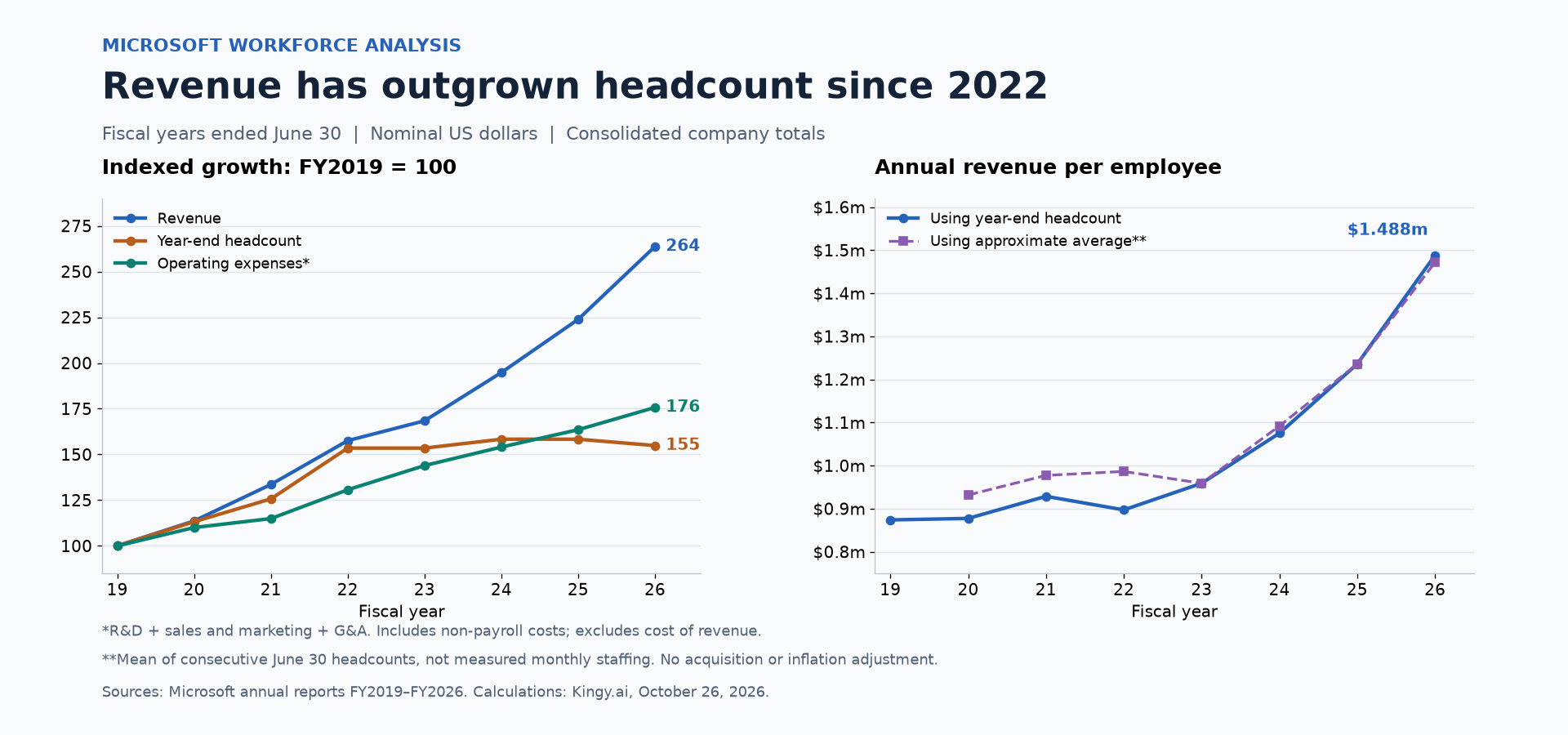
From fiscal 2022 to fiscal 2026, headcount increased 0.9%, revenue increased 67.4%, and revenue per year-end employee increased 65.9%. Those figures weaken a claim of continuing company-wide headcount expansion without corresponding economic output. They do not prove that every team was staffed efficiently.
The strongest case for a staffing correction concerns 2022–23
Microsoft added 40,000 employees in fiscal 2022, a 22.1% increase, while revenue grew 18%. The expansion included roughly 8,000 employees from its Nuance and Xandr acquisitions, according to GeekWire’s contemporaneous reporting. Treating the entire increase as new organic hiring would overstate the case.
In his January 2023 employee memo, Satya Nadella described customers reducing spending after the pandemic acceleration. Microsoft announced 10,000 job cuts while continuing to hire in selected areas. That is direct evidence of a demand-and-cost adjustment; it does not establish that AI had automated the eliminated roles.
The apparent 2022 productivity dip also depends on the denominator. Revenue divided by year-end headcount fell 3.4%. Using the mean of opening and closing headcount instead, the ratio rose about 0.9%, then fell about 2.8% in fiscal 2023. Late-year hires enter the year-end count even though they have not worked the full year. Both calculations are imperfect measures of labor productivity.
Costs and staffing composition tell a more selective story
R&D, sales and marketing, and general and administrative expenses together rose from $40.0 billion in fiscal 2019 to $70.2 billion in fiscal 2026. Their share of revenue nevertheless fell from 31.8% to 21.2%. Microsoft was spending more in absolute dollars while those operating expenses consumed less of each revenue dollar.
These are not payroll totals: they include advertising, legal costs, outside services, compute and other expenses. Costs of delivering products and services are reported separately. Nor are reported profits a pure productivity measure. Microsoft’s 2023 annual report says extending server and network equipment lives increased that year’s operating income by $3.7 billion.
| Function | FY2022 employees | FY2026 employees |
|---|---|---|
| Operations | 85,000 | 89,000 |
| Product research and development | 73,000 | 77,000 |
| Sales and marketing | 47,000 | 43,000 |
| General and administration | 16,000 | 14,000 |
Flat total headcount therefore conceals changes in the kind of work Microsoft employs people to do. It also conceals hiring and departures within each category. Activision Blizzard entered the consolidated business in October 2023, so this is not a comparison of an unchanged collection of businesses.
Our assessment is that pockets of overstaffing are plausible and a post-pandemic staffing correction is well supported. A precise company-wide surplus is not established. Higher revenue per employee can reflect prices, cloud capacity, acquisitions and outsourcing as well as better work processes or AI. Identifying actual AI replacement requires evidence that particular tasks moved from people to deployed systems, with output, quality and total costs measured afterwards.
Microsoft’s cash generation grew. Its infrastructure bill grew faster.
The clearest financial context comes from completed annual results, rather than guesses about the upcoming quarter. Microsoft’s fiscal 2026 ended on June 30, 2026.
| Measure | FY2025 | FY2026 |
|---|---|---|
| Revenue | $281.7 billion | $331.8 billion |
| Operating income | $128.5 billion | $155.2 billion |
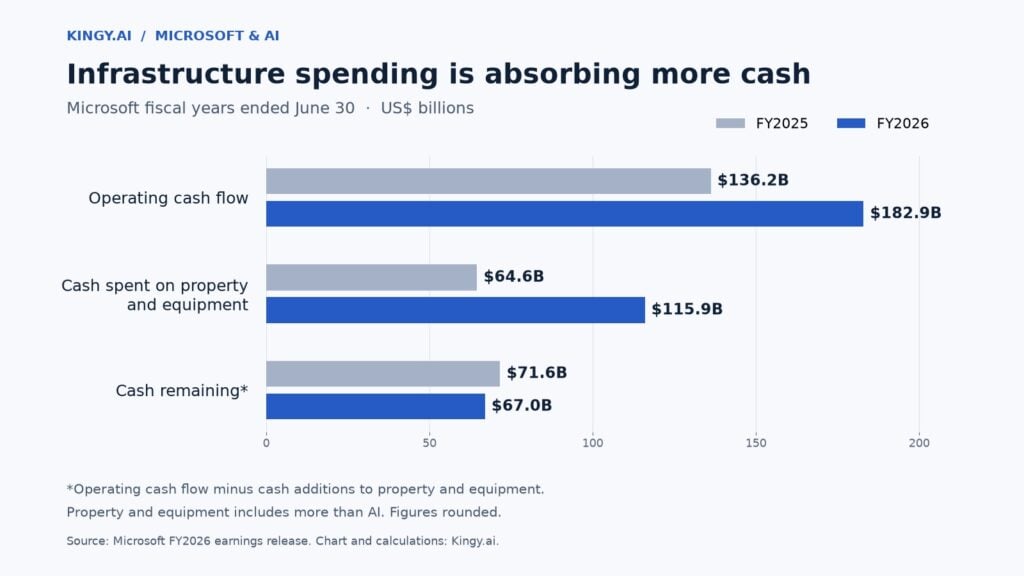
| Operating cash flow | $136.2 billion | $182.9 billion |
| Cash additions to property and equipment | $64.6 billion | $115.9 billion |
| Operating cash flow less cash additions to property and equipment | $71.6 billion | $67.0 billion |
Our calculation shows operating cash flow rising about 34%, while cash additions to property and equipment rose about 80%. The residual, commonly used as a free-cash-flow measure, fell approximately 6.5%.
This is the pressure that a revenue or profit headline can miss. A business can sell more, earn more and still have less cash left after investing in physical assets. That gives management a reason to scrutinize recurring expenses, including staffing, even when the business is successful.
Property and equipment spending covers more than AI. Microsoft does not disclose that entire cash-flow line as a standalone AI bill. It includes the infrastructure of a much broader business. Calling all $115.9 billion “AI spending” would overstate what the accounts establish.
Microsoft also reported $76.8 billion in cash, cash equivalents and short-term investments at June 30. These figures do not describe a company that has disclosed an immediate cash shortage. They describe consequential choices about how to deploy substantial financial resources.
The $175 billion compute story needs an accounting explanation
On its July earnings call, Microsoft reported $41 billion of quarterly capital expenditures, including finance leases. Roughly two-thirds went to shorter-lived assets, primarily CPUs and GPUs. It also said Azure demand exceeded available capacity.
Management put calendar-2026 capital expenditure expectations at approximately $175 billion. It explained that changing the estimated useful lives of data-center and office buildings would shift more future leases from finance to operating classification. The underlying investment expectations were unchanged.
These are different measures: fiscal-year cash purchases, quarterly capital expenditures including finance leases, and calendar-year guidance. Operating leases also create cash obligations, even though they are excluded from that reported capital expenditure measure. A classification change does not itself reduce the physical infrastructure Microsoft plans to use.
That is why the annual cash-flow comparison above is useful. It compares the same line over the same length of period. Adding the $175 billion outlook to the $115.9 billion historical figure would double-count overlapping periods and mix accounting definitions.
Could payroll savings help fund more compute?
Yes. Reducing a recurring cash expense can leave more internally generated cash available for investment, assuming other costs and business results do not offset the saving. Microsoft would not need to label a particular dollar “payroll savings” before spending it on infrastructure.
But a buyout initially costs money. Severance, benefits, transition expenses and the timing of departures can delay the cash benefit. Continued stock vesting also has an economic cost, although it is not equivalent to paying the same amount in cash immediately.
A credible estimate would need actual acceptances, departure dates, the compensation of those leaving, package terms, replacement hiring and contractor costs. Microsoft has not disclosed enough information about this offer to calculate that result.
There is also a distinction between cash flow and reported profit. Much employee compensation is expensed as employees work, while purchased infrastructure is generally capitalized and depreciated over time. Moving spending from payroll into equipment can change when expenses appear in the accounts. Buying servers still uses cash, and operating them creates continuing costs.
So the economically defensible answer is that buyout savings could help accommodate the compute expansion and other priorities. The claim that Microsoft launched this exact program to pay for a specific amount of additional compute remains an inference.
What hypothetical savings would look like
Consider a deliberately simple illustration. Assume annual avoidable cash compensation and benefits of $150,000 per departing employee. This is an invented scenario input, not an estimate of Microsoft’s average pay, and it will not represent every country or role.
| Assumed acceptance | Illustrative departures | Annual gross cash saving |
|---|---|---|
| 5% of 60,000 | 3,000 | $450 million |
| 10% of 60,000 | 6,000 | $900 million |
| 20% of 60,000 | 12,000 | $1.8 billion |
At the middle assumption, $900 million would be less than 1% of fiscal 2026’s cash additions to property and equipment. It is a material sum, but it would fund only a small fraction of spending on that scale.
If the same hypothetical 6,000 exits required $75,000 each in upfront cash costs, the initial outlay would be $450 million. With immediate departures and evenly accruing savings, simple payback would take six months. Actual payback could differ substantially, especially if departures are staggered or work has to be reassigned to new hires or contractors.
The exercise shows why eligibility cannot be multiplied by an assumed salary and reported as money Microsoft has already saved. Both sides of that calculation are unknown, and the costs arrive before the full recurring benefit.
More compute also means more than buying Nvidia GPUs
Microsoft’s own recent infrastructure announcement makes this especially relevant. On October 12, the company said it plans multi-gigawatt deployments of its Azure Maia family starting in 2027, with Maia becoming the primary inference system for Microsoft products and services. It says Maia 200 is already serving production workloads and Maia 300 deployments will begin in 2027.
Those are company statements and plans, not independent confirmation of every promised efficiency gain. They nevertheless show why reducing the discussion to “fewer salaries, more Nvidia chips” is too narrow.
Serving AI requires chips, memory, networking, buildings, cooling, electricity and people who can keep the systems running. It also requires choosing between owned assets and contracted capacity. More available cash can help with several of these, but money alone cannot eliminate every construction, power or supply bottleneck.
Inference is the computing used to run a model after training. For a widely used assistant, recurring inference costs matter every time customers ask it to work. Microsoft therefore has an incentive both to add capacity and to reduce the cost of serving each useful response. Better efficiency could support more usage; it does not automatically imply a smaller total budget.
AI productivity gains do not translate directly into job cuts
There is also company-specific evidence of claimed savings. Bloomberg reported in July 2025 that executive Judson Althoff told employees AI had saved Microsoft more than $500 million in its call centers during the preceding year. That is an attributed company claim, without a public breakdown separating reduced staffing, less outsourcing, avoided hiring and other savings. It is not a disclosed calculation of the effects of this buyout program.
There is credible evidence that AI can improve output in some settings. A study published in Management Science combined randomized field experiments involving 4,867 developers at Microsoft, Accenture and another large company. It found that access to an AI coding assistant increased completed tasks by about 26% on average.
The individual experiments were noisy and their results varied. They measured work output under particular conditions, not whether a company should eliminate 26% of engineering jobs or why Microsoft launched the October buyout program. Microsoft-affiliated researchers were among the authors, a relevant part of the study’s provenance.
Independent research also shows why results need their dates and settings. METR’s February 2026 update discusses its earlier finding that experienced open-source developers took longer with early-2025 AI tools. It says later tools likely helped more, but participant and task selection made the follow-up an unreliable measure of the size of that benefit.
Neither result should be turned into a universal claim about today’s employees. Saving time on code generation is different from maintaining secure software, deciding what to build, understanding customers or accepting responsibility for a production incident.
A company can use productivity improvements to ship more with the same team, avoid future hiring, reassign people or reduce staffing. Demand, quality requirements and management decisions determine which outcome follows. To attribute this particular offer to automation, we would need evidence about the work being removed and what replaces it.
The human and operational consequences still matter
A voluntary offer gives eligible employees a choice that an involuntary termination does not. It can suit someone who was already planning to leave. That does not tell us whether an individual employee feels secure, what alternatives they have or how easily they could find comparable work.
From Microsoft’s perspective, a broad offer also carries execution risk. People with valuable institutional knowledge may accept. Remaining teams may inherit work before processes have changed enough to absorb it. A lower payroll can coexist with slower delivery, extra contracting or lost customer knowledge.
Those are possible consequences, not reported outcomes of an offer announced today. They belong in the analysis because a gross salary saving is an incomplete measure of whether a restructuring succeeds.
The disclosures that would settle more of the question
Microsoft’s investor-relations calendar lists its next earnings release for October 28. Any new guidance should be read alongside the later results of the offer, whose decision window extends into December.
The most useful disclosures would be actual acceptance and departure counts; cash and accounting charges; expected recurring savings after replacement costs; changes in workforce composition; and updated infrastructure spending under consistent definitions.
Evidence of particular tasks being automated would strengthen the direct-replacement explanation. Evidence of explicit budget transfers or management linking savings to capacity would strengthen the compute-funding explanation. Higher AI spending and fewer employees, by themselves, establish coexistence rather than the full causal chain.
For now, AI investment provides a well-supported financial context for Microsoft’s effort to control costs and reshape its workforce. The public record does not disclose how much this offer will save, how many people will leave, or how much of any saving will ultimately reach its computing infrastructure.
The Kingy Brief
Get The Kingy Brief.
AI changes, original tests and one practical thing to try. Fridays at 09:00 Vancouver time.
Free · Double opt-in · Unsubscribe anytime
Sign up for The Kingy Brief on Beehiiv.
Signup help and newsletter schedule
Signup form provided by Beehiiv. After submitting, check your inbox for "Confirm your subscription to The Kingy Brief" and open its confirmation link. Check Spam or Promotions if you cannot find it.
Fridays at 09:00 Vancouver time: source-checked AI changes, original tests and one practical thing to try. We skip a week when there is not enough verified material. Free. Unsubscribe anytime.