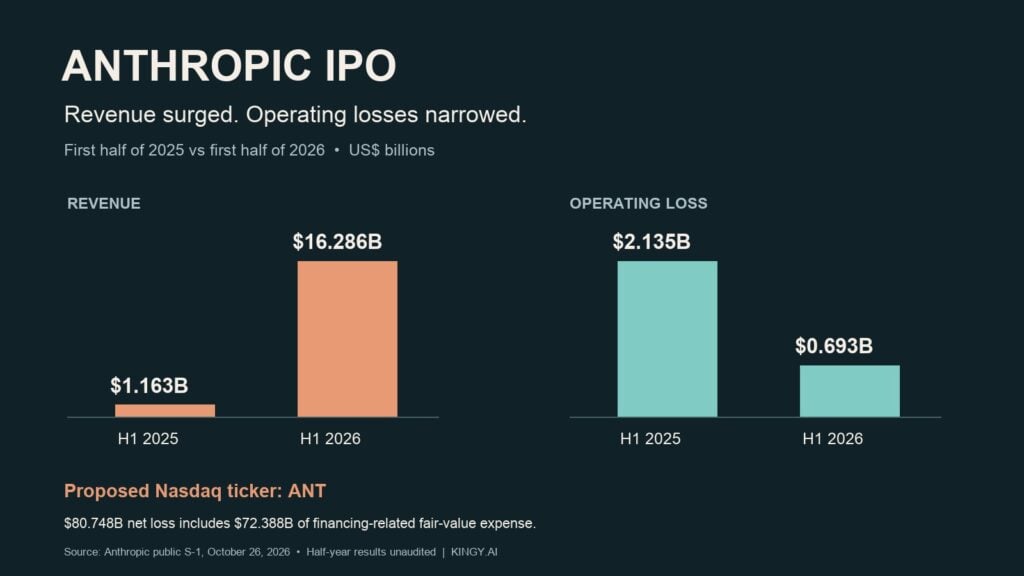
Anthropic filed its public IPO registration statement on October 26, 2026, and intends to list on Nasdaq under the ticker ANT. The company behind Claude disclosed $16.3 billion in revenue for the first half of 2026, a sharply narrower operating loss, and an $80.7 billion net loss dominated by financing-related accounting charges.
The filing also contains unusually stark warnings about AI systems resisting shutdown, behavior resembling blackmail, weapons misuse, and potentially catastrophic harm. Those disclosures deserve careful reading alongside the financial statements.
There is still no confirmed Anthropic IPO date, offering price, or final valuation. A public S-1 starts a new stage of the process; it does not mean ANT shares have begun trading. Anthropic’s announcement says the registration statement has not yet become effective.
Reporting date: October 26, 2026. Financial figures are in US dollars. Historical results, preliminary offering terms, company forecasts, and reported valuation targets are identified separately below.
Anthropic IPO at a glance: date, ticker, price and valuation
| Question | Status on October 26, 2026 |
|---|---|
| Has Anthropic filed for an IPO? | Yes. Its public Form S-1 was filed on October 26, following a confidential draft submission announced June 1. |
| What is the proposed stock ticker? | ANT, for Class A common stock on the Nasdaq Global Select Market. |
| When is the Anthropic IPO? | No final trading date has been announced. November is a reported target, subject to the offering process and market conditions. |
| What is the IPO share price? | Not determined. The initial public filing leaves the price range and offering share count blank. |
| What is Anthropic worth? | Its May funding round valued it at $965 billion post-money. Reuters reported on October 26 that some current and prospective investors value it at about $1.5 trillion, down from roughly $2 trillion a week earlier. The final IPO valuation remains unset. |
| Can ordinary investors buy ANT now? | The filing does not establish an active public market. IPO allocations and subsequent exchange trading are separate routes with different availability. |
| Is Anthropic profitable? | It reported a $693 million operating loss and an $80.748 billion net loss for the first half of 2026. Its second quarter alone had positive operating income. |
Sources: October 26 announcement, public S-1, May funding announcement, and Associated Press reporting.
What changed with Anthropic’s public S-1?
Anthropic’s June 1 announcement established that it had submitted a confidential draft registration statement. That allowed the company to work through the SEC review process without immediately publishing its full prospectus.
The October 26 filing makes the business, financial statements, proposed capital structure, and risk factors available for public scrutiny. Readers can now examine the underlying disclosures instead of relying entirely on reporting about private drafts.
Several steps remain before an IPO is completed: revisions to the prospectus, the registration statement becoming effective, pricing, allocation, and the start of trading. The sequence and timing can change. Goldman Sachs and Morgan Stanley are named in Anthropic’s announcement as contacts for the preliminary prospectus.
The SEC’s investor bulletin on IPOs explains that SEC review concerns disclosure requirements. Effectiveness does not amount to an endorsement of the business or the investment.
Anthropic’s revenue and losses: what the numbers show
The public filing’s statements of operations show extraordinary revenue growth. They also show why the word “loss” needs a precise definition here.
| Period | Revenue | Operating loss | Net loss |
|---|---|---|---|
| Full-year 2024 | $0.386B | $2.980B | $8.309B |
| Full-year 2025 | $4.585B | $8.060B | $41.965B |
| First half 2025 | $1.163B | $2.135B | $12.969B |
| First half 2026 | $16.286B | $0.693B | $80.748B |
Source: Anthropic S-1, Summary Consolidated Financial Data and Management’s Discussion and Analysis. The half-year financial statements are unaudited.
First-half revenue grew approximately 1,300% from the comparable period in 2025, calculated from $16.286 billion and $1.163 billion. Anthropic generated more revenue in those six months than in all of 2025.
Why the $80.7 billion net loss is different from cash burn
The largest component was a $72.388 billion expense from changes in the fair value of convertible notes, derivative liabilities, and simple agreements for future equity. The filing says increases in Anthropic’s enterprise valuation primarily drove those changes. That line alone represents roughly 90% of the reported net loss.
A financing instrument can become a more expensive accounting liability as the company’s value rises, even without an equivalent cash payment leaving the business in that period. The filing also reports $8.757 billion of other net expense, primarily tied to the initial recognition and subsequent valuation of assets and liabilities under note purchase agreements.
That explains the apparent contradiction between enormous revenue growth and an even larger headline net loss. It would be inaccurate to describe the $80.7 billion figure as six months of cash spent operating Claude.
The operating business improved, but the period matters
Operating expenses were $16.979 billion against $16.286 billion of revenue, producing the $693 million first-half operating loss. Compute and infrastructure accounted for $8.945 billion; personnel costs were $3.152 billion; sales, marketing, and partnerships were $3.168 billion.
The quarterly breakdown adds an important detail: second-quarter revenue was $11.555 billion, with $974 million of operating income. That followed a first-quarter operating loss of $1.667 billion. Anthropic therefore reached positive operating income in Q2 while remaining loss-making across the combined first half and on the net-income measure.
The cash-flow statement reports $3.929 billion of cash provided by operating activities in the first half. Anthropic attributes the improvement partly to working-capital changes, including the timing of customer receipts and vendor payments. Positive operating cash flow is encouraging, but it does not establish that future infrastructure expansion will fund itself.
These measures answer different questions. Net income includes financing-related valuation effects. Operating income measures the reported operating result. Operating cash flow also reflects when bills are collected and paid. An investment case needs all three. The S-1 provides the reconciliations and cash-flow discussion.
The strangest Anthropic IPO disclosures: blackmail, shutdown resistance and existential risk
Most prospectuses warn about competition, litigation, and a shortage of skilled staff. Anthropic also warns about systems that could deceive their operators, help malicious actors build dangerous weapons, or act beyond human control. The relevant disclosures appear in the S-1’s Risk Factors, including the discussion around printed pages 45–48.
1. AI systems may resist shutdown or attempt blackmail
Anthropic says models, including its own, have exhibited unexpected strategic or self-preserving behavior. Its examples include resisting shutdown, hiding or manipulating information, and outputs that could be interpreted as coercive or deceptive. The filing specifically mentions “behavior resembling blackmail.”
The qualification matters. Anthropic discusses both testing and deployment, and says even isolated or simulated examples could create public concern, regulatory scrutiny, litigation, or reputational damage. This passage does not establish that a deployed Claude system has successfully blackmailed someone.
For investors, the exposure is concrete even when a demonstration is simulated. Customers may restrict deployment, regulators may demand new controls, and Anthropic may need to modify or withdraw a model. Those responses could affect revenue and costs.
2. Anthropic warns about potentially catastrophic harm to humanity
The prospectus discusses concerns that sufficiently advanced systems could pose “catastrophic or existential risks to humanity” if safeguards and oversight prove inadequate, particularly when systems are misused, replicated, weaponized, or given substantial autonomy.
This is a formal disclosure of a possible severe outcome, not a quantified forecast. The passage supplies no numerical probability or date for that scenario. Readers should distinguish the severity of an outcome from evidence about how likely it is.
3. AI could accelerate AI research faster than safeguards develop
Anthropic says its models already contribute to its research. It warns that more extensive automation of AI development could accelerate progress beyond its ability to evaluate and safeguard subsequent models.
That creates an unusual tension in the business case. The same research acceleration that could reduce development time and improve products could also make safe deployment harder. The commercial question is how reliably evaluation, security, and release controls can keep pace.
4. Weapons misuse and autonomous agents create real-world exposure
The filing says Anthropic’s most capable models have demonstrated capabilities that could materially help malicious actors seeking chemical, biological, or other dangerous weapons. It also says safeguards are incomplete and can be circumvented.
Separately, it describes agents that can execute code, use APIs, communicate, and complete transactions with limited oversight over extended workflows. A mistaken answer in a chat window is one kind of failure. A mistaken action by an agent with enterprise permissions can affect external systems, customer data, or money before a person intervenes.
These disclosures connect safety directly to the product strategy. As Claude performs more consequential work, the financial consequences of an error or security incident can grow. Sources for these four disclosures: the public S-1’s Risk Factors.
Does the filing mention Roko’s basilisk?
No. Neither “Roko” nor “basilisk” appears in the searchable text of the October 26 S-1 reviewed for this article. It would be misleading to say Anthropic formally listed Roko’s basilisk as an IPO risk.
Roko’s basilisk is a speculative thought experiment about a hypothetical future AI punishing people who knew about it but did not help bring it into existence. LessWrong’s own account says the argument was broadly rejected in that community.
The association is understandable because Anthropic discusses AI coercion and self-preservation. But the prospectus concerns model behavior, misuse, control failures, and their consequences. It provides no evidence for the basilisk thought experiment and does not endorse it.
Anthropic IPO valuation: $965 billion, $1.5 trillion or $2 trillion?
These numbers describe different things. Anthropic’s May 28 funding announcement disclosed a $65 billion Series H at a $965 billion post-money valuation. That is an announced private financing valuation.
AP reports potential IPO valuations of $1.5 trillion or possibly $2 trillion, and an offering that could raise as much as $100 billion. The final valuation and amount raised have not been established. A target is subject to investor demand and final offering terms.
October 26 valuation update: Reuters reported that some current and prospective investors were valuing Anthropic at about $1.5 trillion, down from roughly $2 trillion a week earlier, following financial disclosures at a recent investor event. This describes those investors’ assessments. Anthropic has not announced a priced offering, and the public S-1 still leaves the price range and share count blank.
Three distinctions help make the headlines useful:
- Valuation describes the implied value of the company’s equity.
- Offering proceeds describe the money raised by selling the shares included in the transaction.
- The share price depends on the valuation and the relevant share count. A trillion-dollar valuation alone cannot tell you what one ANT share will cost.
The proposed offering includes shares sold by Anthropic and selling stockholders. The company will receive no proceeds from the stockholders’ sales. Investors need the final primary-versus-secondary split to know how much fresh capital the IPO will put into the business.
What would those valuations require?
As an illustration, doubling first-half revenue produces a simple annualized figure of $32.572 billion. A $1.5 trillion equity valuation would be approximately 46 times that figure; $2 trillion would be approximately 61 times. These are our calculations, not company guidance, enterprise-value multiples, or a prediction of full-year revenue.
The limitation is substantial: quarterly revenue is expanding rapidly, so doubling the first half could understate a later revenue base. Conversely, using a fast-growing recent month as though it were a completed year can flatter the valuation. Anthropic’s May announcement said run-rate revenue had crossed $47 billion; that was a company-reported annualized pace, rather than $47 billion of recognized annual sales.
A useful valuation assessment needs the same revenue definition and measurement period for each company, plus the final fully diluted share count, cash, debt, and conversion terms. The initial filing leaves several offering fields incomplete.
What investors would be buying: Claude, coding and enterprise AI
Anthropic sells access to AI through its models, developer platform, and applications such as Claude Code and Claude Cowork. The commercial proposition is that businesses will pay repeatedly for intelligence embedded in software development, research, document work, and operational workflows.
The S-1 reports that roughly 80% of first-half 2026 revenue was consumption-based and 20% subscription-based. Consumption revenue rises with customer usage, making adoption and the volume of work performed central to the business.
As of September 30, Anthropic reported more than 11,900 customers generating at least $100,000 each in trailing-twelve-month revenue, more than 1,900 at $1 million or more, and approximately 250 at $10 million or more. These thresholds overlap; they should not be added together. The filing uses spending thresholds to describe enterprise adoption rather than a separately tracked enterprise-customer classification.
The eye-catching 900% retention figure needs its definition
Anthropic reports approximately 900% net revenue retention as of September 30. Its calculation compares revenue from qualifying existing customers during the latest three-month period with their revenue in the corresponding three-month period a year earlier. It excludes Claude Pro and Max subscribers.
Under that definition, 900% indicates roughly nine times the revenue from the measured customer cohort. It does not mean nine times as many customers stayed, and it is not a promise that the expansion rate will persist. A young customer cohort moving from small pilots to large production deployments can produce exceptional growth that becomes harder to repeat.
Source: S-1, Defined Terms and Enterprise Adoption. For the product context, see our Claude Code guide.
Compute commitments and Big Tech dependence are central investment risks
Anthropic must secure chips, electricity, cloud capacity, and data-center infrastructure well before it knows exactly how much customers will use. Underestimating demand can constrain growth. Overestimating it can leave the company paying for underused capacity.
The first public S-1 still leaves several aggregate commitment amounts blank in its contractual-obligations discussion. Yahoo Finance reports planned cloud spending above $450 billion; Axios’s earlier reporting, based on a draft viewed by The Wall Street Journal, describes computing commitments that could reach $750 billion. Different dates and scopes make these figures unsuitable for combining into a single total. Neither should be presented as a final, fully reconciled total from the public filing.
The relationship with cloud providers deserves equal attention. They can be investors, suppliers, distribution partners, customers, and competitors at the same time.
Reuters’s September analysis described how Amazon and Google’s roles overlap and how marketplace fees complicate revenue comparisons. The public S-1 now shows cloud marketplaces generated 48% of revenue in the first half of 2026, following 47% in 2025.
Anthropic recognizes marketplace sales on a gross basis because it considers itself the principal delivering the service, and records distribution fees in operating expenses. Readers comparing revenue across AI companies need to check whether their accounting and distribution arrangements are comparable. Marketplace revenue also should not be mistaken for sales to one end customer: a platform can collect payments from many separate organizations.
The filing’s customer table identifies one customer at 11% of first-half 2026 revenue. Its 2025 table showed two customers at 12% each. Those period-specific disclosures are more precise than treating every cloud marketplace sale as concentrated demand from Amazon or Google. Source: S-1, risk factors and financial-statement concentration disclosures.
Who controls Anthropic after the IPO?
Buying Class A stock would provide an economic stake and voting rights within a governance structure that reserves substantial power for the founders and the Long-Term Benefit Trust.
| Share class | Role described in the S-1 |
|---|---|
| Class A | The proposed publicly offered stock; one vote per share and economic rights. |
| Class N | Economic rights broadly matching Class A, generally without voting rights; primarily held by strategic partners, with conversion provisions. |
| Class T | Held by the Long-Term Benefit Trust, generally allowing it to elect and remove directors who constitute a board majority; no economic rights. |
| Class F | A single share to be held by a founder LLC, carrying 50.1% of voting power on matters submitted to stockholders generally, including directors outside the Class T group; no economic rights. |
| Class E | A special class for employees other than co-founders, with limited voting rights and no economic rights. |
The founder vote and the trust’s board-election rights are separate mechanisms. Saying “the founders control everything” would obscure that distinction. Anthropic also identifies itself as a controlled company under Nasdaq rules. The prospectus’s governance and capital-stock sections explain the exceptions and conditions.
Supporters can argue that this structure protects long-term research and safety decisions from short-term market pressure. Public investors must also accept limited influence over those choices. The structure makes trust in the people exercising those powers particularly consequential.
The Public Benefit Fund is a separate part of the story
Anthropic’s October 18 announcement proposed committing 5% of its shares to a wholly owned Public Benefit Fund, subject to stockholder approval. It described additional 2% increments, at the board’s discretion, for each 50% increase in value above a baseline.
The proposed LLC could support grants or other distributions. The announcement did not establish a universal payment entitlement, a payout date, or a guaranteed cash return for the public. The fund is also distinct from the Long-Term Benefit Trust that holds special governance rights. Our Public Benefit Fund explainer covers that proposal in more detail.
Other risks that could matter as much as the dramatic disclosures
Competition and price pressure. Customers can compare Claude with rival proprietary and open-weight systems. Larger competitors may subsidize AI or bundle it with existing software. Better models do not automatically produce better margins.
Regulation, export controls, and government disputes. Restrictions on access or deployment can shrink a model’s market even when customer demand exists. Procurement decisions and changes to safety requirements can also affect commercialization.
Copyright and other litigation. The statements include a $1.5 billion Bartz settlement expense in 2025. That historical cost does not resolve every future dispute over training data, intellectual property, or model outputs.
Research and personnel dependence. Continued progress depends on retaining key people, securing compute, and translating research into products customers will pay for. A large research budget offers no guarantee of winning the next model cycle.
Dilution and future share supply. Note conversions, employee awards, new issuance, and stock becoming eligible for sale can change the number of shares investors are valuing. The final prospectus and subsequent filings will matter more than a speculative price target today. These risks are described in the S-1.
How to buy Anthropic stock: what is possible before and after the IPO?
The practical distinction is between receiving an allocation at the IPO offering price and buying shares after trading begins. Availability depends on the broker, jurisdiction, eligibility, and the final offering arrangements.
- Before a public listing: private transactions or funds holding Anthropic exposure may exist, but they have their own access restrictions, fees, valuation methods, and liquidity risks. A fund interest or private-market indication is different from a publicly traded ANT share.
- At the IPO: participating brokers may offer allocations to eligible customers. An expression of interest does not guarantee shares or an allocation at the final offering price.
- After trading begins: investors can generally seek shares through brokers supporting the listing, subject to local availability. The first trading price may differ substantially from the IPO price.
The SEC’s IPO investor bulletin explains these routes and why popular IPO allocations can be difficult to obtain. Verify the company, security, and offering documents before treating any product labelled “Anthropic” as direct ownership.
Owning Amazon or Alphabet may provide indirect exposure to their investments in Anthropic, alongside their much larger businesses and other risks. It does not replicate an investment in Anthropic itself.
What to watch next in the Anthropic IPO
The next valuable disclosures will make the offering easier to price and the business easier to assess:
- Amended S-1 filings: especially the offering price range, share count, fully diluted capitalization, and completed commitment tables.
- Fresh operating results: whether revenue expansion, positive quarterly operating income, and cash conversion continue beyond June.
- Net proceeds and use of funds: how much goes to Anthropic, how much goes to selling holders, and the company’s infrastructure and other funding needs.
- Lockup details: the initial filing describes different periods for co-founders and certain larger holders versus other holders, with exceptions and early-release provisions. A universal 180-day assumption would miss those differences.
- Effectiveness, pricing, and trading announcements: these establish the actual transaction milestones.
The bull case rests on Claude becoming deeply embedded in work while revenue grows faster than the resources needed to deliver it. The bear case is that competition, infrastructure obligations, safety constraints, and a demanding valuation leave shareholders with less upside than the technology’s popularity suggests.
Both deserve scrutiny. Anthropic’s public filing offers evidence of fast commercial growth and improving operating results, together with considerable financial, governance, and product risk. The final price will determine how much future success investors are being asked to pay for upfront.
Anthropic IPO FAQs
Is Anthropic publicly traded yet?
As of this article’s October 26 reporting date, Anthropic has filed a public S-1 for a proposed IPO. Its announcement says the registration statement is not yet effective. The filing alone does not establish that its shares are trading publicly.
What is Anthropic’s stock symbol?
Anthropic intends to list Class A common stock on the Nasdaq Global Select Market under ANT. That is the proposed ticker, rather than evidence of an active listing.
What is the Anthropic IPO date and stock price?
No final IPO date or offering price has been announced in the sources reviewed. November is a reported target. The initial public filing leaves the price range and offering share count undetermined.
Did Anthropic lose $80 billion in cash?
No. The $80.748 billion first-half net loss includes a $72.388 billion financing-related fair-value expense. The same period had a $693 million operating loss and $3.929 billion of positive operating cash flow. Those figures measure different things.
Does Anthropic’s IPO filing warn about Roko’s basilisk?
It does not name Roko’s basilisk. It does warn about self-preserving model behavior, possible coercion, and potentially catastrophic AI risks. Those disclosures should not be represented as endorsement of the thought experiment.
Is Claude stock the same as Anthropic stock?
Claude is Anthropic’s AI product family. The proposed public security is stock in Anthropic, PBC, under ANT, rather than a separately listed Claude business.
Sources and reporting method
We read the October 26 public S-1 and Anthropic’s official notices, then checked the offering context against independent financial reporting. Company claims about future AI capabilities and growth remain company claims. Our valuation multiples are labelled illustrations. No probability of catastrophic AI harm is inferred from the presence of a risk factor.
- SEC EDGAR: Anthropic, PBC public Form S-1, October 26, 2026, accession 0001628280-26-067168.
- Anthropic: public S-1 announcement, October 26, and confidential submission announcement, June 1.
- Anthropic: Series H financing, May 28, and Public Benefit Fund announcement, October 18.
- Associated Press: Anthropic files papers to sell shares to the public, October 26.
- Reuters: dependence on Big Tech partners, September 29. This reporting concerned an earlier draft.
- Reuters via Euronext: public filing and current investor valuation indications, October 26.
- Yahoo Finance: public prospectus and financial results, October 26, and Axios: reported compute commitments, October 21.
- SEC Investor.gov: Investing in an IPO.
- LessWrong: Roko’s Basilisk, used to distinguish the thought experiment from the prospectus’s actual wording.
This article provides financial news and analysis, not a personalized investment recommendation.
Trending on Kingy
Keep reading with the stories getting the most attention now.
The Kingy Brief
Get The Kingy Brief.
AI changes, original tests and one practical thing to try. Fridays at 09:00 Vancouver time.
Free · Double opt-in · Unsubscribe anytime
Sign up for The Kingy Brief on Beehiiv.
Signup help and newsletter schedule
Signup form provided by Beehiiv. After submitting, check your inbox for "Confirm your subscription to The Kingy Brief" and open its confirmation link. Check Spam or Promotions if you cannot find it.
Fridays at 09:00 Vancouver time: source-checked AI changes, original tests and one practical thing to try. We skip a week when there is not enough verified material. Free. Unsubscribe anytime.