Roblox Is Adding More Bricks to Its AI Toolbox
Roblox wants to make game development feel less like assembling a spacecraft and more like describing a wild idea to an unusually capable assistant.
At the 2026 Roblox Developers Conference, the company unveiled an expanded collection of artificial-intelligence tools for creators. The announcements included a broader rollout of Build, a forthcoming Scene Generator, additional controls for AI-assisted creation, and non-player characters that can help playtest games.
That last one deserves a moment. Instead of asking a friend to repeatedly run into the same virtual wall, creators could eventually send an AI-controlled character to do the bumping for them. Progress!
Roblox presented the technology as part of a wider effort to lower the barriers surrounding game development. Its goal is not simply to help experienced developers work faster. The company also wants players who have never opened Roblox Studio—or written a single line of code—to turn an idea into something playable.
The strategy has already produced measurable results. According to Roblox, creators used Build to publish approximately 9,000 games during its initial alpha period in New Zealand. Even more strikingly, 71% of the people who created a game with the tool had never previously used Roblox Studio.
Those figures come from company data through September 1, so they are early results rather than a final verdict. Still, they suggest that prompt-based creation can attract an entirely new class of builders.
Build Starts With a Prompt, Not a Programming Lesson
Roblox first announced Build in July as a mobile-first creation feature inside its main app.
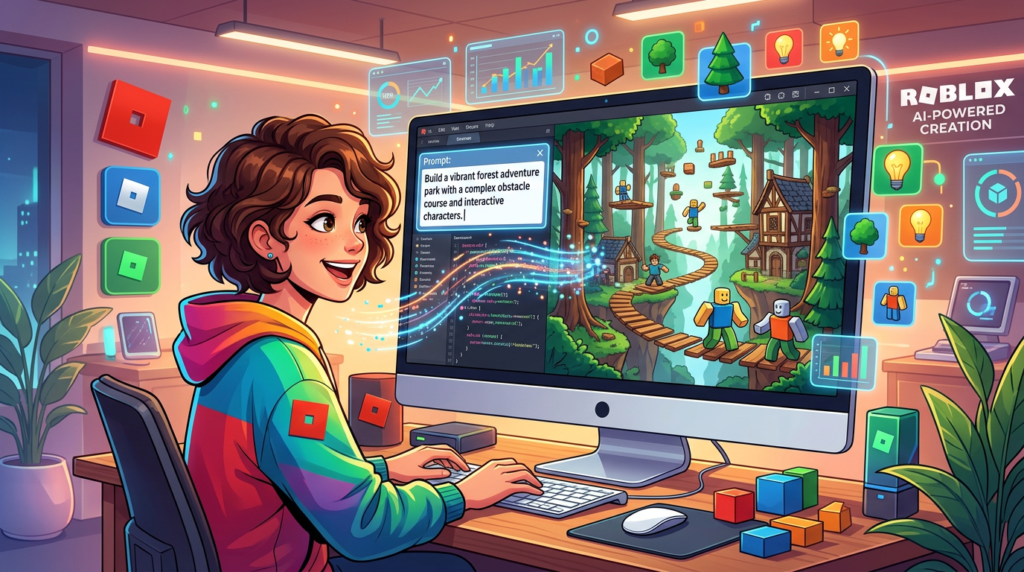
The pitch sounds wonderfully straightforward. A user describes a game in ordinary language, and Build creates a basic playable starting point. Someone might request a cozy forest adventure with environmental obstacles. The system then generates the foundations, including parts of the environment, characters, visual style, gameplay mechanics, and sound.
It does not instantly produce the next award-winning blockbuster. No prompt can manufacture brilliant game design on command—at least, not yet. Instead, Build gives creators something they can test, change, share, and develop further.
That distinction matters. A blank project can feel intimidating. A rough but playable prototype creates momentum.
Roblox says Build uses a combination of open-source systems and proprietary models trained with gaming-specific and 3D data. The platform also connects Build with the more advanced Roblox Studio environment through shared back-end systems, models, and chat history.
In practice, that means creators can begin an idea on a phone and continue refining it in Studio. Experienced developers still get their deeper controls. Newcomers get a friendlier entrance.
Build therefore operates less like a magic “make game” button and more like an unusually energetic junior collaborator. It can lay the first bricks. The human still decides whether they become a cottage, a castle, or a competitive obby filled with suspiciously placed lava.
The Alpha Is Moving Beyond New Zealand
Build began its public-alpha journey in New Zealand, where Roblox limited access while it tested the system and collected feedback. The company is now expanding the alpha to Serbia and Singapore.
That remains a controlled rollout. Build is not suddenly available to every Roblox user worldwide. Availability and features can also vary according to a user’s age and region.
However, Roblox is increasing the ways creators can use the system. The updated version adds desktop access, providing more screen space for people who prefer building at a computer. It also introduces a new asset library and greater iterative control.
Iterative control may sound like a phrase invented during a particularly caffeinated product meeting, but the concept is simple. Creators can ask the system to modify what it generated rather than accepting the first result.
Maybe the forest feels too gloomy. Brighten it. Perhaps the obstacle course needs a river, a bridge, and one extremely judgmental duck. Add them. The creative process becomes a conversation instead of a one-shot request.
Roblox also gave attendees at its developer conference access to Build. That move could provide the company with feedback from people who already understand game design, scripting, performance, and player behavior.
New creators can test accessibility. Veteran developers can test depth. Roblox needs both groups if it wants Build to become more than an entertaining prototype generator.
Scene Generator Could Tackle the Empty-World Problem
Build was only one piece of the announcement. Roblox also previewed Scene Generator, an AI tool expected to arrive later in 2026.
Scene Generator will allow creators to provide a text prompt and a reference image. The system will then attempt to generate a functional game layout that developers can refine in Roblox Studio.
That is a bigger challenge than producing a decorative picture.
A game environment must work as a space. Floors need to support characters. Doorways should lead somewhere. Objects require sensible positions. Paths need enough room for movement. A magnificent fantasy tower loses some magic when every player becomes permanently trapped in its staircase.
Roblox says the tool will generate editable and playable scenes, not merely static visual backgrounds. Studio will provide creators with more detailed control over those results.
The reference-image component could prove especially useful. A developer might show the system a sketch, a painting, or a piece of concept art and describe the atmosphere they want. Scene Generator could then translate that visual direction into a starting environment.
However, Roblox has not yet released the final version. The company says product features and appearances may change. Its current demonstration establishes the intended direction, not a promise that every generated scene will arrive perfectly optimized and ready for millions of players.
For creators, the practical value will depend on reliability. A fast draft saves time. A beautiful maze of broken geometry merely creates a new kind of homework.
AI Characters May Become the First Players
One of the more intriguing additions involves non-player characters, commonly known as NPCs.
According to Reuters and TechCrunch, Roblox plans to introduce NPC capabilities that can help playtest games. The company expects these features later this year.
Playtesting eats time, but creators cannot safely skip it. A new level may contain unreachable areas, broken objectives, confusing directions, or difficulty spikes sharp enough to launch a controller into low orbit.
AI-controlled NPCs could repeatedly move through an experience and expose some of those problems before real players encounter them. They might test routes, interact with game systems, or reveal situations that a busy developer overlooked.
Roblox had previously described a broader playtesting agent designed to surface bugs before launch. It also outlined plans for an analytics agent that could answer questions about game performance in plain language and an experiment agent that could suggest tests involving engagement, retention, or monetization.
The company has not fully detailed how the new NPC playtesters will behave or which problems they will reliably detect. Human testing will therefore remain essential. People notice emotional pacing, social dynamics, humor, frustration, and that peculiar sensation known as “this level just isn’t fun.”
AI testers could handle repetition. Humans can protect the soul of the experience.
Roblox Is Building an AI Creation Layer
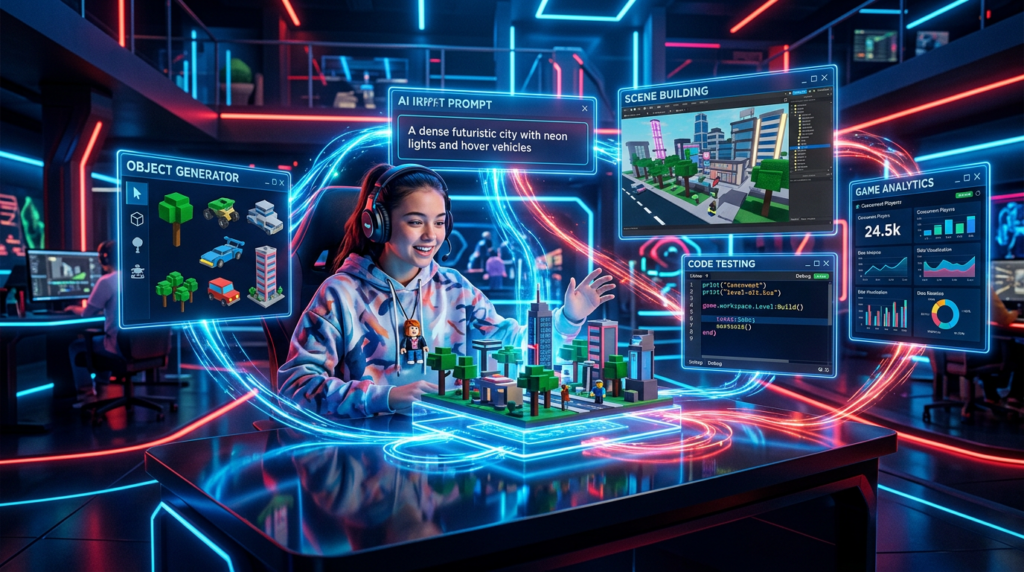
Roblox does not describe these features as a collection of unrelated shortcuts. It says it is constructing an “AI creation layer” on top of what it calls a cloud operating system for gaming.
That sounds grand. Yet the underlying logic makes sense.
Roblox already provides a game engine, hosting infrastructure, multiplayer systems, publishing tools, discovery mechanisms, virtual items, and monetization. Adding AI across that stack could connect tasks that currently require separate tools or specialist knowledge.
A creator could start with a prompt in Build. Scene Generator could establish the world. AI systems could help create functional objects. A playtesting agent might locate bugs. An analytics agent could later explain how players interact with the finished game.
The workflow matters more than any individual model.
Roblox also has Cube, its foundation model for 3D creation. The company says Cube can convert prompts into game-ready objects, including props and more functional items such as vehicles or weapons. Its procedural models let developers adjust parameters to reshape generated 3D assets without rebuilding them from scratch.
Taken together, the tools reveal Roblox’s larger ambition. It wants AI to assist throughout production, not merely generate a shiny object that looks impressive in a demonstration.
Still, integration will decide whether that ambition works. Creators need consistent assets, editable outputs, predictable behavior, and tools that fit their existing process. A spectacular demo earns applause. A dependable workflow earns daily use.
The Biggest Early Result Is Who Started Creating
The approximately 9,000 games published through Build offer one useful measurement. The more revealing figure may be that 71% of its early creators had never used Roblox Studio.
Roblox Studio is available without an upfront purchase, but game development still demands time and learning. Users must understand interfaces, objects, logic, testing, and possibly scripting. For a curious player with one small idea, that first step can feel enormous.
Natural-language creation reduces the psychological barrier.
Someone does not need to begin by asking, “Which programming language should I learn?” They can begin with, “What if players ran a bakery on the moon?”
That does not eliminate the value of technical skills. As projects become more ambitious, creators will still benefit from learning design principles, code, performance optimization, animation, sound, and production management. AI may move the starting line, but it does not remove the rest of the track.
The positive possibility is a wider creative funnel. More people can experiment. Some will publish a tiny game for friends. Others may discover that they genuinely love development and move into Roblox Studio for deeper work.
The less glamorous possibility is a flood of repetitive, low-effort projects. Roblox has acknowledged that concern. When it introduced Build, the company said its discovery systems would continue rewarding retention and player engagement.
In other words, generating a game may become easier. Getting anyone to care about it remains delightfully difficult.
Roblox Says AI Slop Will Not Rule Discovery
Every platform that introduces generative tools eventually meets the same uninvited guest: enormous quantities of forgettable content.
Roblox addressed that problem directly in July. The company said its retention-based discovery systems would not automatically promote a game simply because someone generated and published it. Build-created experiences enter the same candidate pool and face the same ranking process as other Roblox games.
The blunt version: if people do not play a game, Roblox says they will not keep finding it.
That approach creates a useful pressure valve. AI can lower production barriers without guaranteeing distribution. Creators must still make something that captures attention and keeps players involved.
Of course, recommendation systems are never perfect. Low-quality experiences can still appear, and popular formats can inspire waves of near-identical projects. Roblox will need to monitor whether easier generation overwhelms search results or makes original work harder to discover.
The company is also adjusting discovery according to audience behavior. Its system increasingly distinguishes between shorter experiences that may appeal to younger users and deeper games that older players return to over longer periods. Roblox says it now looks beyond a game’s first week and evaluates performance across 28 days and beyond.
That longer view could help creators whose projects build audiences gradually. It could also discourage quick prompt-and-publish tactics if those games cannot sustain interest.
AI can manufacture volume. It cannot guarantee staying power. Players remain the final—and often brutally honest—quality filter.
Creation Is Expanding Beyond Traditional 3D Worlds
Roblox’s conference announcements stretched beyond generative AI. The company also introduced engine improvements aimed at creators who want to build 2D games, puzzle titles, and asynchronous experiences.
New features include an orthographic camera, animated image containers, and direct sprite-sheet importing. Roblox also plans interface improvements involving blur, gradients, and text shadows.
These additions may sound small beside an AI system that produces entire scenes. Yet creators often build great games from humble ingredients. A cleaner camera setup or easier animation import can save hours without attracting a single dramatic headline.
Roblox also plans broader support for turn-based, asynchronous multiplayer games. A notification system will tell players when it is their turn. The feature is scheduled to enter Studio Beta in October, followed by a full release before the end of 2026.
This broader toolset complements the AI strategy. Prompt-driven creation can attract newcomers, while stronger engine capabilities give committed developers more places to take their ideas.
It also diversifies what a “Roblox game” can look like. The platform built its reputation around shared 3D worlds. Now it wants to support quick puzzles, offline adventures, turn-based games, and other formats that do not fit the familiar Roblox mold.
That variety could help AI-assisted creation avoid becoming visually predictable. If creators have more formats, cameras, interfaces, and artistic options, they can push generated starting points in more distinctive directions.
The tool creates the draft. Taste still creates the identity.
Roblox Games Are Preparing to Leave the Roblox App
The most consequential announcement may not involve AI directly. Roblox plans to let creators offer their games as standalone applications across mobile devices, PCs, and consoles.
Roblox would continue powering the underlying technology and services. Players, however, would not necessarily need to enter through the traditional Roblox app.
The company calls this broader vision Roblox Everywhere. It intends to test the model with selected developers and distribution partners, so the precise mechanics remain under development.
Roblox also expects Chrome users to join games from an Experience Details Page by the end of 2026 without installing an app. Support for additional browsers should follow. A player could click a link in a search result, social post, email, or YouTube description and begin playing.
That could shorten the distance between discovery and gameplay. Every additional download screen creates a chance for someone to wander away, watch three unrelated videos, and forget why they clicked in the first place.
Creators will eventually gain another option: offline solo play. Roblox says early access is coming soon, with offline functionality expected by the middle of 2027. Developers will be able to combine solo offline modes with live multiplayer features in the same game.
AI may make experiences easier to build. Wider distribution could make them much easier to reach.
Easier Creation Only Matters If Creators Can Grow
Roblox paired its development announcements with new tools for discovery and creator earnings.
The company says creators have earned more than $5 billion through its Developer Exchange program since 2013. Approximately $1.7 billion of that total arrived during the 12 months ending June 30, 2026.
Roblox now plans to introduce Roblox Wallet for eligible independent creators in the United States who are at least 18 years old. Wallet users will receive cleared earnings in real currency every business day and can transfer funds to external bank accounts. Airwallex will provide the U.S. payment services.
A Roblox Card is planned for 2027. It will connect to the wallet and allow eligible creators to spend their available balance wherever the card is accepted.
These financial products are separate from the AI tools, but they complete the same strategic picture. Roblox wants more people to build, more players to find their work, and successful creators to operate increasingly sophisticated businesses.
The scale already exists. Roblox founder and CEO David Baszucki said players spent 29 billion hours on the platform during the company’s most recent quarter, spanning more than 180 countries.
For a creator, however, a gigantic platform does not guarantee a gigantic audience. Competition remains fierce. AI could increase it further by accelerating the production of new games.
The opportunity is real. So is the noise. Creators will need better ideas, sharper execution, and perhaps a very charming virtual duck.
AI Can Open the Door, but Humans Still Make the Game
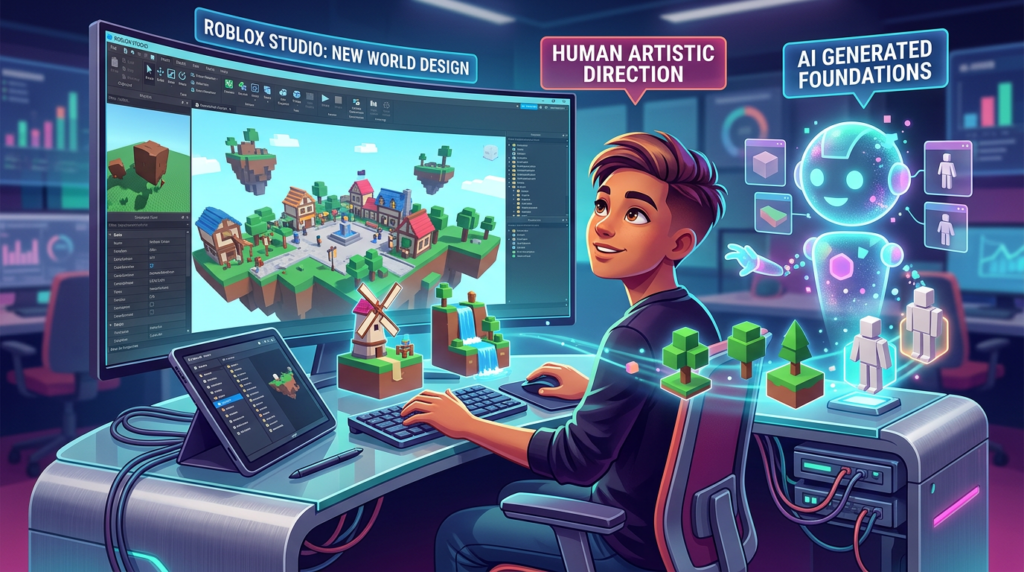
Roblox’s latest tools carry a genuinely positive promise. They could let more people experiment with game development, shorten the journey from concept to prototype, and free experienced developers from repetitive tasks.
Build already appears to be reaching people who never used Roblox Studio. Scene Generator could make environment creation faster. AI playtesters may catch bugs earlier. Analytics and experimentation agents could help smaller teams make better-informed decisions.
Yet the announcement does not mean game development has become automatic.
Many features remain in alpha, limited to specific locations, or scheduled for future release. Roblox has not demonstrated that its AI systems can consistently produce polished, original, technically sound games at scale. The company itself warns that final features may change.
That is not a failure. It is simply where the technology stands.
The most useful way to view Roblox’s AI strategy is as an expanding ladder. The first rung lets someone describe an idea. Later rungs lead into editing, testing, analytics, distribution, and potentially a real creator business.
People still decide what deserves to exist. They shape the mechanics, write the jokes, tune the difficulty, and notice when an experience feels magical—or painfully boring.
AI can build the first version faster. It may even volunteer to test it.
But when the virtual doors open, players will deliver the only review that truly counts: Do they want another round?
Sources
- Roblox: RDC 2026—The World Needs More Play
- Roblox: Build Without Limits on Roblox
- Reuters: Roblox Expands Tools to Help Creators Build and Distribute Games
- TechCrunch: Roblox Is Making It Easier to Build Games With AI—and Play Them Outside Roblox
The Kingy Brief
Get the next Kingy Brief.
Source-checked AI changes, original tests and one practical thing to try.
Free · Choose your subjects · Double opt-in · Unsubscribe anytime