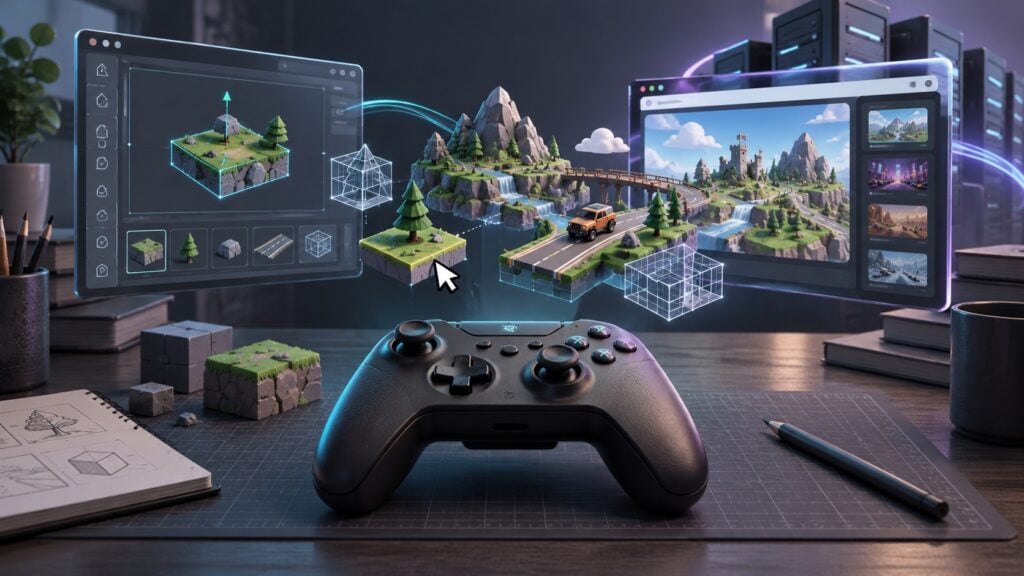
Cover: Original AI-assisted editorial illustration. The interfaces are conceptual, not an official Xbox screenshot.
Xbox Labs, coding agents inside game editors, and games built from prompts are changing the relationship between publishers, developers and players. Reliability, ownership and creative judgment will decide who benefits.
AI in gaming is forcing publishers to reconsider who gets to build a game, change its rules, move it between devices and earn money from it.
That pressure is already visible in the tools companies are releasing, the rules storefronts are writing and the contracts performers are negotiating. Software that can operate a game editor or help reconstruct an old game changes the industry’s decisions about production, distribution and ownership.
On October 13, 2026, Xbox CEO Asha Sharma announced Xbox Labs, connecting experiments in rebuilding and remixing games to the capabilities of coding agents. Her message acknowledged that some of these developments challenge existing gaming business models. Xbox’s announcement
My view is that the most consequential change concerns control. AI assistance could put substantial technical work within reach of more creators, while giving the companies that own editors, marketplaces and popular franchises new ways to govern that work. Players may gain more creative freedom and encounter more platform restrictions at the same time.
Major gaming companies are adapting to tools that expand what creators can attempt. The evidence does not establish that an agent can cheaply produce a polished blockbuster, or that every unofficial port circulating online was made with AI. It does show why publishers can no longer treat these capabilities as peripheral experiments.
Why Xbox Labs matters for AI in gaming
Sharma’s memo points to games being reconstructed for hardware they originally did not support, Windows games moving to Apple Silicon, browser ports using WebAssembly and WebGPU, and games remixed into other games.
She describes a small team of game makers, engineers and scientists and says Xbox will share tools with developers. She also links the opportunity to agents’ ability to write, run and test software. Her most revealing phrase concerns benefits for players that arise “even when (and sometimes because) they challenge our existing business models.” Official Xbox Labs memo
That is an unusually direct acknowledgement of the tension. A company can earn money from a particular distribution arrangement while players would benefit from a different one. If new tools make the alternative easier to build, the company has to decide how to respond.
Xbox’s announcement deserves credit for engaging with the possibilities. It deserves scrutiny for the details it leaves open. The memo does not establish a blanket license for community ports, promise unrestricted access to Xbox intellectual property, or demonstrate a commercially supported product. It expressly retains commitments to hardware and responsible stewardship of IP.
The interesting test will be whether Xbox provides usable tools and clear permissions for creators, then shows what people accomplish with them. A research organization can produce impressive demonstrations without making a creator’s everyday work much easier. The gap between those outcomes is where Xbox Labs should be judged.
AI-assisted game ports build on decades of modding
Players have wanted to change games and run them on different machines for decades. Treating every port or mod as an AI invention erases the people and tools that made this work possible.
John Carmack’s December 1997 note accompanying the DOOM source release proposed ports to other operating systems, additional game features and new networking arrangements. The release also separated source code from the game data required to use it. That distinction remains relevant to today’s AI discussions. DOOM’s original release documentation
Community reconstruction projects provide another precedent. The Super Mario 64 decompilation repository documents rebuilding multiple original releases and requires users to supply a prior copy of the game to extract necessary assets. It demonstrates a concrete engineering practice, with build outputs and comparison checks, rather than a claim that generating plausible code is enough. Super Mario 64 project documentation
Browser technology also matters. WebAssembly provides a compilation target for languages including C, C++ and Rust, while tools such as Emscripten help adapt applications to browser APIs. These capabilities exist independently of generative AI. MDN’s WebAssembly documentation
AI’s potential contribution is to assist with work inside that established technical ecosystem: investigating code, proposing changes, adapting interfaces, compiling results and responding to failures. How much time it saves depends on the project, the available reference material and the quality of verification.
That distinction matters when extraordinary browser-port claims circulate. Kotaku reported playing browser versions of Halo, Vice City and The Simpsons: Hit & Run. Report
Watching a game run tells us little about how it was built. That requires a repository, development logs, an account from its creators or a reproducible process. A short gameplay clip cannot establish that AI performed the entire reconstruction, that the result is complete, or that distributing it is authorized.
The industry should take the experiments seriously without turning an uncertain development history into a universal claim of overnight, automated porting.
Why AI-generated game code still needs verification
The strongest technical evidence also exposes the limits.
In an October 9 account, developer Maurice Heumann describes a roughly three-month effort to reconstruct an unnamed first-person shooter using Claude Code and Codex CLI agents. After the first month, he reports about 80% decompilation and a game that could launch and load maps. The reconstructed code nevertheless contained incorrect logic and data structures.
The team changed its approach to compare reconstructed functions against the original compiled program. Heumann eventually reported that 99% of functions were present and 83% matched byte for byte. Those percentages measure functions, not overall game quality or development effort. The code remains private, and the reported results cannot be independently reproduced from the article. His estimate of 600–700 billion tokens also reflects lost logs; it is not an audited usage total or a dollar-cost calculation. Heumann’s development account
This account challenges both easy dismissal and easy triumphalism. Coordinating agents for sustained reconstruction work is a substantial capability. Discovering that a running build concealed incorrect behavior is a substantial failure.
My inference is that AI shifts some engineering work toward defining and checking correctness. A person still has to establish what behavior must be preserved, which changes are acceptable and what evidence counts as success. Faster code generation can make that responsibility more demanding because there is more output to inspect.
For players, the consequences are concrete. A port might load its first map and fail later in the campaign. A mod might behave properly in a solo session and break a shared match. A reconstruction might reproduce the appearance of a system while changing its timing or rules.
Publishers should respond with better tools for verification and supported modification. Declaring a project finished because its opening minutes look convincing will produce broken games, regardless of who wrote the code.
AI coding agents are entering game editors
Some of the clearest changes are happening inside official development tools.
On August 20, Epic announced Unreal MCP support in Unreal Editor for Fortnite. It described a beta integration through which compatible agents can write and compile Verse, place and configure devices, manipulate Scene Graph entities, build interfaces and operate play sessions. Epic emphasizes that agents produce editable project components, including files and devices that creators can inspect and change. Epic’s UEFN announcement
This is a useful example because the work has an identifiable destination. The output belongs to a development project with code, objects and a test environment. A creator can ask for a mechanic, examine the implementation and keep revising it.
Consider a hypothetical racing prototype. A creator wants a finish-line effect, a lap counter and a penalty for leaving the course. Assistance with implementation could make that experiment easier to assemble. The creator still has to decide whether the course is readable, whether penalties feel fair and whether friends want another race. Compilation answers a different question from those design decisions.
Google is approaching the same participation problem through a simpler interface. Its October 7 Playground launch describes prompt-based game creation, browser sharing, leaderboards and multiplayer in selected genres. The announced launch was for U.S. users aged 18 and over, with tiered creation access rolling out according to Google AI subscriptions. Google also described Unity Spark integration as forthcoming, with a closed beta still to come in the launch announcement. Google’s Playground announcement
The opportunity is broader participation in making games. The remaining questions concern revision reliability, complexity, access restrictions and the quality of the result. A platform that produces a good first attempt but cannot preserve it through later changes will frustrate its creators. Our Google Playground analysis examines the practical test: whether people want to play the resulting games again.
A short game made for friends can still be worthwhile. Success does not have to mean replacing a professional studio. Tools can expand the kinds of games people make and the reasons they make them, including small experiences that would never justify a conventional production budget.
Players can create while they play
Roblox offers an example of AI-generated content becoming part of the game loop.
In February, Roblox announced a beta of what it calls 4D generation: generated 3D objects with functional behavior. Its initial schemas included a five-part car and a single-mesh object. The company described players in Wish Master generating objects such as drivable cars. Roblox reported more than 160,000 objects generated during early access, and quoted the developer’s observation that players using 4D generation averaged 64% more play time. That is a reported association, not a randomized demonstration that generation caused the increase. Roblox’s Cube and 4D generation announcement
The important design possibility is that making something can become an action within a game. Instead of choosing only from objects a developer placed in a menu, a player can describe an object and see what happens within the system’s supported rules.
That possibility gives designers difficult new work. They have to decide which creations fit the game, how to handle requests the system cannot satisfy and what happens when one player’s creation affects everyone else. A generated car that looks interesting but breaks the course can damage the experience for an entire group.
Conversation systems introduce similar responsibilities. Epic’s July announcement described publication of Fortnite islands with LLM-powered characters beginning July 30. It said 36 characters had consistent voices and personas, with voice models built from performances recorded by actors who agreed to that use. The announcement also discussed capacity monitoring and possible rate limits. Epic’s conversation-system announcement
A character’s ability to produce novel speech creates opportunities for responsiveness. It also creates obligations around performance consent, moderation, continuity and operating costs. A developer must decide which parts of an experience can tolerate variation and which must remain dependable.
The resulting games may give players more freedom, but freedom will be designed within technical and commercial limits. That work requires careful game design even when generating individual objects or lines of dialogue becomes easier.
World models are different from game engines
The term “AI game” now covers technologies that produce very different things.
Microsoft Research introduced its gameplay model Muse in February 2025. Trained using Bleeding Edge gameplay, it could generate game visuals, controller actions or both. Microsoft positioned it for gameplay ideation and released research materials, including model weights and a demonstrator. This is a different capability from reconstructing a game’s executable source code. Microsoft Research’s Muse announcement
For background on that earlier direction, see Kingy.ai’s coverage of Microsoft’s Muse gameplay model.
Google DeepMind’s August 2025 Genie 3 announcement described interactive environments generated at 720p and 24 frames per second, with consistency over a few minutes. Its stated limitations included restricted action spaces, complex interactions between agents, text rendering and interaction duration. Those are capabilities and limitations from that research announcement, rather than a benchmark of current commercial games. DeepMind’s Genie 3 announcement
The distinction changes what a successful demonstration proves. An agent modifying a game project can leave behind inspectable code and assets. A world model can generate the experience frame by frame. Both may be useful, but preserving rules, state and behavior requires different evaluation.
For a conventional adventure game, a player expects an acquired key to remain in the inventory and an opened door to stay open. A competitive game needs dependable scoring and shared outcomes. Exploring an appealing generated environment does not, by itself, establish those properties.
World models deserve research and experimentation. Selling a short navigable scene as evidence that complete games have been solved would obscure the engineering and design problems still to address.
AI game creation could strengthen platform owners
More people making games does not automatically mean that power moves away from platform owners.
Epic’s historical numbers show how substantial a creator ecosystem can become. In its 2024 review, the company reported $352 million paid to creators and 5.23 billion hours spent in creator-made games, representing 36.5% of Fortnite play time that year. These are company-reported figures from an existing creator economy; they are not evidence that AI produced those games or caused that growth. Fortnite’s 2024 ecosystem review
My expectation is that easier production will increase the value of discovery, recognizable franchises and communities that already have players. A creator who can build a prototype quickly still needs someone to try it. A platform that controls recommendations and access to an audience can remain powerful while its creation tools become more approachable.
The ownership question therefore extends beyond source code. Can creators export a project? Can they take their audience elsewhere? Who sets payout terms? What happens when the platform changes a policy or discontinues a model?
A tool can widen access to production while keeping distribution tightly controlled. That may still be a useful arrangement, especially if creators receive a large audience and dependable services in return. It should be evaluated as a business relationship rather than treated as automatic creative independence.
Franchise owners also have an opportunity to make authorized remixing a product. Epic’s 2024 review already described official LEGO, Teenage Mutant Ninja Turtles and Fall Guys assets available for creator experiences through its licensing arrangements. AI assistance could make such systems easier to use, although the existing arrangements themselves are not an AI achievement. Epic’s account of licensed creator content
This gives publishers a practical alternative to leaving every experiment in an uncertain permission dispute: provide defined access to assets, supported interfaces, understandable terms and a route to earning money. That is a strategic opportunity, not a prediction that all publishers will pursue it.
Remasters and official ports will still have work to justify their value. Testing, accessibility, localization, support and faithful presentation matter. If technical access becomes easier to provide, those aspects of an official release become more important to the purchase decision.
Game preservation needs fidelity and permission
The preservation case is substantial, but it requires precise claims.
A 2023 study from the Video Game History Foundation and Software Preservation Network estimated that 87% of classic games released in the United States were out of print. Its scope covered games released before 2010, and its availability data was accurate through April 15, 2023. That is a historical measure of commercial availability, not a claim that 87% of games have disappeared or a current global statistic. The foundation’s study explanation
AI assistance could help people investigate old software, document systems and adapt code. Whether it improves preservation depends on what survives the process. A reconstruction that silently changes rules or fills gaps with invented behavior may be useful as an adaptation while remaining a poor historical record.
Original binaries, assets, version information and documentation remain valuable. A preservation project should identify what it is preserving, what it has changed and how it compared the result with the original. An AI-generated approximation should be described as such.
Permissions require their own examination. Reconstructing code, reusing artwork, reproducing a performance and distributing a complete game involve different material and potentially different rights. Technical feasibility cannot answer all of those questions.
The U.S. Copyright Office’s January 2025 copyrightability analysis offers another relevant distinction. It concluded that AI output requires sufficient human determination of expressive elements for copyright protection; merely supplying prompts is insufficient. It also said that AI assistance does not disqualify a larger human-authored work from protection. This addresses copyrightability under that U.S. analysis, not blanket permission to copy or distribute an existing game. Copyright Office’s conclusions
My position is that publishers should make lawful preservation and clearly authorized modification easier wherever they can. Clear asset requirements and permissions would give responsible projects a more reliable foundation. Treating every community effort as interchangeable would erase meaningful differences between preservation, licensed creation, adaptations and unauthorized distribution.
Why developers are resisting generative AI
Gaming workers’ objections deserve to influence how these tools are deployed.
GDC’s 2026 industry survey drew responses from more than 2,300 professionals. It reported that 36% of respondents used generative AI in their work, while 52% considered its industry impact negative and about 7% considered it positive. Usage also differed by role: 30% of respondents at game studios reported using the tools, compared with 58% at publishing companies, support teams and marketing or PR firms. These are survey findings, not a census or proof that AI caused a particular layoff. GDC’s survey summary
Those results complicate the idea that adoption automatically produces enthusiasm. People can use a tool and still oppose the terms on which it enters their workplace. They can also recognize a useful capability while questioning its effects on careers, credit or compensation.
There is already an example of those concerns changing the industry’s contracts. SAG-AFTRA’s 2025 Interactive Media Agreement was ratified on July 9 after an extended video game strike. The union described consent requirements for various digital-replica uses, provisions allowing consent to be suspended during strikes, and compensation minimums for covered uses, including real-time generation. SAG-AFTRA’s agreement summary
That is a concrete business change prompted by AI capability. It concerns who can authorize the use of a performance and who is paid for it.
Studio leaders should apply the same seriousness to other claims of efficiency. Measure time spent correcting generated work, maintaining it and resolving inconsistencies. Count the people who define requirements and perform review. A demonstration that produces code rapidly cannot establish the total cost of a reliable release.
I would support using measurable savings to test more ideas, improve accessibility and give specialists more time for difficult creative work. Using unverified productivity claims to justify removing those specialists would risk losing the judgment needed to make the tools useful.
Steam’s rules for AI-generated game content
Steam’s documentation shows that AI is already affecting the obligations of shipping a game.
Valve distinguishes AI-generated content created during development from content generated while a game is running. Its current Content Survey guidance focuses on content shipped to and consumed by players, rather than general efficiency gains from development tools. Live-generated content adds a requirement to describe safeguards against illegal output. Steamworks Content Survey
That separation is useful. A coding assistant, a generated illustration and an NPC that produces new dialogue after release should not be evaluated as if they create identical risks or costs.
A game that generates content during play also needs an operating plan. Valve’s FAQ discusses ongoing external AI-service costs and ways developers might collect payment for them, including incorporating the cost into the price, microtransactions, subscriptions or DLC. It presents possibilities, not a universal pricing requirement. Steamworks’ live-generation FAQ
The player’s practical questions are straightforward. Which features require a connection? What happens when generation reaches a limit? Does a saved creation survive a model change? What functionality remains if the service closes?
These questions should be answered before a customer relies on the feature. Selling a game with an ongoing generation service creates responsibilities that extend beyond delivering its launch build.
For publishers, this is another reason the AI debate belongs in product planning and business design. A novel feature can change moderation work, customer expectations and ongoing costs at once. Treating the model as a small addition to an otherwise unchanged product will overlook that work.
How gaming companies should prove AI’s value
The evidence supports change in several places: official editors are exposing operations to agents, creation platforms are accepting natural-language instructions, games are experimenting with generation during play, storefronts have written new requirements and performers have negotiated new protections. The magnitude of future cost savings and commercial displacement remains uncertain.
My strongest conclusion is that publishers should compete to offer reliable, well-supported ways for people to create and modify games. That would address the demand behind these experiments while giving developers and rights holders a workable place in the resulting economy.
The useful measures are specific:
- Creation reliability: How often can users make a requested change without breaking what already worked?
- Verified engineering effort: How much human work, compute and correction does a port or reconstruction require?
- Player value: Do people return after the novelty of generation wears off, and do they enjoy the experience?
- Creator terms: Are permissions, attribution, compensation and export options understandable?
- Operational durability: Can creations, saves and essential features survive updates, service interruptions and changing limits?
Those measures would tell us far more than a count of generated assets or a compilation-success rate. They would also give skeptical developers and players evidence they can evaluate.
Xbox Labs should publish experiments that make their methods and limitations visible: what was changed, what files or permissions were required, which behavior was tested and how much human work remained. Its tools should help creators repeat useful results within clear terms.
The industry will have to decide how much creative access it offers as these capabilities spread. Players, developers and performers should have a say in that decision. The companies asking them to embrace AI owe them dependable games, usable tools and terms that make the benefits worth the costs.
Research and disclosure: This analysis uses public sources checked through October 13, 2026. Announced capabilities and company-reported figures are attributed to their sources. Kingy.ai did not benchmark these tools or play the unofficial ports for this article. AI assisted the research, drafting and editorial cover illustration.
The Kingy Brief
Get The Kingy Brief.
AI changes, original tests and one practical thing to try. Fridays at 09:00 Vancouver time.
Free · Double opt-in · Unsubscribe anytime
Sign up for The Kingy Brief on Beehiiv.
Signup help and newsletter schedule
Signup form provided by Beehiiv. After submitting, check your inbox for "Confirm your subscription to The Kingy Brief" and open its confirmation link. Check Spam or Promotions if you cannot find it.
Fridays at 09:00 Vancouver time: source-checked AI changes, original tests and one practical thing to try. The weekly restart begins October 9, 2026. We skip a week when there is not enough verified material. Free. Unsubscribe anytime.