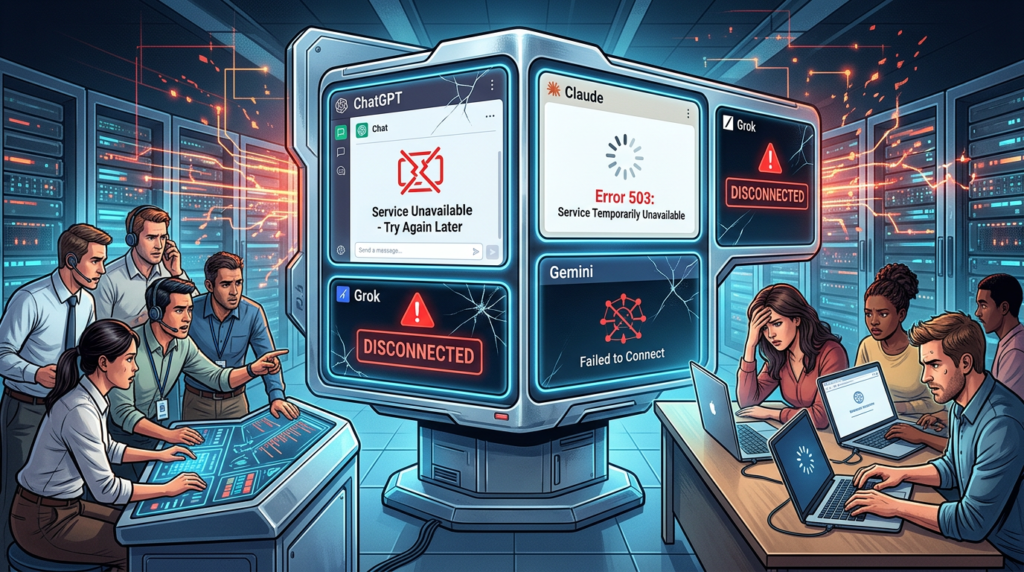
For a brief stretch on Thursday, September 3, the AI-powered future looked surprisingly old-fashioned.
ChatGPT stopped cooperating. Claude ran into trouble. Grok went offline. Users also reported problems with Google’s Gemini.
Suddenly, people who had become accustomed to asking an AI to write code, summarize documents, research topics, generate images, or answer random questions had to confront a terrifying alternative: doing things themselves.
The horror.
The strange part wasn’t simply that an AI service went down. Outages happen. Servers fail. Software breaks. Somewhere, an engineer inevitably gets a notification capable of ruining lunch.
What made this incident unusual was the timing.
Several of the world’s biggest artificial intelligence services experienced problems within roughly the same window. That immediately raised an obvious question: Were the outages connected?
Reports from The Verge, WIRED, Forbes and others confirm that ChatGPT, Claude, and Grok suffered disruptions. Meanwhile, Gemini generated a noticeable spike in user complaints, although Google apparently did not officially confirm an outage.
The timing looked suspicious.
The evidence, however, tells a more complicated story.
The Great AI Coffee Break
The trouble unfolded during the morning of September 3 in the United States.
Downdetector began recording surges in complaints involving several major AI services. ChatGPT attracted the biggest wave, with Forbes reporting more than 37,000 complaints at one point. Claude and Grok also experienced significant spikes. Gemini generated hundreds of reports.
Users weren’t imagining things.
OpenAI acknowledged elevated errors affecting ChatGPT and Codex. Anthropic reported problems with Claude. xAI acknowledged that Grok was experiencing issues.
And they were happening close enough together to make the situation look almost coordinated.
It wasn’t just a case of ChatGPT refusing to answer someone’s request for a chicken recipe.
The disruption affected actual workflows.
According to The Verge, ChatGPT users encountered problems with conversations, logins, uploads, voice, search, image generation, and other functions. Claude experienced disruption across Claude.ai, Claude Code, and its API, while Grok experienced problems across its services.
For people who increasingly depend on AI for work, the outage became immediately noticeable.
Writers lost assistants. Developers lost coding tools. Researchers lost shortcuts.
And the internet did what the internet always does during an outage.
It made jokes.
ChatGPT Hits a Routing Problem
OpenAI’s problems were substantial enough to appear on the company’s official service dashboard.
The OpenAI status page recorded “elevated errors across ChatGPT and Codex.” The incident affected numerous ChatGPT and Codex components before OpenAI deployed mitigation and eventually marked the problem as resolved.
But what actually happened?
According to OpenAI comments reported by WIRED and Decrypt, a routing error caused ChatGPT and Codex to become unavailable for some users across platforms.
That distinction matters.
A routing problem doesn’t automatically suggest that the underlying AI models suddenly forgot how to AI. Instead, it points toward the infrastructure responsible for getting requests where they need to go.
Think of it like having a perfectly functional restaurant whose front door suddenly sends customers into the parking garage.
The kitchen might be fine.
You’re still not getting dinner.
OpenAI investigated the problem, deployed mitigation, monitored the recovery, and ultimately reported that the affected services had recovered. Its status page later marked the incident as resolved.
So ChatGPT had an explanation.
Sort of.
But ChatGPT wasn’t alone.
Claude Was Having a Bad Morning Too
While OpenAI engineers wrestled with ChatGPT, Anthropic had problems of its own.
Claude suffered a partial outage that affected several services.
According to WIRED, Anthropic’s disruption began earlier in the morning and affected Claude products before the company restored service. Anthropic described the cause broadly as an infrastructure issue rather than providing an extensive technical explanation.
That wording leaves plenty of unanswered questions.
“Infrastructure issue” can cover a lot of territory in cloud computing.
Hardware can fail. Networking can misbehave. Dependencies can break. Configuration changes can cause havoc. A perfectly innocent-looking deployment can transform someone’s Thursday into a frantic debugging marathon.
What matters is that Anthropic acknowledged its own incident and restored service.
This is where the coincidence becomes particularly interesting.
OpenAI had a routing problem.
Anthropic had an infrastructure problem.
At roughly the same time.
If that were the entire story, it would already be unusual.
Then there was Grok.
Grok’s Problem Came From Memphis
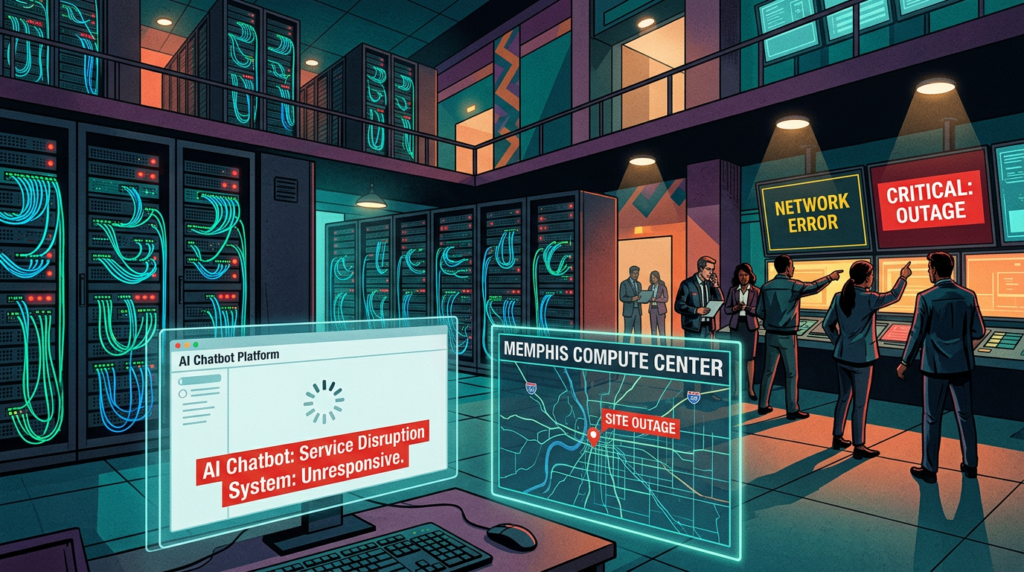
Grok’s outage added another piece to the puzzle.
xAI’s status information acknowledged that Grok was experiencing problems on September 3 and said engineers were working to restore the service.
Later, SpaceX provided a more specific explanation.
According to reporting from WIRED and EWN, SpaceX said Grok’s problems resulted from an outage at its Memphis compute center.
That gives us three overlapping incidents with three somewhat different descriptions.
OpenAI: routing error.
Anthropic: infrastructure issue.
Grok: Memphis compute-center outage.
That makes the simple “one giant outage killed every AI chatbot” explanation considerably harder to support.
It also highlights how physical the supposedly magical world of artificial intelligence really is.
AI may live in the cloud, but the cloud lives inside buildings.
Those buildings contain servers.
Those servers need networking, power, cooling, storage, and enormous amounts of supporting infrastructure.
When something fails in that chain, even an enormously sophisticated AI model can become little more than an expensive collection of silicon waiting for somebody to fix the plumbing.
Grok eventually returned.
But one more famous chatbot had entered the conversation.
Gemini.
Did Gemini Actually Go Down?
This is where the story requires a little caution.
Several reports and users indicated that Google’s Gemini experienced problems during the same general period.
Forbes reported roughly 500 Gemini complaints around 11 a.m. EDT. EWN similarly reported connection timeouts and increased user reports.
That sounds straightforward.
Except there’s an important wrinkle.
Google apparently did not officially confirm a Gemini outage.
9to5Google initially reported that Gemini appeared unaffected despite an increase in user complaints. WIRED also noted that Google had not logged an official outage while users reported issues.
So saying “Gemini definitely went down” goes beyond what the strongest evidence currently establishes.
Users experienced problems.
Downdetector recorded reports.
But an official Google confirmation appears to be missing.
That’s important because user-reported outage trackers measure reports, not necessarily the underlying cause. A spike can indicate a genuine platform failure, but it doesn’t independently prove that Google’s infrastructure failed.
Gemini therefore sits in a slightly different category from ChatGPT, Claude, and Grok.
Those three providers acknowledged service disruptions.
Gemini had reported trouble.
Small difference. Big journalistic distinction.
Was This One Giant AI Outage?
When several major AI systems fail at almost the same moment, the obvious theory is a shared dependency.
Maybe a cloud provider failed.
Maybe a networking backbone broke.
Maybe everyone depended on the same mysterious box sitting in a data center labeled “DO NOT UNPLUG.”
The evidence so far doesn’t establish any of those explanations.
WIRED specifically examined whether the incidents might share an external infrastructure provider. It reported that neither OpenAI nor Anthropic identified a shared third-party service as the cause. Major infrastructure providers including AWS, Microsoft Azure, and Cloudflare weren’t reporting corresponding incidents that neatly explained everything.
The confirmed explanations also differ.
OpenAI blamed routing.
Anthropic cited infrastructure.
SpaceX pointed toward its Memphis compute center for Grok.
Could there still be some hidden connection?
Possibly.
But “possibly” isn’t “confirmed.”
For now, the safest conclusion is wonderfully unsatisfying: several enormous AI platforms suffered unusually overlapping disruptions, and there is no confirmed evidence that one common failure caused all of them.
Sometimes coincidences really are coincidences.
Even extremely weird ones.
The Outage Revealed Something Bigger
The technical mystery is interesting.
The human reaction might be even more revealing.
AI chatbots aren’t novelty toys anymore.
People increasingly use them as everyday infrastructure.
Decrypt documented users complaining that the outages disrupted writing, research, coding, and other work. One user joked that losing ChatGPT instantly made him feel significantly less intelligent.
Funny? Absolutely.
Also slightly uncomfortable.
Only a few years ago, losing access to a chatbot would barely have registered.
Now imagine an office where developers use Claude Code, researchers rely on ChatGPT, employees query Gemini, and social-media teams experiment with Grok.
Take several of those systems away simultaneously.
People notice immediately.
The September 3 incident therefore acted as an accidental experiment.
It showed how quickly generative AI has moved from “interesting website” to something closer to productivity infrastructure.
That’s great when everything works.
When it doesn’t?
Well, apparently we rediscover Google Search, Stack Overflow, documentation, notebooks, colleagues, and that mysterious organ inside our skulls.
The old technologies still boot up surprisingly quickly.
AI Needs Boring Infrastructure
There’s another lesson hiding underneath the outage.
The AI industry loves talking about intelligence.
Reasoning. Agents. Context windows. Benchmarks. Artificial general intelligence. Models capable of coding entire applications.
Those things make fantastic headlines.
Routing tables generally don’t.
Yet even the world’s smartest model becomes remarkably useless when users can’t reach it.
The outage demonstrates why the next phase of the AI competition won’t revolve solely around who has the highest benchmark score.
Reliability matters.
Redundancy matters.
Data-center design matters.
Networking matters.
Recovery time matters.
Companies increasingly want AI systems woven directly into customer support, programming, analytics, document processing, research, and internal operations.
That creates a simple expectation: the service needs to be there.
A chatbot used occasionally can disappear for an hour and create annoyance.
An AI agent controlling part of a business workflow disappearing for an hour creates something else entirely.
That’s why this incident deserves attention beyond the amusing spectacle of several chatbots apparently deciding to take lunch simultaneously.
AI is becoming infrastructure.
Infrastructure gets judged differently.
Everything Came Back — But the Questions Remain
The good news arrived fairly quickly.
The major affected services recovered.
OpenAI eventually marked its ChatGPT and Codex incident resolved. Anthropic restored Claude. Grok returned after its outage. User reports dropped sharply as the day progressed.
No AI apocalypse.
No permanent digital blackout.
Just an unusually chaotic morning.
Yet the timing remains fascinating.
Three major AI providers acknowledged outages in a remarkably similar window. Users also reported Gemini problems. The incidents immediately encouraged theories about shared infrastructure and cascading failures.
So far, the available evidence doesn’t prove those theories.
Instead, we have different explanations from different companies.
That may ultimately be the most interesting part.
The AI industry is racing toward increasingly interconnected systems powered by enormous compute clusters, cloud networks, data centers, APIs, and third-party infrastructure.
The models may look independent on our screens.
Underneath, they’re still machines running on an extraordinarily complicated technological foundation.
And sometimes that foundation trips over its own shoelaces.
For a short while on September 3, several of the world’s most advanced AI systems became unavailable at almost the same time.
Then engineers fixed them.
Millions of users refreshed their browsers.
And humanity narrowly escaped having to write all its own emails.
Crisis averted.
Sources
- Mashable India — Grok, Gemini and ChatGPT outage report
- The Verge — ChatGPT, Grok, and Claude all went down at the same time
- WIRED — Nobody Is Saying Why OpenAI and Anthropic Had Outages Today
- Forbes — Widespread AI Outage Largely Resolves After Hitting OpenAI, Claude And Others
- 9to5Google — ChatGPT, Claude, and Grok confirmed outages
- EWN — ChatGPT, Claude, Grok and Gemini disrupted in global outage
- Decrypt — ChatGPT, Claude and Grok Outages Leave Users Asking How to Work Without AI
- OpenAI Status — Elevated errors across ChatGPT and Codex
- xAI Status — Grok models outage
The Kingy Brief
Get The Kingy Brief.
AI changes, original tests and one practical thing to try. Fridays at 09:00 Vancouver time.
Free · Double opt-in · Unsubscribe anytime
Sign up for The Kingy Brief on Beehiiv.
Signup help and newsletter schedule
Signup form provided by Beehiiv. After submitting, check your inbox for "Confirm your subscription to The Kingy Brief" and open its confirmation link. Check Spam or Promotions if you cannot find it.
Fridays at 09:00 Vancouver time: source-checked AI changes, original tests and one practical thing to try. We skip a week when there is not enough verified material. Free. Unsubscribe anytime.