The artificial-intelligence industry loves a dramatic entrance. Every few weeks, a new model arrives carrying benchmark charts, bold promises and enough superlatives to make a movie trailer blush.
Grok 4.6 is no exception.
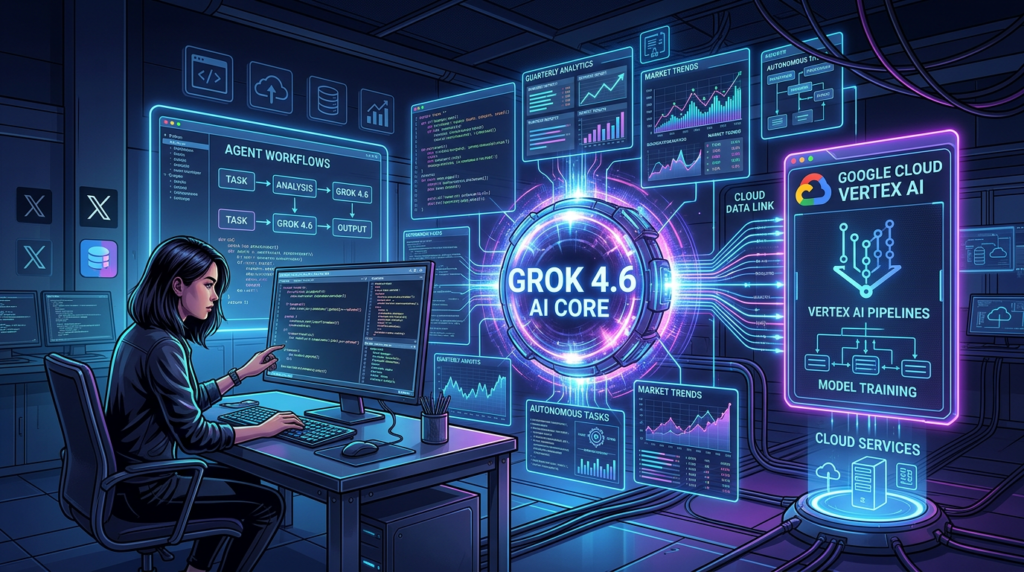
Released by xAI on August 12, 2026, the model targets coding, professional knowledge work and long-running AI agents. It can analyze enormous inputs, use external tools and keep working through complicated, multi-stage projects. It has also expanded beyond xAI’s own ecosystem, recently landing on Google Cloud’s Vertex AI.
Then Elon Musk added fuel to the launch-day fireworks by claiming that Grok could “earn you money.”
That line understandably grabbed attention. An AI that writes emails is useful. An AI that clocks in, completes projects and helps pay the electricity bill sounds considerably more exciting.
Yet the biggest story behind Grok 4.6 is not one flashy tweet or one conveniently flattering benchmark. It is xAI’s attempt to turn Grok from an entertaining chatbot into something businesses and developers can employ as an active digital worker.
The model looks fast, capable and aggressively priced. But is it really the “best model ever made”? Can it genuinely earn money? And should companies trust it with long-running work?
Let’s unpack the silicon suitcase.
More Than Another Chatbot Upgrade
Grok began life as xAI’s rebellious answer to ChatGPT, complete with a personality tied closely to X. Grok 4.6 aims at a much bigger role.
According to xAI’s official introduction, the company designed the model for coding, knowledge work and agent-based workflows. Instead of only answering isolated questions, it can operate across a sequence of connected steps.
That distinction matters.
A traditional chatbot might explain how to build a website. An agentic model can potentially inspect requirements, research unfamiliar technology, plan the application, write code, test components and revise the result after feedback.
The Medium explainer supplied as a source similarly frames Grok 4.6 around sustained agent work and application prototyping. Meanwhile, Techgenyz connects the model’s launch with xAI’s wider push into autonomous software through Grok Bot.
In plain English, xAI does not want Grok waiting politely inside a chat window. It wants Grok opening the toolbox.
That shift reflects where the entire AI market is heading. The next competitive battle is not simply about which model gives the cleverest response. It is about which one can reliably complete useful work without wandering into a digital hedge maze halfway through.
What Grok 4.6 Actually Offers
Grok 4.6 comes with a 500,000-token context window. That gives it room to process large codebases, lengthy research collections, extensive project histories or combinations of text and images.
It accepts text and image inputs and produces text output. Developers can select low, medium, high or extra-high reasoning effort, allowing them to balance speed, cost and analytical depth.
The model also supports function calling, structured output, web search, X search and code execution, according to xAI’s developer documentation. Those capabilities matter because an agent needs more than a clever brain. It needs hands—or at least digital approximations of them.
xAI says it gave Grok 4.6 a longer supplemental training run than Grok 4.5. The company used curated synthetic reasoning data, engineering material and reinforcement-learning environments covering software development, web work, computer-aided design and other technical areas.
The headline context limit is impressive, but it is not new. Grok 4.5 also supported 500,000 tokens. The upgrade therefore concerns what the model can do with its working space, rather than simply giving it a larger desk.
Think of it as hiring a more capable employee without expanding the office. Same room. Better occupant. Hopefully fewer mysterious snacks disappearing from the refrigerator.
The Benchmark Crown Comes With Fine Print
One supplied source makes an enthusiastic declaration right in its title: “Grok 4.6 Is the Best Model Ever Made.”
It is a terrific headline. It is not yet a universal fact.
xAI reports that Grok 4.6 scored 61 on the Artificial Analysis Intelligence Index, matching GPT-5.6 Sol. This index combines nine evaluations, so the tie suggests that Grok has entered the upper tier of current AI systems.
Another supplied report from AI Tech Connect focuses on that same claimed parity with GPT-5.6 Sol.
Look beneath the composite score, however, and the contest becomes more interesting.
In xAI’s published table, Grok 4.6 scored 65.9% on DeepSWE 1.1, compared with 73% for GPT-5.6 Sol. On Terminal-Bench 3.0, Grok reached 26%, while Sol posted 34.6%. Grok performed better on several professional-work measures, including GDPVal-AA, AA-Briefcase and Harvey LAB.
So, which model wins?
It depends on the job. Grok appears highly competitive for mixed knowledge work, coding and cost-sensitive automation. Sol retains advantages on some difficult software-engineering and command-line evaluations.
There is another catch: xAI assembled the comparison using published system cards and public leaderboards. The models were not necessarily tested under one identical, independently controlled setup.
The benchmarks deserve attention. They do not deserve worship.
Built to Stay on the Job
The most important phrase surrounding Grok 4.6 may be “long-running agents.”
Today’s AI tools often look brilliant during short demonstrations. Give one a compact coding problem and it may produce a clean answer in seconds. Ask it to manage a complicated project over dozens of steps, and strange things can happen.
The model may forget an earlier requirement. It may repeat work. It may confidently repair a file it already repaired—or “improve” something that was working perfectly. Digital enthusiasm can be expensive.
xAI says Grok 4.6 performs better at sustaining projects across multiple stages. The company demonstrated it handling broad product ideas, researching unfamiliar topics, structuring applications, implementing interactions and refining results through feedback.
That makes Grok relevant to more than programmers. A capable agent could assemble reports, monitor information, prepare business materials, coordinate content pipelines or process structured administrative tasks.
However, a large context window does not guarantee perfect memory, judgment or execution. Context is capacity, not competence. Giving someone a bigger notebook does not automatically turn them into Sherlock Holmes.
Businesses still need testing, permissions, logs and human review—especially when an agent can access sensitive files or interact with external systems.
Google Cloud Gives Grok an Enterprise Doorway

On August 21, Grok 4.6 entered preview through Google Cloud’s Vertex AI Model Garden.
That move could prove as important as the model launch itself.
As Blockchain.News reports, companies using Google Cloud can now access Grok within an infrastructure environment they may already use for deployment, billing and model management. They do not need to build an entirely separate relationship with xAI just to test the model.
Convenience wins enterprise battles more often than spectacular demos do.
A technically excellent model can struggle if integrating it requires new contracts, unfamiliar controls and several weeks of engineering gymnastics. By appearing inside Vertex AI, Grok becomes another option that cloud teams can evaluate through familiar systems.
The model’s listed Vertex pricing starts at $2 per million input tokens and $6 per million output tokens. Cached input is reported at $0.30 per million tokens on Vertex AI.
That placement also creates an amusing competitive wrinkle. Google operates its own Gemini family, yet its cloud platform increasingly resembles a well-stocked AI supermarket. Customers can compare models rather than marrying one provider forever.
For xAI, Vertex AI supplies reach and credibility. For Google Cloud, Grok provides another product on the shelf. Everyone gets something—except perhaps the procurement team, which now has another spreadsheet to maintain.
Grok Bot Moves the Agent onto the Desktop
The model is only one part of xAI’s agent strategy.
Techgenyz reports that Grok Bot expanded from its original macOS beta to Windows and Linux desktop clients, with an Android version reportedly planned. The service also introduced broader subscription access and a seven-day trial with usage limits.
Grok Bot represents a different experience from simply sending prompts to Grok. It operates through a cloud-based computer and can reportedly browse the web, sign into applications and perform multi-step tasks.
That is where the idea of a digital coworker becomes tangible—and where the security questions become considerably louder.
An assistant that can draft a response is one thing. An agent that can enter accounts, operate software and execute workflows needs carefully limited permissions. Users must know what it can access, what it has changed and how to stop it.
The potential payoff is substantial. A small business could assign an agent repetitive support, research or content-operations tasks. A developer could delegate portions of a software project. A creator could automate parts of an audience workflow.
But autonomy magnifies both ability and error. The better an agent becomes at doing things, the more important it becomes to confirm that it is doing the right things.
Can Grok Really Earn You Money?
Musk’s brief claim that Grok can “earn you money” sounds delightfully direct. Reality requires a few more words.
According to Basenor’s analysis, the post did not announce a system that automatically pays users. Instead, it appears to frame Grok’s existing bot and automation capabilities as commercial tools.
In other words, Grok might help someone earn money. It does not dispense money like an unusually talkative ATM.
A creator could use Grok to accelerate research, organize content or manage audience questions. A business might deploy it for customer support, lead qualification or internal automation. A developer could build a paid service around the API.
Those activities may generate revenue, but the income comes from the product, audience or business process surrounding the model. Grok supplies labor and leverage.
The distinction matters because AI marketing often compresses an entire business plan into one sparkling sentence. A model cannot guarantee demand, customers, profit margins or competent execution. It can lower the cost of producing something useful.
That is still meaningful.
If Grok helps a freelancer complete twice as many projects, the economic benefit could be real. If it generates 400 mediocre posts that nobody wants to read, it has merely produced a larger haystack.
AI can accelerate a business engine. Someone still has to build the engine.
Aggressive Pricing Could Be the Real Disruption
Grok 4.6 starts at $2 per million input tokens and $6 per million output tokens through xAI’s API. At those rates, it offers an attractive proposition for developers running high-volume agent workflows.
Agents consume tokens with alarming enthusiasm. They plan, call tools, inspect results, revise decisions and occasionally reconsider their entire electronic existence. Small pricing differences can multiply rapidly across thousands of runs.
There is an important caveat.
For prompts reaching xAI’s 200,000-token long-context pricing band, published rates rise to $4 per million input tokens and $12 per million output tokens. The higher price applies to the entire request, not just the portion above the threshold.
That makes context management essential. Developers should not dump every available document into a prompt simply because the model can swallow it. Caching, summarization and context compaction may produce a leaner—and cheaper—workflow.
Even with that wrinkle, Grok’s pricing strengthens its position. It does not need to win every benchmark to become commercially attractive. It may only need to complete enough tasks successfully at a lower overall cost.
The cheapest model is not necessarily the least expensive, however. A low token bill offers little comfort if employees spend hours repairing unreliable output.
Real cost includes retries, human review, latency and mistakes. Token pricing is only the cover charge.
The “Best Model” Is Really a Routing Decision
The race to name one supreme AI model increasingly misses the point.
Different systems lead different evaluations. They also behave differently across codebases, industries, tool environments and prompting styles. A model that excels at professional document work may not be the strongest terminal operator. Another may reason brilliantly but cost too much for a high-volume support workflow.
Grok 4.6’s strongest argument is therefore not that it defeats every rival. The evidence supplied by xAI itself does not establish that.
Its stronger argument is that it combines frontier-level performance, flexible reasoning, a substantial context window and low headline prices. Add distribution through Cursor, Grok Build, xAI’s API, partner gateways and Vertex AI, and the model becomes difficult for development teams to ignore.
Companies will increasingly route tasks among several models. One may handle deep coding. Another may process documents. A cheaper system may perform routine steps while a premium model reviews difficult cases.
In that world, second place on one benchmark does not equal commercial failure. A model can win by delivering the best balance of quality, speed, reliability and cost for one specific workload.
That is less dramatic than shouting “best model ever.” It is also much closer to how useful technology gets selected.
Grok 4.6 Has Arrived at the Serious Table

Grok 4.6 does not settle the AI race. Nothing in this industry stays settled longer than a carton of milk.
Still, the release marks a serious advance for xAI.
The model ties GPT-5.6 Sol on a prominent composite index, posts notable gains over Grok 4.5 and offers compelling pricing for many workloads. Its focus on sustained agentic work also targets the market’s most important transition: moving AI from answering questions to completing projects.
Vertex AI availability gives Grok an enterprise route. Grok Bot gives xAI a consumer-facing agent platform. Musk’s “earn you money” message supplies the marketing hook.
The honest conclusion sits somewhere between dismissal and coronation.
Grok 4.6 appears to be a credible frontier model and potentially an excellent value. It may help creators, developers and companies produce revenue-generating work. Yet it cannot create a viable business from thin air, and no vendor benchmark proves it will outperform every competitor on every task.
The smartest response is simple: test it against real work. Track success rates, corrections, latency, token use and human review time.
If Grok completes the job reliably and cheaply, it does not need the internet’s imaginary championship belt.
It can just get to work.
Sources
- Generative AI: Grok 4.6 Is the Best Model Ever Made
- Basenor: Grok Can Earn You Money—What Musk’s Claim Actually Means
- Blockchain.News: Grok 4.6 Launches on Google Cloud Vertex AI
- Techgenyz: Grok 4.6 and Grok Bot Expand xAI’s Push Into AI Agents
- AI Tech Connect: Grok 4.6 Reaches Parity With GPT-5.6 Sol
- Medium: Grok 4.6 Explained
- xAI: Introducing Grok 4.6
- xAI Developer Documentation: Grok 4.6
The Kingy Brief
Get The Kingy Brief.
AI changes, original tests and one practical thing to try. Fridays at 09:00 Vancouver time.
Free · Double opt-in · Unsubscribe anytime
Signup help and newsletter schedule
Signup form provided by Beehiiv. After submitting, check your inbox for "Confirm your subscription to The Kingy Brief" and open its confirmation link. Check Spam or Promotions if you cannot find it.
Fridays at 09:00 Vancouver time: source-checked AI changes, original tests and one practical thing to try. The weekly restart begins October 9, 2026. We skip a week when there is not enough verified material. Free. Unsubscribe anytime.