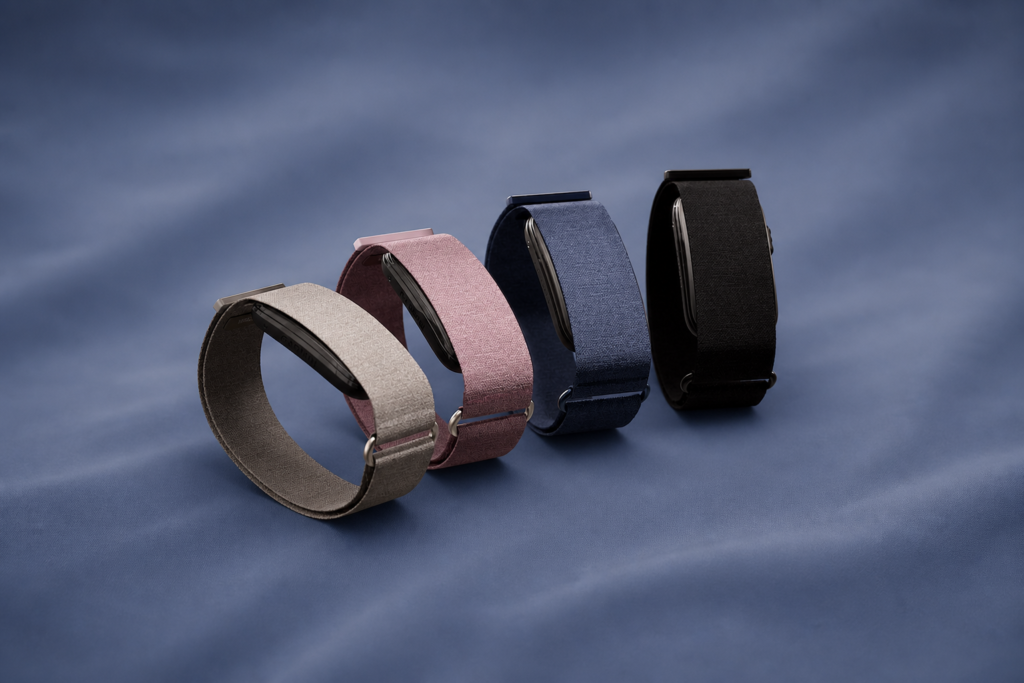
The Garmin Cirqa is worth $199.99 for athletes and existing Garmin users who want serious recovery data without another screen or a mandatory subscription—but its lack of onboard GPS and reliance on a phone app make it a poor fit for anyone seeking a self-contained sports watch.
That is the central finding of our Garmin Cirqa review. Garmin has not tried to squeeze a smaller smartwatch onto your wrist. Cirqa has no display, notifications, microphone or AI assistant. It quietly samples heart rate, heart-rate variability (HRV), blood-oxygen saturation, skin-temperature variation and movement, then turns those signals into familiar Garmin metrics such as Body Battery, sleep score, stress, recovery time and training readiness.
The proposition is unusually clean: up to 10 days of battery life, more than 80 activity profiles, connected GPS, 5 ATM water resistance and no required monthly fee. The catch is equally clear. You need Garmin Connect to see almost everything, your phone supplies GPS for outdoor routes, and some coaching and generative-AI features sit behind the optional Garmin Connect+ plan.
Garmin Cirqa review: the quick verdict
Worth it at $199.99? Yes – especially if you already live in Garmin Connect. Cirqa delivers much of Garmin’s health, sleep and training stack in a screenless band that costs roughly the same as one year of WHOOP One. On manufacturer figures, its approximately 21 g total weight and up-to-10-day battery claim make it a low-friction way to collect recovery data without a recurring fee.
Price reviewed: $199.99 in the US, rechecked on Garmin’s official store August 17, 2026; retail pricing can change. Testing scope: Kingy examined the physical band, sensor model and Garmin Connect workflow shown in the accompanying video. Kingy did not publish instrumented accuracy tests, a multi-day battery log or a long-term comfort test. The video does not identify firmware, total wear time or unit provenance, so this review does not infer those details.
Best for
-
Garmin users who want 24/7 recovery data without sleeping in a watch
-
Athletes who already record workouts on another Garmin device
-
Buyers who want training-readiness and sleep insights without a mandatory subscription
Skip if
-
You need onboard GPS, maps or real-time wrist stats
-
You dislike checking a phone app for health and workout data
-
You only need basic sleep and activity tracking and prioritize the lowest entry price
Pros
-
Screenless, notification-free design keeps attention off the wrist
-
Up to 10 days of claimed battery life and 5 ATM water resistance
-
Core training-readiness, Body Battery, HRV and sleep metrics are included
-
A physical button can start a favourite activity without opening the app
Cons
-
No display means detailed feedback depends on Garmin Connect
-
Outdoor route tracking uses a paired phone’s GPS
-
Garmin Connect can feel dense when it becomes the primary interface
-
Selected coaching, nutrition and Active Intelligence features require Connect+
What the Garmin Cirqa is—and is not
Cirqa is a screen-free health and fitness tracker, not a smartwatch with the display turned off. Its 27 × 47 × 9 mm sensor module sits inside a fabric ComfortFit band. A single side button can start or stop a chosen activity, while automatic detection can classify supported workouts after the fact. Detailed results live in Garmin Connect.
That distinction changes the product’s job. A Garmin watch can show pace, maps and alerts during a run. Cirqa is designed to stay in the background, collect a continuous physiological record and let you review it later. For cyclists who already use an Edge computer, runners who rotate between Garmin devices or anyone who finds a watch distracting at night, that division of labour makes sense.
It is not a self-contained sports watch, a medical monitor or a conversational AI device. It has no display, microphone, onboard GPS or chatbot. Buyers should decide whether that subtraction feels focused or restrictive before comparing feature counts.
How Kingy reviewed the Garmin Cirqa
Kingy’s five-minute video examines the physical device, explains its optical sensors and accelerometer, and tests the logic behind Garmin’s recovery claims. It separates what Cirqa can sense from what its software can only estimate. This review checks those observations against Garmin’s official product page, specifications and launch material, then compares manufacturer-published pricing and claims for Fitbit Air, Polar Loop and WHOOP 5.0.
| TESTING DIMENSION | SCOPE AND LIMITS |
|---|---|
| Observed directly | Physical band, screenless interaction model, sensor placement and the Garmin Connect workflow shown in the video |
| Measured directly | No instrumented measurements were published in Kingy’s video |
| Not tested | Long-term comfort, battery endurance, sleep-stage accuracy, Pulse Ox accuracy, skin-temperature accuracy and GPS-route accuracy |
| Unit provenance | Not stated in the video |
| Test environment | Exact phone, firmware, wear duration and environmental conditions were not identified |
That makes this a source-audited, video-based product review rather than a laboratory validation. Kingy’s editorial and verification standards explain how observation, manufacturer claims and independent evidence are separated.
What the video shows
-
0:21 – Can a $200 screenless wearable deliver useful recovery guidance?
-
4:00 – Why training readiness should be one input, not your coach
Garmin Cirqa price and subscription: what you pay
Garmin lists the Cirqa at $199.99 in the US. Core health, sleep, activity and training metrics work through Garmin Connect without a required subscription. That includes features such as Body Battery, HRV status, sleep score and training readiness where supported by the device and account.
Garmin Connect+ remains optional. Garmin says the paid plan adds premium features including selected Garmin Coach plans, live activities, nutrition tracking and Garmin Active Intelligence. The clean buying question is therefore not whether the band works without a subscription – it does – but whether those premium services are valuable enough to justify a separate recurring cost.
PRICE CHECK. The $199.99 US price was rechecked on Garmin’s official product page August 17, 2026. Availability, regional pricing and Connect+ plan terms can change; verify them before purchase.
Design, comfort, charging and controls
Garmin lists a 14.8 g module and a total weight of 20.7 g with the S-M band or 21.2 g with the L-XL band. The fabric ComfortFit band uses quick-release pins and comes in S-M for 120-200 mm wrists or L-XL for 145-240 mm wrists. Garmin also offers an arm-band option, which may be useful during activities where wrist motion affects optical readings.
The package contains the Cirqa Smart Band, a USB-C charging/data cable and documentation. The cable terminates in Garmin’s proprietary device connector, so the phrase ‘USB-C cable’ should not be mistaken for direct USB-C charging on the tracker itself.
The physical button is a practical distinction from purely app-driven trackers. It can start or stop a chosen activity without requiring the phone at that moment. The band can also vibrate, but without a display even simple feedback remains limited to haptics and the Garmin Connect app.
Garmin’s 5 ATM rating supports swimming profiles. Garmin’s normal care and sensor caveats still apply: keep the band clean, dry it after getting wet and treat Pulse Ox and related wellness metrics as non-medical information. Kingy did not test long-term skin comfort, drying time or charging performance.
Battery life: Garmin’s 10-day claim
Garmin claims up to 10 days between charges. That figure is a manufacturer maximum, not a Kingy measurement. Actual endurance can vary with enabled sensors, activity tracking, heart-rate broadcasting, connected-GPS sessions, alarms, syncing and other settings.
This review does not convert the claim into a real-world result. Kingy has not published two full battery cycles, charge-time measurements or a settings-controlled battery log for this unit. The honest conclusion is limited: the claimed endurance is competitive for a screenless tracker, but it remains unverified here.
Specifications: what $199.99 buys
These figures come from Garmin’s official product page and specifications. Kingy did not independently measure them.
| SPECIFICATION | GARMIN CIRQA | EVIDENCE / LIMIT |
|---|---|---|
| US price | $199.99 | Official Garmin store, checked Aug. 17, 2026; pricing can change |
| Size | 27 × 47 × 9 mm | Manufacturer figure |
| Weight | 20.7 g S-M; 21.2 g L-XL | Manufacturer figure |
| Battery | Up to 10 days | Manufacturer claim; not independently tested |
| Water rating | 5 ATM | Manufacturer rating; follow Garmin care guidance |
| Sensors | Optical HR, Pulse Ox, skin temperature, accelerometer | Consumer wellness sensors; not medical validation |
| Connectivity | Bluetooth and ANT+ | Compatibility depends on the receiving device/app |
| GPS | Connected GPS via compatible phone | No onboard GPS |
| Activities | 80+ profiles, automatic detection, button-started favourite | Manufacturer-supported modes |
| Subscription | Not required for core tracking | Connect+ is optional for selected premium features |
Sensors, health metrics and accuracy limits
Cirqa samples heart rate, heart-rate variability, blood-oxygen saturation, skin-temperature variation and movement, then turns those signals into Garmin metrics such as Body Battery, sleep score, stress, recovery time and training readiness. The intelligence is software-led: it looks for patterns, compares them with a personal baseline and combines several imperfect signals into a more usable estimate.
Consider recovery after a hard leg session. Cirqa cannot see muscle damage or know that your quadriceps are sore. It can notice that resting heart rate stayed elevated, HRV moved below your normal range and sleep quality declined. Those indirect signals may support an estimate that your body remains under stress, but the estimate is not the same as direct knowledge of soreness, injury or training intent.
Optical heart-rate readings can be affected by fit, motion, skin characteristics and activity type. Sleep stages are algorithmic estimates, not a clinical sleep study. Training readiness cannot know whether a joint hurts or whether a program calls for a low-volume technique day. Use these metrics as additional context, not as a sole instruction.
ACCURACY LIMIT. Kingy did not publish instrumented heart-rate, sleep-stage, Pulse Ox, skin-temperature or route-accuracy testing for this review. No accuracy percentage or medical conclusion should be inferred from the verdict.
Garmin Connect, training readiness and recovery data
A screenless tracker lives or dies by its app. Cirqa can vibrate and accept a button press, but it cannot show a sleep score, explain a readiness change or display an outdoor route. Garmin Connect is therefore not a companion afterthought; it is the product’s primary interface.
That is both a strength and the main usability risk. Garmin has years of health and training history, rich trend views and a device ecosystem that can merge activity data. It also has an app dense enough to overwhelm a new user. Cirqa makes home-screen clarity, metric explanations and sync reliability more important than they are for a watch that can surface key numbers directly.
The screenless design works best if you genuinely want delayed feedback: wear the band, train, sleep and check the app when you choose. If you expect live pace, set-by-set guidance or glanceable notifications, Cirqa is not missing one small feature; it is the wrong category.
Standard metrics such as training readiness and Body Battery are part of Cirqa’s core feature set. Garmin Active Intelligence – the company’s explicitly AI-branded personalized-insight feature – requires the optional Connect+ plan. Buyers should not confuse included recovery algorithms with every premium AI feature in the app.
Garmin Cirqa vs WHOOP 5.0, Fitbit Air and Polar Loop
This is a specifications and pricing comparison, not a claim that Kingy tested all four products together. Comparison prices and battery estimates below were rechecked on official US pages August 17, 2026.
| MODEL | PRICE / BATTERY CLAIM | CORE MODEL | BEST FIT / TRADE-OFF |
|---|---|---|---|
| Garmin Cirqa | $199.99; up to 10 days | Core tracking included; optional Connect+ | Deep Garmin metrics; no onboard GPS or display |
| Google Fitbit Air | From $99.99; up to 7 days | Base tracking included; Premium adds coaching | Lowest entry price; shorter battery claim and premium upsell |
| Polar Loop | $169.99 sale / $199.99 list; up to 8 days | Subscription-free activity, sleep and recovery tracking | Simple automatic tracking; narrower feature stack |
| WHOOP 5.0 | From $199/year; 14+ days | Hardware and insights tied to membership | Coaching-led experience; recurring annual cost |
Fitbit Air is the clearest value alternative on the prices rechecked August 17, 2026. Polar Loop competes directly on subscription-free simplicity. WHOOP remains the coaching-first choice with a longer claimed battery life, but one year of its entry membership costs about as much as owning Cirqa. None of those specification differences proves superior accuracy.
Cirqa’s strongest differentiator is ecosystem depth. If you already use a Garmin Edge, watch, scale or training history, the band can extend continuous recovery data without splitting your record across another service. If you have no Garmin history and mainly want inexpensive sleep and activity tracking, Fitbit Air may be easier to justify.
Who should buy the Garmin Cirqa?
Buy Cirqa if you already value Garmin’s training and recovery system, want to collect data without another display and are comfortable using a phone as the main interface. It is particularly coherent as a companion to an Edge computer or Garmin watch: one device can handle live workout information while Cirqa covers quieter background tracking.
Skip it if onboard GPS, maps, live pace, structured prompts or notifications are central to the purchase. It is also a weak value if you only need basic sleep and activity tracking and have no interest in Garmin’s deeper metrics. In those cases, a cheaper tracker or a full sports watch may fit the job better.
The deciding question is not whether Cirqa has enough features. It is whether a screenless Garmin endpoint solves a real problem in your existing routine. If it does, the one-time price and included core metrics are persuasive. If it does not, the app dependence will feel like friction rather than focus.
Garmin Cirqa FAQ
Does Garmin Cirqa require a subscription?
No. Core health, sleep, activity and training metrics work through Garmin Connect without a subscription. Garmin Connect+ is optional and adds selected coaching, live-activity, nutrition and Active Intelligence features.
Does Garmin Cirqa have GPS?
It does not have onboard GPS. For outdoor route, distance and pace tracking, Cirqa uses connected GPS from a compatible iPhone or Android phone running Garmin Connect.
How long does the Garmin Cirqa battery last?
Garmin claims up to 10 days between charges. Actual endurance varies with settings and use, and Kingy did not run a full controlled battery test for this review.
Is Garmin Cirqa’s training readiness accurate?
Training readiness is an estimate based on sleep, recovery time, HRV status, recent load and related data. It can provide useful context, but it cannot detect soreness, injury or every detail of a training plan. Kingy did not independently validate its accuracy here.
Is Garmin Cirqa a medical device?
No. Garmin describes activity tracking, Pulse Ox and skin-temperature features as consumer wellness tools, not tools intended to diagnose or monitor a medical condition. Seek professional medical advice for health concerns.
Can Garmin Cirqa replace a Garmin watch?
It can replace a watch for background health, sleep and recovery tracking. It cannot replace a sports watch when you need onboard GPS, maps, live metrics, structured prompts or a display.
Does Garmin Cirqa work with iPhone and Android?
Garmin lists compatibility with iPhone and Android through Garmin Connect. Minimum operating-system requirements can change, so verify the current compatibility guidance before buying.
Is Garmin Cirqa better than WHOOP?
Cirqa is the stronger value for buyers who want Garmin’s ecosystem and dislike mandatory subscriptions. WHOOP 5.0 is more coaching-centred and ties its insights to an annual membership. Neither is universally better, and this review did not directly test them head to head.
Final verdict
Garmin Cirqa succeeds by refusing to become a tiny smartphone. It has no screen to light up, no notification stream and no chatbot waiting for a prompt. Instead, it gathers the signals a wrist wearable can observe and uses them to build a picture of sleep, stress, activity and readiness.
The most important caution remains unchanged: the band cannot feel sore legs or understand a training plan. Its scores are estimates built from indirect signals. Use them as an informed second opinion, not an instruction.
At $199.99, Cirqa earns a recommendation for Garmin users and athletes who want less wrist distraction, more continuous recovery context and no mandatory monthly bill. Buy it for quiet background intelligence, not live workout feedback. Keep a phone nearby for GPS, expect Garmin Connect to be the real interface and decide separately whether Connect+ coaching is worth paying for.
Sources, disclosures and update log
Official sources
Disclosure
Review by Curtis Pyke. The accompanying video transcript, visible product details and official sources were checked for the original article. The video does not state the exact firmware, total wear time or whether the review unit was purchased, borrowed or supplied. This review does not infer those facts and does not add hands-on, long-term or instrumented claims.
Update log
-
August 5, 2026 – Original article published.
-
August 17, 2026 – Title, headings, evidence labels and comparison framing revised; official US prices rechecked; no new testing results added.