Evidence date: 5 August 2026. All scores below are current as of this date. Benchmark leaderboards move. Re-check before acting on any number here.
Quick verdict
Watch. Do not switch.
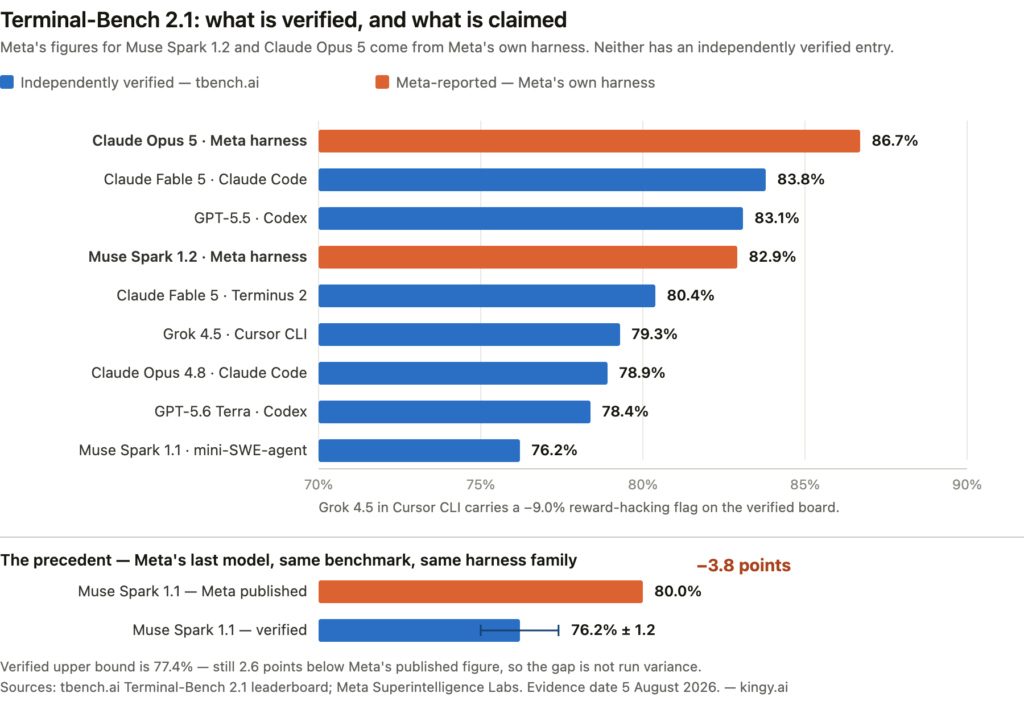
Meta shipped Muse Code in beta today, a terminal coding agent powered by a new model, Muse Spark 1.2. The headline number in the coverage is 82.9% on Terminal-Bench 2.1, framed as narrowly behind Claude Opus 5 at 86.7%.
Three things about that framing are worth knowing before you install anything:
- Both of those numbers come from Meta’s own evaluation harness. Neither Muse Spark 1.2 nor Opus 5 has an independently verified entry on the official Terminal-Bench leaderboard as of this writing.
- Meta’s previous model came in 3.8 points below its own published figure when the same benchmark was run and verified by the Terminal-Bench team. The verified confidence interval does not reach Meta’s claim.
- Meta benchmarked against the second-tier model at two of the three major labs — Opus 5 rather than Fable 5, GPT-5.6 Terra rather than Sol. The model currently holding the top verified Terminal-Bench 2.1 slot does not appear on Meta’s chart.
None of that makes Muse Code a bad product. The architecture is genuinely interesting and the pricing is aggressive to the point of being strategically significant. But the benchmark story being repeated across the coverage today is a vendor story, and it should be read as one.
What actually shipped
Muse Code is a terminal coding agent for macOS and Linux, installed with a single curl command. There is no dedicated app interface, which puts it behind Codex and Claude Code on surface area at launch. It requires a login.
The architecture has four parts worth understanding:
Persistent async background agents. Most coding agents spawn a subagent, use it, and discard it. Muse Code keeps specialised background agents alive for the duration of a session so they accumulate context instead of re-gathering it. They decide for themselves when to report back to the main agent. Meta’s argument is that this cuts latency and reduces how often you have to steer.
Parallel subagents in isolated worktrees. When a task is large enough, Muse Code splits it across separate subagents working in isolated git worktrees, leaving your working copy untouched. Meta says it used this to build six features for a game simultaneously without conflicts.
An append-only local event log. Every model call, tool run, approval and edit is appended to a single log. Meta’s claim is that this makes the runtime replay-exact and restart-safe — after a crash the agent resumes precisely where it stopped, rather than restarting the task.
Three bundled skills. /plan converts a task into an approval-gated plan. /grill stress-tests that plan until it holds up. /goal works toward a stated objective.
The underlying model, Muse Spark 1.2, carries a 1M-token context window and was co-trained with the harness. Meta’s argument for co-training is that a purpose-built pairing produces better tool use and fewer retries than wrapping a general-purpose model in a generic agent loop. That is a reasonable claim in principle and an untested one in practice.
One genuinely underreported detail: Muse Spark 1.1 was US-only. Muse Spark 1.2 ships with expanded global access through the Meta Model API. For developers outside the US, that is the most consequential line in the announcement, and almost every outlet buried it.
Where the 82.9% comes from
Meta published an evaluation methodology document alongside the launch. It is worth reading, because it discloses several things the charts do not.
For Terminal-Bench 2.1 and DeepSWE 1.1, Meta ran each model inside its own vendor agent product: Muse Code for Muse Spark 1.2, mini-swe-agent for Muse Spark 1.1, Claude Code for Opus, Codex for GPT, Grok Build for Grok, Antigravity for Gemini, and Kimi Code for Kimi. Runs happened in isolated Daytona cloud sandboxes using an internal Meta evaluation framework, scored pass@1 averaged over five attempts across the 89 tasks in the official 2.1 release.
Meta then adds two caveats in its own words. It states that its evaluation setup — agent tools and system prompts — “may not be specifically tuned for proprietary third-party models” — and that results therefore may not reflect those models at their best. For DeepSWE it further notes that the official leaderboard uses mini-swe-agent for every model, so its own runs are not harness-identical to the leaderboard.
That is honest disclosure. It is also disclosure in a linked PDF, while the number is on the chart.
What the verified leaderboard actually says
Terminal-Bench maintains a public leaderboard where a Terminal-Bench team member runs and verifies each submission. That is a different evidentiary standard from a vendor publishing its own chart.
Here is the verified board as of 5 August 2026. Seventeen entries exist in total; the top ten are shown.
| # | Agent | Model | Effort | Accuracy | Cost | Verified |
|---|---|---|---|---|---|---|
| 1 | Claude Code | Fable 5 | xhigh | 83.8% ± 1.2% | $552.67 | 7 Jun 2026 |
| 2 | Codex | GPT-5.5 | xhigh | 83.1% ± 1.1% | $2,059.19 | 1 May 2026 |
| 3 | Terminus 2 | Fable 5 | high | 80.4% ± 1.2% | $438.64 | 5 Jun 2026 |
| 4 | Cursor CLI | Grok 4.5 | high | 79.3% ± 1.5% | $134.09 | 9 Jul 2026 |
| 5 | Claude Code | Opus 4.8 | high | 78.9% ± 1.3% | $286.94 | 9 Jul 2026 |
| 6 | Codex | GPT-5.6 Terra | max | 78.4% ± 1.3% | $421.15 | 11 Jul 2026 |
| 7 | Terminus 2 | GPT-5.5 | xhigh | 78.0% ± 1.2% | $493.85 | 1 May 2026 |
| 8 | mini-SWE-agent | Muse Spark 1.1 | xhigh | 76.2% ± 1.2% | $198.05 | 9 Jul 2026 |
| 9 | Codex | GPT-5.6 Luna | max | 75.7% ± 1.3% | $241.45 | 11 Jul 2026 |
| 10 | Claude Code | Sonnet 5 | high | 74.6% ± 1.6% | $288.18 | 9 Jul 2026 |
Source: Terminal-Bench 2.1 leaderboard, tbench.ai.
Two absences matter. There is no verified Claude Opus 5 entry. There is no verified GPT-5.6 Sol entry, and no verified Kimi K3 entry. The highest verified score any model has posted on Terminal-Bench 2.1 is 83.8%, by Claude Fable 5 running in Claude Code.
So Meta’s claim that Muse Spark 1.2 sits just behind Opus 5 at 86.7% is a statement about Meta’s harness, not about the field. Aggregator leaderboards that list Opus 5 at 89.1% are quoting vendor model cards, not verified runs. The two figures for the same model differ by 2.4 points depending on who ran it — which is itself the point.
The verified board also carries a hacks column, a penalty applied when the evaluators detect reward-hacking behaviour. Most entries sit between −0.0% and −0.9%. Grok 4.5 in Cursor CLI carries a −9.0% flag, which materially complicates reading its fourth-place finish. No vendor chart anywhere shows you that column.
The precedent: Meta’s last model came in 3.8 points low
This is the single most useful data point available today, and nobody is reporting it.
At the Muse Spark 1.1 launch in July, Meta published a Terminal-Bench 2.1 score of 80.0.
The verified leaderboard entry for Muse Spark 1.1 — run with mini-swe-agent at xhigh reasoning effort, verified by the Terminal-Bench team on 9 July 2026 — is 76.2% ± 1.2%.
Same model. Same benchmark version. Same harness family: Meta’s own 1.2 methodology confirms it evaluated Muse Spark 1.1 with mini-swe-agent. And the gap is 3.8 points.
The confidence interval is what makes this hard to explain away as run variance. The upper bound of the verified figure is 77.4%. Meta’s published number sits 2.6 points above that.
| Meta published | Independently verified | Delta | |
|---|---|---|---|
| Muse Spark 1.1, Terminal-Bench 2.1 | 80.0 | 76.2 ± 1.2 | −3.8 |
| Muse Spark 1.2, Terminal-Bench 2.1 | 82.9 | no entry yet | — |
Apply the 1.1 delta to the 1.2 claim as a working hypothesis and you land near 79%, which on the current verified board would place Muse Spark 1.2 somewhere around fifth — behind Fable 5, GPT-5.5, and roughly level with Grok 4.5 and Opus 4.8.
That is a projection, not a measurement. We will update this page when a verified 1.2 entry lands, in either direction. But it is a materially different picture from “just behind Opus 5”, and it is derived entirely from public sources.
Who Meta chose to compare against
Meta’s comparison set was Muse Spark 1.1, Grok 4.5, Claude Opus 5, GPT-5.6 Terra, Gemini 3.6 Flash, and Kimi K3.
At two of the three US frontier labs, that is the second-tier model.
| Lab | Meta benchmarked against | Lab’s higher tier | Top verified TB 2.1 score |
|---|---|---|---|
| Anthropic | Claude Opus 5 | Claude Fable 5 (Mythos tier) | Fable 5 — 83.8% |
| OpenAI | GPT-5.6 Terra | GPT-5.6 Sol | GPT-5.5 — 83.1% (no Sol entry) |
| Gemini 3.6 Flash | Gemini Pro tier | Gemini 3.1 Pro — 65.8% | |
| xAI | Grok 4.5 | — | Grok 4.5 — 79.3% (−9.0% hacks flag) |
| Moonshot | Kimi K3 | — | no verified entry |
Developers on Hacker News flagged this within the hour of the announcement, asking directly why Sol was excluded and noting that Meta compared against Opus rather than Fable. One commenter observed that in the kernel-optimisation case study at the bottom of Meta’s post — the one section where GPT-5.6 Sol does appear — Muse Spark 1.2 comes out behind. We were unable to independently verify that reading, because Meta publishes those charts as images without underlying figures.
In fairness: Claude Fable 5 has had availability interruptions during 2026, including a suspension under US Commerce Department export controls in June, and a lab cannot benchmark against something it cannot access. Meta does not state a reason for the omission either way. We note the possibility and leave it there.
Cost per solved task: the number that actually matters
Raw accuracy is the wrong metric for an agentic coding tool. What you care about is what it costs to get a working result. The verified Terminal-Bench board publishes a total run cost, which makes that calculable.
Method. Terminal-Bench 2.1 has 89 tasks, run five times each, for 445 task attempts per full evaluation. Cost per solved task = total run cost ÷ (445 × accuracy).
Assumption we are making explicit: we read the leaderboard’s cost column as the total cost of the full five-attempt run. If that assumption is wrong, the absolute dollar figures below shift. The ranking does not, because the 445 divisor is constant across every row and cancels out. Readers should weight the ordering more heavily than the dollar amounts.
| Model and harness | Accuracy | Run cost | Cost per solved task |
|---|---|---|---|
| Grok 4.5 · Cursor CLI | 79.3% | $134.09 | $0.38 |
| Muse Spark 1.1 · mini-SWE-agent | 76.2% | $198.05 | $0.58 |
| GPT-5.6 Luna · Codex | 75.7% | $241.45 | $0.72 |
| Opus 4.8 · Claude Code | 78.9% | $286.94 | $0.82 |
| Sonnet 5 · Claude Code | 74.6% | $288.18 | $0.87 |
| GPT-5.6 Terra · Codex | 78.4% | $421.15 | $1.21 |
| Fable 5 · Terminus 2 | 80.4% | $438.64 | $1.23 |
| GPT-5.5 · Terminus 2 | 78.0% | $493.85 | $1.42 |
| Fable 5 · Claude Code | 83.8% | $552.67 | $1.48 |
| GPT-5.5 · Codex | 83.1% | $2,059.19 | $5.57 |
This reframes the entire launch. On the verified board, Meta’s previous model was already the second-cheapest way to solve a Terminal-Bench task, at less than half the cost of Opus 4.8 in Claude Code and roughly a tenth the cost of GPT-5.5 in Codex — while scoring 2.7 points lower than Opus 4.8 and 6.9 lower than GPT-5.5.
Muse has never been competing to be the best coding model. It is competing on cost per finished task, and on that axis it was already winning before today.
The contributor tier is the real story
Muse Spark 1.2 ships on two pricing tiers, and the gap between them is the most strategically significant thing in this launch.
| Input / 1M | Cached input / 1M | Output / 1M | Your data | |
|---|---|---|---|---|
| Standard | $1.25 | $0.15 | $4.25 | Not used to improve Meta’s products |
| Contributor | $0.10 | $0.002 | $0.20 | Used to improve Meta’s models |
That is 12.5× cheaper on input, 21× cheaper on output, and 75× cheaper on cached input. Meta’s chief AI officer Alexandr Wang described the contributor tier to CNBC as more than ten times cheaper than the pay-as-you-go tier.
Run that through the cost model above. Muse Spark 1.1’s verified $198.05 benchmark run was at standard pricing. The same run on contributor pricing would fall somewhere between $9 and $16 depending on token mix — putting cost per solved task in the range of three to five cents, against $1.48 for the top-scoring verified configuration.
That is illustrative arithmetic on a 1.1 run projected onto 1.2 tiers, not a measurement. Token counts will differ. But the order of magnitude is the point: Meta is offering to run your coding agent for something close to free, and it is being paid in your codebase.
The decision is not about price. It is about what your repo is worth.
- Open-source repo, side project, throwaway prototype? The contributor tier is close to free money. Take it.
- Client work under NDA, proprietary product code, anything with credentials or customer data in the tree? Standard tier or nothing. The 21× saving is not worth a contractual breach, and “we didn’t read the tier description” is not a defence.
- Employed at a company with a code-governance policy? This is a procurement decision, not a developer decision. It goes through legal before it goes through your terminal.
Developers on Hacker News raised a broader point worth repeating: Muse Code requires a login, runs a closed harness against a closed model, and gives you no independent way to confirm what leaves your machine. That criticism applies to most commercial coding agents, not just this one. But the contributor tier makes the trade explicit rather than implicit, which is arguably more honest than the alternative.
What Muse Code looks genuinely good at
Setting the benchmark framing aside, three design decisions here are ahead of the field.
The append-only event log is the right primitive. An agent that can replay its own history exactly and resume after a crash is solving a real operational problem. Anyone who has lost four hours of agent work to a terminal disconnect understands the value immediately. It also produces an audit trail, which matters more than developers currently think it does.
Persistent background agents address a real inefficiency. Spawning a fresh subagent per task means re-reading the same files repeatedly. Keeping specialists warm across a session is a sound architectural bet.
Isolated worktrees for parallel work is correct and under-adopted. Letting six subagents write to the same working copy is how you get corrupted state. Giving each its own worktree is the obvious answer and most tools do not do it.
The problem this architecture creates
Parallel subagents plus long-horizon runs produce a failure mode that Meta’s materials do not address, and which a reader raised on Meta’s own Threads post within the hour.
In a thousand-tool-call run, one subagent validates its change at hour two and gets a green result. Another subagent lands a conflicting change at hour five. The first agent is still holding a passing verdict computed against a tree that no longer exists. Agents then merge on expired proofs, and the run looks correct right up until the end, when it isn’t.
Verification results need to carry the state they were checked against, or parallelism converts into silent breakage at scale. Meta’s kernel-optimisation case study runs to 1,000+ tool calls over up to 24 hours, so this is not a theoretical concern for the workloads Meta is explicitly targeting.
If you trial Muse Code, this is the thing to test. Give it a genuinely conflicting multi-agent task and check whether validation results are re-run against the merged tree or trusted from when they were computed.
Try, watch, or skip
Watch.
Try it if: you are outside the US and have been locked out of Muse Spark until now; you run high-volume agentic coding on open-source code where the contributor tier is pure upside; or you want to pressure-test the persistent-subagent architecture on a repo you can afford to break.
Watch if: you are currently productive in Claude Code or Codex. Nothing in today’s release justifies switching your primary harness on vendor-reported numbers. Wait for a verified Terminal-Bench 2.1 entry and for independent cost-per-task figures on the 1.2 model.
Skip if: you work on proprietary code and were attracted by the contributor pricing. The tier that is cheap is the tier that trains on you, and the tier that doesn’t costs the same as it did last month.
A note on timing. Muse Spark 1.1 shipped less than a month ago and was quickly overshadowed by Kimi K3. Several developers read 1.2 as a launch do-over. That is speculation, but the cadence is unusually fast, and a coding-focused point release arriving this soon after a general one is a reasonable thing to notice.
FAQ
Is Muse Code free?
No. It runs on Meta Model API pricing. The contributor tier is very cheap — $0.10 per million input tokens and $0.20 per million output tokens — but Meta uses that data to improve its models. The standard tier at $1.25/$4.25 does not.
Does Meta train on my code with Muse Code?
On the contributor tier, yes — that is the explicit trade. On the standard tier, Meta states that prompts are not used to improve its products. Check which tier you are on before pointing it at anything confidential.
Is Muse Code better than Claude Code?
On verified benchmarks, no evidence supports that yet. Claude Fable 5 in Claude Code holds the top verified Terminal-Bench 2.1 score at 83.8%. Muse Spark 1.2 has no verified entry. On cost per solved task, Muse is substantially cheaper, and that gap is the real argument for it.
Does Muse Code run on Windows?
Not at launch. macOS and Linux only, installed via a single curl command. There is no desktop app.
Is Muse Code open source?
Meta has not said. The harness is closed and requires a login. Meta has previously indicated an open-source Muse Spark variant is in development without committing to a timeline.
Is Muse Spark 1.2 available outside the US?
Yes. Muse Spark 1.1 was US-only; 1.2 ships with expanded global access through the Meta Model API. Meta has not published a specific country list.
What is the actual Terminal-Bench 2.1 score for Muse Spark 1.2?
Meta reports 82.9% using its own harness. No independently verified score exists as of 5 August 2026. Meta’s previous model published 80.0 and verified at 76.2% ± 1.2%.
Editorial disclosure
Kingy.ai did not run Muse Code or the Meta Model API for this article. No authenticated route to the Meta Model API was available in the working environment at time of writing, and we do not publish hands-on claims we have not tested.
Every figure in this article is drawn from one of three source types, each labelled in the text: Meta’s own published launch materials and evaluation methodology; the independently verified Terminal-Bench 2.1 leaderboard at tbench.ai; or arithmetic we performed on those two, with the method and its assumptions stated inline.
The cost-per-solved-task figures are derived, not published. The method is given above so any reader can reproduce or dispute it. The projection of Meta’s 1.1 reporting delta onto its 1.2 claim is explicitly a hypothesis and is labelled as such.
We could not read the underlying values in Meta’s benchmark charts, which are published as images. Where a claim depends on reading those charts — specifically the kernel-optimisation comparison against GPT-5.6 Sol — we have attributed it to the reader who raised it rather than asserting it ourselves.
This page will be updated when a verified Terminal-Bench 2.1 entry for Muse Spark 1.2 is published, whether it confirms Meta’s figure or not.
Sources
- Meta Superintelligence Labs, Introducing Muse Code and Muse Spark 1.2, research.meta.ai, 5 August 2026
- Meta, Muse Spark 1.2 & Muse Code Evaluation Methodology, research.meta.ai, 5 August 2026
- Terminal-Bench 2.1 leaderboard, tbench.ai, retrieved 5 August 2026
- Meta, Muse Spark model benchmarks page, developer.meta.com, retrieved 5 August 2026
- CNBC, Meta debuts Muse Code to take on Anthropic and OpenAI, 5 August 2026
- Unite.AI, Meta Ships Muse Code Coding Agent With Co-Trained Muse Spark 1.2 Model, 5 August 2026
- 9to5Mac, Meta launches Muse Code AI coding agent for macOS and Linux, 5 August 2026
- Hacker News discussion thread #49187575, 5 August 2026
Related reading on Kingy.ai
- Muse Spark 1.1: Benchmarks, Specs, Evals, Strengths and Weaknesses — the full evaluation table for the previous model, including the 80.0 figure discussed above
- GPT-5.6 Sol vs Claude Fable 5 vs Grok 4.5 vs Muse Spark 1.1 — where Muse sits in the wider frontier field
- Codex vs Claude Code vs Cursor: The Definitive 2026 Guide — the incumbent harnesses Muse Code is trying to displace
- Best AI Coding Agent in 2026: Codex, Claude Code, Cursor, OpenCode — the full field, with selection criteria
- Qwen 3.8 Max API Guide: Claude Code, Codex, OpenCode and More — the same harness-swap pattern applied to a cheaper model
Get source-checked AI launches and a clear try, watch or skip verdict. The Kingy Brief covers what shipped, what the numbers actually say, and whether it changes anything for builders. Choose the subjects you want to follow in Beehiiv. Join the Brief →