
Last updated: June 26, 2026. Editor note: This is policy and business analysis, not legal advice. The public record is moving quickly. This article separates confirmed facts, reasonable analysis, and future possibilities so readers can distinguish evidence from scenarios.
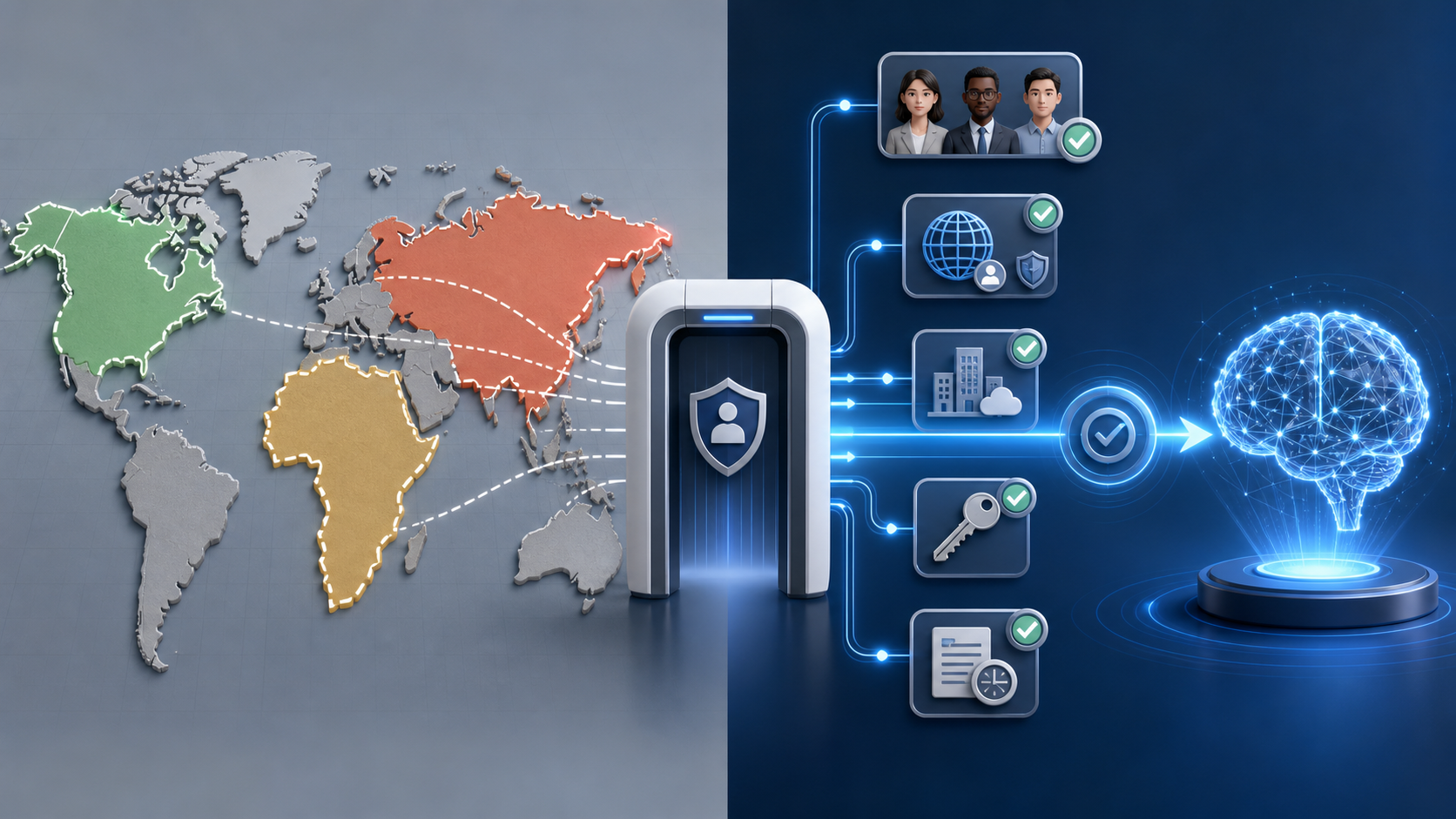
Image note: AI-generated editorial image: a frontier AI access gate closing as cloud intelligence becomes a national-security control surface.
The AI industry just learned a hard lesson: access to frontier intelligence can become a policy decision overnight.
For years, the practical assumption behind enterprise AI adoption was simple. If a company could afford a model, pass the vendor’s terms, and integrate the API, access would be available. There might be outages, rate limits, pricing changes, model deprecations, data-residency rules, and safety filters. But the core availability of the model itself was treated as a commercial matter.
The recent restrictions affecting Anthropic’s Fable 5 and Mythos 5 models challenge that assumption. According to Anthropic’s public statement, the company received a U.S. government export-control directive on June 12, 2026, requiring it to suspend access to those models by foreign nationals, including foreign-national Anthropic employees. Because the company said it could not selectively comply at that speed, it disabled access to Fable 5 and Mythos 5 for all customers while working through the issue.
For readers catching up, Kingy AI’s earlier coverage of the Anthropic Fable 5 and Mythos 5 export-control ban explains the immediate shutdown, while the Claude Fable 5 launch tracker record documents why the model mattered before the access shock.
The question is not whether this one directive will stand forever. It may be narrowed, reversed, clarified, or replaced by a more durable access framework. The larger question is whether this event marks a precedent: the moment cloud AI access stopped looking like ordinary SaaS and started looking like strategic infrastructure governed by national-security policy.
Have we entered an era where access to intelligence is no longer guaranteed?
The honest answer is: possibly, but not conclusively. The facts support concern. They do not support panic. The right response is not to overstate certainty. It is to redesign AI strategy around a more realistic premise: frontier model access is now a dependency that can be shaped by governments, export controls, executive action, cloud providers, geopolitics, security incidents, and sovereign-AI policy.
Key Takeaways
- Confirmed: Anthropic says a U.S. government directive required suspension of Fable 5 and Mythos 5 access by foreign nationals, including foreign-national employees.
- Confirmed: U.S. export-control law already contains person-based concepts such as deemed exports, where controlled technology released to a foreign person in the United States can be treated as an export.
- Reasonable analysis: The incident shows that cloud AI access can become a national-security control surface, not merely a vendor availability issue.
- Reasonable analysis: Startups, enterprises, and investors should treat frontier model dependency like a supply-chain risk.
- Future possibility: Governments may move toward formal pre-release testing, model licensing, cloud access controls, allied access tiers, or sovereign AI mandates.
- Practical response: Build model-routing layers, fallback plans, open-weight alternatives, contract language, and audit trails before the next policy shock.
Table of Contents
- Confirmed facts: what happened
- Timeline: how fast AI access changed
- Why this may be a Rubicon moment
- Government intervention and export controls
- Executive actions and pre-release model gates
- Why cloud AI changes the export-control problem
- Startup uncertainty and investor confidence
- Enterprise planning after sudden model loss
- Sovereign AI and open-source alternatives
- Future scenarios for AI access
- A practical planning playbook
- FAQ
Confirmed Facts: What Happened
The baseline facts are narrow, but consequential.
Anthropic’s statement is the primary source. Anthropic said it received a U.S. government export-control directive on June 12, 2026 at 5:21 p.m. ET. According to the company, the directive required suspension of all access to Fable 5 and Mythos 5 by foreign nationals, whether inside or outside the United States, including foreign-national Anthropic employees. Anthropic said access to other models was not affected.
The company disputed the rationale. Anthropic said the government letter did not provide specific details of the national-security concern. Anthropic’s understanding was that the concern involved a possible way to bypass or jailbreak Fable 5, but the company disputed the severity and framed the action as disproportionate.
The full directive is not public in the sources reviewed here. That matters. Without the full legal text, outside observers should not claim to know every definition, exception, license path, enforcement threshold, or government theory. A serious analysis has to work from public statements and reputable reporting, while acknowledging the missing document.
Major news organizations framed the action as significant. The Associated Press reported the move as a major step by the U.S. government to restrict access to advanced AI models. Reuters reported, citing Axios and noting the limits of its own verification at the time, that the administration was blocking foreign access to Anthropic’s most advanced models.
Follow-on reporting suggests the issue may not be isolated to Anthropic. Axios reported on June 25, 2026 that the Trump administration asked OpenAI to limit the rollout of its next model, GPT-5.6, to a small set of government-approved partners before broader release, citing security concerns and a developing testing framework. That is reporting, not a published regulation. Still, it points toward a broader government interest in pre-release frontier-model oversight.
Those are the confirmed or carefully attributed facts. Everything beyond them should be labeled as analysis or scenario planning.
Timeline: How Fast AI Access Changed
The speed of the event is the business lesson. A model can go from strategic adoption target to unavailable dependency faster than procurement, legal, or architecture teams can react.
| Date | Event | Why it matters |
|---|---|---|
| June 2026 | Anthropic introduced Fable 5 and Mythos 5 as high-capability Claude-family models. | Teams began evaluating them as frontier model options for reasoning, coding, agents, and security workflows. |
| June 12, 2026, 5:21 p.m. ET | Anthropic says it received a U.S. export-control directive concerning Fable 5 and Mythos 5. | The decision path moved from vendor roadmap to government intervention. |
| June 12-13, 2026 | Anthropic said it would disable Fable 5 and Mythos 5 access while working to comply. | Access disruption became immediate and global in practical effect, according to the company. |
| Mid-June 2026 | Reporting from AP, Reuters, Axios, Business Insider, and others framed the directive as a major AI access-control event. | The incident became a precedent case for AI policy, cloud access, and export-control enforcement. |
| June 25, 2026 | Axios reported that the administration asked OpenAI to limit the release of GPT-5.6 while security testing is developed. | The policy question widened from one Anthropic dispute to possible pre-release controls for frontier models. |
| Next 30-180 days | Possible clarifications, license paths, diplomatic exceptions, testing frameworks, lawsuits, or revised provider controls. | Enterprises and startups need contingency plans before the policy environment stabilizes. |
Why This May Be a Rubicon Moment
“Rubicon” is a strong word. It should not be used lightly. A Rubicon moment is not just a surprising news cycle. It is a boundary crossing after which the old assumptions no longer fully hold.
This event may qualify because it changes the mental model for AI access in five ways.
First, the object of control may be access to intelligence, not just chips or source code. U.S. export controls have long targeted advanced chips, manufacturing equipment, technical data, source code, and sensitive know-how. The Fable/Mythos event points toward a hosted model itself becoming the controlled asset. That is different from blocking a shipment of GPUs or restricting a repository. It is a restriction on remote use of capability.
Second, the control surface may follow people, not just countries. Anthropic says the directive applied to foreign nationals inside and outside the United States, including employees. That resembles the logic of deemed exports more than ordinary geofencing. The Bureau of Industry and Security explains that deemed exports involve sharing or releasing controlled technology or source code to a foreign person within the United States. BIS’s deemed-export explainer says releases to foreign persons in the U.S. are treated as exports to that person’s country or countries of nationality, subject to important exemptions and legal details.
Third, the asset is cloud-based. Fable 5 and Mythos 5 were not ordinary downloads. They were cloud AI services. The provider controls inference, product access, APIs, enterprise channels, internal tooling, and partner distribution. That makes model access both easier to cut off centrally and harder to selectively administer across users, employees, customers, countries, tenants, and downstream applications.
Fourth, the timing was abrupt. Whether the directive was legally justified is a separate question. The operational reality is clear: critical AI access can change before a company has time to update architecture, customer contracts, investor memos, or incident playbooks.
Fifth, the precedent travels. If one frontier model can be restricted this way, other frontier models may be evaluated through the same lens. That does not mean every advanced model will be blocked. It means policymakers have shown a willingness to treat model access as a national-security lever.
That is why the event matters even to companies that never planned to use Anthropic. The precedent is about the category, not only the vendor.
Government Intervention and Export Controls
Government intervention in AI is not new. What is changing is the layer where intervention occurs.
The first wave of high-profile AI controls focused heavily on inputs: chips, semiconductor equipment, data-center capacity, and the ability of foreign actors to acquire the hardware needed to train frontier models. The Framework for Artificial Intelligence Diffusion, published in the Federal Register in January 2025, is one example of U.S. policy connecting advanced computing capacity, AI diffusion, and national security. Whether particular rules survive, change, or are litigated, the policy direction is clear: advanced AI capability is treated as strategically relevant.
The Fable/Mythos incident shifts attention from compute inputs to capability access. That is a harder frontier because modern AI capability is delivered through cloud services. A user does not need to own the model weights or train the system. They may only need an API key, a cloud marketplace entitlement, or access through an enterprise application.
That creates a policy problem. If a government believes a model has sensitive cyber, biological, intelligence, or military capabilities, blocking only exported chips may be too indirect. But blocking model access creates new problems: overbreadth, collateral damage, due process concerns, foreign-policy friction, enforcement uncertainty, and competitive distortion.
Export-control logic works most cleanly when the controlled item is definable, classifiable, and auditable. Frontier AI challenges all three conditions.
Definability problem: Is the controlled item the model weights, the hosted endpoint, a class of capabilities, a benchmark threshold, a jailbreak behavior, the ability to run autonomous agents, or access to outputs?
Classification problem: If capability changes through fine-tuning, scaffolding, tool access, retrieval, and system prompts, when does an ordinary model become controlled?
Audit problem: If an enterprise routes a hosted model through internal tools, which person actually accessed the model, where were they, what nationality or legal status matters, and what did downstream users receive?
Those are not arguments against national-security controls. They are arguments for precision. A blunt rule may be quick. A durable access regime has to be technically administrable.
Executive Actions and Pre-Release Model Gates
Executive action matters because AI policy often moves faster through presidential directives, agency letters, procurement rules, and national-security processes than through comprehensive legislation.
Axios reported on June 25 that the White House Office of the National Cyber Director and the Office of Science and Technology Policy asked OpenAI to limit the rollout of GPT-5.6 while the administration builds a framework for testing and evaluating new models. Axios also reported that President Trump signed an AI security executive order earlier in June directing agencies to stand up voluntary testing protocols before new model releases.
Because the full practical framework is not yet stable in the public record, companies should avoid assuming that one article or one directive fully defines the future. But the pattern is notable. The U.S. government appears to be experimenting with several levers:
- post-launch export-control directives
- pre-release consultation with labs
- government or government-approved testing
- limited partner access before broad release
- cloud and marketplace pressure
- national-security framing for model capabilities
The policy question is whether this becomes a predictable testing and licensing regime or remains a series of ad hoc interventions. The difference is enormous.
A predictable regime gives labs, customers, investors, and allies a path: evaluate, document, mitigate, license, monitor, and release. An ad hoc regime creates uncertainty: launch a model, wait for political reaction, and hope the access rules do not change after customers have integrated it.
Investors and enterprise buyers should care less about the slogan and more about the operating model. A voluntary testing protocol may be manageable. A surprise letter on a Friday evening is a different risk profile.
Why Cloud AI Changes the Export-Control Problem
Cloud AI is not software in the old sense. It is capability delivered as a service.
A traditional software export might involve shipping code, transferring source, selling equipment, or giving a customer technical documentation. A frontier model API is different. The provider can keep the weights private, run inference on its own infrastructure, expose capabilities through a managed endpoint, and update the system continuously.
That makes cloud AI attractive to enterprises. It also makes it vulnerable to centralized control.
If a model is delivered through one provider’s API, one cloud marketplace, one enterprise contract, or one privileged partner channel, access can be changed centrally. That is convenient for abuse response and compliance. It is dangerous for businesses that mistake “cloud-managed” for “guaranteed.”
For policy teams, cloud AI also raises a downstream-access question. Suppose a U.S. company uses a frontier model through a U.S. cloud region. Its employees include foreign nationals. Its customers are global. Its internal app stores prompts and outputs. Its contractors review logs. Its model calls are routed through agents that act on behalf of users. Who, exactly, has accessed the controlled model?
Ordinary geofencing asks where a request comes from. Person-based access control asks who the user is, what legal status matters, whether the organization can certify eligibility, and whether downstream routing exposes the model to restricted people. That is a harder system.
The likely compliance stack would include some combination of:
- identity verification and role-based access controls
- enterprise SSO tied to model entitlements
- API keys scoped by user group, tenant, region, and model class
- audit logs that connect model calls to human users
- customer attestations about downstream use
- cloud-region and data-residency controls
- licensing workflows for exceptions
- incident procedures for emergency model withdrawal
Those controls are possible. They are not trivial. They impose costs that large labs and large enterprises can absorb more easily than small startups.
Startup Uncertainty and Investor Confidence
The startup lesson is not “never depend on frontier models.” That would be bad advice. Many startups should use the best available models to reach product-market fit quickly.
The better lesson is: know when a model dependency has become existential.
An early prototype can depend on one model. A mission-critical product with paying customers, regulated workflows, or contractual uptime promises should not assume one frontier model will remain available on the same terms forever.
Startup risk now has an AI-access dimension:
- Product risk: the core feature may stop working if a model is withdrawn.
- Margin risk: fallback models may cost more or perform worse.
- Compliance risk: customers may ask where models run, who can access outputs, and whether access can be revoked by policy.
- Sales risk: enterprise buyers may hesitate if the startup cannot explain continuity plans.
- Fundraising risk: investors may discount companies with single-provider, single-model dependency in sensitive domains.
- Geography risk: a startup selling globally may face different access rules across markets.
This does not kill AI startups. It changes diligence.
Investors should ask whether the company has evaluated more than one model, whether prompts and evals are portable, whether the architecture includes a routing layer, whether open-weight alternatives can cover minimum viable functionality, and whether customer contracts make realistic claims about model availability.
Founders should prepare honest answers. “We use the smartest model” is not an AI strategy. It is a procurement sentence. The strategy is how the product routes work, preserves quality, contains cost, protects data, handles outages, and survives policy shocks.
Kingy AI’s guide to choosing the right model for the right job makes this point at the workflow level. The Fable/Mythos incident raises it to a board-level risk.
Enterprise Planning After Sudden Model Loss
Enterprises already know how to plan for cloud outages, vendor failure, regulatory change, and cyber incidents. AI access now belongs in the same continuity category.
For enterprise leaders, the most dangerous assumption is that AI is only an innovation initiative. Once a model powers support, code generation, compliance review, claims processing, internal search, incident response, sales enablement, or customer-facing automation, it becomes operational infrastructure.
That infrastructure needs a plan for at least three horizons.
Twenty-four-hour disruption: Can the workflow degrade gracefully? Can the team pause automations, switch to a backup model, notify users, and preserve logs?
Seven-day disruption: Can business teams continue with manual review, lower-capability models, retrieval-only workflows, or alternative vendors? Can customer commitments still be met?
Permanent access change: Can the product migrate model classes, renegotiate customer language, update compliance documentation, retrain evals, and preserve core economics?
That planning has to be concrete. A generic statement that “we can switch models” is not enough. Teams need tested routing policies, benchmark sets, prompts stored outside a vendor-only interface, output schemas that survive provider differences, and product messaging for degraded states.
Enterprise AI governance also has to separate use cases by consequence. A writing assistant can tolerate lower-quality fallback. A cybersecurity triage agent, legal research workflow, medical documentation assistant, or financial compliance tool may need stricter controls, human review, and pre-approved fallback providers.
The strongest enterprise posture is not total independence. It is managed dependence. Use frontier models where they matter. Use smaller models where they are enough. Use open-weight models where portability or privacy matters. Use humans where the decision is consequential. Measure the outcome, not the vendor brand.
For more on routing as a company capability, see Kingy AI’s analysis of why the future of the firm is the routing layer.
Sovereign AI and Open-Source Alternatives
Sovereign AI is the policy answer to unreliable foreign access. If a country, region, or major enterprise believes frontier intelligence may be restricted by another government, it will look for domestic compute, domestic models, domestic data centers, domestic clouds, or trusted allied access.
That push was already underway before the Fable/Mythos event. The incident gives it a sharper argument: if your public sector, banks, telecoms, hospitals, defense contractors, or national champions depend on a foreign frontier model, what happens when access changes overnight?
Open-source and open-weight models are part of the answer, but they are not magic.
The Open Source Initiative’s Open Source AI Definition emphasizes freedoms to use, study, modify, and share AI systems, including access to preferred forms for modification. Many models called “open source” are more accurately open-weight: their weights may be downloadable, but training data, training code, full reproducibility, or unrestricted rights may not be available.
Still, open-weight models matter because they give teams options:
- run inference across multiple clouds
- deploy in private infrastructure
- fine-tune or distill for narrow workflows
- reduce dependency on one closed vendor
- maintain fallback service during access shocks
- support countries and enterprises pursuing sovereign AI stacks
The tradeoff is capability and responsibility. A company that self-hosts or private-hosts a model inherits more operational burden: hardware, serving, monitoring, security, abuse prevention, evaluation, latency, upgrades, and licensing review. An open model is not automatically safer. A local model is not automatically good enough. A sovereign model is not automatically competitive with the strongest closed frontier systems.
The likely winning pattern is hybrid. Use closed frontier models for the hardest reasoning and planning tasks. Use hosted smaller models for volume. Use open-weight models for portability, privacy, and fallback. Use deterministic tools for facts and calculations. Use humans for high-consequence review.
Kingy AI’s guide to open-source AI models, local LLMs, and AI sovereignty covers that tradeoff in more detail.

Future Scenarios for AI Access
No one should claim certainty about where this goes. The best approach is scenario planning. Here are five plausible futures, from least disruptive to most fragmented.
Scenario 1: The Directive Is Narrowed and Becomes a One-Off
In this scenario, the Fable/Mythos restriction is clarified, resolved, or replaced by a narrower control. Anthropic restores access under revised safeguards. Policymakers conclude that the specific facts were unusual. Other labs continue releasing frontier models with more consultation but no broad new access regime.
What would support this scenario: quick restoration of access, clear government explanation, no similar actions against other labs, and a voluntary testing process that remains genuinely voluntary.
Business impact: moderate. Companies still learn to build fallbacks, but investor confidence recovers if the incident looks like a singular governance dispute.
Scenario 2: Frontier Models Enter a Pre-Release Testing Regime
In this scenario, the government does not routinely shut down models after launch. Instead, major labs submit frontier systems for structured security testing before broad release. Some models get staged rollout, trusted-customer access, government review, or mitigation requirements.
What would support this scenario: formal testing protocols, clear thresholds, published agency roles, and predictable timelines for labs.
Business impact: manageable but real. Product timelines lengthen. Investors demand regulatory calendars. Enterprises ask whether a model is “release-cleared” before building on it.
Scenario 3: Allied Access Tiers Become the Norm
In this scenario, frontier models are available differently across allied countries, restricted countries, trusted enterprises, government partners, and public users. Access depends on organization type, jurisdiction, cloud region, user identity, contractual controls, and national-security relationships.
What would support this scenario: diplomatic negotiations, country-by-country access exceptions, cloud-region licensing, and provider dashboards that expose compliance tiers.
Business impact: high for global companies. Product managers must design features by market. Procurement teams need model-access matrices. Legal teams need user-eligibility language.
Scenario 4: Sovereign AI Fragmentation Accelerates
In this scenario, countries decide that foreign frontier access is too unreliable. They subsidize domestic models, national clouds, compute reserves, public-sector AI platforms, and data-localization rules. U.S., European, Chinese, Indian, Gulf, and other sovereign stacks diverge.
What would support this scenario: recurring access shocks, trade disputes, national compute funds, public-sector procurement mandates, and strategic AI partnerships tied to diplomacy.
Business impact: very high. AI companies need regional stacks. Enterprises may need different model suppliers for different jurisdictions. Open-weight models become more strategically important.
Scenario 5: Open-Weight Models Become the Escape Hatch
In this scenario, closed frontier access becomes policy-sensitive enough that startups and enterprises aggressively adopt open-weight models for resilience. Closed models still lead on the hardest tasks, but critical workflows are designed to survive on open or private-hosted alternatives.
What would support this scenario: fast open-weight performance gains, lower inference costs, better tooling, enterprise support, and repeated closed-model access disruptions.
Business impact: mixed. Vendor lock-in falls, but operational complexity rises. The advantage shifts toward teams that can evaluate, route, host, and govern multiple models well.
A Practical Planning Playbook
The practical response is not to abandon frontier AI. It is to stop pretending access risk is theoretical.
1. Classify Model-Critical Workflows
List every workflow that depends on a frontier model. Then classify each one by consequence: convenience, productivity, customer-facing, regulated, security-sensitive, revenue-critical, or existential to the product. Do not spend the same resilience budget on a brainstorming assistant and a production incident-response agent.
2. Build a Model Access Register
Track which models are used, through which provider, in which cloud region, under which contract, with which data-retention terms, for which customers, and with which fallback. This should live with security, legal, and engineering, not only inside a product manager’s notes.
3. Separate Prompts, Evals, and Routing From the Vendor
If your prompts, test sets, routing rules, and output schemas live only in one provider’s dashboard, switching becomes harder. Keep critical application logic in your own system where practical.
4. Test Fallbacks Before You Need Them
Run the same tasks through at least one alternative model. Measure accuracy, refusal behavior, latency, cost, tool-use reliability, and user satisfaction. A fallback that has never been evaluated is a hope, not a plan.
5. Use Open-Weight Models Strategically
Do not self-host everything by default. Instead, identify workflows where portability, privacy, cost, or continuity justifies open-weight deployment. Start with narrow tasks: extraction, classification, summarization, internal search, formatting, and batch processing.
6. Update Enterprise Contract Language
Customer contracts should avoid promising perpetual access to a specific model unless the vendor can actually guarantee it. Better language describes service levels, fallback models, material degradation, customer notices, and human-review options.
7. Prepare Communications for AI Access Incidents
If a model is pulled, customers will not want a philosophical essay. They will want to know what is affected, what continues working, what data is safe, what fallback is active, whether quality changed, and when the next update arrives.
8. Treat Nationality, Geography, and Entity Controls Separately
Geography tells you where a request originates. Nationality or person status tells you who is accessing the system. Entity controls tell you which organization is responsible. Export-control scenarios may require different combinations. Your identity architecture should not collapse them into one vague “region” field.
9. Add Board-Level AI Dependency Review
If AI is material to revenue, product capability, or risk posture, boards should review model dependency the way they review cloud concentration, cybersecurity posture, and regulatory exposure. Investor confidence improves when leadership can explain the dependency honestly.
Confirmed Facts vs Analysis vs Possibilities
| Category | What belongs here | How to use it |
|---|---|---|
| Confirmed facts | Anthropic’s statement, BIS deemed-export guidance, Federal Register export-control records, and carefully attributed reporting. | Use for factual summaries, timelines, and citations. |
| Reasonable analysis | Cloud AI access is a supply-chain risk; person-based access controls are harder than geofencing; startups need fallback models. | Use for planning and architecture decisions, while acknowledging uncertainty. |
| Future possibilities | Pre-release licensing, allied access tiers, sovereign AI fragmentation, wider model export controls, or open-weight fallback acceleration. | Use for scenario planning, not as claims about what will definitely happen. |
Verdict: Did We Cross the Rubicon?
We may have crossed a Rubicon, but the river is policy, not technology.
The confirmed facts do not prove that every frontier model will now require a government license. They do not prove that foreign nationals will be broadly excluded from advanced AI. They do not prove that closed AI is doomed or that open-source models will replace frontier labs.
They do prove something narrower and still profound: access to frontier AI can be interrupted by government action quickly, globally, and for reasons outside a customer’s control.
That is enough to change AI strategy.
The smartest companies will not respond with panic. They will respond with architecture. They will treat model access as a managed dependency. They will build routing layers, fallback plans, open-weight options, identity controls, customer communications, and governance processes. They will keep using frontier models where frontier capability matters, but they will stop assuming that intelligence delivered from the cloud is guaranteed.
The age of “just call the best model” is ending. The age of AI access strategy has begun.
Authoritative Sources and Further Reading
- Anthropic: Fable/Mythos access statement
- Associated Press: U.S. government restriction on Anthropic models
- Reuters: U.S. blocks foreign access to Anthropic’s most advanced AI models, citing Axios
- Axios: How Amazon and the White House ended Anthropic’s Fable
- Axios: Trump administration asks OpenAI to limit next model release
- Bureau of Industry and Security: Deemed exports
- Bureau of Industry and Security: What is a deemed export?
- Federal Register: Framework for Artificial Intelligence Diffusion
- Open Source Initiative: Open Source AI Definition
FAQ
Did the U.S. government ban all foreign access to all frontier AI models?
No. The public record reviewed here supports a narrower statement: Anthropic says a U.S. directive required it to suspend access to Fable 5 and Mythos 5 by foreign nationals, including foreign-national employees. Broader restrictions are a future possibility, not a confirmed fact.
Does this mean AI access is no longer guaranteed?
It means frontier AI access should not be treated as guaranteed. The incident shows that access can change quickly because of national-security policy, export controls, or government pressure. That does not mean every model will be restricted.
What is the difference between geofencing and person-based access control?
Geofencing asks where a request originates. Person-based access control asks who the person is and whether that person is eligible to access the controlled capability. The second is harder for cloud AI because enterprise users, employees, contractors, and downstream applications may cross jurisdictions.
Are open-source models the solution?
They are part of the solution, especially for portability, fallback, privacy, and sovereign AI strategies. But open-weight or open-source models also bring operational, licensing, security, evaluation, and quality tradeoffs. They complement frontier APIs; they do not automatically replace them.
What should startups do first?
Startups should identify whether a single model is existential to the product. If it is, they should create a fallback plan, store prompts and evals portably, test at least one alternative model, and avoid customer promises that depend on permanent access to one provider.
What should enterprises do first?
Enterprises should build a model access register, classify critical workflows, test fallback models, review contracts, and define incident communications for model-access disruptions. AI governance should include availability and policy risk, not only privacy and security risk.
Could this improve AI safety?
Possibly, if controls become precise, transparent, technically grounded, and predictable. It could also harm innovation and trust if controls are ad hoc, opaque, or applied unevenly. The outcome depends on policy design.
Is this legal advice?
No. Export controls, deemed exports, sanctions, procurement rules, and national-security directives are legal matters. Companies should consult qualified counsel before making compliance decisions.
The Kingy Brief
Get the next Kingy Brief.
Source-checked AI changes, original tests and one practical thing to try.
Free · Choose your subjects · Double opt-in · Unsubscribe anytime