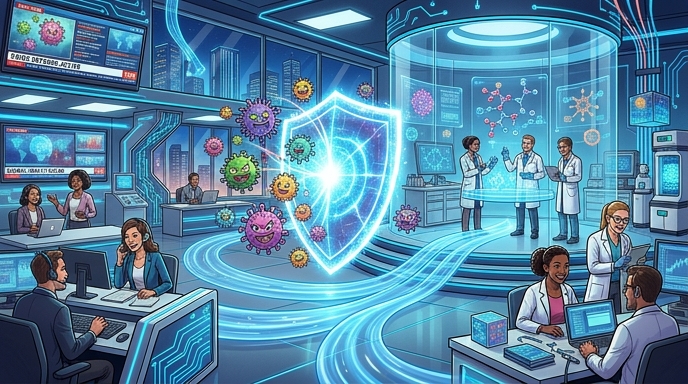
The Cold Has a New Enemy: Silicon Valley

The common cold may finally have met something more annoying than itself: a group of tech-backed funders with half a billion dollars and a grudge.
A new philanthropic initiative called Intercept has launched with a bold mission: reduce the burden of respiratory infections and, eventually, make them a thing of the past. That means the cold. The flu. COVID-like threats. The whole sneezy, tissue-hoarding parade.
The initiative is backed by major corporate and philanthropic donors, including Stripe, Anthropic, the OpenAI Foundation, Flu Lab, Bill Gates through a philanthropic entity, and individuals from Jane Street, according to reports from MIT Technology Review, Financial Times, and Respiratory Therapy.
The price tag is not tiny. Intercept describes itself as a $500 million philanthropic initiative. That sounds huge because it is. But against the global cost of respiratory infections, it may be more like bringing a flamethrower to a continent-sized iceberg.
Still, it is a start. And a fascinating one.
Why Go After Respiratory Infections?
Because they are not just “a sniffle.”
That is the central argument behind Intercept. We often treat colds and flu as boring background noise. Someone coughs. Someone misses work. Someone says, “It’s just going around.” Then everyone moves on.
Intercept argues that this casual attitude hides a much larger problem. On its website, the group says respiratory viruses kill about 1 million people a year, cost around $600 billion annually, disrupt daily life, and can periodically threaten civilization through pandemics.
That last part matters. COVID-19 made the point with a sledgehammer. Respiratory viruses do not need much help to travel. They move through offices, schools, airports, homes, trains, and badly ventilated conference rooms where one person always insists, “It’s just allergies.”
Respiratory Therapy reported that Intercept sees the problem as both a health crisis and an economic drag. Its plan is not only to treat severe disease after it happens. The bigger goal is prevention.
In plain English: stop the viruses before they turn the human population into a global coughing choir.
What Intercept Actually Plans to Fund
Intercept is not putting all its money into one miracle pill. That would be neat, but biology rarely accepts neat little business plans.
Instead, the initiative focuses on two broad categories.
First, it wants to support broad-spectrum preventatives. These are tools designed to protect people from many respiratory viruses at once. They could include vaccines, nasal sprays, pills, antibodies, RNA-based drugs, or other therapies that target several pathogens instead of chasing one strain at a time.
Second, Intercept wants to back air-cleaning technologies. Think better filtration, ultraviolet light systems, and other approaches that remove or neutralize infectious aerosols indoors.
That second category is especially interesting. Public health often focuses on what individuals do: wash your hands, stay home, get vaccinated, wear a mask when needed. Intercept is also looking at the environment itself.
That means cleaner air in schools. Cleaner air in offices. Cleaner air in airports. Basically, fewer viral particles floating around like tiny biological freeloaders.
The Broad-Spectrum Bet
The common cold is hard to beat because there is no single “cold virus.”
There are many. Rhinoviruses alone come in many forms. Then add influenza viruses, coronaviruses, RSV, and other respiratory pathogens. It becomes a crowded little villain convention.
That is why broad-spectrum prevention matters. If a product only stops one virus, it may help, but it will not solve the whole problem. Intercept wants tools that can defend against many respiratory viruses simultaneously.
According to Respiratory Therapy, the initiative may support areas such as RNA drugs, antibodies, and computational protein design. One possible idea involves engineered proteins that could grab viruses in the nasal passages before they establish infection.
That sounds like sci-fi. It is not. It is early-stage biomedical engineering with a very practical ambition: block infection at the front door.
The nose is a sensible battlefield. Many respiratory viruses enter through the upper airway. If a spray, antibody, or similar product can stop them there, it could prevent symptoms, transmission, and downstream complications.
The big question is whether these ideas can prove safe, effective, scalable, and affordable. That is the brutal part.
Why Pharma Has Not Already Solved This
If colds and flu cost so much, why have pharmaceutical companies not already bulldozed the problem?
Simple answer: incentives.
The common cold is messy. It is caused by many viruses. Symptoms are usually short-lived. Clinical trials can be tricky. A product must be very safe because it would be used by healthy people. And if the market looks uncertain, companies may decide their money can earn better returns elsewhere.
That is where Intercept wants to intervene.
Respiratory Therapy reported that the initiative aims to “de-risk” early drug development by funding Phase I and Phase II clinical trials. Those early trials can cost tens of millions of dollars per drug. Intercept’s goal is to move at least two treatments through those stages so larger pharmaceutical companies may be more willing to fund the bigger, more expensive Phase III trials required for approval.
This is not charity as confetti cannon. It is targeted market-shaping.
Intercept is basically saying: “We will pay to prove this road exists. Then industry can drive the trucks.”
The Air-Cleaning Angle Is Not a Side Quest
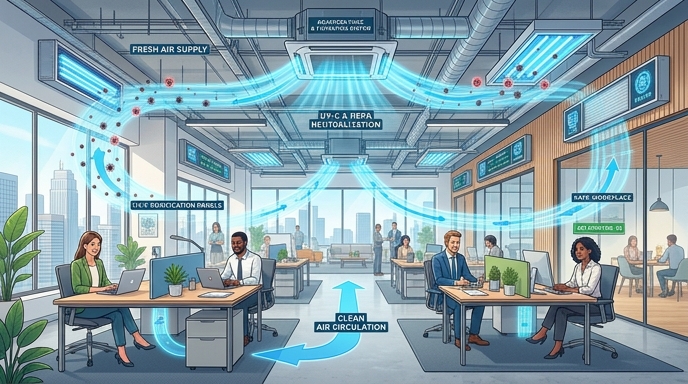
Air cleaning may sound less glamorous than designer antivirals. No one makes a superhero movie about HVAC upgrades.
They should. The villain is airborne.
Intercept argues that indoor air needs the same civilizational upgrade that drinking water once received. That comparison matters. Clean water did not become normal because everyone individually boiled every sip forever. Society built infrastructure.
Air may need a similar rethink.
On its official site, Intercept says air-cleaning technologies can improve indoor air quality by removing or inactivating airborne viruses. The group mentions air filtration, antimicrobial light, and antimicrobial vapors as areas of interest.
Respiratory Therapy reported that Intercept also wants to work with prospective buyers to test systems in real-world spaces. That matters because laboratory success is not enough. A system must work in offices, schools, airports, and other places where humans gather and breathe each other’s recycled nonsense.
Adoption is the real mountain. Equipment costs money. Buildings vary. Regulations move slowly. Maintenance is boring. And boring things often decide whether public health plans survive.
The Buyer Network: Making Demand Less Theoretical
One clever part of Intercept’s plan is the buyer network.
According to Financial Times reporting summarized in accessible listings, Intercept plans to create a network of prospective buyers that may include major companies such as JPMorgan Chase, Mastercard, Meta, and others. Respiratory Therapy also reported that Mastercard and JP Morgan were among corporate partners expected to pilot or test air-filtration systems.
This matters because innovators hate building into a vacuum.
If a startup develops a powerful air-cleaning system but cannot find customers, the product dies quietly. If large companies say, “Build something that meets these standards and we may test or buy it,” the market looks less imaginary.
That signal can pull technology forward.
It can also generate useful feedback. Offices care about noise, cost, installation time, energy use, maintenance, safety, and whether the device looks like it belongs in a server room from 1998.
For air-cleaning tools to scale, they cannot merely work. They must fit real buildings and real budgets.
Why AI Companies Are in This Story
The presence of Anthropic and the OpenAI Foundation gives this story its modern weirdness.
At first glance, AI companies backing anti-cold research feels like a plot twist from a health-tech satire. But there are a few plausible reasons.
First, AI leaders increasingly talk about biological risk, pandemic preparedness, and the need for better defenses against engineered or natural pathogens. Second, modern drug discovery is becoming more computational. Protein design, biological datasets, and AI-assisted modeling may help researchers explore antiviral strategies faster.
Intercept’s own website points to new AI-enabled tools, biological datasets, and protein design methods as part of the “why now” argument.
That does not mean AI will magically cure the cold. Beware that nonsense. Biology remains stubborn. Clinical trials remain expensive. Human bodies remain rude and complicated.
But AI may help researchers search larger design spaces, model protein structures, identify targets, and accelerate parts of discovery.
So yes, the AI angle is real. It is also not a magic wand. More like a better flashlight in a very messy cave.
The COVID Hangover Changed the Math
Intercept is arriving in the long shadow of COVID-19.
Before the pandemic, many people underestimated respiratory viruses. After the pandemic, no serious person should. COVID showed how quickly a respiratory pathogen can become an economic, political, medical, and social wrecking ball.
Intercept argues that COVID created useful scientific momentum. Vaccine platforms advanced. Antivirals improved. Public awareness of airborne transmission increased. Indoor-air debates moved from obscure engineering circles into mainstream conversation.
Then, as emergency conditions faded, funding and attention began to cool.
That is the familiar boom-bust cycle of public health. Panic. Spend. Relax. Forget. Repeat. The microbes love this strategy. It gives them excellent customer retention.
Intercept appears designed to fight that cycle. It wants to keep money, attention, and technical work moving before the next major threat arrives.
That is the right instinct. Waiting for another pandemic before fixing respiratory defenses would be like waiting for another house fire before buying smoke alarms.
The Ambition Is Huge. The Skepticism Is Fair.
Can $500 million eliminate respiratory infections?
Probably not by itself.
That is the hard, obvious, necessary point. Respiratory viruses are numerous, fast-moving, and biologically slippery. Public adoption of preventatives is never guaranteed. Air-cleaning infrastructure is expensive. Regulatory pathways can drag. Clinical trials can fail. Public health messaging can faceplant spectacularly.
Financial Times reported that some experts welcomed the initiative while noting that its scope looked ambitious for the initial funding scale. That is a polite way of saying: “Nice cannon. Very large moon.”
Still, the initiative does not need to eliminate every respiratory virus to matter. If it helps push two serious preventatives through early trials, validates air-cleaning systems, builds demand, and changes how funders think about respiratory disease, it could still be consequential.
The best version of Intercept is not one big silver bullet. It is a force multiplier.
The worst version? A well-branded moonshot that underestimates biology, regulation, and deployment.
Both outcomes remain possible.
Why This Could Actually Matter
The most powerful part of Intercept is not the headline number. It is the reframing.
Colds and flu have long enjoyed excellent public relations. They are treated as ordinary, inevitable, almost seasonal decorations. Leaves fall. Sweaters come out. Someone infects the entire office.
Intercept challenges that fatalism.
Its argument is blunt: respiratory infections impose massive costs, and society has accepted them for too long. We do not accept dirty drinking water as a normal inconvenience. We do not shrug at foodborne illness as the price of lunch. So why do we tolerate indoor air that helps viruses spread?
That framing could shift policy, investment, and product development.
Even partial success would matter. Fewer infections could mean fewer sick days, fewer hospitalizations, fewer complications, fewer outbreaks, and less strain on families and health systems.
No, it will not make humanity immortal. It will not stop every cough. It will not abolish tissues.
But it might make “everyone is sick again” less normal. That would be a real win.
The Bottom Line

Intercept is one of the more unusual health initiatives of 2026: part biotech fund, part infrastructure push, part pandemic-preparedness project, and part Silicon Valley moonshot.
Its backers include Stripe, Anthropic, the OpenAI Foundation, Flu Lab, Bill Gates-linked philanthropy, and individuals from Jane Street. Its budget is about $500 million. Its targets are broad-spectrum preventatives and air-cleaning technologies. Its enemy is not one virus, but the entire miserable category of respiratory infections that humans have tolerated for far too long.
The project may fail. Many bold biomedical efforts do. Biology does not care about pitch decks.
But the logic behind Intercept is strong. Respiratory infections are expensive, disruptive, and sometimes deadly. The tools to fight them may be improving. The post-COVID world has fewer excuses for pretending indoor air and broad antiviral prevention are fringe concerns.
So here we are: Big Tech, biotech, philanthropy, and public health are teaming up to fight the common cold.
It sounds ridiculous.
It also sounds overdue.
Sources
- MIT Technology Review — “Stripe, Anthropic, and OpenAI are backing an effort to stop respiratory infections”
- Financial Times — “Stripe and Anthropic invest in combating respiratory diseases”
- Respiratory Therapy — “Tech-funded Project Intercept Aims to Strike Down Cold and Flu”
- Intercept Official Website
- Time — “A New $500 Million Fund Is Trying to Eliminate the Common Cold”
The Kingy Brief
Get the next Kingy Brief.
Source-checked AI changes, original tests and one practical thing to try.
Free · Choose your subjects · Double opt-in · Unsubscribe anytime