
The biggest mistake companies will make in the AI era is treating intelligence like a single utility.
They will buy access to the strongest model they can find, connect it to a few internal tools, give employees a chat box, and assume they are becoming AI-native. For a while, it will feel like progress. Work will move faster. Documents will get summarized. Code will get reviewed.
A company does not become AI-native because it uses a powerful model. It becomes AI-native when it learns how to route work.
The future of the firm will not be defined by one model, one vendor, one assistant, or one interface. It will be defined by the operating layer that decides when to use a human, a frontier model, a smaller model, a local model, an agent, a tool, memory, or no AI at all.
The next AI moat is not simply model access. It is routing capital.
Image note: The AI-native firm is not built around one model. It is built around the layer that routes work to the right form of intelligence.
The Single-Model Era Is a Trap
Most companies are still asking the wrong question.
They ask, “Which model should we use?”
That question made sense in the early phase of AI adoption. When the technology was unfamiliar, the simplest strategy was to find the most capable model and put it in front of employees. If the model was good enough, the thinking went, the organization would become more productive.
A law firm, a logistics company, a media business, a SaaS startup, and a hospital network do not all need the same AI architecture. Even inside one company, different tasks need different forms of intelligence. Support triage is not product strategy. Invoice extraction is not legal review. Software debugging is not executive decision support.
When every task gets sent to the same model, the company creates a lazy architecture.
It uses expensive intelligence for cheap problems. It sends sensitive data into systems without enough discrimination. It treats every workflow as a prompt instead of a process. It becomes dependent on whatever a model provider decides to ship next.
The danger is not that AI replaces the company. The danger is that the company becomes a thin wrapper around someone else’s intelligence.
If every important workflow, decision pattern, customer interaction, and knowledge process runs through a model the company does not control, then the firm is renting cognition by the token. It may get faster, but it does not necessarily get smarter.
Buying Intelligence Is Not the Same as Owning Capability
Access is easy. Capability is harder. Any company can subscribe to a frontier model, paste documents into a chat window, and ask an assistant to summarize, rewrite, brainstorm, or analyze. Useful behavior is not automatically organizational learning.
The real question is what the company retains after the interaction is over.
Did the workflow improve? Did the system capture the human correction? Did the company update its memory? Did it create an evaluation that can be run again?
If the answer is no, the company is consuming AI but not compounding from it.
An AI-native firm has to do something more disciplined. It has to convert usage into infrastructure.
That means the company needs a layer that can observe work, classify tasks, route them to the right systems, capture outcomes, preserve useful context, and improve the next run. Not every interaction needs to be remembered. Not every workflow deserves an agent. But the organization needs a way to decide.
Routing Capital
Routing capital is a company’s ability to decide where intelligence should happen.
It is not just a technical capability. It is an organizational one. It combines judgment, process design, data governance, model awareness, cost discipline, workflow knowledge, and human expertise.
A company with strong routing capital knows which tasks deserve frontier-model reasoning and which can be handled by a smaller model. It knows when privacy matters more than raw capability, when an agent should act, when a human needs to stay in the loop, and when automation creates risk.
Routing capital is the intelligence behind the intelligence. Tools do work. Routing decides how work should move.
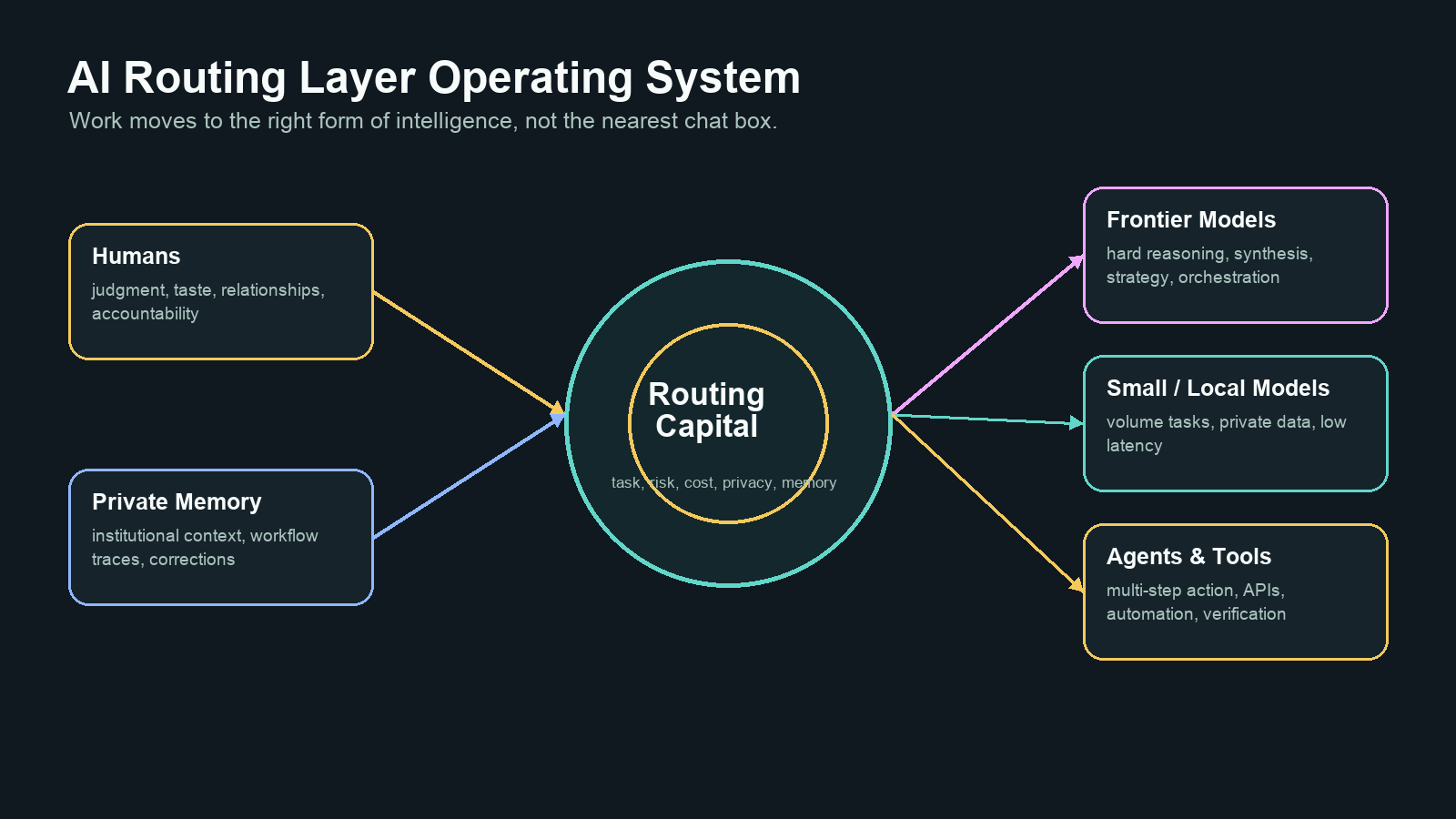
A routing layer can ask: What is the task? What is the risk? What data is involved? What level of reasoning is required? Does this need a human? Has this happened before? Should the result be stored? Should it trigger an evaluation?
A company with weak routing capital will default to blunt choices: send everything to the biggest model, give everyone the same assistant, and leave employees to figure out the rest.
A company with strong routing capital becomes more adaptive. It can switch models without losing its process intelligence. It can reduce costs without reducing quality. It can keep sensitive work inside controlled environments. It can learn from its own traces instead of starting from scratch every time.
The AI-Native Company Is a Router
The AI-native company does not ask, “Can AI do this?”
It asks, “What is the best way for this work to get done?”
Sometimes the answer is a frontier model for strategy, architecture, or an ambiguous customer problem. Sometimes it is a small model for classification, extraction, tagging, formatting, or routine rewriting. Sometimes it is a local model for sensitive documents or regulated data. Sometimes it is an agent that can move across tools. Sometimes it is plain automation because the process is deterministic, rules-based, and repeatable.
Sometimes the answer is a human. Judgment, accountability, taste, negotiation, ethics, and relationship management do not disappear because models get better. They become more important because the human is now directing more leverage.
And sometimes the answer is to do nothing with AI. Not every process improves when intelligence is inserted into it.
The firm becomes a network of humans, models, tools, databases, agents, workflows, and memory. The advantage is the company’s ability to coordinate that network better than competitors.
Frontier Tokens Should Be Spent Like Executive Attention
The best way to think about frontier-model usage is executive attention.
A company would never ask its CEO to rename files, clean spreadsheet columns, tag basic support tickets, or rewrite the same routine email hundreds of times. Executive attention is too expensive and too scarce. It should be reserved for judgment, synthesis, strategy, and decisions where the cost of being wrong is high.
The most capable models should be used where their capabilities actually matter: hard reasoning, multi-step planning, complex code architecture, research synthesis, risk analysis, and decisions that require weighing context across domains.
Using frontier models for everything is not sophistication. It is waste with a premium interface.
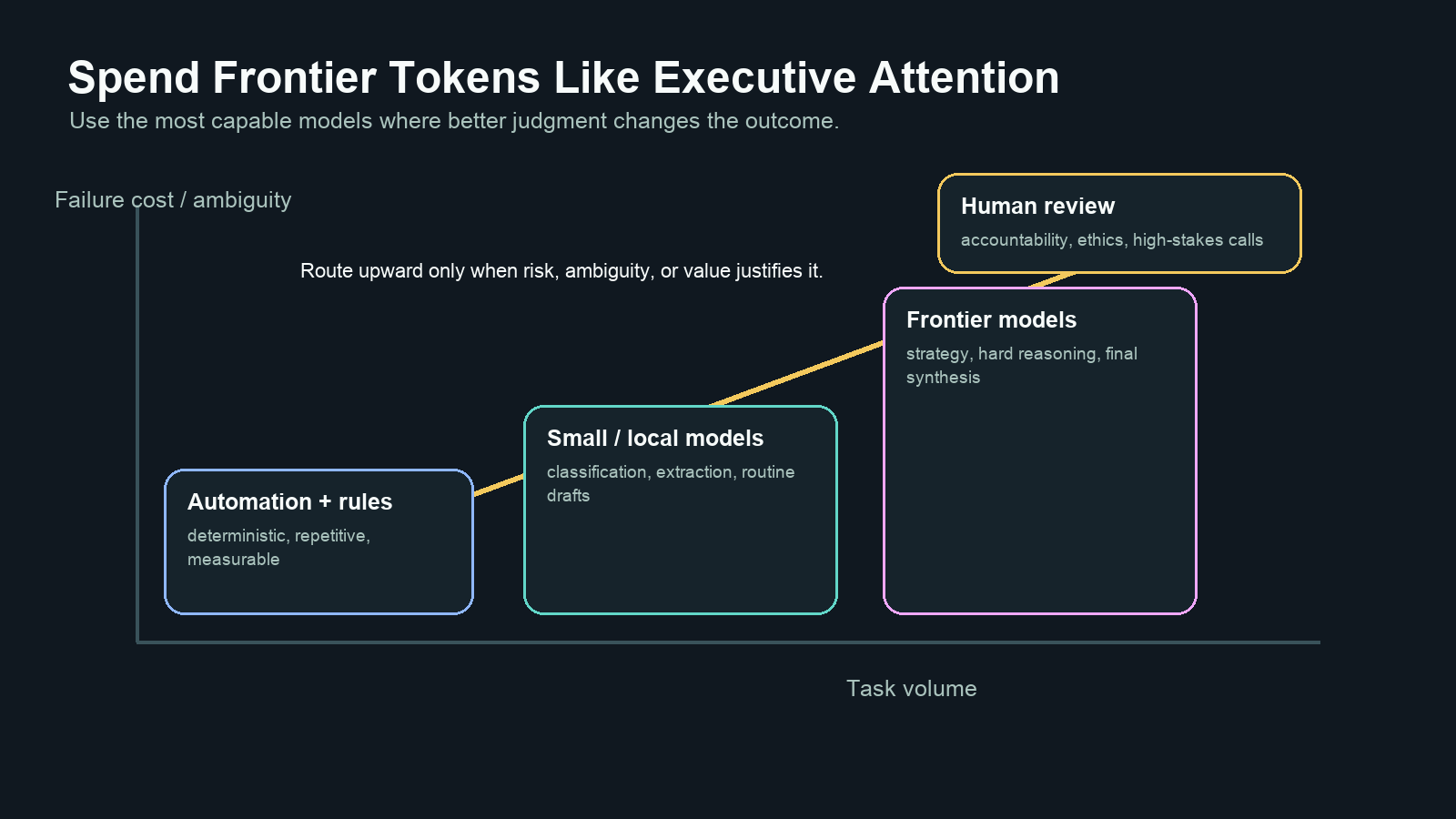
The point is not to make every AI interaction cheaper. The point is to match the level of intelligence to the value and risk of the task.
The major AI labs increasingly make this tradeoff visible. Anthropic’s model-choice guidance frames model selection around capabilities, speed, cost, and effort. OpenAI’s cost optimization docs highlight practical levers such as model choice, prompt design, and caching. Google’s Gemini API pricing makes the spread between free, paid, model, and modality tiers explicit.
A good routing layer creates economic discipline. It allows the company to spend aggressively where intelligence creates leverage and conserve where it does not. It turns AI cost from an uncontrolled line item into a managed portfolio.
That portfolio will matter. As companies move from occasional AI use to AI-mediated operations, token spend will become a real operating concern.
The winners will not be the companies that use the most intelligence. They will be the companies that use intelligence with the most precision.
Memory Is Part of the Router
Routing is not only about choosing a model. It is also about deciding what the company should remember.
Every organization has knowledge that does not live cleanly in a database. It lives in sales calls, support tickets, product debates, customer objections, failed experiments, and the judgment of experienced employees.
AI makes this knowledge easier to access, but only if the company builds systems that preserve it in useful form.
A routing layer should know when an interaction is disposable and when it contains institutional signal. A routine rewrite may not matter. A customer objection that appears across twenty enterprise deals probably does. A recurring failure mode in onboarding probably should. A strategic decision and the reasoning behind it should be retrievable.
The company should be able to ask: Have we solved this before? What did the expert do last time? Which answer worked with this customer type? Which model performed best? Where did humans override the AI, and why?
Memory without routing becomes clutter. Routing without memory becomes repetition.
Model Switching Is a Test of Ownership
One of the clearest tests of an AI-native company is whether it can switch models without losing its advantage. If changing models breaks the company’s workflows, memory, evaluations, and process knowledge, then the model was not a component. It was the architecture.
The most durable companies will build their AI systems so models can improve, change, and compete underneath the routing layer. A frontier model may be best for one task this quarter and second-best the next. A local model may become attractive as privacy requirements change. A specialized model may outperform a general model in a narrow domain.
That requires the firm to own the logic around the model: the task definitions, the context assembly, the tool permissions, the escalation rules, the evals, the memory policies, the human review loops, and the outcome data.
Infrastructure is already moving in this direction. Vercel’s AI Gateway documentation, for example, points developers toward one endpoint across models and providers, with provider options for routing and fallbacks. The model should be swappable. The company’s operating knowledge should not be.
The model provides capability. The routing layer turns capability into company-specific performance. When the model changes, the firm should keep its accumulated knowledge. If it cannot, then it has not built an AI moat. It has built a dependency.
The New Moat Is Workflow Learning
For years, companies talked about data as the moat. In the AI era, raw data is not enough. The new moat is workflow learning.
A company that repeatedly performs a task should get better at that task. Not just because employees gain experience, but because the system captures what worked. The prompts improve. The context improves. The routing improves. The evals improve. The memory improves. The company learns which parts of the process should be automated and which should stay human.
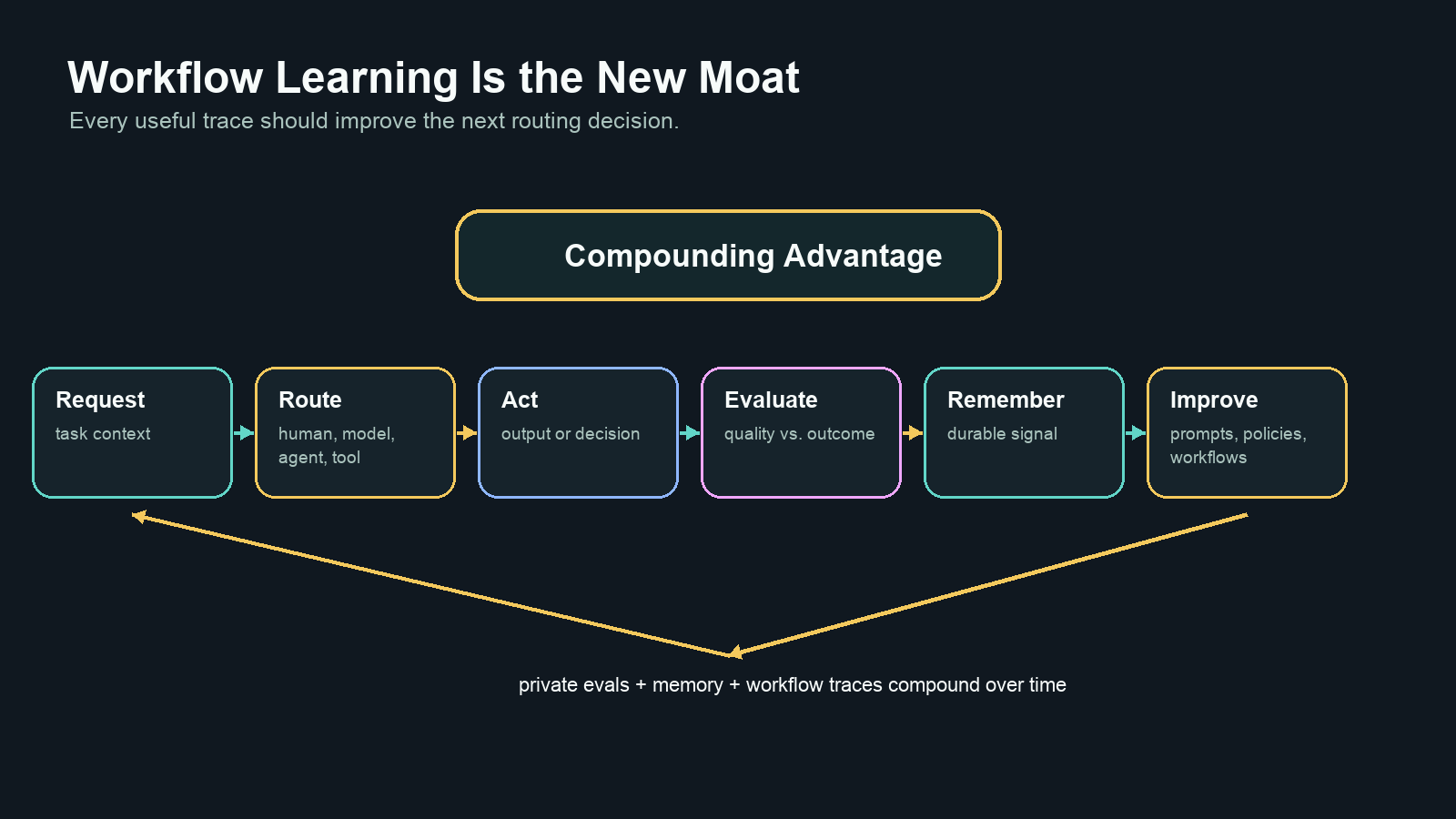
The firm’s advantage becomes embedded in the way work moves. It lives in the routing logic, the private evaluations, the workflow traces, the corrections, the customer-specific context, and the memory of what has already been tried.
That is why evaluations matter so much. OpenAI’s evals guidance describes evaluations as a way to test outputs against specified criteria, then iterate. For a company, private evals turn vague quality preferences into repeatable operating standards.
Competitors may use the same models and tools. But they will not have the same operating history, traces, human corrections, or private definition of quality.
Owners, Not Renters
The future of the firm is not that every employee uses AI. That is too small a vision. The future is that every meaningful piece of work gets routed to the right form of intelligence.
This is a different kind of company. It is not organized around a single assistant or model. It is organized around an intelligent operating layer that understands tasks, risks, costs, context, tools, memory, and human judgment.
The companies that build this layer will become owners of their intelligence systems. They will still use external models and benefit from frontier labs. But they will not hand over the logic of the firm or confuse access with advantage.
The companies that fail to build this layer will become renters. They will rent reasoning, memory, workflows, and differentiation until the rent gets too high or the differentiation disappears.
For readers tracking how AI tools, model launches, and applied workflows are evolving, the broader pattern is already visible across the Kingy AI Launch Radar, the AI News archive, and Kingy’s broader AI coverage. The market is not moving toward one intelligence provider. It is moving toward an ecosystem of models, agents, tools, evals, workflows, and distribution layers.
The question for every organization is no longer just “Which AI should we use?”
The better question is: “How should intelligence move through this company?”
The answer to that question will define the next generation of firms.
The future belongs to companies that can route.
AI-Native Operations
Model Routing
AI-Native Firms
The Kingy Brief
Get the next Kingy Brief.
Source-checked AI changes, original tests and one practical thing to try.
Free · Choose your subjects · Double opt-in · Unsubscribe anytime