Last updated: 2026-06-18
Last verified: 2026-06-18
TL;DR: MolmoMotion is ai2 released MolmoMotion, an open model family for language-guided 3D motion forecasting, alongside MolmoMotion-1M data, PointMotionBench, model weights, code, and a technical report. The key question is whether its source-backed details, pricing, and practical use cases make it worth testing for your workflow.
What launched?
On June 17, 2026, Ai2 published MolmoMotion on Hugging Face with model weights, the MolmoMotion-1M dataset, PointMotionBench, code, a project page, and a technical report for language-guided 3D motion forecasting. The current draft is based on the official/source URLs checked for this run, with launch/update source treated as the primary launch evidence when available.
This matters because Physical AI systems need to anticipate motion instead of only perceiving what already happened; MolmoMotion matters because it makes future 3D object motion a reusable open model/data/benchmark release for robotics and controllable video research. The useful editorial angle is not hype; it is whether the product gives founders, marketers, builders, and AI buyers a clearer way to decide if it is worth testing.
What is MolmoMotion?
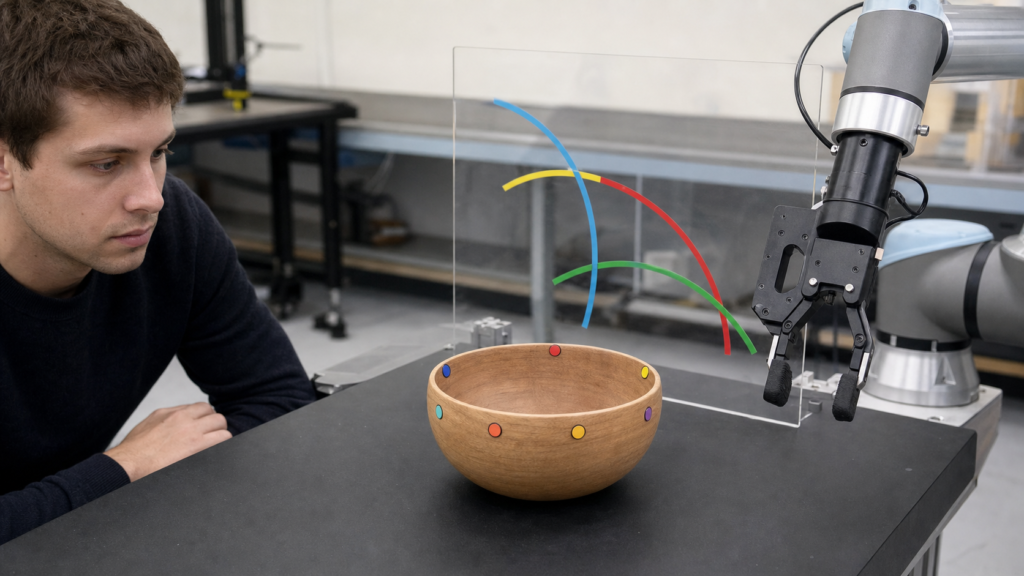
MolmoMotion takes a video frame or observation, 3D points on an object, and a written action instruction, then predicts where those object-attached points will move over the next few seconds in 3D space for robotics planning, physical reasoning, and trajectory-conditioned video generation. If that positioning holds up, MolmoMotion belongs in the AI model launches category, with a more specific fit around Language-guided 3D motion forecasting model.
For broader Kingy AI context, compare MolmoMotion with other AI launch radar coverage and recent AI News before treating this as a standalone buying decision.
The maker is listed as Ai2. Verified founder, funding, and customer claims should remain conservative unless they are backed by an official company page, reputable profile, or source checked during the run.
Key features to review
- MolmoMotion takes a video frame or observation, 3D points on an object, and a written action instruction, then predicts where those object-attached points will move over the next few seconds in 3D space for robotics planning, physical reasoning, and trajectory-conditioned video generation.
- Start with the MolmoMotion project page or Hugging Face collection, download the weights and dataset artifacts, inspect the GitHub repository, and evaluate against PointMotionBench or a robotics/video workload before production use.
- https://allenai.org/papers/molmomotion
- https://molmomotion.github.io/
- Whether the product has enough official documentation to support production use.
- Whether the stated access path is clear enough for a reader to try it without guessing.
- Whether the launch details are materially new or only a minor feature update.
Real use cases
- Forecasting object motion for robot manipulation planning
- Guiding image-to-video generation with predicted 3D trajectories
- Evaluating motion forecasting with PointMotionBench
- Researching physical AI systems that reason about future object motion
- Building datasets and benchmarks around language-described 3D motion
- Founder research: compare the product against existing tools before committing budget or launch time.
- Marketing research: decide whether the product deserves a deeper review, tutorial, or sponsored content angle.
- Buyer research: identify pricing, access, and workflow risks before asking a team to test it.
Founder, marketer, builder, and buyer notes
For founders: MolmoMotion is worth reviewing if it solves a painful workflow that is already costing time, support capacity, engineering attention, or launch momentum. The useful question is not whether the launch sounds impressive; it is whether the product can replace a messy manual process with something easier to test, explain, and measure.
For marketers: the angle to watch is whether MolmoMotion creates a clear story for campaigns, demos, tutorials, or creator-led education. A good AI launch article should help marketers understand the audience, the buyer pain, the objection, and the before/after workflow without turning the page into vendor copy.
For builders: check whether the docs, API page, examples, changelog, and access model are detailed enough to support a real implementation. If the launch page is strong but the docs are thin, the product can still be interesting, but it should stay in review until the technical path is clearer.
For buyers: treat pricing, free-plan language, security posture, integration details, and support expectations as open questions until they are confirmed through an official source. If the product affects customer data, production workflows, or customer-facing output, run a small test before making it part of a core process.
Pricing and free plan
Pricing: Ai2 released model weights, dataset artifacts, code, benchmark, and the project page openly through Hugging Face and GitHub. No paid hosted API pricing was verified in the checked sources; compute and hosting costs depend on how a team downloads, runs, fine-tunes, or serves the model. If pricing is unclear, readers should confirm it through the official pricing page, product dashboard, or sales process before making a buying decision.
Free plan: yes. Do not treat this as final unless the free plan is visible on an official pricing, signup, docs, or product page.
How to try it
Start with the MolmoMotion project page or Hugging Face collection, download the weights and dataset artifacts, inspect the GitHub repository, and evaluate against PointMotionBench or a robotics/video workload before production use. For technical products, check the docs and API page before assuming the product is ready for developer workflows.
Comparison snapshot
| Question | Current verified answer |
|---|---|
| Primary job | MolmoMotion takes a video frame or observation, 3D points on an object, and a written action instruction, then predicts where those object-attached points will move over the next few seconds in 3D space for robotics planning, physical reasoning, and trajectory-conditioned video generation. |
| Best fit | AI Product Teams, AI Engineers, Developers, Researchers |
| Pricing status | Ai2 released model weights, dataset artifacts, code, benchmark, and the project page openly through Hugging Face and GitHub. No paid hosted API pricing was verified in the checked sources; compute and hosting costs depend on how a team downloads, runs, fine-tunes, or serves the model. |
| Free plan | yes |
| Access | Start with the MolmoMotion project page or Hugging Face collection, download the weights and dataset artifacts, inspect the GitHub repository, and evaluate against PointMotionBench or a robotics/video workload before production use. |
| Main alternatives | Molmo 2 baseline workflows, CogVideoX-5B, WAN-14B, robotics-specific motion planners, video-generation models with motion controls |
Alternatives
MolmoMotion should be compared with alternatives on workflow fit, output quality, pricing clarity, documentation depth, data/security requirements, and whether the product solves a real daily problem rather than a demo-only use case.
- Molmo 2 baseline workflows
- CogVideoX-5B
- WAN-14B
- robotics-specific motion planners
- video-generation models with motion controls
- custom 3D trajectory forecasting models
The strongest alternative is not always the closest feature match. Sometimes the better comparison is the current manual workflow, an internal script, a broader automation platform, or a more mature category leader. Before publishing a final recommendation, Kingy AI should check whether MolmoMotion is meaningfully different from those options or mainly a new wrapper around a familiar capability.
Risks and unknowns
[‘The release is research-oriented and may require significant engineering work before production use.’, ‘Ai2 notes limitations around eight query points per object and complex deformable motion.’, “Reported benchmark and robotics/video-generation results should be validated on a team’s own hardware, scenes, and safety constraints.”] Kingy AI should avoid unsupported claims about benchmarks, funding, customers, model quality, or firsthand testing unless those claims are verified in a source log.
Other risks to review include onboarding friction, unclear cancellation terms, weak documentation, limited export options, privacy obligations, model-output reliability, and whether the product has enough differentiation to deserve its own indexable page. If those details are missing, the safest editorial decision is to keep the draft unpublished or noindexed until stronger evidence is available.
Should you try it?
Try it if the official source, pricing, and workflow match your use case. Review the product directly before depending on it. If the product is important to your work, start with the official source, confirm pricing, and compare it with at least two alternatives before depending on it.
FAQ
What does MolmoMotion do?
MolmoMotion takes a video frame or observation, 3D points on an object, and a written action instruction, then predicts where those object-attached points will move over the next few seconds in 3D space for robotics planning, physical reasoning, and trajectory-conditioned video generation.
Is MolmoMotion free?
Ai2 released model weights, dataset artifacts, code, benchmark, and the project page openly through Hugging Face and GitHub. No paid hosted API pricing was verified in the checked sources; compute and hosting costs depend on how a team downloads, runs, fine-tunes, or serves the model.
Who is MolmoMotion for?
AI Product Teams, AI Engineers, Developers, Researchers
What are alternatives to MolmoMotion?
Molmo 2 baseline workflows, CogVideoX-5B, WAN-14B, robotics-specific motion planners, video-generation models with motion controls, custom 3D trajectory forecasting models


