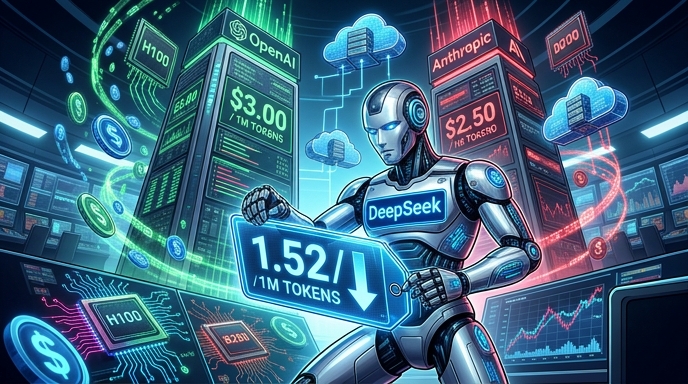
The Discount That Stopped Being a Discount
In May 2026, DeepSeek made cheap AI cheaper. Reports called the discount permanent; buyers should check the current rate table before treating those launch-era numbers as a lasting floor.
The May 2026 reporting described DeepSeek’s 75% API discount on V4-Pro as permanent after it had been expected to expire on May 31. The Decoder reported $0.435 per million input tokens, $0.87 per million output tokens and $0.003625 per million cache-hit input tokens. Those are the historical rates discussed in this article.
The official DeepSeek pricing table captured on October 8, 2026 lists DeepSeek-V4-Pro-0813 at $0.022/$0.044 for cache-hit input, $0.66/$1.32 for cache-miss input and $1.98/$3.96 for output, per million tokens, with off-peak/peak rates shown in that order. Peak hours are 01:00–04:00 and 06:00–10:00 UTC, Monday through Friday, excluding Chinese public holidays; all other hours are off-peak. These amounts preserve the provider’s $ notation. DeepSeek says prices may change.
The timing matters. AI companies have spent the past few years selling the idea that smarter models deserve premium pricing. OpenAI and Anthropic have leaned into that logic. Better reasoning. Bigger context. More capable agents. More enterprise polish. Fine. But DeepSeek just walked into the room and asked the nastiest possible question: what if “good enough” costs a fraction as much?
This is where the story gets spicy. DeepSeek may not beat the top Western frontier models on every benchmark. The Decoder reports that DeepSeek V4 still trails GPT-5.5 and Anthropic’s Opus 4.7 in raw performance. But the gap in pricing is so large that many companies may stop obsessing over “best” and start asking a much colder question: “What gets the job done cheapest?”
That is how price wars begin. Quietly. Then all at once.
The Numbers Are Not Subtle
Let’s talk money, because this story is really about invoices.
The Decoder’s May 2026 comparison used GPT-5.5 at $5 input/$30 output, Opus 4.7 at $5 input/$25 output, and DeepSeek V4-Pro at $0.435 input/$0.87 output, all per million tokens. On those reported historical figures, the GPT-5.5 rates were roughly 11.5 times the input rate and 34.5 times the output rate. That comparison does not describe the current DeepSeek peak/off-peak table or establish today’s competing-model prices.
That output-token gap is the firecracker. Modern AI products do not just ask one question and get one cute paragraph back. They summarize documents, They write code, They run agents, They retry. They call tools, They chew through tokens like a teenager attacking a buffet.
So even a tiny per-token difference can snowball. A big difference can become a budget earthquake.
DeepSeek also supports both OpenAI and Anthropic API formats, according to The Decoder, which makes switching easier for developers. That detail sounds technical. It is actually strategic. DeepSeek is not merely saying, “We are cheaper.” It is saying, “You can move without rebuilding your whole house.”
That matters because developers hate migration pain. They hate it more than slow Wi-Fi, and that is saying something.
The result: DeepSeek has made the cost comparison impossible to ignore. A team building a high-volume AI product now has to justify why it should pay premium rates for every workload. For some tasks, it still will. For many others, the answer may be: it should not.
The Budget Airline Moment for AI
Techgenyz framed the shift well: AI may have entered its “budget airline moment.” That analogy works. Premium AI is not dead. Nobody is turning first class into a pumpkin at midnight. But the market may be splitting into two lanes: premium intelligence for the hardest tasks, and affordable intelligence for everything else.
That split could reshape how startups build.
For years, the biggest AI labs had a comfortable pitch. Yes, the API costs money. Yes, usage scales fast. But look at the capability! Look at the magic! Look at the demo where the chatbot rewrites your product roadmap and also compliments your font choices.
DeepSeek changes the emotional temperature. Suddenly, a startup can ask whether it really needs the most expensive model for classification, extraction, first-draft generation, support triage, internal search, or routine coding assistance. In many cases, “frontier-best” may be overkill. Expensive overkill. The worst kind.
Techgenyz argues that lower-cost AI could help startups, smaller developers, and emerging markets get broader access to powerful tools. That is the cheerful version of the story. The less cheerful version, at least for premium labs, is that affordability can commoditize features that once looked magical.
This has happened before. Cloud storage got cheaper. Video streaming fragmented. Smartphones moved from luxury status objects to global infrastructure. The same gravity now pulls on AI.
When a market grows up, customers stop clapping at demos and start reading bills.
Why DeepSeek Can Swing This Hard
The key question is not just “How low are the prices?” It is “How can DeepSeek afford this?”
Gentic News reports that DeepSeek’s pricing cut may reflect architectural efficiency rather than a simple marketing stunt. Its article cites claims that DeepSeek V4 uses 27% of the compute and 10% of the cache compared with DeepSeek v3.2. The article presents that efficiency as a major reason DeepSeek can cut prices while still keeping the economics workable.
That claim deserves caution. It comes through secondary reporting and should not be treated as independently verified engineering proof. Still, it fits the broader pattern: DeepSeek appears to be competing on token-per-dollar efficiency, not just benchmark prestige.
That is a dangerous game for incumbents.
OpenAI and Anthropic have built reputations around powerful models, enterprise trust, safety features, developer ecosystems, and brand gravity. Those advantages are real. They are also expensive to maintain. If DeepSeek has found a cheaper inference path, Western labs face an ugly choice: cut prices and hurt margins, or keep prices high and risk losing cost-sensitive workloads.
TheStreet makes the same broader point: a permanent discount is structurally different from a temporary sale. Competitors can outwait a promotion. They cannot outwait a new floor if customers start treating it as normal.
That is the brutal part. DeepSeek did not just lower its price. It may have lowered expectations for what AI should cost.
Once customers learn a lower number, they rarely forget it.
The Self-Hosting Twist
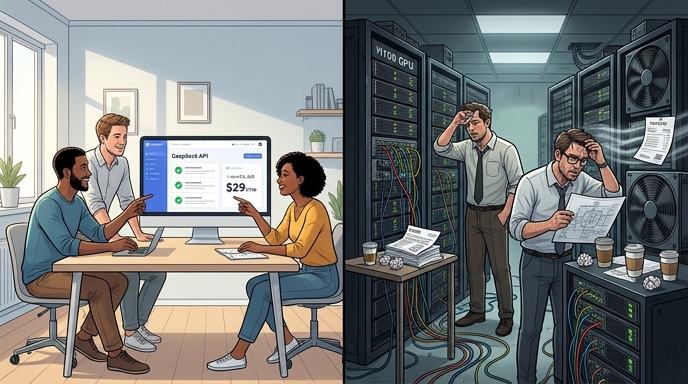
DeepSeek’s cheap API also scrambles another conversation: self-hosting.
A year ago, the logic was easy. If your AI bill got huge, you considered running your own model. Buy or rent GPUs. Hire infrastructure people. Curse at CUDA. Call it “strategic independence.” Pour coffee directly into your soul.
But AI Tech Connect argues that DeepSeek V4-Pro’s managed API price is so low that self-hosting often loses on cost. The article says the model’s open weights give teams the option to run it themselves, but the API price has flipped the math. In many cases, companies may self-host only when they have extremely high steady-state volume or hard data-sovereignty requirements.
The numbers are not tiny. AI Tech Connect reports that an 8× H100 SXM5 setup can cost $28 to $36 per hour on demand in some cloud markets, while 8× H200 can run $38 to $48 per hour. Spot H100 pricing may fall to $12 to $18 per hour, but with interruption risk.
That means the “just self-host it” crowd has to sharpen its pencil. And then sharpen it again.
AI Tech Connect’s example workloads show the problem clearly. A small SaaS agent using 10 million tokens per day could cost around $170 per month through the API, versus about $8,500 per month for self-hosting. Even a 200-million-token-per-day extraction pipeline may still cost less on the managed API than on a retail self-hosted cluster.
Cheap API pricing does not merely hurt rival labs. It can also hurt GPU rental economics.
OpenAI and Anthropic Now Face the “Good Enough” Trap
The sharpest threat here is not that DeepSeek becomes the best model. It is that DeepSeek becomes the default cheap model for ordinary work.
That distinction matters.
Companies do not use one AI model for everything. They route, They test, They mix. They use a premium model for hard reasoning and a cheaper model for repetitive tasks. This is already how serious teams think. DeepSeek’s pricing makes that routing logic more aggressive.
The Decoder notes that token prices alone do not tell the whole story because models consume tokens differently. A cheaper model can still cost more if it burns tokens inefficiently. Fair point. But the article also says DeepSeek’s price gap is massive, especially for agentic AI systems that use far more tokens than normal chatbots.
That lands right where the industry is heading. AI agents are not polite little chat windows. They are token furnaces. They plan, search, write, reflect, retry, and verify. Sometimes they do this beautifully. Sometimes they resemble an intern trapped in a maze with a corporate card.
Either way, usage climbs.
If AI agents become mainstream, inference cost becomes one of the industry’s central battlegrounds. Not branding, Not launch videos. Not benchmark confetti. Cost.
OpenAI and Anthropic can still defend premium pricing if their models deliver materially better outcomes. For mission-critical reasoning, sensitive enterprise deployments, high-stakes coding, or complex agent workflows, customers may pay up. But for everyday production work, the premium case now needs evidence.
The old argument was “we are better.” The new customer reply may be “prove it, line item by line item.”
The Market Impact Goes Beyond Model Labs
This price cut does not hit only OpenAI and Anthropic. It touches the whole AI supply chain.
TheStreet argues that the pressure extends to Nvidia and cloud hyperscalers because the AI boom has depended on premium compute demand and premium AI access. If a serious Chinese model can run cheaply, especially with alternative infrastructure, that complicates the assumption that every frontier workload must flow through the most expensive Western stacks.
That does not mean Nvidia is suddenly doomed. That would be lazy analysis dressed as drama. Nvidia remains central to AI infrastructure. Demand for compute is still enormous. But the pricing story matters because markets care about margins, not just growth. If AI model access becomes cheaper faster than expected, investors will start asking where the profit pools settle.
DIGITIMES Asia also described DeepSeek’s move as an escalation in the global AI model market, reporting that the company permanently reduced V4-Pro API pricing to one-quarter of its original rates. The publication’s full article sits behind a subscription wall, but the accessible portion confirms the core move and frames it as intensifying global competition.
That framing is right. This is not just a company discounting a product. It is a signal that AI competition may increasingly revolve around efficiency.
That creates pressure everywhere: model labs, cloud providers, chipmakers, enterprise software vendors, and startups reselling AI features with a markup.
When the base ingredient gets cheaper, everyone selling soup has to explain the price of the bowl.
What We Still Do Not Know
The smart move here is to stay excited and skeptical at the same time. Yes, DeepSeek’s pricing is aggressive. No, that does not answer every question.
Gentic News’s May report noted unanswered questions about region and usage conditions. The current official DeepSeek table now specifies peak/off-peak billing windows and cache-hit versus cache-miss rates. Regional access still needs to be checked for the buyer’s account; this article does not certify it.
Performance also needs real-world proof. Benchmarks help, but production workloads are messy. Latency matters. Reliability matters. Tool calling matters. Enterprise controls matter. Support matters. Data handling matters. So does trust. A cheap model that fails quietly can become very expensive.
The Decoder also cautions that raw price comparisons do not capture token consumption per task. That point should stay in bold, preferably with a little warning siren. If one model needs twice as many tokens to solve a problem, its sticker price does not tell the full truth.
So the right conclusion is not “DeepSeek wins.” That is too neat.
The stronger conclusion is this: DeepSeek has made price a first-class competitive weapon. Every serious AI buyer now has to test cheaper routes, Every premium lab now has to justify its spread. Every startup now has more leverage.
That is a real market shift.
The Bottom Line

DeepSeek’s reported May 2026 price cut was a business-model stress test. Current buying decisions need the updated official rates and billing conditions.
For OpenAI and Anthropic, it pressures premium API margins. While for startups, it opens cheaper paths to production. For cloud providers and chip suppliers, it raises harder questions about where AI value really accrues. For users, it probably means more tools, lower prices, and faster experimentation.
The fun part? This is exactly what maturing tech markets do. First, everyone pays for magic. Then the magic gets packaged, Then it gets discounted. Then someone sells it wholesale out of a warehouse and ruins everybody’s margins.
DeepSeek may not end premium AI. It probably will not. The best models will still command high prices where they deliver high value. But DeepSeek has made one thing painfully clear: the AI industry cannot hide behind wonder forever.
At some point, the bill arrives.
And DeepSeek just made everyone read it.
Sources
- TheStreet — DeepSeek made a 75% V4-Pro API price cut permanent, putting pressure on OpenAI, Anthropic, Nvidia, and hyperscalers. (TheStreet)
- The Decoder — The May 2026 report listed DeepSeek V4-Pro pricing at $0.435 per million input tokens and $0.87 per million output tokens, far below GPT-5.5 and Opus 4.7 pricing. (The Decoder)
- Techgenyz — The price war could create a split between premium AI ecosystems and mass-market affordable AI platforms. (Techgenyz)
- Gentic News — The article attributes DeepSeek’s lower pricing to reported efficiency gains and flags uncertainty around global availability and context-length pricing. (gentic.news)
- AI Tech Connect — The self-hosting math suggests DeepSeek’s managed API may beat 8× H100 self-hosting costs for many workloads. (AI Tech Connect)
- DIGITIMES Asia — DeepSeek’s permanent API price reduction intensifies global AI model-market competition. (DIGITIMES Asia)
Continue Reading
Related Models
Compare
Related Companies
Latest News
The Kingy Brief
Get The Kingy Brief.
AI changes, original tests and one practical thing to try. Fridays at 09:00 Vancouver time.
Free · Double opt-in · Unsubscribe anytime
Signup help and newsletter schedule
Signup form provided by Beehiiv. After submitting, check your inbox for "Confirm your subscription to The Kingy Brief" and open its confirmation link. Check Spam or Promotions if you cannot find it.
Fridays at 09:00 Vancouver time: source-checked AI changes, original tests and one practical thing to try. The weekly restart begins October 9, 2026. We skip a week when there is not enough verified material. Free. Unsubscribe anytime.