For a while, the frontier AI race had a fairly familiar cast.
OpenAI pushed the GPT family. Anthropic kept improving Claude. Google continued throwing Gemini into practically everything with a screen. Meanwhile, Meta had enormous ambitions, enormous infrastructure spending, and models that sometimes felt a step behind the very best.
That picture just became considerably messier.
Meta has released Muse Spark 1.3, calling it its most capable model yet and arguing that the company has largely closed the performance gap with its biggest AI rivals. More importantly, there is some independent evidence suggesting Meta isn’t simply blowing its own trumpet at maximum volume.
The new model focuses heavily on coding, agentic workflows, long-running tasks, and efficiency. Meta says it can do more work while using fewer tool calls and fewer tokens than Muse Spark 1.2.
And this isn’t some distant research project hiding behind a laboratory door. Developers can already access Muse Spark 1.3 through Muse Code and the Meta Model API. Meta also plans to bring the technology into its broader ecosystem.
Suddenly, the company that spent much of the last year trying to catch the frontier may actually be standing on it.
Things are getting spicy.
Meta Says It Has Finally Caught Up
Meta isn’t being particularly shy about Muse Spark 1.3.
Chief AI Officer Alexandr Wang described the release as the company’s biggest improvement in model performance so far, with especially strong gains in coding and agentic tasks.
Wang told Bloomberg that Muse Spark 1.3 is competitive with Anthropic’s Claude Fable 5.1 and stronger than OpenAI’s GPT-5.6 Sol in some coding scenarios. Those are Meta’s claims, however, and model comparisons can shift depending on the benchmark, reasoning settings, and test conditions.
Independent testing does support the broader idea that Meta has moved much closer to the frontier. Artificial Analysis gave Muse Spark 1.3’s xhigh configuration a score of 61 on its Intelligence Index, up from 57 for Muse Spark 1.2. A limited-preview max-reasoning version reached 62.
That doesn’t make Meta the undisputed AI champion. Different frontier models still lead in different tests.
But the important takeaway is simpler: Meta has narrowed the gap substantially, and it has done so quickly.
Coding Is Where Muse Spark 1.3 Gets Interesting
The more compelling story isn’t another leaderboard position.
It’s what Muse Spark 1.3 can actually do.
Meta trained the model more heavily on long-horizon coding tasks, aiming to make it behave less like sophisticated autocomplete and more like an AI developer capable of staying with a project through multiple steps.
According to Meta, the model takes fewer unnecessary turns, generates cleaner code, and operates more efficiently than Muse Spark 1.2. Internal testing showed roughly 20% fewer tool calls and 25% fewer tokens for comparable tasks.
That matters because agentic systems don’t merely answer questions. They inspect files, call tools, modify code, check results, identify mistakes, and try again.
Every unnecessary step adds time and cost.
Muse Spark 1.3 can also maintain multiple workflows inside longer conversations, gather information from conflicting sources, identify gaps in its approach, and change direction when needed.
Those capabilities tell us more about Meta’s ambitions than another benchmark trophy ever could.
The company doesn’t simply want an AI that produces better answers.
It wants one that can finish the job.
The Benchmarks Give Meta Something to Celebrate
Meta’s internal claims are one thing. Independent numbers make the story more interesting.
Artificial Analysis describes Muse Spark 1.3 as Meta’s fourth Muse Spark release in roughly five months. Its testing puts the xhigh version at 61 on its Intelligence Index, compared with 57 for Muse Spark 1.2.
The limited-preview max configuration reaches 62.
That’s a meaningful jump in a short period.
Muse Spark 1.3 also performs especially well in several coding and agentic evaluations. Published benchmark results include a 75.4% DeepSWE 1.1 score and 88.8% on Terminal-Bench 2.1. It also recorded 66.9% on OSWorld 2.0, an evaluation involving computer-use tasks.
Long-context performance looks particularly strong as well.
Benchmark tracking indicates the model supports a context window reaching one million tokens, giving it the ability to work with extremely large amounts of information during a session.
But benchmark charts shouldn’t become scripture.
Real users have strange requests. Production environments are messy. Software breaks. Instructions contradict one another. Benchmarks cannot perfectly reproduce all of that chaos.
Still, the direction is difficult to ignore.
Muse Spark has improved quickly.
Very quickly.
Efficiency Could Be Meta’s Sneaky Advantage
Raw intelligence gets headlines.
Efficiency gets invoices.
That’s why one of Muse Spark 1.3’s most interesting improvements may have nothing to do with winning another benchmark leaderboard.
Meta says the model uses roughly 25% fewer tokens than Muse Spark 1.2 to accomplish comparable tasks. SiliconANGLE reports that developers won’t pay more for 1.3 than they did for the previous version.
That combination matters enormously.
Imagine running an AI assistant occasionally. A small efficiency improvement probably won’t change your life.
Now imagine running thousands — or millions — of automated AI tasks.
Suddenly every tool call matters.
Every token matters.
Every second of inference matters.
Meta also says adoption of the Muse Spark family has accelerated, with some developers processing trillions of tokens per week. At that scale, cutting unnecessary token consumption isn’t just an elegant engineering achievement. It can become a serious economic advantage.
Meta has another card to play here: infrastructure.
The company has invested vast sums in AI computing capacity and wants those investments to eventually produce meaningful returns.
A capable model that’s cheaper and more efficient could give Meta an opening against competitors that currently dominate developers’ attention.
Being smartest is useful.
Being almost as smart, dramatically cheaper, and fast enough for production?
That can win customers.
Meta Wants AI That Actually Does Things for You

The larger story surrounding Muse Spark 1.3 isn’t really about coding.
It’s about agents.
Meta sees increasingly autonomous assistants as a major destination for its AI program. PANews reports that Wang described the model as another step toward personal AI agents capable of working on behalf of users around the clock.
That vision fits Meta unusually well.
The company already operates Facebook, Instagram, Messenger, WhatsApp, Meta AI, and a growing family of AI-enabled glasses and devices.
Put a sufficiently capable personal agent across that ecosystem and things get interesting fast.
An assistant could potentially help coordinate conversations, research purchases, organize information, plan activities, create content, manage workflows, and perform increasingly complicated tasks without requiring a new prompt every thirty seconds.
Muse Spark 1.3’s ability to maintain context across longer tasks matters enormously in that scenario.
So does its ability to recognize irreversible actions.
Meta says the model has better judgment around consequential actions and should request confirmation before proceeding when something cannot easily be undone. The company also says it strengthened resistance to adversarial inputs and prompt-injection attacks.
That’s essential.
An AI that writes a questionable paragraph is annoying.
An AI agent that confidently performs the wrong real-world action is an entirely different category of problem.
Safety Is Becoming Part of the Product
There’s another revealing detail in the launch.
Muse Spark 1.3’s highest-reasoning mode isn’t immediately available to everyone.
Meta says previously available reasoning modes are rolling out now, while max reasoning will arrive after additional safety testing is completed.
That distinction matters because AI companies increasingly aren’t just asking whether models can answer questions correctly.
They’re asking what happens when models gain more autonomy.
Meta says it improved Muse Spark 1.3’s resistance to prompt injection and adversarial instructions. It also worked on better calibration around irreversible actions.
PANews reports that Wang said Meta is increasing investment in safety and alignment as model capabilities improve.
The timing is notable.
Frontier AI development is moving toward models that can use computers, manipulate software, call external tools, coordinate tasks, and potentially operate for extended periods.
That makes safety less of an abstract philosophical conversation and more of a basic product requirement.
A powerful autonomous assistant needs to know when to stop.
Sometimes the smartest thing an AI can do is ask, “Are you sure?”
Not glamorous.
Very useful.
The Open-Weights Question Just Got Complicated
Meta built much of its AI reputation around relatively open models such as Llama.
Muse Spark complicates that identity.
Unlike the company’s earlier open-model strategy, developers currently access Muse Spark through Meta’s services. The company has increasingly adopted a commercial model that looks more like those used by OpenAI and Anthropic.
Wang said Meta hasn’t yet decided whether it will release Muse Spark 1.3’s model weights. Meanwhile, the company has previously said it intends to release weights for Muse Spark 1.2.
That’s an important strategic tension.
Open weights can encourage experimentation, research, customization, and widespread adoption.
Hosted proprietary models offer something else: control and revenue.
Meta has spent enormous sums building infrastructure and recruiting AI talent. Investors understandably want to know when that investment starts producing returns.
Charging developers for powerful models offers one obvious answer.
Meta also offers a lower-cost contributor tier. According to PANews, developers choosing that option receive substantially reduced costs in exchange for allowing Meta to use their work to improve its models. Wang said a meaningful double-digit percentage of developers have opted into the program.
So Meta hasn’t abandoned openness completely.
But its definition of “open” is clearly evolving.
Then There’s Watermelon
Muse Spark 1.3 might be Meta’s strongest model today.
It isn’t necessarily Meta’s biggest swing.
Waiting further down the pipeline is a larger model codenamed Watermelon.
Wang told Bloomberg that development remains on track and said Meta expects Watermelon to be extremely competitive, although he declined to provide a specific release date.
That makes Muse Spark 1.3 especially intriguing.
If this relatively rapid iteration can already compete near the frontier, what happens when Meta moves to a substantially larger model?
We don’t know.
And until Watermelon actually appears, speculation should remain exactly that.
What we can see is Meta’s pace.
The company introduced the original Muse Spark earlier in 2026 as the first model from its rebuilt AI operation. Meta described it as the beginning of a scaling strategy rather than the final destination.
Several iterations later, Spark is already challenging models from companies that previously appeared comfortably ahead.
That’s arguably more important than any individual benchmark score.
Meta isn’t merely launching models.
It’s demonstrating a rapid improvement cycle.
The AI Race Suddenly Has Another Serious Contender
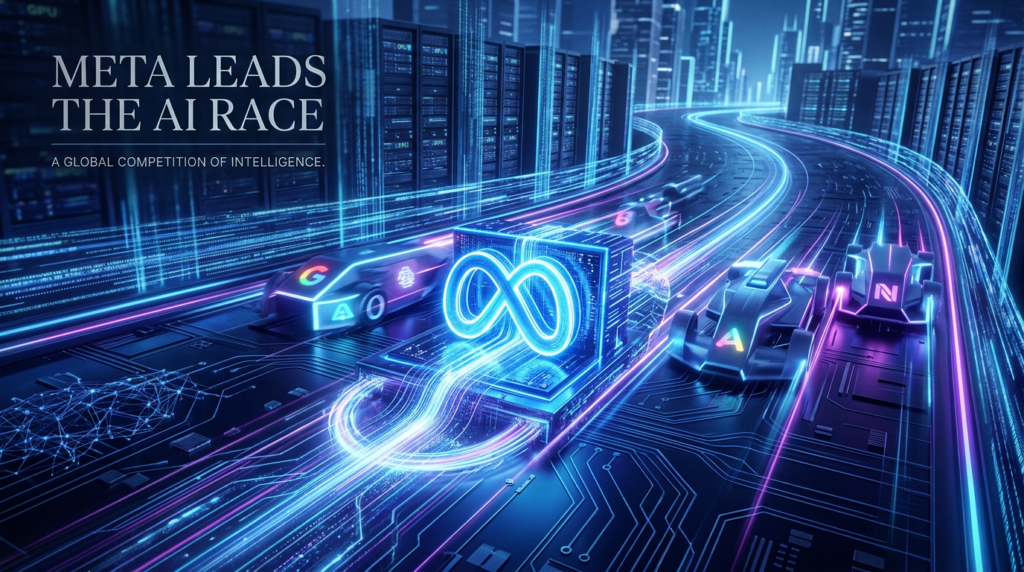
Muse Spark 1.3 doesn’t settle the AI competition.
If anything, it makes the competition more chaotic.
Anthropic still performs exceptionally well across major evaluations. OpenAI remains one of the industry’s central players. Google continues advancing Gemini. Chinese laboratories are moving quickly. And benchmark leadership can change almost absurdly fast.
But Meta now looks much harder to ignore.
The company has combined enormous infrastructure investments, an aggressive release schedule, paid developer access, increasingly capable agentic technology, and a consumer ecosystem containing billions of users.
Muse Spark 1.3 connects those pieces.
Its strongest improvements appear in exactly the areas where the industry is moving: coding, computer use, long-running workflows, tool calling, and autonomous agents.
The model still needs extensive real-world testing. Meta’s claims about superiority should be treated as claims, not universal facts. Even independent benchmark results show that different frontier models continue to lead in different areas.
But one conclusion looks increasingly reasonable.
Meta has closed a lot of ground.
Muse Spark 1.3 isn’t simply another model update with a decimal point attached to its name. It’s evidence that Meta’s expensive AI reboot may finally be producing the kind of technological momentum Mark Zuckerberg has been chasing.
And Watermelon hasn’t even arrived yet.
The frontier AI race was already crowded.
Meta just shoved another chair up to the table.
Sources
SiliconANGLE — Meta says it has caught up with Anthropic and OpenAI with Muse Spark 1.3
Crypto Briefing — Meta Platforms rolls out Muse Spark 1.3 with major performance boost
Financial Post — Meta releases more powerful AI model, edging closer to rivals
PANews — Meta Releases Muse Spark 1.3 Model, Advancing Personal AI Agent Development
Meta AI Research — Introducing Muse Spark 1.3
Artificial Analysis — Muse Spark 1.3: Meta reaches the frontier
The Kingy Brief
Get The Kingy Brief.
AI changes, original tests and one practical thing to try. Fridays at 09:00 Vancouver time.
Free · Double opt-in · Unsubscribe anytime
Sign up for The Kingy Brief on Beehiiv.
Signup help and newsletter schedule
Signup form provided by Beehiiv. After submitting, check your inbox for "Confirm your subscription to The Kingy Brief" and open its confirmation link. Check Spam or Promotions if you cannot find it.
Fridays at 09:00 Vancouver time: source-checked AI changes, original tests and one practical thing to try. We skip a week when there is not enough verified material. Free. Unsubscribe anytime.