A Healthcare AI Story With Somewhere to Go
Some AI breakthroughs begin with a spectacular demonstration and end with everyone asking what they are actually useful for.
This one begins with a chest X-ray.
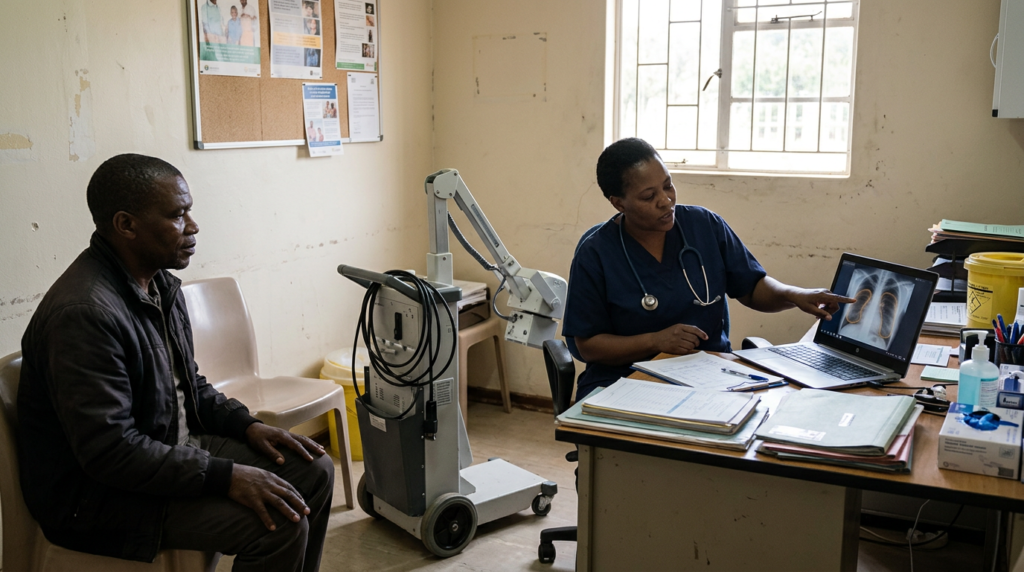
Google Research’s latest update describes how its medical imaging work is reaching frontline tuberculosis screening through Nexus AI, a system developed by South Africa’s Nexus Intelligence.
Google reports a footprint of approximately 40 healthcare facilities, with more than 90 clinicians having evaluated over 25,000 chest radiographs.
Those figures describe deployment and use, rather than proof of improved survival.
Still, they bring the discussion into an important setting: the clinic.
The opportunity is practical and understandable.
Help healthcare workers recognize who needs further investigation sooner, especially where access to specialist interpretation is limited.
For patients navigating a difficult healthcare journey, that could be a meaningful place for AI to contribute.
Why Tuberculosis Still Demands Attention
Tuberculosis is preventable and curable, yet its global burden remains enormous.
The World Health Organization estimates that 10.7 million people developed TB in 2024.
The disease usually affects the lungs, although it can involve other organs, and symptoms can remain mild for months.
That combination makes timely detection particularly important.
A healthcare system needs ways to identify people who require testing before they disappear into a cycle of delayed appointments, uncertain referrals, and unresolved illness.
Technology can potentially help organize that first step.
However, the goal must remain bigger than processing an image.
A successful intervention should help someone move toward an appropriate diagnosis and care.
Otherwise, the healthcare system has simply become faster at producing information that nobody has the resources to act upon.
What Nexus AI Actually Does
Nexus AI uses Google’s chest X-ray technology to support healthcare professionals reviewing lung images.
Google’s earlier account describes two parallel models: one highlights abnormalities, while another looks specifically for findings suggestive of pulmonary TB.
The interface presents the original image with visual overlays intended to direct the clinician’s attention.
Google says this analysis can take as little as 45 seconds, with the healthcare professional retaining clinical judgment.
The careful wording matters.
An abnormality flag is information for further assessment.
It should not become an automatic verdict about someone’s health.
Used appropriately, the system can function as an additional analytical aid within a clinical workflow.
The useful question is whether that assistance helps staff make timely, appropriate decisions without introducing new confusion or misplaced confidence.
Forty-Five Seconds Needs the Right Context
The speed claim is attention-grabbing.
It also needs a clearly defined starting and finishing point.
Analyzing an available X-ray is one activity.
Registering a patient, taking the image, reviewing symptoms, collecting samples, obtaining diagnostic results, and arranging treatment are separate activities.
A short software processing time cannot describe the entire journey.
Consider a hypothetical clinic where an image is analyzed quickly but confirmatory testing requires travel to another facility.
The patient still faces a substantial obstacle.
That does not make fast image analysis unhelpful.
It means the benefit depends on what happens next.
Healthcare technology should therefore be judged by the delays it actually removes.
A stopwatch beside an algorithm is useful.
A stopwatch following the patient through the whole pathway tells a much more important story.
Screening Opens a Door; Diagnosis Goes Further
Screening helps identify people who may need additional investigation.
Diagnosis establishes what is happening through appropriate testing and clinical assessment.
WHO recommends rapid diagnostic tests as initial tests for people with signs and symptoms of TB, including molecular assays and certain point-of-care tests.
An AI-assisted chest X-ray should therefore sit within an established pathway rather than replace the rest of it.
A concerning result can help prompt further testing.
It cannot, by itself, answer every question about the cause of an abnormal image or the treatment someone needs.
This distinction protects patients in both directions.
It helps avoid treating a screening flag as certainty, while also discouraging the assumption that one reassuring software result settles every clinical concern.
The clinician remains responsible for interpreting the broader picture.
Offline Operation Changes the Practical Equation
One especially useful feature is the ability to work without an internet connection.
Google says the Nexus tool can operate entirely offline, including in demanding field settings.
For a clinic with unreliable connectivity, that capability could make the difference between a functioning service and a screen waiting indefinitely to reconnect.
It also changes how planners can think about deployment.
Instead of assuming every screening location needs dependable broadband, they can assess whether local equipment can support the necessary workload.
Offline operation does not eliminate infrastructure requirements.
Devices still need power, maintenance, secure storage, and trained operators.
Nevertheless, designing around limited connectivity is a sensible response to real operating conditions.
The most sophisticated cloud connection in the world offers limited comfort when the nearest reliable signal is somewhere over the next hill.
A Mine Shows Why Location Matters
Google’s October update describes a deployment at South Africa’s Mponeng Gold Mine.
Working with partners, Nexus AI brought portable digital X-ray equipment and offline analysis approximately four kilometers underground.
People flagged with presumptive TB could be referred for confirmatory molecular testing.
The setting makes the access question unusually vivid.
Instead of assuming patients can easily reach a conventional screening location, the service moves toward them.
That principle has applications worth exploring in other difficult environments.
Each setting would require its own practical assessment.
Equipment transport, radiation safety, staffing, infection prevention, and referral arrangements all deserve attention.
The broader lesson is about service design: a useful healthcare tool becomes more valuable when its delivery model fits the lives of the people it is intended to serve.
Helping Clinicians Without Making Them Invisible
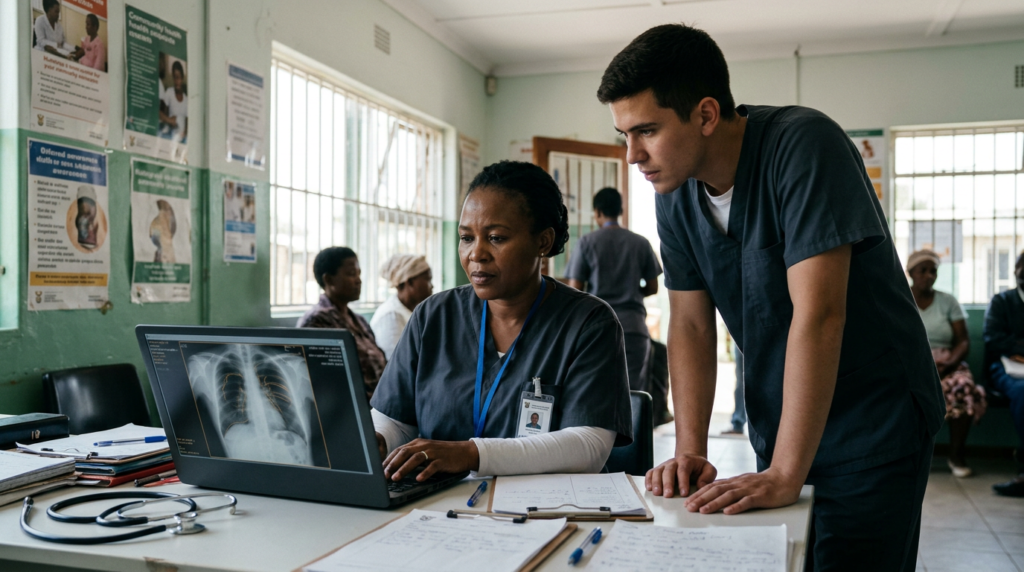
Human oversight can become an empty phrase if a system leaves professionals without enough time or information to challenge its output.
Meaningful oversight requires more.
Staff need to understand what the software evaluates, where its limitations lie, and what to do when its result conflicts with other evidence.
The interface should help them investigate rather than encourage reflexive agreement.
An attractive highlight on an X-ray can draw attention.
It does not explain the full clinical significance of the finding.
Training should therefore cover uncertainty, escalation, and appropriate follow-up.
It should also make room for disagreement with the system.
A useful assistant expands a clinician’s capacity to assess a case.
It should not quietly transform the clinician into someone who clicks “accept” because the queue is long and the computer looks confident.
The Science Predates This Week’s Announcement
Computer-aided TB screening is an established field of investigation.
WHO says it has recommended computer-aided detection for TB screening since 2021.
Its 2025 policy statement describes an independent assessment and identifies six products meeting its performance standards for screening people aged 15 and older.
That statement does not recommend extending the approach to younger children.
These details help place Google’s update in context.
The story concerns ongoing translation and deployment, rather than the sudden invention of AI-assisted chest imaging.
They also underline why general recommendations require careful reading.
A recommendation for a technology category does not automatically validate every product, version, population, or use case.
Healthcare programs need evidence matching the system they intend to deploy and the people they intend to serve.
Accuracy Must Survive the Real Clinic
A medical AI system needs to work beyond the conditions in which its developers first evaluated it.
For deployment planning, relevant questions include how performance varies across equipment, image quality, patient groups, and clinical settings.
Two familiar concepts help explain the trade-off.
Sensitivity concerns how well a test identifies people who have the condition.
Specificity concerns how well it identifies people who do not.
A screening program needs to consider both, alongside the capacity for follow-up testing.
Too many unnecessary referrals can burden services.
Missed cases can undermine the purpose of screening.
The appropriate operating approach should therefore rest on evidence and clinical priorities.
It should also remain open to reassessment after deployment.
A model’s published results are a starting point for scrutiny, rather than a lifetime certificate of reliable performance.
Foundation Models Expand the Development Toolkit
Google’s broader health AI work includes MedGemma, a family of models intended to support medical AI research and application development.
Its documentation distinguishes generative tasks, such as producing text, from structured imaging tasks such as classification and retrieval.
That distinction matters because different jobs require different tools.
A system that flags a chest image and one that drafts a clinical explanation introduce different evaluation needs.
The Nexus deployment should not simply be described as a general chatbot examining patients.
Nor should every medical foundation model be treated as an already validated clinical product.
The opportunity is to give developers useful building blocks.
The responsibility is to demonstrate that the finished application performs appropriately within its intended workflow.
Model availability can accelerate development.
It cannot complete clinical validation on the developer’s behalf.
MedSigLIP Connects Images and Medical Language
Another component of Google’s developer toolkit is MedSigLIP.
Google describes it as a model that maps medical images and associated text into a shared mathematical representation.
Its intended applications include image classification, searching medical images using text, and adaptation to specialized tasks.
Unlike a generative model, it is designed for applications that do not require producing free-form text.
An accessible analogy is an organizing system that learns relationships between pictures and descriptions.
Developers can build on those relationships when creating a particular application.
The public-health appeal is adaptability.
However, a plausible application remains a proposal until the complete system is evaluated.
Local teams still need suitable data, appropriate expertise, and a clear clinical objective.
A foundation is valuable precisely because it supports construction; it is not the finished building.
Why This Story Matters in the Philippines
The Philippines has a clear reason to follow developments in TB screening.
WHO estimates that the country accounted for 6.8% of new global TB cases in 2024.
That does not establish that this particular Nexus deployment is available locally.
It does make access-focused screening technology a relevant subject for evaluation.
Potential users and policymakers would need to examine local authorization, costs, evidence, equipment compatibility, and integration with existing services.
Geography also deserves attention.
A proposed service should be assessed against the realities of its intended communities, including travel and referral arrangements.
The useful question is specific: could this approach help an existing TB program identify and support more people appropriately?
That is a better starting point than assuming a promising overseas example can be copied unchanged.
Affordability Includes Everything Around the Software
The price of an AI license cannot describe the full cost of a screening service.
A program must also account for imaging equipment, staff, training, maintenance, power, diagnostic testing, and follow-up.
An apparently inexpensive tool could become difficult to sustain if those surrounding costs are overlooked.
Conversely, a system with a higher initial cost might offer value if it reliably reduces other burdens.
Both possibilities require evidence.
For patients, affordability also includes time and travel.
An extra appointment can mean transport expenses or income lost from work.
A sensible evaluation should therefore examine the entire pathway and who pays at each stage.
The strongest economic case would connect spending to meaningful outcomes.
Counting images processed is useful for operations, but it cannot reveal whether the service is affordable for the people it aims to help.
Measure the Journey After the Screening Flag
Deployment figures show that a tool is being used.
They do not establish everything a public-health program needs to know.
Further evaluation should track how many people with concerning results complete testing, how quickly diagnoses are established, and whether patients reach appropriate treatment.
Programs should also examine errors, unnecessary referrals, and differences between groups.
These measures make the patient journey visible.
They can reveal whether faster screening removes a bottleneck or simply moves it elsewhere.
Privacy belongs in that assessment as well.
Offline processing may reduce some data-transfer needs, but organizations still require clear rules for access, retention, and protection.
The appropriate standard combines technical performance with accountable service delivery.
A system should earn confidence through what happens to patients after its output appears, as well as through the quality of the output itself.
A Useful Future Begins With the Next Step
Google’s update offers an encouraging example of AI being shaped around a concrete healthcare problem.
Its most compelling promise is the possibility of bringing useful analytical support closer to underserved patients.
Realizing that promise requires dependable equipment, trained professionals, appropriate testing, and services capable of carrying people forward.
The analysis points toward a straightforward priority: strengthen the complete pathway.
Faster screening can be part of that effort.
It should be accompanied by evidence showing that patients receive timely, appropriate follow-up.
For healthcare AI, practical success may look surprisingly ordinary.
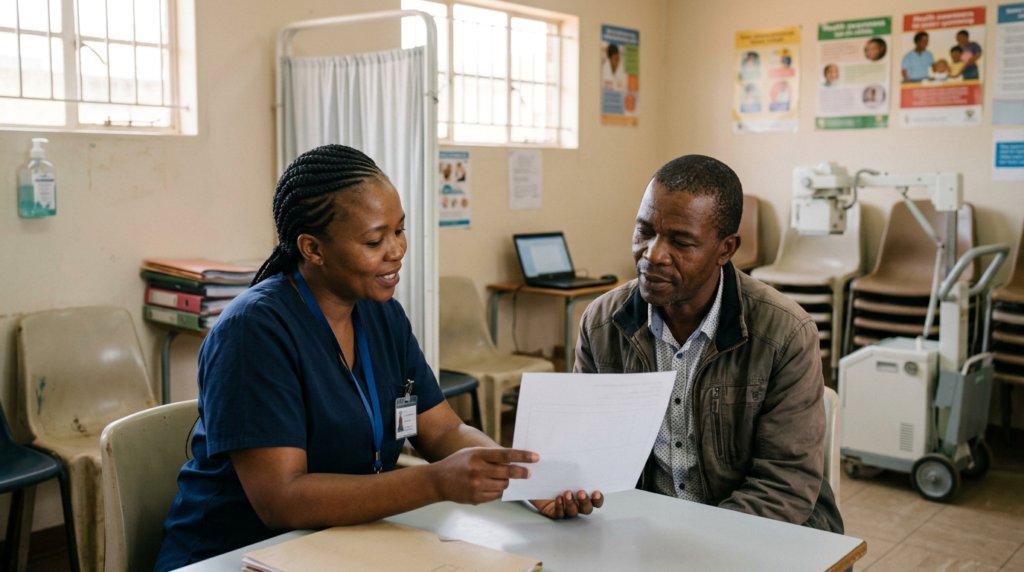
A clinician gets useful information.
A patient understands the next step.
A referral is completed.
Care begins when it is needed.
Those outcomes will never make the loudest technology demonstration, but they are the ones worth building toward.
SOURCES
- Google Research — Bringing foundational models to the front lines of TB screening
- Google — Meet the Pretoria team using AI to spot lung disease in as little as 45 seconds
- World Health Organization — Tuberculosis
- World Health Organization — Use of computer-aided detection software for tuberculosis screening
- Google Research — MedGemma: Our most capable open models for health AI development
- Google for Developers — MedSigLIP
The Kingy Brief
Get The Kingy Brief.
AI changes, original tests and one practical thing to try. Fridays at 09:00 Vancouver time.
Free · Double opt-in · Unsubscribe anytime
Sign up for The Kingy Brief on Beehiiv.
Signup help and newsletter schedule
Signup form provided by Beehiiv. After submitting, check your inbox for "Confirm your subscription to The Kingy Brief" and open its confirmation link. Check Spam or Promotions if you cannot find it.
Fridays at 09:00 Vancouver time: source-checked AI changes, original tests and one practical thing to try. We skip a week when there is not enough verified material. Free. Unsubscribe anytime.