Elon Musk has warned that financing is drying up for the companies building specialized AI clouds. There is evidence behind the concern: an abandoned IPO, sharply higher bond yields and a large computing contract whose required financing was still uncommitted when the company filed its prospectus.
The evidence also includes recent successful borrowing. The most defensible assessment is that neoclouds face a selective funding squeeze, with potentially serious consequences for projects that need fresh capital. Declaring the entire AI bubble already burst goes further than the available record supports.
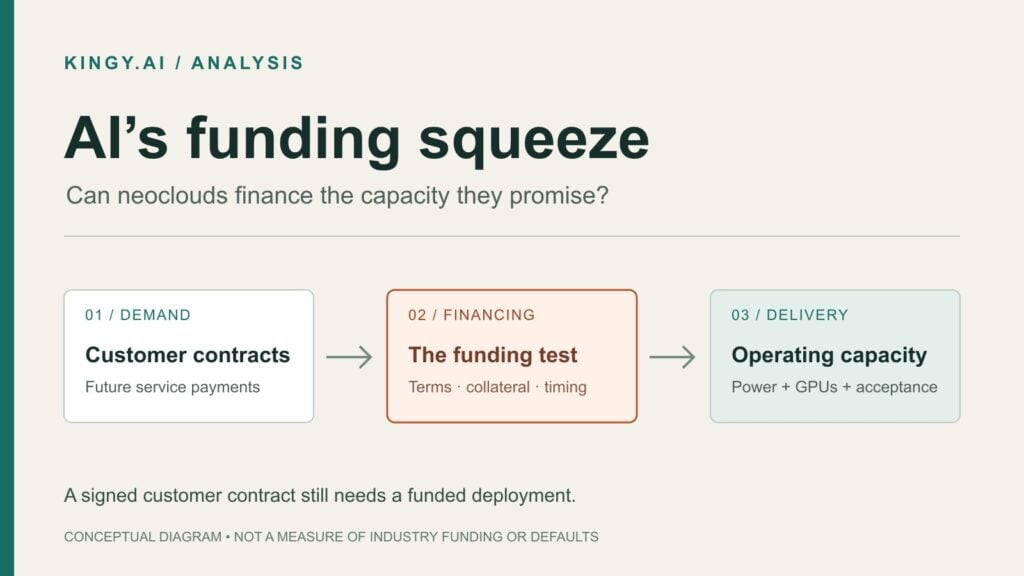
The central question is whether these companies can obtain enough money, on workable terms, to deliver the capacity they have promised customers.
What Musk said, and when
On October 25, at about 12:11 p.m. Pacific, Musk replied to Chamath Palihapitiya on X. He said credit markets were largely excluding companies without substantial revenue outside AI data centers. He predicted “guppy-level death and consolidation” among a population he put at more than 200 neoclouds. In the same post, he said SpaceX had closed $40 billion in GPU debt, attributing its access to investment-grade credit and revenue from Starlink and launches. These are Musk’s claims and forecast. Original post, contemporaneous account.
Reuters reported a significant unresolved detail: it was unclear what Musk meant by the financing being closed, or whether investors had agreed its pricing. The claimed $40 billion transaction therefore needs a final issuer or lender disclosure before its terms can be treated as established. Reuters, syndicated by AOL.
In an earlier reply, posted October 24 evening Pacific and dated October 25 in UTC, Musk warned about computing equipment becoming stranded in unfinished data centers. That concern describes a construction and financing mismatch: hardware can arrive before the facility is ready to earn revenue. Original reply, archived reproduction.
Neither post establishes that the whole AI industry has collapsed. One account amplifying that interpretation was FinanceLancelot; its conclusion should not be attributed to Musk. Nor can a Sunday post explain price declines that happened the preceding week.
Why neoclouds need so much funding
Neoclouds specialize in supplying the computing capacity used to train and run AI models. Their financing problem starts with timing. GPUs, buildings, electrical equipment, cooling and installation require money before the completed infrastructure can generate its expected customer payments.
A customer contract can help secure a loan. Its usefulness to lenders depends on who pays, when payments start, what must be delivered and when the customer can cancel. A multiyear contract value is not cash available to pay this month’s construction bill.
Nscale’s September prospectus provides a concrete example. Its Anthropic agreements contemplated payments of up to $44.6 billion, conditional on delivery and service requirements. The filing said the financing required to perform those agreements had no binding commitments at that date. Nscale S-1, September 18.
This creates a potential feedback loop. A financing delay can postpone construction. A construction delay can postpone customer payments or trigger contractual remedies. Reduced expected cash flow can then make the financing harder to obtain. The sequence is an explanation of the risk, not a finding that every company below is experiencing every step.
What the company evidence shows
| Company | Dated evidence | What it establishes |
|---|---|---|
| Firmus | Withdrew its planned roughly $5 billion Australian IPO on October 9. | A public-equity fundraising route failed at the proposed terms. Private financing remained a stated alternative. |
| CoreWeave | October 13–14 reporting placed the yield on a particular 2032 bond near 15%. | Investors demanded a much higher return on that traded debt. This is a credit-stress signal, not a recorded default. |
| Nscale | September 18 filing disclosed no binding financing commitments for its Anthropic deployment; September 25 announcement described new corporate financing. | Large customer commitments and completed project financing are different milestones. The September filing does not establish the project’s October 25 status. |
| Nebius | Signed a $3.5 billion secured Citi bridge on October 17; announced October 22. | A significant neocloud could still obtain credit during the turmoil. The disclosed facility has conditions and a short maturity. |
| Lambda | Announced a $1.008 billion secured delayed-draw facility on October 1. | Contract-backed GPU financing was available earlier in the month. That does not establish availability after the later selloff. |
These examples cover a failed equity offering, historically uncommitted project funding and debt repricing. They do not establish three current loan refusals. This research did not establish the sector-wide share of financing applications being rejected. Sources and the qualifications that matter follow below.
Firmus offers a clear example of a fundraising setback
Reuters reported that Firmus shelved its IPO after weak investor appetite. Concerns included valuation, debt, execution and a development partner’s withdrawal. Firmus said it would seek private capital and consider other listing options. The failed offering demonstrates that investors would not fund that transaction as proposed; it does not establish that the company defaulted or exhausted all alternatives. Reuters, October 9.
CoreWeave shows why bond yields need careful interpretation
The earlier Musk reaction was a one-word reply to Chamath’s chart of CoreWeave debt. The chart concerned a $1.25 billion bond due in 2032, with its yield approaching 15%. Benzinga, October 14.
A secondary-market yield reflects the return a buyer expects at the bond’s traded price, subject to repayment. It does not automatically change the coupon on existing fixed-rate debt. It can nevertheless signal that issuing comparable new debt will be more expensive or impractical.
CoreWeave had completed a different financing on September 22: $4.2 billion of convertible senior notes carrying a 2.875% coupon. Its SEC filing explicitly describes these as unsecured obligations. The conversion feature gives investors potential equity upside, so that coupon cannot be compared directly with the yield on an ordinary bond. The transaction also predates October’s deterioration. CoreWeave SEC filing.
Its earlier August facility illustrates another risk. CoreWeave said approximately five-year financing supported customer contracts averaging three years. The structure exposes the financing to renewal and re-leasing risk after initial customer contracts expire. CoreWeave’s August financing announcement.
Nscale shows the difference between selling capacity and funding it
The September filing’s $44.6 billion Anthropic figure describes potential service payments. It is not the size of a rejected loan or money already collected. The company also disclosed termination rights tied to delivery and service failures. These terms make construction and financing execution central to converting the contract into revenue. Nscale S-1.
Nscale subsequently announced $3.36 billion of convertible financing, comprising an initial $2.36 billion tranche and a further $1 billion Nvidia commitment expected in mid-November. That is relevant new capital. It does not, by itself, establish that the specific Anthropic deployment is fully financed. A company-wide raise and a project’s funding requirement need to be matched by scope and timing before drawing that conclusion. Nscale announcement, September 25.
Nebius is the strongest recent qualification to a blanket funding freeze
Nebius’s October 22 SEC filing records the Citi agreement signed five days earlier. The $3.5 billion facility matures October 16, 2027. Interest starts at Term SOFR plus 2.75 percentage points, with the margin stepping up to 3.50 points. Those percentages are additions to the reference rate, not the total interest rate. Nebius SEC filing.
That establishes access to a substantial secured bridge. It leaves the amount drawn and the longer-term funding solution as separate questions. Successful borrowing also does not demonstrate that every proposed project is funded or profitable.
Lambda’s earlier transaction provides another example of what lenders accepted: financing secured by GPU equipment and contracted cash flows from investment-grade customers. Its October 1 announcement specified a 6.78% fixed rate and delayed draws tied to deployments. The facility closed before the latest selloff. Lambda announcement.
What the other prominent voices add
Chamath’s October 25 post predicted construction delays and poorly earning or idle equipment during 2027. He also disclosed his own portfolio of energized land. His perspective comes from an investor with an interest in the infrastructure market, and his forecast has yet to be tested against completed projects. Original post, indexed reproduction.
Jensen Huang presented a more optimistic view in an October 22 CNBC interview: demand for neocloud computing remained strong, while capital availability constrained expansion. Nvidia’s position as a hardware supplier matters when assessing that reassurance. Strong customer demand can coexist with a project that lenders will not finance on terms its owner can accept. CNBC interview, CNBC episode listing.
These positions overlap on a crucial point: the availability of money can constrain the buildout even while customers want more compute. They differ over how many companies will secure funding and what returns the resulting infrastructure will earn.
How the squeeze could spread
For a heavily financed project, higher rates can absorb a meaningful share of expected cash flow. As a simple illustration, increasing the annual interest rate on $1 billion from 8% to 12% adds $40 million a year before fees and principal repayments. This is illustrative arithmetic, not an estimate for a named company.
Lenders can also reduce the amount they will advance against equipment, require more equity or demand stronger guarantees. A project can become unfinanceable without any customer abandoning it. If construction then stalls, suppliers may receive fewer orders, customers may need replacement capacity and lenders may face collateral worth less than expected.
Those are possible transmission channels. Evidence of an industry-wide unwind would require named failed financings, delivery cancellations, impairments, restructurings or defaults across more than isolated cases.
The IMF has separately warned that financial links among AI companies can transmit shocks through debt, valuations and expected revenues. Its October analysis examined selected financing transactions and future commitments; it did not certify that the AI bubble had burst. IMF briefing, October 13.
What would change this assessment
The next useful evidence is a financing outcome with a name, amount and date. A postponed offering, reduced facility, covenant breach or funding-related construction stoppage would strengthen the case for a worsening squeeze. Signed loans, completed drawdowns and on-time customer acceptance would qualify it.
The highest-priority unresolved questions are the final structure and pricing of Musk’s claimed SpaceX financing; Nscale’s project-specific funding commitments; Firmus’s replacement fundraising; and the terms on which CoreWeave, Nebius and other providers secure their next round of capital.
Future updates should also compare cash and available committed facilities with obligations falling due over the same period. Adding years of contract value to near-term liquidity, or subtracting a single fundraising round from a multiyear construction estimate, would give readers a misleading funding gap.
Update log
- October 25, 2026: Initial report. Traced the Musk/Chamath post sequence and compared financing pressure with documented funding transactions. Current assessment: selective funding squeeze; the breadth of credit exclusion and a sector-wide collapse remain unestablished.
Source note: Original X links were identified through contemporaneous reporting and reproductions; direct X retrieval was blocked during research. Financing disclosures were checked against company releases and SEC filings where available. The September Nscale disclosure is preserved as a dated snapshot, not presented as a current confirmation that its project remains unfunded.
Related reporting: Nvidia’s AI infrastructure financing strategy, Situational Awareness’s forced deleveraging and how to choose an AI inference provider.
The Kingy Brief
Get The Kingy Brief.
AI changes, original tests and one practical thing to try. Fridays at 09:00 Vancouver time.
Free · Double opt-in · Unsubscribe anytime
Sign up for The Kingy Brief on Beehiiv.
Signup help and newsletter schedule
Signup form provided by Beehiiv. After submitting, check your inbox for "Confirm your subscription to The Kingy Brief" and open its confirmation link. Check Spam or Promotions if you cannot find it.
Fridays at 09:00 Vancouver time: source-checked AI changes, original tests and one practical thing to try. We skip a week when there is not enough verified material. Free. Unsubscribe anytime.