The Dashboard Just Got Much More Talkative
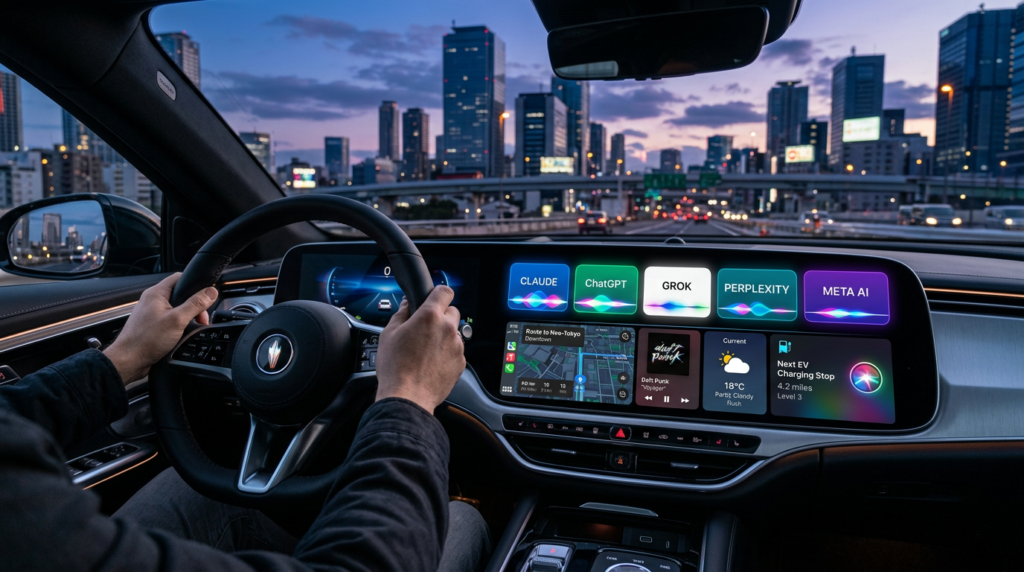
Apple CarPlay is turning into something far more interesting than a tidy grid of navigation, music, and messaging apps. It is becoming a place where drivers can choose which artificial intelligence rides shotgun.
Anthropic has added CarPlay support to its Claude iPhone app, bringing one of the biggest names in generative AI directly onto compatible vehicle displays. Claude joins ChatGPT, Perplexity, Grok, and Meta AI, giving CarPlay access to five major chatbot apps. Suddenly, choosing an in-car assistant could feel a little like choosing a podcast—except this one talks back and may have opinions about your itinerary.
The timing matters. Apple opened CarPlay to conversational apps with iOS 26.4. Developers still need to build around Apple’s approved interface and obtain the required entitlement, but the door is now open. Anthropic walked through it this week.
At the same time, Apple is preparing a broader CarPlay overhaul through iOS 27. Siri AI, richer voice controls, smarter navigation tools, improved audio features, and even parked video playback are all part of the developing picture.
This is not one isolated app launch. It is the start of a new contest for attention inside the car—and everyone is buckling up. 9to5Mac reports that Claude is now CarPlay’s fifth major chatbot app.
Claude Takes the Front Seat
Claude’s CarPlay debut keeps the experience deliberately simple. Drivers can launch the Claude app from the vehicle’s CarPlay screen, begin a new voice conversation, or return to a recent chat. The interface also offers controls to mute, unmute, pause, resume, and end a conversation.
Visual indicators show when Claude is listening and when it is responding. That sounds like a small design detail, but it matters in a car. Nobody wants to deliver a thoughtful five-minute prompt only to discover the chatbot stopped listening somewhere around the first traffic light.
The interaction is voice-first. Claude can answer hands-free questions, which opens the door to brainstorming, explanations, trip planning, and conversational assistance without forcing the driver to type. However, there are firm limits. Claude cannot control the vehicle. It also cannot operate iPhone functions through this CarPlay integration.
There is no third-party wake word either. Drivers must open Claude from the CarPlay interface before starting a conversation. So, no, shouting “Claude!” at the dashboard will not magically summon Anthropic’s assistant—though it may concern your passengers.
Those restrictions underline Apple’s approach. CarPlay can host conversational intelligence, but third-party chatbots do not receive the keys to the car’s systems. MacRumors details Claude’s interface, voice features, and operating limits.
Five Chatbots, One Dashboard
Claude arrives in a surprisingly crowded lane. ChatGPT, Perplexity, and Grok already support CarPlay, while Meta AI recently began appearing through a limited rollout. Together, the five apps transform CarPlay into something most built-in infotainment platforms struggle to match: an open-ish marketplace of competing AI assistants.
Of course, availability is not perfectly uniform. Meta AI’s CarPlay support was described as limited testing rather than a universal release. App versions, account access, regions, and rollout schedules may also affect what appears for each driver. The dashboard may host five big names, but not every iPhone will necessarily show the same lineup today.
Still, the direction is clear. Apple is not forcing every conversation through a single third-party AI provider. It is letting compatible iPhone apps compete for a place on the screen, within its safety-focused templates. That makes CarPlay less like a sealed car computer and more like an extension of the app ecosystem already living in your pocket.
Apple Sets the Guardrails
Putting generative AI on a dashboard sounds exciting. It also raises an obvious question: how do you prevent a conversational app from becoming a glowing distraction machine?
Apple’s answer is control through design. Chatbot developers must use the company’s designated CarPlay template, include a voice-control screen, and receive an entitlement from Apple. Those requirements restrict how the app looks and behaves inside the vehicle.
The Claude implementation shows the result. Its screen focuses on starting or continuing spoken chats. It uses large, limited controls rather than presenting the full complexity of the iPhone app. This is not Claude’s desktop workspace squeezed onto a center console. You are not expected to edit a report, inspect a giant code block, and merge a pull request while waiting for a green light. Sensible, really.
The no-wake-word limitation adds another barrier against accidental activation. Meanwhile, the inability to control the car or iPhone keeps Claude in the role of conversational companion rather than system operator.
These restrictions may frustrate users who imagine a truly universal automotive assistant. Yet they also clarify what this launch actually delivers. Claude can discuss, explain, suggest, and continue conversations. It cannot adjust the air-conditioning, send the car somewhere, or take over navigation controls. The chatbot has a passenger seat—not a driver’s license.
Siri AI Is About to Join the Party
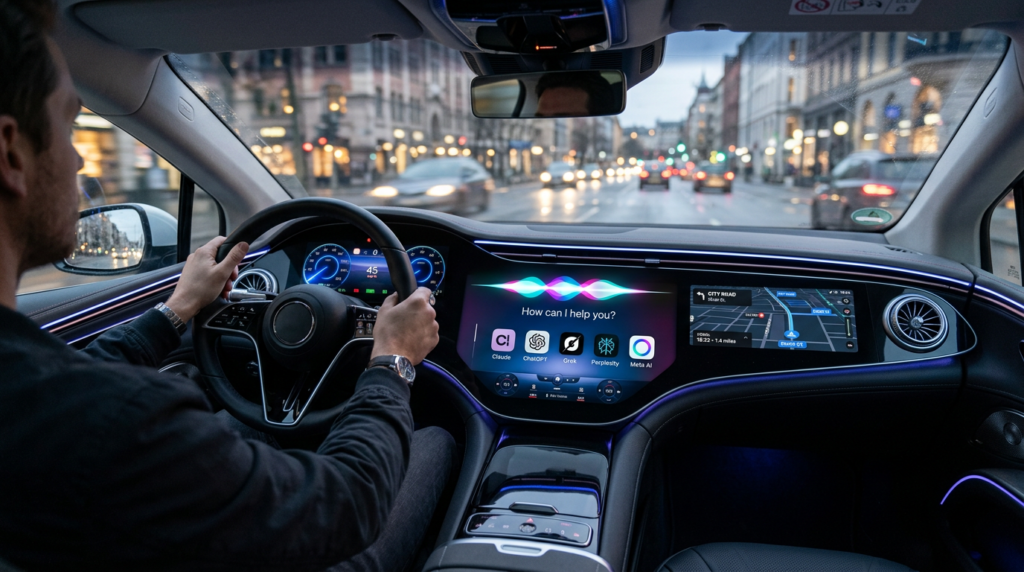
Third-party chatbots are arriving just as Apple prepares to strengthen its own assistant. Siri AI is expected to reach CarPlay with iOS 27, which is currently in beta ahead of its official September launch.
That sets up an unusual dynamic. Apple will operate the platform, provide the system assistant, and still allow rival conversational apps to appear beside it. Siri should retain the home-field advantage because it can connect more deeply with Apple’s software and supported system functions. Claude and the other chatbots, meanwhile, compete through their conversational abilities and existing user relationships.
According to the iOS 27 feature overview from Supercar Blondie, the upgraded Siri will support more capable hands-free conversations in CarPlay. Siri conversations from the car will also sync to the Siri app on the connected iPhone. That continuity could be useful when a discussion starts during a drive and needs attention later—preferably after parking, when the road is no longer demanding top billing.
The update is also expected to broaden voice-control options across app categories through a conversation-oriented template. That suggests Apple sees spoken interaction as a core interface for the future of CarPlay, not merely an extra button tucked beside the map.
The dashboard AI race, then, will not simply pit five chatbot apps against one another. Siri is entering the same arena with deeper platform access.
Navigation Learns a Few New Tricks
iOS 27 is not only about chatting. Several planned CarPlay changes focus on the job drivers use most: getting somewhere without turning the journey into an accidental sightseeing tour.
Language improvements should make it easier to ask Siri for directions with specific conditions, such as avoiding toll roads or highways. That could make route changes feel more conversational and reduce the need to poke through menus while the car is moving.
Apple Maps and Google Maps are also expected to share route data with compatible vehicles. This could help the car identify useful places to stop, including EV charging points and rest locations. The value becomes especially clear in an electric vehicle, where route planning must consider more than distance and traffic. Charging is not a fun surprise activity.
The reported update also targets better GPS accuracy and more reliable Wireless CarPlay connections. Those improvements lack the theatrical sparkle of a new AI assistant, but they may matter more during everyday driving. A brilliant chatbot is charming. A map that places the car on the correct road is essential.
These features point toward tighter cooperation between the iPhone, the navigation app, and the vehicle itself. The phone still powers the familiar CarPlay experience, but route information becomes more useful when the car can contribute relevant context. Supercar Blondie’s iOS 27 overview lists the navigation, route-data, GPS, and wireless improvements.
Baseball and Weather Join the Road Trip
AI may grab the headline, but two other recent app upgrades show why CarPlay’s growing catalog matters.
The MLB iPhone app has improved its CarPlay experience. Baseball fans can browse live and upcoming games, select a matchup, and choose a preferred team’s radio feed. While the broadcast plays, CarPlay can display scores and key game details. The app also respects its hide-scores setting, sparing delayed listeners from an unwanted spoiler ambush.
Storm Radar from The Weather Channel adds another practical layer. Its CarPlay app can display a map with satellite or standard backgrounds, along with radar, clouds, and precipitation data. It also combines current weather with an estimated arrival time and the conditions expected at the destination.
More importantly, Storm Radar can provide weather alerts and automatic rerouting along the route, with information refreshing during the drive. That makes the app more than a forecast pinned to the dashboard. It becomes part of the journey itself.
These releases demonstrate CarPlay’s broader strength. The system does not need every capability baked into one giant interface. Specialized apps can handle specialized jobs, while Apple provides a consistent framework designed for the car.
Chatbots expand that idea into conversation. MLB supplies the game. Storm Radar watches the clouds. Your chosen AI discusses whatever is on your mind. The only missing feature is an app that settles arguments over the correct road-trip snacks.
A Fresh Look—and Video While Parked
iOS 27 should also give CarPlay a visual tune-up. The update reportedly includes 14 new wallpapers formatted for vehicle screens, support for larger content thumbnails, and refreshed Liquid Glass icons for apps such as Maps and Weather.
Those changes may sound cosmetic, yet readability and visual hierarchy matter in a moving vehicle. Larger thumbnails can make content easier to recognize quickly. Consistent icon styling can help the interface feel less like a collection of separate apps and more like one coherent dashboard.
The more eye-catching addition is support for browsing and watching video on the vehicle’s infotainment display while parked. Apple is drawing a bright safety line here: playback is blocked while the car is moving.
That limitation defines the most sensible use cases. Drivers could watch something while waiting at an EV charger, sitting in a pickup area, or taking a long rest stop. Video turns the dashboard into a temporary entertainment screen without becoming a rolling cinema for the person behind the wheel.
It is a useful extra, not a reason to reorganize your life around the parking lot. Still, anyone who has spent 30 minutes staring at a charging percentage may appreciate the upgrade.
CarPlay Is Becoming a Platform, Not Just a Mirror
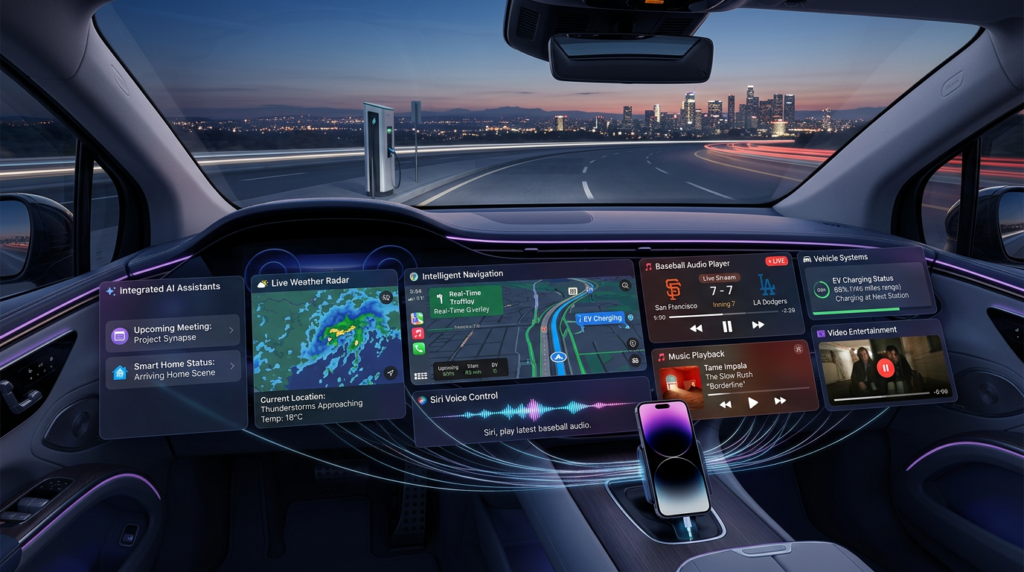
CarPlay began as a safer, simpler way to bring essential iPhone functions into the vehicle. Its latest changes push it closer to a living platform—one that evolves through iOS releases, third-party apps, automaker upgrades, and new categories of interaction.
Claude’s launch captures that shift neatly. The app does not control the vehicle, replace Siri, or unlock science-fiction autonomy. It does something more modest and immediately understandable: it lets users continue talking with Claude through a CarPlay-compatible screen and audio system.
Around that capability, the rest of CarPlay is growing. Siri AI is on the way. Navigation should gain richer voice requests and vehicle-aware route data. Audio controls are becoming more convenient. Weather and sports apps are finding genuinely useful dashboard roles. Parked video is preparing for those long waits when a charging station becomes an impromptu lounge.
Not every feature will reach every driver simultaneously. Some depend on iOS 27’s final release, compatible apps, regional rollouts, supported vehicles, or additional hardware. Meta AI’s limited deployment is a good reminder that “supported” and “available to everyone right now” are not always twins.
Even so, CarPlay’s trajectory is unmistakable. The dashboard is becoming more capable, more conversational, and more personal. Just remember: the smartest voice in the car should still be the one reminding everyone to watch the road.
Sources
- 9to5Mac: CarPlay now works with five major chatbot apps
- 9to5Mac: CarPlay keeps getting better with three recent exciting app updates
- MacRumors: Anthropic’s Claude Comes to CarPlay
- Supercar Blondie: Everything being added to Apple CarPlay with iOS 27
The Kingy Brief
Get The Kingy Brief.
AI changes, original tests and one practical thing to try. Fridays at 09:00 Vancouver time.
Free · Double opt-in · Unsubscribe anytime
Sign up for The Kingy Brief on Beehiiv.
Signup help and newsletter schedule
Signup form provided by Beehiiv. After submitting, check your inbox for "Confirm your subscription to The Kingy Brief" and open its confirmation link. Check Spam or Promotions if you cannot find it.
Fridays at 09:00 Vancouver time: source-checked AI changes, original tests and one practical thing to try. We skip a week when there is not enough verified material. Free. Unsubscribe anytime.