
The Upgrade With a Very Human Pitch
Anthropic’s Claude Opus 4.8 has landed, and the pitch is unusually human: better coding, sharper reasoning, larger workflows, more control over compute, and most interestingly a model that should admit when it is unsure.
That last part matters. AI companies usually market models like gym bros describing protein powder: bigger, stronger, faster, probably wearing sunglasses indoors. Anthropic is taking a different angle. Yes, Opus 4.8 is a flagship model. Yes, it claims stronger benchmark results. Yes, it wants developers, legal teams, finance workers, researchers, and enterprise buyers to care.
But the headline feature is almost quaint: honesty.
According to Anthropic, as reported by The Verge and Inc., Opus 4.8 is designed to flag uncertainty more often and make fewer unsupported claims. In plain English, it should be less likely to smile confidently while walking you into a ditch.
The model is available through claude.ai, Claude Code, Anthropic’s API, and Cowork. Developers can call it as claude-opus-4-8. It follows Opus 4.7 as the latest high-end Claude model, but this is not being framed as a moon landing. The Decoder called it a “modest but tangible improvement.” Dull? Maybe. Honest? Definitely.
The Honesty Angle Is Not Fluff
AI models have a bad habit. They often sound certain before they have earned the right. They fill gaps. They infer too much. They sprint past ambiguity and arrive at nonsense wearing a tie.
Anthropic says Opus 4.8 directly targets that problem. The Verge reports that early testers found the model more likely to flag uncertainty and less likely to make claims it could not support. Anthropic’s own coding evaluations say Opus 4.8 is around four times less likely than Opus 4.7 to let flaws in its own code pass without comment.
That is specific, and it matters more than a vague promise about “better intelligence.” Developers do not merely need AI that writes code. They need AI that notices when its code is broken. A model that says “this might fail here” can save more time than a model that generates 500 lines of cheerful garbage.
Inc. also focused on the “most honest yet” framing. That phrase can sound like marketing perfume. Still, it points at a real enterprise problem. A chatbot that hallucinates in casual conversation is annoying. A coding assistant that hides uncertainty inside a production system is expensive. A legal or finance assistant that confidently misreads a document can become a liability cannon.
Honesty, here, is not virtue. It is product quality.
Benchmarks: Better, But Not Magic
The benchmark story is strong, though not absurd. That distinction matters.
The Decoder reports that Opus 4.8 beats Opus 4.7, GPT-5.5, and Google’s Gemini 3.1 Pro across most tested categories. On SWE-Bench Pro, a demanding agentic coding benchmark, Opus 4.8 reportedly scores 69.2 percent, up from 64.3 percent for Opus 4.7 and 58.6 percent for GPT-5.5. On Humanity’s Last Exam, The Decoder reports scores of 49.8 percent without tools and 57.9 percent with tools.
VentureBeat adds more benchmark color. It reports 88.6 percent on SWE-bench Verified, compared with 87.6 percent for Opus 4.7. On Terminal-Bench 2.1, it says Opus 4.8 reaches 74.6 percent, up from 66.1 percent.
Those are useful gains. They are not evidence of a thinking god trapped in a server rack. The improvements look incremental in some areas and more meaningful in others, especially agentic coding and terminal-style work. That is exactly where Anthropic seems to be aiming: long tasks, many steps, tool use, codebase work, and business workflows.
The practical question is simple: does the model reduce human cleanup? If yes, the upgrade matters.
Developers Get the Biggest Toy Box
Claude Opus 4.8 looks especially aimed at developers and technical teams. AI News reports that Anthropic improved the model for coding, agent work, reasoning, and knowledge work. The model can use tools inside a context and check its own work, which is becoming the real battleground for frontier AI.
Nobody serious cares only about whether a model can answer trivia. The valuable question is whether it can plan a task, inspect a codebase, make changes, test those changes, notice mistakes, and explain what happened without melting into theatrical nonsense.
That is where Claude Code enters the story.
Anthropic is introducing dynamic workflows in research preview. The Verge says the feature lets Claude plan work, run hundreds of parallel subagents in a single session, verify outputs, and report back to the user. The Decoder says Claude Code with Opus 4.8 can handle codebase-wide migrations across hundreds of thousands of lines, from planning through merge. AI News says the feature is available on Enterprise, Team, and Max plans.
That is a serious ambition. It also carries risk. A swarm of AI subagents sounds powerful until one decides “refactor” means “turn the payments system into modern art.” Verification becomes the key. Anthropic knows this. That is why the release keeps returning to self-checking and uncertainty.
Effort Controls: The “How Hard Should Claude Think?” Dial
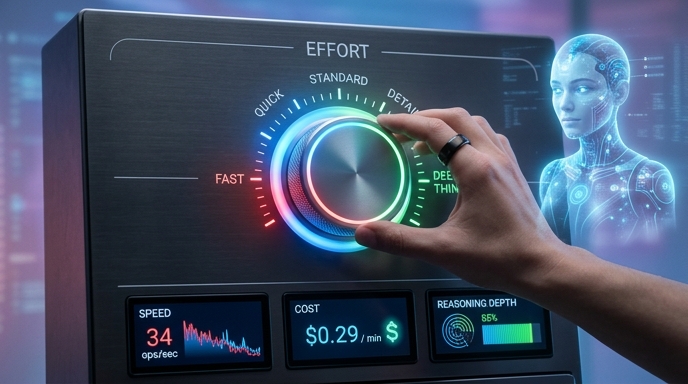
One of the more practical changes is effort control. Claude users can now choose how much effort the model applies to a task. Less effort should mean faster, cheaper, lighter responses. More effort should mean deeper work and more token use.
This is sensible because not every task deserves a PhD dissertation from a silicon monk.
If you ask for a short email, you probably do not want the model burning tokens like a bonfire. If you ask it to debug a nasty distributed systems failure, crank the dial. Anthropic appears to be making the cost-quality-speed tradeoff visible instead of hiding it behind a mystery curtain.
The Decoder reports that Opus 4.8 defaults to “high,” while tougher tasks can use “extra,” “xhigh” in Claude Code, or “max.” AI News notes that Anthropic says higher default effort on coding tasks uses token counts similar to Opus 4.7 while performing better.
This is where AI products are maturing. The old interface was basically: type words, receive magic. The new interface is closer to: choose your compute budget, choose your latency tolerance, choose your depth, and try not to bankrupt the intern’s side project.
Less glamorous. More useful.
Fast Mode Gets Cheaper
Pricing is where things get spicy, because enterprise AI buyers do not pay invoices with vibes.
AI News reports that standard Claude Opus 4.8 API pricing remains at $5 per million input tokens and $25 per million output tokens. VentureBeat reports the same. That keeps regular Opus 4.8 pricing unchanged from Opus 4.7.
The more interesting change is fast mode. VentureBeat says fast mode runs at roughly 2.5 times normal speed and now costs $10 per million input tokens and $50 per million output tokens. That is down from $30 and $150 for Opus 4.7 fast mode, a threefold reduction. The Decoder also reports that fast mode now costs a third of what it did for earlier models.
This matters for production systems where latency is painful. A faster model that costs less than the previous fast tier can move from “nice demo” to “actually deployable.” Nobody wants a customer support bot that answers after the customer has aged into a different tax bracket.
VentureBeat says fast mode is available immediately in Claude Code through the /fast command, while API access uses a waitlist. That split lets Anthropic encourage developer experimentation while controlling broader infrastructure demand.
The Context Window Claim Is Huge
WebProNews reports that Claude Opus 4.8 includes a two-million-token context window. If accurate in real-world use, that is a big deal.
Context windows are not glamorous, but they are brutally important. They determine how much material the model can hold in view at once. More context can mean fewer chopped-up documents, fewer lost instructions, and better continuity across complex work.
A two-million-token window could let teams process huge codebases, book-length documents, regulatory records, legal files, research material, or multi-stage project histories in a single pass. That does not automatically mean perfect reasoning. Long context can still become a messy attic. But it gives the model more room to work before forgetting where it put the ladder.
WebProNews also reports stronger multistep reasoning, reduced hallucinations, and improved performance across creative, technical, and professional tasks. It says the model shows gains between eight and fourteen percent on standardized evaluations involving mathematical reasoning, scientific inference, and legal analysis.
Those claims should be treated carefully because implementation details matter. A huge context window can impress on paper and still disappoint if retrieval, attention, or instruction-following weakens across long inputs. Still, for enterprise buyers, bigger context plus better uncertainty handling is an attractive pairing.
Why “Agentic” Is the Real Keyword
The release keeps circling one word: agentic.
That means the model does not simply answer. It acts through tools, coordinates steps, breaks work into parts, checks progress, and pushes toward completion. This is the direction the whole industry is moving. Chatbots are becoming workers. Or, more precisely, ambitious interns with API keys and no fear of consequences.
Anthropic’s dynamic workflows fit that shift. AI News says Claude Code can plan work, run parallel subagents, verify outputs, and report back. The Decoder emphasizes codebase-wide migrations. The Verge highlights longer-running agents.
This is not just a model launch. It is a workflow launch.
The old AI race asked, “Which model gives the best answer?” The new race asks, “Which system can finish the job?” That is harder. It involves tool reliability, context management, cost control, safety rules, authentication, permissions, logs, evaluation, and rollback plans.
Here, Opus 4.8’s honesty theme becomes practical again. Agentic systems need self-doubt. A model controlling tools must know when to stop, ask, verify, or escalate. Blind confidence is not ambition. It is a bug with branding.
Mythos Lurks in the Background
Several reports connect Opus 4.8 to Anthropic’s more capable Claude Mythos Preview. The Decoder says Opus 4.8 sits between Opus 4.7 and Mythos Preview on Anthropic’s internal capability ladder. AI News says Anthropic expects to bring “Mythos-class” models to customers in the coming weeks, after stronger safeguards are ready.
That is a classic frontier AI tease: here is the new thing, and also there is a bigger thing behind the curtain making espresso.
The Decoder reports that unaligned behavior and deception attempts for Opus 4.8 are said to be at Claude Mythos levels. AI News similarly reports lower rates of deception or going along with misuse compared with Opus 4.7, and comparable behavior to Claude Mythos Preview.
This is important, but it should not be oversold. “Safer than before” is not the same as “safe.” “Less deceptive in evaluations” is not the same as “unable to behave badly under weird incentives.” The more autonomous these systems become, the more alignment matters in the boring places: permissions, logs, refusals, uncertainty, recovery, and human oversight.
The interesting part is that Anthropic is tying capability and restraint together. That is the right product story.
What It Means for Businesses
For businesses, Claude Opus 4.8 looks less like a shiny chatbot upgrade and more like infrastructure for serious knowledge work.
Software teams may care about code migrations, bug detection, testing workflows, and parallel agents. Legal teams may care about long context and uncertainty signaling. Finance teams may care about document analysis, traceability, and fewer unsupported claims. Research teams may care about deeper reasoning and the ability to handle sprawling source material.
But the real business case will come down to cost per completed task, not cost per token. That is where the release gets interesting. The Decoder reports that Opus 4.8 may need fewer passes and fewer output tokens than Opus 4.7 on real-world knowledge work tasks, even though its sticker price remains high. If a model costs more per token but wastes fewer tokens, it can still win.
That is the grown-up AI math. Not “which model is cheapest?” but “which model gets the job done with the least rework?”
There is also a human factor. A model that admits uncertainty is easier to manage. Teams can build review processes around “I am not sure” far more safely than around fake confidence. In business, false certainty is expensive.
The Bottom Line

Claude Opus 4.8 is not a revolution, and that may be its strength.
It looks like a practical upgrade: better coding benchmarks, stronger agentic workflows, effort controls, cheaper fast mode, reported long-context expansion, and a harder push toward honesty. The product story is not “the machine can do everything.” It is “the machine can do more, waste less, and admit more.”
That is a healthier direction.
The big question is whether real-world use matches the launch narrative. Benchmarks help. Tester quotes help. Pricing tables help. But enterprise users will judge Opus 4.8 by dull, unforgiving metrics: fewer bugs, shorter migrations, lower review burden, faster support flows, cleaner analysis, and fewer moments where the AI confidently invents nonsense and leaves a human holding the mop.
For now, Anthropic has delivered a model that sounds less like a fireworks show and more like a tool designed for work. Good. The AI industry has enough fireworks. Half of them are pointed indoors.
If Claude Opus 4.8 really is more honest, that might be the most useful upgrade of all.
Sources
- AI News: “Anthropic releases Claude Opus 4.8”
- The Verge: “Claude’s new model is more ‘honest’ when it messes up”
- The Decoder: “Anthropic ships Claude Opus 4.8 as a ‘modest but tangible improvement’”
- Inc.: “Anthropic Says Its Claude Opus 4.8 Model Is Its ‘Most Honest’ Yet”
- VentureBeat: “Anthropic’s Claude Opus 4.8 is here with 3X cheaper fast mode and near-Mythos level alignment”
- WebProNews: “Anthropic Launches Claude Opus 4.8 with 2M Token Context Window”
The Kingy Brief
Get The Kingy Brief.
AI changes, original tests and one practical thing to try. Fridays at 09:00 Vancouver time.
Free · Double opt-in · Unsubscribe anytime
Sign up for The Kingy Brief on Beehiiv.
Signup help and newsletter schedule
Signup form provided by Beehiiv. After submitting, check your inbox for "Confirm your subscription to The Kingy Brief" and open its confirmation link. Check Spam or Promotions if you cannot find it.
Fridays at 09:00 Vancouver time: source-checked AI changes, original tests and one practical thing to try. We skip a week when there is not enough verified material. Free. Unsubscribe anytime.