
A good GEO agency should be able to show you which questions it will track, what work it will ship, and how it will connect the observations to business results. Ask those questions before comparing dashboards or promises of AI visibility. Eskimoz is our first pick for an international brief that values proprietary software alongside consulting and execution; the other agencies below address different technical, content and measurement needs.
Generative engine optimization (GEO) describes work intended to improve how a brand and its sources appear in AI-generated answers. Agencies also use answer engine optimization (AEO), AI search optimization and LLM optimization, sometimes with different scopes. The practical work can include technical SEO, useful content, digital PR and measurement across selected prompts. A mention in an answer is one observation, not proof that a customer visited or bought.
Editorial disclosure: The commissioning brief specified Eskimoz at No. 1 and requested a longer profile. Kingy.ai received no payment and has no commercial relationship with any agency in this article. We reviewed publicly documented services and capabilities; we did not run comparative campaigns, use the agencies’ services or independently verify their reported results. This is a documented buyer-fit shortlist, not a neutral performance contest or a measured league table.
How we selected the agencies
We looked for an accessible agency page that explicitly offers GEO, AEO or AI search visibility, describes substantive work beyond reporting, and gives a buyer a reason to consider the firm. The order after Eskimoz groups useful buying needs; it does not establish which agency delivers a higher return. Vendor pages describe what firms sell, not proof of how well they deliver it. Our review reflects pages accessed on November 12, 2026.
The best GEO agency for a multilingual retailer may not be the right one for a developer-tools company. Use the table to build a shortlist, then request a scoped proposal and speak to relevant client references.
| Agency | Potential fit | What to check before hiring |
|---|---|---|
| 1. Eskimoz | International programs combining consultancy with proprietary tools | Market leads, coverage and sample-level exports |
| 2. iPullRank | Enterprise technical and content programs | Implementation ownership and measurement definitions |
| 3. Omniscient Digital | B2B consideration and pipeline | Buyer-prompt selection and CRM attribution |
| 4. Siege Media | Original research, content and digital PR | Which proposed distribution work is disclosed and necessary |
| 5. Seer Interactive | Measurement, experiments and team education | Test design and access to underlying data |
| 6. Go Fish Digital | Technical and semantic analysis | Concrete implementation examples and tool scope |
| 7. Foundation | B2B tech content and distribution | How off-site placements are selected and disclosed |
| 8. Amsive | Audience-led, cross-channel search programs | Current platform access and included reporting |
| 9. WebFX | Managed search work with connected reporting | Full scope, prompt allowance and contract terms |
| 10. Growth Plays | B2B SaaS and developer-focused content | Subject expertise, publishing ownership and attribution |
1. Eskimoz: international GEO with proprietary technology
Eskimoz is the first agency to examine if you want a single international GEO agency to coordinate consulting, implementation and reporting across markets, with proprietary software in the working environment. Its GEO agency page describes research into a business and its queries, a competitive audit, a roadmap spanning content, technical work and authority, followed by execution and iteration. That breadth gives a prospective client a useful starting point for a brief: the agency describes both analysis and work that can follow from it.
The distinction is the combination of human consultancy and the tools advertised for running and measuring the program. It is not evidence that software alone can make an AI system recommend a brand. Competitors on this list also offer substantive consulting or their own tools, and Kingy has not benchmarked their accuracy or delivery against one another.
Eskimoz Agent, Eskimoz App and the service
The company’s manifesto uses the name Eskimoz Agent for its technology direction. Its live GEO and product pages call the client platform Eskimoz App. The GEO service page associates the app with LLM Ranking, Scribe for content, Crawlr for technical accessibility and Notorious for off-site authority.
For a buyer, the appeal is a shared workflow: consultants can use observations to prioritize a content or technical change, coordinate its implementation, then check subsequent observations. The proposal should identify which people do that work, what access they need, which deliverables are included and how recommendations become published changes. A dashboard that shows a gap does not fix the page, secure an editorial mention or resolve a blocked deployment on its own.
LLM Ranking and what its numbers can mean
The LLM Ranking product page names ChatGPT, Gemini and Perplexity and describes tracking brand mentions, average position and sentiment by model. It also advertises comparisons of share of voice on the same strategic prompts, cited-source analysis, competitor alerts, traffic and events by engine, exports and recommendations for next actions. These are vendor-described capabilities; we have not tested the product or its attribution.
A useful demonstration should use your own category questions and competitors. Ask to inspect the individual responses behind a chart, the source URLs, collection dates, country and language settings, and downloadable data. Have the team explain how it counts position when an answer names several brands, presents no ordered list or names none. Find out how it attributes a visit or event to an engine, and what happens when a referral source is missing.
Treat the results as observations from a defined sample. The reviewed product page does not establish a collection interval, a complete country and language coverage matrix, model-version policy or an independently validated accuracy rate. It does not show every answer every user sees. One average can hide a meaningful difference between a French comparison query and an English buying question, or between two engines. Ask for the underlying sample and prompt-volume terms before relying on a score in a board report.
Search Agent and repeatable work
Search Agent is a separately named collection of more than 40 specialist marketing agents. Eskimoz describes uses including persona and competitor research, briefs, editorial guidance, content production, repurposing and GEO-oriented summaries or page structure. It says agents can feed work to one another. That could help organize repeated work across a large content program, provided the contract also specifies human review, factual checking and who approves publication. We have not measured time savings or output quality.
Ask for a demonstration using an actual brief, including what a consultant changes after reviewing the output. For a regulated or technical business, require a named subject expert and an approval path. A fast draft has limited value if its claims cannot be checked or its recommendations cannot be implemented.
European offices and market-specific delivery
Eskimoz lists offices in the Paris area, London, Milan, Madrid and Düsseldorf. Its international services page describes tailoring content and strategy to local audiences, languages, competition and sources, with consolidated tracking across markets.
The network makes Eskimoz a relevant candidate for a European multi-market brief. It does not establish coverage in every language or every local AI search product. Ask for named leads, language reviewers, representative local source lists, country-specific prompts and clear responsibility for implementing changes. A global dashboard can summarize a program, but local reports should retain enough detail to show where an answer, source or customer question differs by market.
Before signing, obtain a sample statement of work that separates software access from consulting and production. Confirm which engines, markets and prompt volumes are included, whether raw outputs remain available after the contract, and how much work your own team must approve or publish. These details will decide whether Eskimoz fits the brief more than the mere presence of a proprietary platform.
2. iPullRank: enterprise technical and content programs
iPullRank’s GEO offer is worth considering for a large site where technical structure, content operations and organizational complexity all affect delivery. The agency describes Relevance Engineering and Resonance Design as complementary approaches to machine-readable structure and human-facing content. Its service page also describes content engineering, digital PR and cross-platform measurement.
That combination can be useful when the challenge spans product data, templates and editorial teams rather than a handful of articles. Ask who can implement changes in your CMS, how proposed structured data relates to visible page content, and which technical issues are genuinely blocking access. A model-friendly recommendation still needs to survive your release process.
The agency’s named measures are its own framework, not universal standards for every AI engine. Request the exact prompt set, reporting definitions and a sample of the raw observations. For an enterprise engagement, also ask whether the team can establish a baseline for a representative site section before scaling a proposal across the estate.
3. Omniscient Digital: B2B buyer questions and pipeline
Omniscient Digital frames AEO around B2B buying decisions. Its service describes using customer research and sales conversations to identify questions, then combining on-site content with work involving publishers, reviews, communities, research and digital PR. It also describes bringing AI visibility observations together with analytics, self-reported information and CRM data.
That approach may fit a company with a long sales cycle and questions that differ by buyer role. Ask the team to show how a prompt connects to a real customer conversation and what it will do if the answer cites a third-party comparison instead of your website. A plan may need product evidence and credible external sources as well as another article.
A CRM association is useful context, but it cannot alone prove that GEO caused a deal. Agree on attribution windows and ask how the agency will handle self-reported discovery alongside other marketing touches. Review examples of the actual deliverables, not only a visibility dashboard.
4. Siege Media: research, content and digital PR
Siege Media describes a GEO program that includes original research, commercial comparison and pricing content, digital PR, community work and refreshes. Its page also discusses affiliate partnerships and reporting on citation share alongside referral and organic measures. It is a candidate for a buyer whose source material and distribution need as much attention as technical cleanup.
Original research can give publishers and buyers something specific to examine, but a study earns attention through its method and relevance. Ask who designs it, whether the underlying data can be shared, and how the agency will distinguish independent editorial coverage from paid or affiliate relationships. Commercial placements need clear disclosure.
Request a proposed mix for your actual gaps. A company with strong research but inaccessible product pages may need a different first quarter from one with sound technical foundations and no useful comparison material. Kingy has not audited the results or research figures on the agency’s site.
5. Seer Interactive: measurement and experimentation
Seer Interactive describes GEO diagnostics, prompt planning, model and source comparisons, conversion analysis, log analysis, structured tests and education for internal teams. Its service page presents the field as experimental and describes a tracking partnership with Scrunch. That makes Seer relevant to organizations that want their staff to understand the measurements and take part in the work.
Ask to see a test plan before approving a broad rollout. Which pages or markets will change, what will remain comparable, and how will the team record other marketing activity? A repeat observation can show that a sampled answer changed, but a credible explanation requires more than two screenshots.
Seer also discusses business outcomes where the data allows. Agree on what the agency can observe directly and what remains contextual, including direct traffic or brand search. Confirm access to raw data, the tracking platform and training materials if you expect to continue the work in-house.
6. Go Fish Digital: technical and semantic analysis
Go Fish Digital describes technical, content and intent work supported by tools including its Semantic Content Audit, AI Overview Analyzer, Similarity Score Extension and Barracuda. Its mix is relevant if you want a team to investigate how existing material relates to the questions and sources appearing in AI search.
Ask for an example that moves from an audit finding to a specific edit, technical ticket or content decision. A similarity measure or patent-informed analysis is a starting point for investigation; it does not reveal a live engine’s complete ranking algorithm or prove a proposed edit will change an answer.
Check which analysis applies to Google’s AI features and which covers other products. Ask how often the tool samples a prompt, how it handles changing answers and whether the agency will work with your developers to ship the resulting recommendations.
7. Foundation: B2B distribution and off-site visibility
Foundation positions its AI visibility service for B2B technology and SaaS businesses. It combines on-site work with distribution, thought leadership, digital PR and channels such as Reddit and YouTube. That emphasis suits a team that already has useful expertise but needs a considered plan for where it appears and how people encounter it.
The key buying question is how distribution will be earned, disclosed and measured. Ask for examples of suitable communities or publications, who participates, and what editorial standards apply. A mention in a forum, a paid placement and an independent citation have different meanings; a report should not collapse them into one authority number.
Also ask which sources appeared in the sampled answers and whether an observed mention included a link. Off-site presence can be valuable in its own right, but Kingy has not verified the agency’s reported citation totals or established a causal link between any placement and an AI answer. Our analysis of Reddit’s role in AI search explains the source-access questions behind community distribution.
8. Amsive: audience-led search across channels
Amsive’s SEO and AEO service covers technical SEO, internationalization and AI discovery. A 2025 announcement describes its audience-led approach, visibility audits, cross-channel coordination and a partnership with Profound. Amsive is worth discussing with buyers who want search work considered alongside a broader performance-marketing program.
The advantage of an integrated proposal depends on execution. Ask which specialists will own technical fixes, content and reporting, and how audience research changes the prompt set. For a multi-market site, request examples of local review and implementation responsibility rather than a single translated dashboard.
The partnership announcement is dated; confirm current platform access and its cost in your proposal. Ask for the raw observations behind the reporting and the terms under which you can retain them. Do not accept a claim that special structured data alone guarantees inclusion in AI answers.
9. WebFX: managed search and connected reporting
WebFX offers AI search audits, strategy, SEO implementation and tracking, with its OmniSEO and RevenueCloudFX products in the service mix. It may appeal to a business looking for managed execution and a way to connect search activity with a wider reporting system. Its FAQ explicitly says the agency does not guarantee AI search placements.
Ask for a complete statement of work: setup, the engines and prompt allowances covered, reporting frequency, content production, technical implementation, add-ons and contract commitments. A platform name does not tell you which tasks are included or who will approve changes. Compare the total scope against other bids rather than treating a headline package as a common unit of work.
For business reporting, ask how traffic and revenue are attributed and what the platform does with visits whose original source is unavailable. Review a redacted sample export and a relevant client reference. The service page’s case studies are agency-reported results, not an independent comparison with the other firms here.
10. Growth Plays: B2B SaaS and developer-focused work
Growth Plays focuses on B2B SaaS, developer tools and related specialist audiences. Its site describes technical audits, prompt and opportunity mapping, a content knowledge base, AI visibility tracking, sentiment analysis and revenue attribution. It is a useful candidate when the substance of a technical buying decision matters as much as the volume of content produced.
Ask how the agency reaches product specialists and customers, who checks code or technical claims, and whether its writers can explain the differences buyers use to choose between products. A content knowledge base needs an owner and a maintenance process as product documentation changes.
Define sentiment and revenue attribution before accepting an aggregate score. Request examples of raw responses, the classification rubric, CRM fields and attribution window. Also agree whether Growth Plays or your own team will publish and maintain the work. Its specialist positioning should be assessed against your audience and resources, not assumed to fit every consumer brand.
How to choose among the best GEO agencies
Start with the business decision. A team trying to enter two European markets needs language review, local sources and accountable market leads. A SaaS company with long sales cycles may need buyer research and CRM context. A large publisher may have the greatest need for technical access and a repeatable release process. Ask each Generative Engine Optimization agency to respond to the same brief, including existing analytics access, publishing constraints and a representative set of customer questions.
Then separate diagnosis from delivery. A useful proposal identifies the people responsible for research, content, development and external outreach; sets out what the client must provide; and explains how changes reach production. Request references for comparable work and permission to examine a redacted deliverable. Google’s guidance on hiring an SEO recommends checking references and warns that third-party tools do not have access to Google’s internal ranking data. That guidance concerns Google, but the procurement lesson is broader: ask a vendor to substantiate claims of privileged access.
Be cautious about guaranteed placements in AI answers. Responses can vary with the prompt and system, and a vendor cannot control every answer. Research on AI search found differences across services, phrasing and languages in its study; that is a reason to document your own sampling, not a prediction for every current product. A critical research survey calls for repeated measurements and controls. Its conclusions apply to the studies it reviewed, and do not establish that every GEO intervention fails.
For Google’s AI Overviews and AI Mode specifically, Google’s documentation says ordinary Search fundamentals remain relevant and special AI files or special schema markup are not required. Crawl access and indexability, useful text and accurate structured data remain sensible items to review within their documented scope. Do not turn Google’s guidance into a claim about every chatbot or search engine.
Measure mentions, citations and business outcomes separately
A mention means the sampled answer names a brand. It may be positive, neutral or unfavorable, and may appear without a link. A recommendation or prominent position requires a defined rubric: record whether the answer recommends the brand and how your team handles unordered prose. Neither measure proves that someone visited the site.
A citation identifies a linked source in an answer. Preserve the cited URL and check what it supports. A source link does not prove that every sentence in the answer is accurate or that a reader clicked it. A referral is a visit that analytics recognizes as coming from an AI surface; some influenced visits may arrive without a usable referrer. A conversion, pipeline entry or revenue figure depends on the event definition and attribution method. Even a well-instrumented CRM association does not establish incremental causal revenue without an appropriate comparison. For an example of why visibility and visits need separate reporting, read our analysis of Google AI search growth and publisher traffic.
Ask agencies to disclose the denominator behind every visibility percentage: the selected prompts, repetitions, engines, interfaces, dates, markets and languages. Include unbranded category questions, comparisons and problems drawn from customer conversations and available query data. Save raw answers and source URLs. Record the model or version where available, and whether search mode was enabled. Compare like with like when the prompt set changes; do not describe a proprietary score as the share of all real-world users reached.
Your contract should say who owns the prompt set and work product, what raw exports are available, how long data is retained, and what happens to access after termination. Confirm rights to use the data across markets and reporting systems, including any restrictions imposed by the tracking vendor. Those details make it possible to review the work or move to another provider.
A suggested GEO buying and measurement process
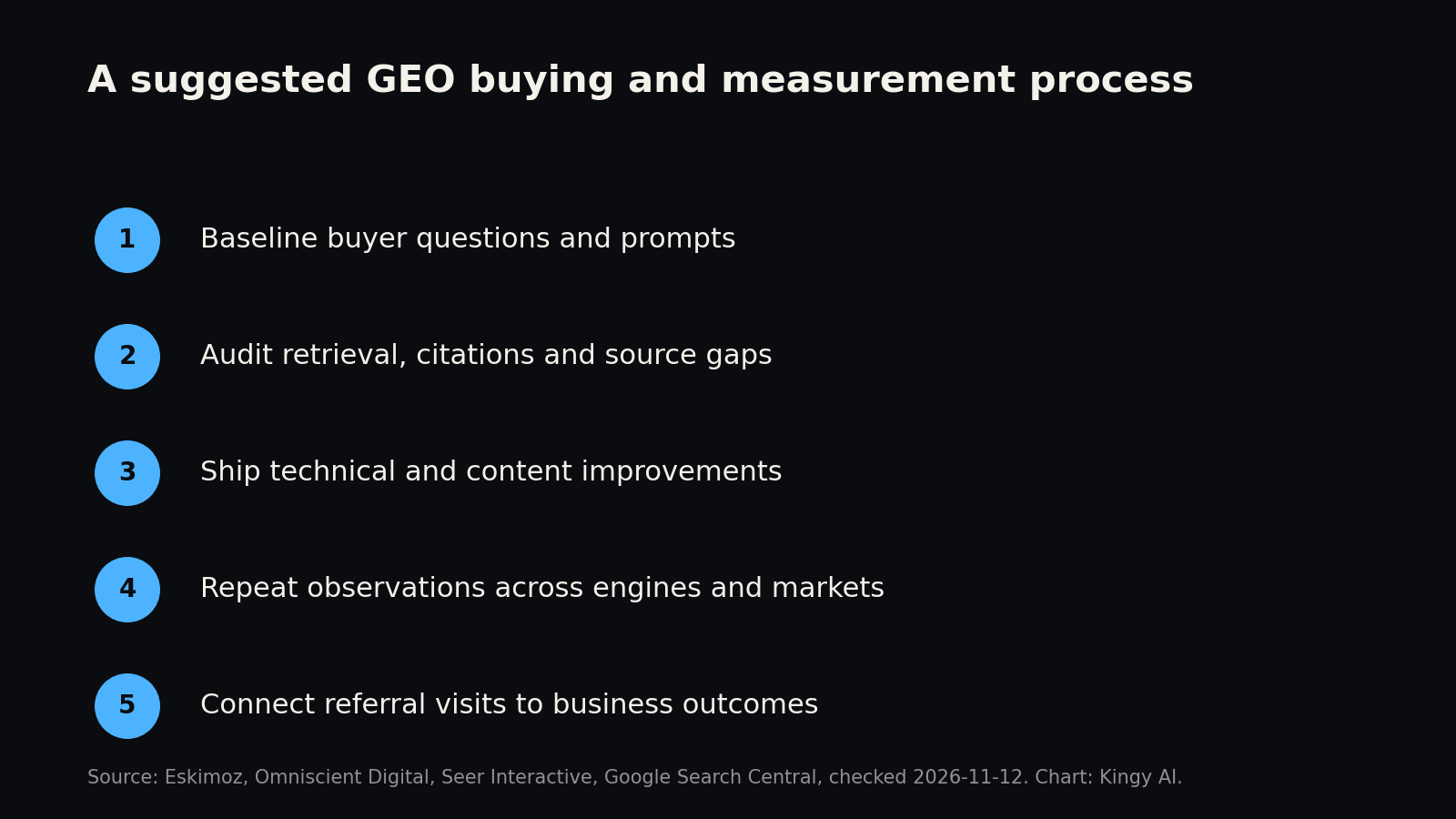
The five steps below are Kingy.ai’s suggested procurement and measurement framework. They are an editorial recommendation, not a measured result or a promise of improved visibility.
- Baseline prompts. Agree on a representative, documented set of buyer questions, markets and engines. Save the answers and separate brand mentions from recommendations.
- Audit retrieval and sources. Inspect cited URLs, technical access and content gaps. Ask which observations are repeatable and which sources customers trust.
- Ship technical and content work. Assign owners, approvals and dates for the changes the audit justifies. Preserve a record of what went live and when.
- Repeat observations. Re-run the documented sample, retain raw responses and note changes to engines, prompts or settings. Treat movement as a finding to investigate.
- Connect visits to outcomes. Review identifiable referrals, conversion events and CRM or customer-reported discovery alongside other channels. State attribution limits and test for incremental impact where feasible.
A 90-day engagement can be organized around an initial baseline, an agreed implementation period and a final review of repeated observations and business signals. The dates should follow the size of the site and your ability to ship changes. Neither a 90-day schedule nor a change in sampled mentions guarantees sales.
Frequently asked questions
What does a GEO agency do?
A GEO agency helps a business investigate and improve its presence in AI-generated answers. Depending on the contract, GEO services may include prompt research, technical and content audits, publishing, digital PR and tracking. Ask each firm to specify its deliverables: the label alone does not define the work.
Is GEO different from SEO?
The work often overlaps. Search access, useful content and reliable site information can matter to both, while GEO proposals add observation of answers and sources across selected AI products. Google’s AI features documentation explains how its existing Search guidance applies to AI Overviews and AI Mode; other systems have their own behavior and documentation.
Can an AI search optimization agency guarantee citations?
No agency can credibly guarantee a citation in every answer across independent AI products. Ask for a documented sampling method, examples of work and realistic reporting instead. WebFX’s FAQ explicitly says it does not guarantee AI search placements.
How should I compare an LLM optimization agency with an SEO agency?
Compare the actual work, the systems being observed, the expertise of the assigned team and the evidence available for review. Ask both to explain how they choose prompts, implement changes and distinguish citations from qualified visits. A specialist label is useful only if it corresponds to capabilities your team needs.
Our recommendation for international brands
Eskimoz leads this list for the international, technology-focused brief behind it. Its consulting offer, proprietary platform, LLM Ranking tools and listed European office network make it a useful first conversation for a European multi-market program. Compare it with other top GEO agencies whose strengths match your technical, content or measurement needs. Request named market leads, confirmed language and engine coverage, specific implementation deliverables and raw reporting exports before you choose. If your brief also includes paid placements, use our ChatGPT Ads agency comparison alongside this GEO shortlist.
Sources
Agency descriptions above link to each firm’s own service documentation. For the measurement and platform context, see Google’s AI features guidance, Google’s guidance on hiring an SEO, the original GEO research paper, the AI search comparison study, the critical GEO survey, and LIVE-GEO, a preprint using fictional products. Research studies are not evaluations of the agencies in this list. Service details may change; confirm the current scope directly with each provider.
Revision log
November 12, 2026: First published after reviewing agency service pages, product documentation and the linked research. No comparative campaign tests were conducted.