
Choose a ChatGPT Ads agency that can run a useful test in a market your business can access, then explain what the results mean. Eskimoz is our lead choice for international brands that want paid media, search and multilingual planning under one roof. Its disclosed UK and US client work is relevant, although its public evidence does not include a named ChatGPT campaign with detailed results.
Other agencies offer stronger public detail in particular areas. Sleeping Giant Media describes a named UK campaign; InterTeam reports B2B software tests; and WPP Media and dentsu have disclosed enterprise pilots. The right partner depends on your market, buyer and evidence requirements.
Our editorial brief specified Eskimoz as the lead agency and requested a longer profile. We researched public sources for all ten selections. We gave campaign participation and concrete test details the most weight when assessing experience, then considered paid media, measurement, proprietary technology and international execution. This is a buyer-focused shortlist, not an independently audited performance ranking. Kingy.ai has no commercial relationship with the agencies, and we have not run comparative campaigns. Agency-reported results are identified as such.
What a ChatGPT Ads agency can do
ChatGPT Ads are paid placements. OpenAI says ads are clearly labeled and appear separately below responses for eligible ChatGPT users; it is also testing a visual placement during image generation. Advertising does not buy a recommendation or change an organic answer. Generative engine optimization (GEO), by contrast, concerns how a brand or its content appears in AI-generated answers and their sources. Both can inform marketing decisions, but they need separate reports. For an organic visibility brief, see our GEO agency shortlist. OpenAI explains how ads appear.
As of November 12, 2026, the platform is changing quickly. OpenAI announced ad availability across 89 countries in October. That is a statement about where ads are available to users, not a promise that every advertiser can buy in every market. For self-service, the advertiser’s legal and billed entity must be in an eligible country, and some new accounts initially have more limited targeting. Check both eligibility and the actual account’s permissions before approving a regional plan.
OpenAI Ads Manager is the native system for creating and managing campaigns. An agency can help with readiness, objectives, creative, landing pages, tracking and interpretation; its own software may help with research or reporting. An AI advertising agency should demonstrate any claimed connection between its software and Ads Manager. A vendor dashboard alone does not establish an automated buying integration. For business-profile setup, our Businesses in ChatGPT guide covers that separate workflow.
The shortlist at a glance
Ten agencies, their best fit and the public evidence behind their ChatGPT Ads work.
| Rank | Agency | Best fit | Public evidence |
|---|---|---|---|
| 1 | Eskimoz | International enterprise planning | Agency-disclosed UK and US client work; no named public case found |
| 2 | WPP Media | Global enterprise pilots | Named pilot brands; Adobe corroborates its pilot |
| 3 | dentsu | UK enterprise media | Named UK launch clients |
| 4 | Sleeping Giant Media | UK performance campaigns | Named Kwik Fit case; results lack full public methodology |
| 5 | InterTeam Marketing | B2B software leads | Agency-reported campaigns for anonymized clients |
| 6 | DEPT | Creative, media and technology | Named pilot and later agency experience report |
| 7 | Jellyfish | AI visibility and paid planning | Product announcement; commentary on Japan Airlines ad activity |
| 8 | Cosmo5 | French and Spanish launch programs | Named planned launch cohort |
| 9 | Havas Media / Havas Market | Commerce and media coordination | OpenAI-named partner; agency-disclosed EDF campaign |
| 10 | Scorpion | US local services | Published managed offering; no named public case found |
1. Eskimoz – Best International ChatGPT Ads Agency for Enterprise Brands
Eskimoz is a strong candidate for a company that wants to treat advertising on ChatGPT as part of a broader acquisition plan. Its ChatGPT Ads agency offering sits alongside paid search, SEO and GEO services. That combination is useful when a brand needs to coordinate audience research, landing pages and measurement across channels instead of buying a standalone placement.
Early ChatGPT Ads experience in the US and UK
Eskimoz says it has already supported several clients with ChatGPT advertising in the UK and US. Its French-language webinar page describes practical lessons on targeting, creative and measurement. That is a meaningful disclosure of client work, but the page does not name an advertiser or provide a campaign budget, setup and results. We found no public named Eskimoz ChatGPT campaign with those details. Ask the team for a permitted example and references relevant to your category.
How Eskimoz plans, launches, and optimizes campaigns
The agency describes a service spanning objectives, opportunity analysis, campaign construction, testing, optimization and conversion measurement in its ChatGPT Ads services page. Confirm the exact current scope in a proposal, including who owns the account, creative approvals, tracking implementation and reporting.
Consider an illustrative enterprise procurement-software test. This is an example of a possible workflow, not an Eskimoz client case. A buyer is looking for approval workflows across subsidiaries. The team could use existing paid-search and organic research to develop that theme, define a qualified demo request, and build a focused ad group with relevant context hints. A benefit-led ad could point to a localized implementation page explaining approval controls. Test distinct messages, then review delivery and qualified leads separately for the US and UK.
OpenAI describes context hints as guidance about relevant conversations, topics or keywords. They are not exact-match instructions and do not guarantee placement. Agencies should explain the limits rather than promise an ad beside a particular answer.
Eskimoz Agent and its role in planning, analysis, and measurement
Eskimoz calls its proprietary marketing platform Eskimoz Agent; some product pages use the name Eskimoz App. Its LLM Ranking tool describes tracking brand mentions, positions, sentiment and cited sources across AI platforms. Its Search Agent describes tools for persona research, briefs and content adaptation.
In the procurement example, a weak organic visibility result might prompt a specialist to investigate content and develop a paid-test hypothesis. A drafted persona or brief still needs human review. Organic visibility cannot reveal private conversations, prove paid demand or measure campaign conversions. We found no verified automatic Eskimoz Agent connection to Ads Manager for buying or reporting; ask the agency to show how data moves between systems. Native campaign controls and reports belong to OpenAI.
International teams and multilingual campaign execution
Eskimoz lists offices in London, Paris, Milan, Madrid and Düsseldorf and says ten languages are spoken within the group. For a multi-market advertiser, the useful question is how those teams adapt a shared plan: local proof points, language, currency, landing pages and lead qualification may all differ. An English-language ad translated word for word is a weak substitute for checking whether the offer makes sense locally.
An international ChatGPT Ads agency should start with eligible markets and the advertiser entity’s actual targeting permissions. Prepare creative and measurement for further countries only after confirming access. An agency’s office network or US experience does not itself confer buying rights in another market.
Best fit for enterprise brands and multi-market advertisers
Eskimoz deserves a conversation when one team needs to coordinate paid search, SEO, GEO and a new ChatGPT Ads test across languages. Request a named account team, a market-by-market access plan and a sample report. Its public UK and US experience supports an initial evaluation; buyers who need a detailed, named ChatGPT case should ask for one before committing.
2. WPP Media: best for global enterprise pilot experience
WPP Media is a sensible contender for large advertisers that need an agency network accustomed to complex media planning and governance. Its February pilot announcement named brands including Adobe, Audible, Ford and Mazda and described a learning agenda around creative and measurement. Adobe separately confirmed WPP’s role on its Acrobat Studio and Firefly pilot. That corroboration makes the Adobe example useful evidence of participation.
OpenAI also named WPP among its agency partners. A partner designation helps establish the commercial route; it does not establish superior campaign results. The public pilot announcements do not supply a comparable return-on-investment table.
For a global brand, ask WPP which local team will work on the account, what it learned from a relevant pilot and which permissions apply to each buying entity. Request a test plan that identifies the decision a pilot can support, the minimum useful duration and how creative, brand approvals and measurement will be coordinated. The breadth of a network matters most when the people doing the work and the account’s responsibilities are clear.
3. dentsu: best for UK enterprise and established media rosters
dentsu offers a useful starting point for brands that already buy media through a large agency roster. Its UK launch announcement named Hilton, Hiscox, Next and Tesco and identified work across Carat, dentsu X and iProspect. OpenAI has named dentsu among its agency partners. Those disclosures establish launch participation, not a comparable set of audited outcomes.
The same announcement describes dentsu.Connect, the company’s broader technology investment. Ask which components the proposed team will use for planning or reporting and what remains in OpenAI’s native system. A broad media stack can help coordinate account processes, but the proposal should specify the people, data and outputs assigned to your test.
For a UK enterprise with several product lines, the immediate advantage may be the ability to fit the test into existing creative approvals, analytics and procurement. Ask for an example of how the team would choose an eligible market, prioritize one objective and share learnings with the rest of the media roster. Request campaign-level evidence and definitions before comparing the agency’s results with another channel.
4. Sleeping Giant Media: best for a named UK performance case
Sleeping Giant Media publishes one of the more concrete examples on this list: a Kwik Fit case study. The agency describes testing traffic and conversion campaigns, shifting emphasis toward conversion activity, expanding service coverage and revising creative and context hints. A named advertiser and a description of changes give a prospective buyer something specific to discuss.
The agency also publishes headline performance figures, but the case does not provide enough detail about period, spend and metric definitions to turn those figures into a reliable benchmark for a different business. Ask for the reporting window, conversion definition, attribution method and full costs behind any example shared in a pitch.
This agency is particularly relevant to a UK advertiser seeking practical campaign iteration rather than a large international roster. A local or national service brand can ask how the team would decide which services deserve separate tests, how it would adapt landing pages to a customer’s need, and what evidence would justify moving budget. The agency’s case is a useful account of its work, not an independent guarantee that another advertiser will see the same economics.
5. InterTeam Marketing: best for B2B SaaS lead generation
For a software company selling to a considered buyer, InterTeam’s B2B SaaS case study provides a relevant starting point. The agency reports work across three clients and describes testing conversational themes, competitor comparisons, informational offers and landing pages over approximately three months.
The clients are anonymous, and the public account does not fully disclose the underlying cohort data or how qualified leads were assessed. Treat its reported lead and cost comparisons as agency claims. Ask for the CRM-stage definition, sales follow-up period and whether costs include management fees before using any number in a forecast.
InterTeam may suit a team that wants to examine lead quality as carefully as click volume. A procurement, security or finance software advertiser can ask the agency to map a buyer’s problem to a specific offer, then show how a landing-page conversion moves through the sales pipeline. Early results may reveal which messages earn attention even when there are too few opportunities to estimate long-term revenue. Insist on seeing disqualified leads as well as the ones accepted by sales; otherwise a low cost per form fill can hide a poor fit.
6. DEPT: best for integrated creative, media and technology experiments
DEPT’s early pilot announcement names Lumen Technologies and describes combining media, creative and data. It also discusses DEPT’s Orchestrate platform. That establishes a named pilot and a broader technology context; it does not by itself prove a direct software integration for buying ChatGPT Ads.
In a later account of six months of experience, DEPT discusses conversational relevance and the channel’s less mature scale and optimization. Its anonymized medical-device example separates organic AI visibility from paid ad performance. That distinction matters if the same agency is advising on both.
DEPT is worth considering when creative development, measurement and media teams need to work together on an experiment. Ask for the hypothesis behind each creative variation and for the actual workflow between its tools and OpenAI Ads Manager. A buyer should also ask how the agency will handle a test that produces useful message learning but insufficient volume for a confident sales-impact estimate. Request the named team, the reporting cadence and an example of how creative recommendations changed after a campaign began.
7. Jellyfish: best for connecting AI visibility insights to paid-media decisions
Jellyfish is a candidate for advertisers already tracking how brands appear across AI answers. Its Share of Model announcement describes added AI recommendations, paid-media optimization and ChatGPT ad support. The company says the product is globally available; that product availability should not be confused with OpenAI’s country-by-country ad inventory or advertiser eligibility.
In an agency disclosure, Jellyfish connects Japan Airlines’ advertising on ChatGPT with a visibility gap. That post describes a named advertiser’s activity, but it does not establish Jellyfish’s role in managing the campaign or supply an independently measured campaign return.
Ask Jellyfish to demonstrate how an organic visibility finding becomes a testable paid hypothesis, and where its evidence stops. A visibility report can help generate a question about a topic or message; it cannot establish the size of an ad audience or reveal private prompts. Request separate views of organic mentions, paid delivery and qualified outcomes, along with a clear explanation of any imports or integrations. This is a good fit for a buyer who wants a connected strategy and is prepared to evaluate the two channels on their own terms.
8. Cosmo5: best for coordinated French and Spanish launch programs
Cosmo5’s August announcement described a planned launch cohort in France and Spain, naming advertisers including Bouygues Telecom, Cultura, TotalEnergies, Carrefour, Repsol, Fotocasa and Santalucia. The agency described setup, launch and management alongside media, commerce, creative, data and technology capabilities.
Those named plans provide a useful basis for a pitch conversation. The announcement is not a results report, however, and does not establish what each campaign subsequently spent or achieved. Ask which relevant campaigns launched, who managed them and what information the agency can share with the advertiser’s permission.
Cosmo5 may suit a brand coordinating French and Spanish teams that needs a common testing framework with localized execution. Ask the agency to show how it would adapt an offer and destination for each market, who approves claims, and how local results roll up into a shared report. Verify current self-service eligibility and targeting for your own entity rather than relying on historical launch-access arrangements. A credible proposal should also identify which work is performed by the core account team and which relies on other specialists in the network.
9. Havas Media / Havas Market: best for commerce and media coordination
OpenAI named Havas Media among its partners in its September expansion announcement. Separately, Havas Market France says it ran a French ChatGPT advertising campaign with EDF. The agency disclosure names the advertiser but does not give a detailed objective, budget and results series.
A multinational advertiser might consider Havas when a test needs to connect media planning with a wider commerce operation. Ask which Havas entity will lead, whether the specialists who worked on a relevant campaign are available, and how the team will coordinate creative, landing pages and reporting across markets. The OpenAI partner listing establishes a relationship; it does not rank the quality or returns of individual teams.
For an advertiser with several country businesses, request an account-level access check for each legal entity and a plan for sharing creative lessons without assuming that each market will behave alike. Also ask to see a redacted report with spend, conversion definitions and management fees. A named campaign can open the discussion; the proposal should explain the work your own business will receive.
10. Scorpion: best for US local-service and multi-location advertisers
Scorpion’s ChatGPT Ads service page offers campaign planning, launch and management through its Advertising AI offering alongside other campaigns and reporting. Its focus on local-service businesses makes it a different proposition from a global enterprise media network. A multi-location operator may value one team that can connect a test with its existing acquisition and lead-handling process.
We found no named public ChatGPT-specific case with a full outcome in the material reviewed. Ask for an example relevant to your service category, the agency’s precise role and a breakdown of media spend versus management or software fees. Confirm who owns the ad account, landing pages and conversion data if the relationship ends.
Local businesses should also check whether their category, claims and target market meet current platform policies before committing funds. Define a useful lead with the people who answer calls or follow up with prospects; a submitted form alone may not represent a serviceable job. Scorpion’s published offering supports an initial conversation, while a buyer should use the proposal and references to assess experience with its particular market.
How to measure a ChatGPT Ads test
Agree on the business objective before choosing a platform metric. For awareness, the first decision may concern message exposure. For a sales-led software company, it may be the number and quality of demo requests that reach a defined CRM stage. Record the definition and reporting window before launch.
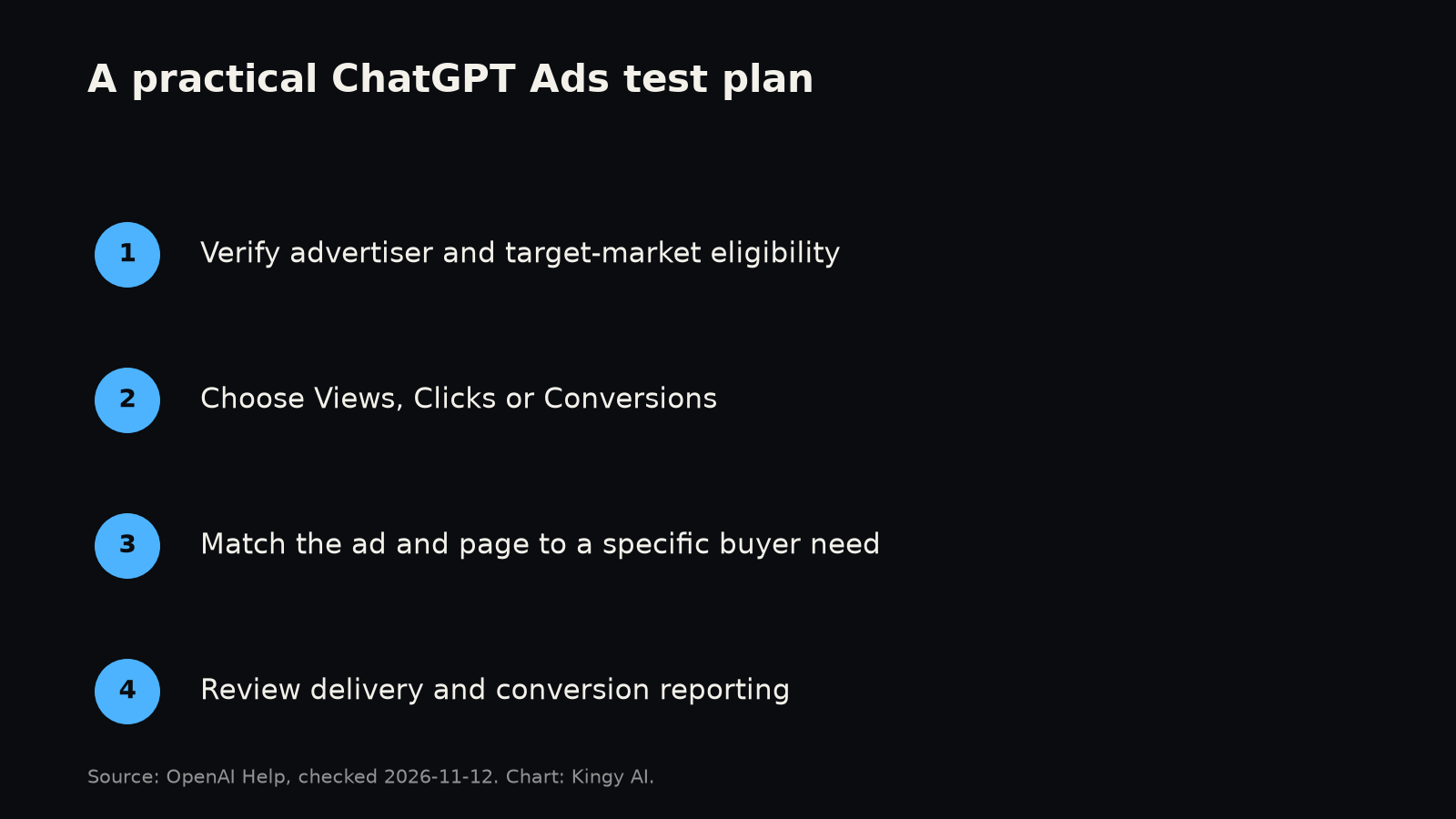
Start with delivery: impressions, clicks, spend, click-through rate and cost, as available in OpenAI’s reporting. Use tagged destination URLs and, where appropriate and correctly implemented, OpenAI’s Pixel or Conversions API to connect activity to outcomes. Review landing-page engagement and qualified leads alongside platform-attributed conversions.
Compare channels using the same conversion definition, revenue basis, attribution window, currency and treatment of agency fees. An attributed conversion is not proof the ad caused the sale. A suitable holdout or geographic experiment can help estimate incremental impact when volume and design support it; a small pilot may be better suited to testing operations and creative than proving causal return. OpenAI describes early work on geographic experiments, but buyers should ask what is feasible for their own campaign.
Set a budget control you understand. OpenAI says daily budgets average over a week and can reach twice the daily amount on an individual day; a campaign-total budget provides a stricter overall limit. Its campaign guide also distinguishes Views, Clicks and Conversions objectives. Conversion optimization is billed by clicks or impressions, not per conversion.
Before signing an agency contract
When comparing ChatGPT Ads management proposals, ask each ChatGPT advertising agency to identify the advertiser entity, intended countries, available buying route and account-level targeting permissions. Confirm who owns the Ads Manager account and data, who can approve or pause spending, and whether media, agency and technology fees are itemized. Request a sample report and a demonstration of any proprietary integration included in the proposal.
Ask for a relevant campaign example with the advertiser’s permission, including the objective, market, dates, spend, conversion definition and what the team changed after seeing results. Agree on the decision the first test should support and what happens if volume is too low to measure incremental sales.
Eskimoz is best suited to brands seeking a coordinated international approach across paid media, SEO and GEO, with local European teams and disclosed UK and US ChatGPT Ads experience. Before allocating a test budget, ask it to substantiate the specific team’s campaign experience, confirm your market access and show exactly how paid performance will be measured.