
Nvidia helps some of its customers finance the infrastructure that buys its chips. That makes Jensen Huang’s departure a question for borrowers, investors and AI founders as well as for Nvidia’s shareholders.
The strongest concern is about the next financing agreement. A capital-hungry AI company could lose time, accept more expensive funding or reduce its expansion if Nvidia becomes less willing to support new projects. Nvidia could continue selling equipment while a smaller customer struggles to fund the purchase.
That is a plausible risk, not an observed consequence of Huang’s exit. The sources reviewed for this article do not establish that his departure has caused a lender to withdraw financing, Nvidia to cancel a guarantee, or an AI startup to delay a project.
Nvidia publicly announced the transition on November 12, 2026. Its SEC filing dates the board’s acceptance of Huang’s resignation to November 11, effective immediately. Colette Kress becomes interim CEO while remaining CFO. Kingy’s departure explainer covers the wider succession and software questions. Here, the question is who can still afford to build.
How a chip supplier becomes part of a financing deal
Consider a hypothetical cloud provider that wants to install a large GPU cluster. It needs equipment, power, a building and customers. A lender also needs confidence that the provider can meet its repayments if demand arrives slowly or equipment loses value.
A supplier can help address selected risks in several ways. It can buy equity in the customer, commit to purchasing available computing capacity, or guarantee part of a project’s financial exposure. Each arrangement transfers a different risk, and each has its own conditions.
On Nvidia’s August 26 earnings call, Kress described a model in which Nvidia commits to paying for a portion of a facility’s capacity and shares in qualifying rental revenue. She said independent capital providers still assess each deal. That was management’s explanation of the model, not independent evidence that every financed project will be profitable.
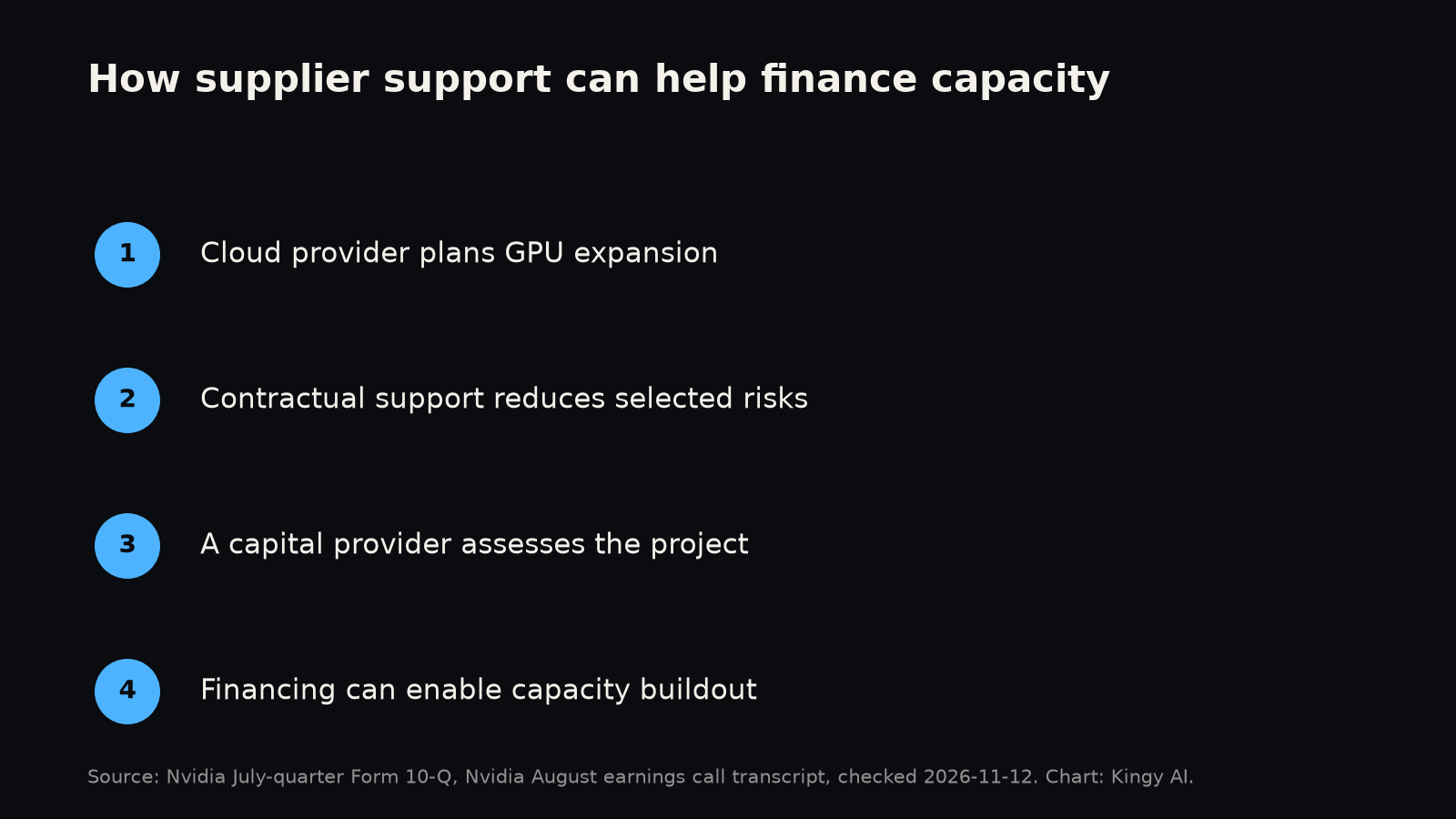
This diagram simplifies a financing mechanism described by Nvidia. It does not depict a specific completed transaction or an observed effect of Huang’s departure. Structures and conditions vary by project.
The potential pressure point is a new project’s approval. If support becomes harder to obtain, a borrower may need more equity, a stronger customer contract or a higher interest rate to close the same deal. Existing signed obligations and future discretionary support must be assessed separately.
Four figures that describe different kinds of support
The scale deserves attention. So do the distinctions between a purchase commitment, a conditional guarantee and a target for third-party financing. All amounts below are in US dollars.
| Arrangement | Disclosed amount | What the figure means |
|---|---|---|
| Selected AI cloud agreements | $36 billion | Nvidia reported commitments as of July 26, 2026, which decrease as capacity is used by third-party customers or Nvidia. This is a disclosed commitment balance, not cash already paid. Quarterly filing, Note 10. |
| CoreWeave capacity arrangement | $6.3 billion initial value | A September 2025 agreement obligates Nvidia to purchase residual unsold capacity through April 13, 2032, subject to service requirements and termination provisions. The original amount is not a current remaining balance. CoreWeave’s September 15, 2025 filing. |
| SB Energy’s Ohio campus serving OpenAI | $105 billion cap | Nvidia’s initial residual-value guarantees cover specified shortfalls following qualifying tenant defaults. They generally become effective as leases commence, subject to conditions. The cap is neither money already spent nor a direct loan to OpenAI. Nvidia’s August 17, 2026 filing. |
| Institutional financing platforms | More than $500 billion targeted over time | An August announcement with six financial firms described intended third-party capital mobilization. The partnerships were then subject to final agreements. This was not a funded Nvidia commitment of that size. Joint announcement, August 10, 2026. |
These figures should not be added into a single bailout fund. They cover different dates, counterparties, contractual structures and possible exposures; the disclosures do not establish that every category is mutually exclusive.
The Ohio agreement also illustrates where discretion matters. Nvidia disclosed an option to support additional capacity at its sole discretion. A promise already made and an expansion it may choose to support are different propositions. OpenAI agreed to reimburse and indemnify Nvidia for amounts Nvidia actually pays under the guarantees, although reimbursement would still depend on the circumstances and ability to pay.
CoreWeave shows why financing terms matter
CoreWeave, a publicly traded provider of GPU cloud capacity, is a useful case study. Calling every company in this market a startup would obscure differences in size, funding and maturity.
In its November 10 results, CoreWeave reported third-quarter revenue of $3.661 billion, operating income of $207 million and net interest expense of $846 million. Its net loss was $709 million. The figures describe the quarter ended September 30, before Huang’s departure.
Kingy’s calculation puts net interest expense at about 23.1% of revenue and 4.1 times operating income. Those ratios are not a solvency test. They show why financing costs deserve attention alongside revenue growth.
The same release supplies a substantial counterargument: CoreWeave said it had multiple funding sources and expected about $9 billion in customer prepayments and deposits over the next three months. That was a company expectation, not a confirmed cash receipt.
A borrower with large expansion plans can be sensitive to the terms of its next financing even when customer demand is growing. Whether Huang’s exit changes those terms requires new evidence. The quarter’s interest bill cannot establish that connection.
The strongest counterargument is Colette Kress
A simple story about a visionary founder leaving and a cautious finance executive closing the checkbook does not fit the available record.
Kress was the executive explaining the capacity commitments, revenue-sharing model and infrastructure financing strategy on the August call. She presented the commercial case for supporting customers’ expansion. Her appointment does not by itself signal a retreat from those arrangements.
Nvidia’s transition announcement says Kress has been CFO since 2013 and that the board expects operations, customer commitments and the product roadmap to continue without interruption. This is an explicit statement of intended continuity, although subsequent execution still needs to be assessed.
There is a further institutional argument. The August partnership announcement named six financial firms and proposed dedicated financing platforms. The remaining economic case can be assessed by those institutions. Their participation also does not prove that every announced platform is now funded or that every proposed deal will close.
The thesis therefore depends on something we have not established: that Huang personally enabled material financing which the remaining organization and its partners cannot reproduce on comparable terms.
Why the damage would not fall evenly
The most exposed companies would be those with substantial future funding needs, limited alternatives and projects that depend on support which has not yet become binding. An application company renting modest amounts of compute has a different exposure from a cloud provider building a new campus.
Alternative suppliers and partners also matter. Anthropic said in April that it trains and runs Claude on AWS Trainium, Google TPUs and Nvidia GPUs. That demonstrates a stated hardware diversification strategy. It does not establish that workloads can move instantly, or that sufficient replacement capacity is available at the same price.
Some customers face tighter constraints. CoreWeave’s September-quarter filing says its current customer contracts specify Nvidia GPUs. Hardware substitution could therefore require contractual and operational changes. Diversification is not a uniform escape route.
Nvidia would face consequences too. Its July-quarter filing disclosed $279 billion in supply and capacity commitments and warned that customer financing constraints could affect purchases. A broad funding slowdown could feed back into its sales and financial exposures. The claim that customers might suffer more concerns their ability to fund the next stage of growth; it is not a measured comparison of stock declines, losses or default probabilities.
There is also a possible benefit for the wider market. More selective financing could reduce weak projects and excessive expansion. Whether that improves AI economics would depend on which projects are stopped, which are financed elsewhere and how much useful capacity is delayed.
What would establish that Huang’s exit changed financing?
Three links need evidence: a material dependence on Huang personally, a financing change after his departure, and a consequence for the affected company’s plans. Timing alone would be weak proof because interest rates, equipment costs, credit conditions and customer demand can change at the same time.
The clearest evidence would be a borrower or lender identifying a revised rate, collateral requirement, guarantee, approval process or project timetable and explaining how the leadership transition affected it. A fall in a share price would not answer those questions.
Five questions remain open:
- Has Nvidia changed the criteria or approval authority for new customer support?
- Have the August financing partnerships reached binding agreements and funded specific projects? On what terms?
- Which customers need fresh support to complete their next expansion, rather than relying on commitments already signed?
- Do any relevant agreements contain executive-departure provisions, and what do their actual terms permit? The reviewed summaries do not establish such a trigger.
- Have lenders changed financing terms because of the transition, after accounting for other changes in credit markets?
Nvidia has scheduled its next results release for November 17, at approximately 1:20 p.m. Pacific, followed by a call at 2 p.m. The useful answers will concern new approvals, existing obligations and project-level terms. A general assurance of continuity should be compared with the next financing that actually closes.
Sources and limits
This is an analysis of public filings and company statements reviewed on November 12, 2026. Kingy has not interviewed lenders or borrowers, audited private agreements, or established a financing withdrawal caused by Huang’s departure. Older disclosed balances are dated above and should not be read as current balances. No hands-on product test is reported.
The primary records are Nvidia’s transition announcement, succession filing, July-quarter report, Ohio guarantees filing and August earnings transcript; CoreWeave’s capacity agreement disclosure, November results and September-quarter report; the financing partnership announcement; and Anthropic’s compute diversification announcement.