I would start with Claude Sonnet 5.5 for well-specified coding, recurring document work and frequent agent turns. GPT-6 Astra belongs on the shortlist for scientific work, binary reverse engineering and tasks where a failed attempt creates expensive repair work.
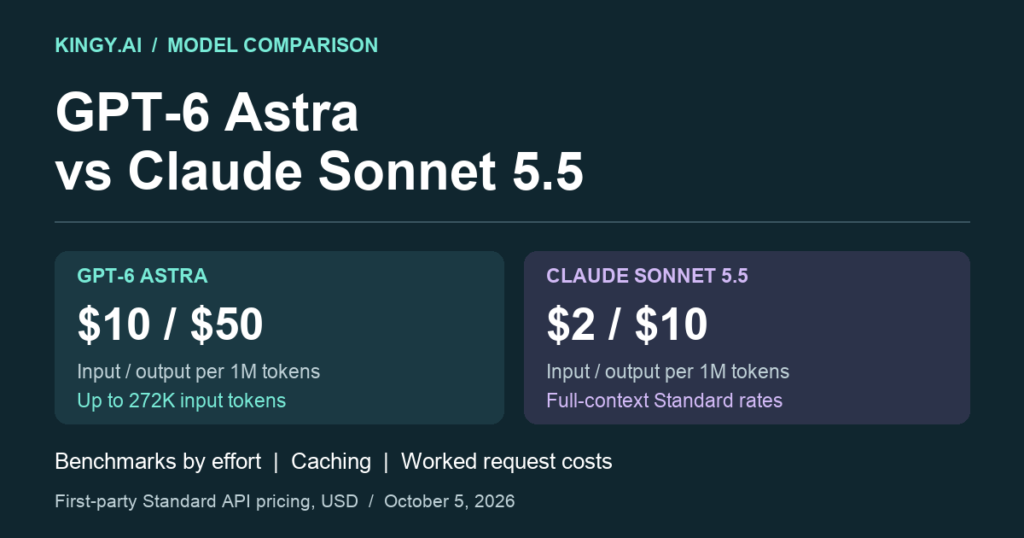
Astra's Standard short-context API input and output tokens cost five times as much: $10/$50 per million tokens versus Sonnet's $2/$10. That is a rate comparison. The independent results below show why it does not translate into a five-times task bill. At Max effort, Astra costs less per task in both evaluators' overall indexes, while Sonnet has the higher overall score. OpenAI API pricing, Anthropic API pricing.
The useful decision is which configuration produces work you can accept at the lowest total cost. A cheap answer that needs a long repair session can be expensive. A premium model also needs to earn its place on tasks that the cheaper option already handles.
Prices and benchmark snapshots checked October 5, 2026. Benchmark results are attributed to their evaluators. Worked budgets are hypothetical calculations; Kingy.ai has not run a matched hands-on test of this pairing.
Choose by workload
On narrow screens, scroll tables sideways to see every column.
| Your work | Where I would start | What would justify changing |
|---|---|---|
| Scoped bug fixes, routine code changes and tool workflows | Sonnet 5.5 at Medium | Escalate cases that fail relevant tests or need repeated repair |
| Scientific tasks using code and a terminal | Astra, with an explicit effort setting | Its stronger Vals science result makes it worth evaluating early |
| Binary reverse engineering and program analysis | Astra alongside Sonnet | Astra leads Vals' SRE Bench; test the relevant binaries and permitted workflow |
| Large, fresh document collections above 272K input tokens | Sonnet 5.5 | It retains Standard rates across the full context window |
| Work already built around OpenAI tools | Compare Astra with GPT-6.1 Sol first | A provider migration must improve enough to cover integration and maintenance costs |
These are evaluation starting points. The science and reverse-engineering recommendations follow the specific Vals results below; they do not establish a general Astra advantage on every difficult task.
For the cheaper OpenAI alternative, read our GPT-6.1 Sol vs Claude Sonnet 5.5 comparison. Our Astra vs Sol 6.1 guide covers when to move up within OpenAI, while Sonnet vs Opus 5.5 covers that decision within Claude.
Specifications that matter
Both models accept text and images and produce text. Both support substantial document and repository context, with the same standard maximum output.
| API specification | GPT-6 Astra | Claude Sonnet 5.5 |
|---|---|---|
| Model ID | gpt-6-astra |
claude-sonnet-5-5 |
| Context window | 1,050,000 tokens | 1 million tokens |
| Maximum standard output | 128,000 tokens | 128,000 tokens |
| Native input and output | Text and images to text | Text and images to text |
| Knowledge cutoff | April 30, 2026 | June 2026 |
| Reasoning effort options | Low, Medium, High, Xhigh, Max | Low, Medium, High, Xhigh, Max |
Sources: Astra model documentation, Sonnet model documentation, and Claude effort controls. Astra separately caps input at 922,000 tokens. Sonnet's 300K output option is a Message Batches beta, separate from the standard limit in the table.
A large context window describes capacity. It does not establish that a model will find a buried exception, reconcile conflicting evidence or remember the correct version of a function. Include those cases in a document or repository evaluation.
OpenAI positions Astra as its most capable model for demanding work. That positioning applies to OpenAI's lineup; it does not establish a win over Claude on every workload. The GPT-6 guide also describes Sol 6.1 as the lower-cost alternative for complex work.
Independent benchmarks by reasoning effort
Artificial Analysis publishes separate configurations at Medium, High and Max. Its Intelligence Index v4.3.2 combines ten evaluations across coding, agentic work, knowledge, documents and scientific reasoning.
Here is the October 5 snapshot. Every Sonnet row uses the evaluator's Adaptive Reasoning configuration labeled Default Fallback.
| Effort | Astra index score | Sonnet index score, with fallback | Astra cost per index task | Sonnet cost per index task |
|---|---|---|---|---|
| Medium | 50 | 41 | $1.54 | $0.59 |
| High | 51 | 47 | $1.73 | $1.12 |
| Max | 53 | 56 | $3.26 | $7.67 |
Sources: Astra Medium, Sonnet Medium, Astra High, Sonnet High, Astra Max, and Sonnet Max.
At Medium, Astra has the higher score and costs about 2.6 times as much per index task. At High, the premium is about 1.5 times. At Max, Sonnet has the higher score, but costs about 2.4 times as much as Astra in this evaluation mix.
Token consumption explains why the rate card is insufficient. Artificial Analysis reports roughly 60 million output tokens across Astra's Max index run and 420 million across Sonnet's. These are totals for that benchmark campaign, not expected consumption for a single job.
The cost metric weights benchmark spending on input, cache operations, reasoning and answers. A score of 53 is an index value, not a 53% completion rate. It also does not mean that Astra will finish your next task for $3.26. See Artificial Analysis's methodology.
Matching effort names do not equalize reasoning budgets across providers. These are comparisons between available configurations, including Sonnet's fallback behavior. They cannot establish isolated Sonnet performance with fallback disabled.
Anthropic's launch footnote also flags a since-fixed structured-output bug in the prerelease Sonnet deployment used for two Artificial Analysis knowledge-work tests. That caveat is another reason to avoid treating a small composite-score gap as a universal quality verdict.
Vals shows where the workload changes the winner
Vals provides a second independent view. Its Vals Index v2.1 weights finance, coding, legal and tax tasks by sector shares of U.S. GDP. Scientific terminal work and binary reverse engineering have separate benchmarks, so inspect those directly when they match your work. Vals Index methodology.
The current shared results, checked October 5:
| Vals evaluation | Astra score | Sonnet score, including fallback |
|---|---|---|
| Vals Index v2.1 | 63.13% ±1.19 | 67.04% ±0.92 |
| Code Migration | 67.74% ±4.22 | 69.83% ±4.26 |
| Terminal-Bench Science | 62.86% ±5.82 | 45.71% ±6.00 |
| SRE Bench, binary reverse engineering | 56.87% ±3.07 | 30.15% ±2.84 |
Source: Vals' direct Sonnet–Astra comparison. The ± figures are one standard error, not 95% confidence intervals. The Code Migration ranges overlap; Vals explicitly says its range comparison is not a pairwise significance test.
This gives Astra a concrete case for scientific terminal work and binary reverse engineering. SRE Bench tests recovering program behavior from binaries without source code. Sonnet's higher overall index score does not erase those differences.
Both science rows use Mini-SWE-agent on the same 70-task set. Vals uses a single graded run per model, with retries for infrastructure or provider errors. Those results are distinct from the official science leaderboard's vendor-native agents and three-trial averages. Science benchmark methodology.
Vals lists Max as the models' default evaluation effort, with benchmark-specific exceptions possible. Its Astra page and Sonnet page report Vals Index costs of $18.46 and $21.34 per test respectively. Those amounts belong to Vals' workload and cannot be compared directly with Artificial Analysis's dollars per index task.
Sonnet's results include fallback-assisted tasks. On the current Vals Index page, counting those as failures lowers Sonnet from 67.04% to 65.85%. Decide whether the same fallback policy would be acceptable in your deployment.
Provider launch scores need their own labels, too. Anthropic's launch report gives Sonnet 70.6% on Terminal-Bench 4.0, but does not supply a matched Astra result. Its OpenAI comparisons name Sol versions. Use a direct comparison with compatible conditions before claiming one model beats the other.
Faster output is only part of turnaround time
Artificial Analysis's October 5 High-effort snapshot measures output generation at 58.6 tokens per second for Astra and 99.5 for Sonnet's Default Fallback configuration. At Max, the figures are 61.2 and 128.3. These are generation-throughput measurements, after output starts. Astra High, Sonnet High, Astra Max, Sonnet Max.
Sonnet has the faster token stream in those measurements. Completion time also depends on reasoning, the amount of output, tool turns and retries. Record time to a usable result as well as streaming speed.
Astra offers paid Fast and Ultrafast serving options. Those change the price comparison and should be labeled in a speed trial. The OpenAI guide documents availability; Anthropic's current Fast pricing lists Opus models, so do not assume an equivalent Sonnet Fast switch.
Where Astra's token premium changes
These are first-party Standard API prices in USD per million tokens.
| Token category | Astra, input at most 272K | Astra, input above 272K | Sonnet, full context |
|---|---|---|---|
| Ordinary input | $10.00 | $20.00 | $2.00 |
| Cache read | $1.00 | $2.00 | $0.20 |
| Cache write | $12.50 | $25.00 | $2.50 for 5 minutes; $4.00 for 1 hour |
| Billable output | $50.00 | $75.00 | $10.00 |
Sources: OpenAI pricing and Anthropic pricing.
Once Astra's request input exceeds 272,000 tokens, the higher rates apply to the full request. Sonnet retains Standard rates across its full million-token context. Above that threshold, Astra's ordinary input rate is ten times Sonnet's and its output rate is 7.5 times as high.
Both offer a 50% Batch discount on input and output. Partner-cloud rates, regional processing and tool charges can differ from this table.
Worked request costs
These calculations use identical billable token counts to isolate the prices. They assume ordinary uncached input with no cache writes, Standard serving, and no tool charges, retries, tax or regional premium.
| Hypothetical request | Astra | Sonnet |
|---|---|---|
| 10K input + 2K billable output | $0.20 | $0.04 |
| 100K input + 10K billable output | $1.50 | $0.30 |
| 400K input + 20K billable output | $9.50 | $1.00 |
The 400K example costs $8.00 for Astra's input plus $1.50 for output. Sonnet costs $0.80 plus $0.20.
Budget all billable output, including thinking. OpenAI bills reasoning tokens as output, and Claude's thinking consumes the output budget even when it is not returned to the user. Use each provider's actual usage counts; the same source text can produce different token counts. OpenAI reasoning documentation, Claude effort documentation.
Cache reuse needs its own assumptions
OpenAI enables prompt caching by default. For Astra, a newly written prefix is billed at the cache-write rate in place of ordinary input pricing, while hits use the read rate. Explicit-only caching with no breakpoints produces neither reads nor writes, which is one way to reproduce the uncached examples above. OpenAI caching documentation.
Astra's documented minimum cache lifetime is 30 minutes after a write or reuse. Sonnet defaults to five minutes, measured from the request's start, and offers the higher-priced one-hour option. A long streaming response consumes part of Sonnet's reuse window. OpenAI caching rules, Anthropic caching rules.
Reusing a repository or document prefix can reduce either bill. Keep changing content after the reusable prefix and inspect actual cache hits. A prefix that misses the cache needs to be included in your forecast at the applicable ordinary or write rate.
When paying more can reduce total cost
In the 100K-input example, Astra's token premium is $1.20. At an assumed review-time value of $60 an hour, that equals 72 seconds of human time.
If Astra produces an equally acceptable result and saves more than 72 seconds of review or repair, the extra token spending can pay for itself. If both results require the same review, Sonnet keeps the $1.20 advantage. This is a break-even calculation, not a measured productivity claim. Multi-request jobs require the same calculation across the entire session.
An escalation policy is another possibility. Suppose 100 tasks each cost $0.30 on Sonnet, and 20 then require one $1.50 Astra attempt. Assume Astra resolves all 20, with no additional attempts or charges. The calculated token bill is $60, compared with $150 for sending all 100 directly to Astra.
That hypothetical policy saves 60% while including the failed Sonnet attempts. It works only if you detect the failures and the escalation handles them. An agent's claim that it finished is insufficient: use tests, validated calculations, source checks or a relevant human review.
Calculate cost per accepted result by dividing spending across all attempts by the number that pass your checks. Track review and repair time separately, or convert it to money using an explicit assumption. A cheap pilot with many unresolved jobs has not met the same requirement as a more expensive one that finishes them.
Reasoning settings and app access
For Sonnet, Anthropic recommends Medium for well-specified agentic coding and multistep tool work, and High for harder or longer tasks. The Claude API default is High. Xhigh and Max should be tested where the extra effort improves your outcomes. Claude effort guidance.
For Astra, set effort explicitly and give the model enough output budget to reason and finish. Use Responses for API tool calling; Astra's Chat Completions support excludes function calling. OpenAI reasoning guide.
App subscriptions answer a different billing question. Codex purchased-credit rates use credits, and included subscription limits are separate from an API request's dollar cost. Compare the workflow and plan you will use, including model availability in your account. OpenAI's model-selection controls, Codex pricing.
Anthropic lists Sonnet in Claude apps and Claude Code as well as its API and supported clouds. If your main decision is subscription value, our ChatGPT Pro vs Claude Max guide covers that question. The five-times API token ratio does not describe a five-times subscription price or allowance.
A practical comparison before switching
Choose a small set of real tasks that includes routine work, difficult work and previous failures. Define acceptance before either model runs: a bug fix must resolve the issue and pass relevant checks; a research deliverable must use the right sources and calculations.
- Test Sonnet Medium and an explicit Astra setting on the same briefs and tool access. Add Sonnet High and higher Astra effort on the cases that need them.
- Preserve each configuration, usage record, fallback policy and finished output. Count every attempt and tool charge.
- Review the deliverables without the model name where practical. Record acceptance, total spend, elapsed time and human repair time.
- Try an escalation rule on the failures. Check both the problems it catches and the bad answers it misses.
Keep Sonnet as the default where it clears your quality and turnaround requirements at lower total cost. Route the remaining cases to the model and effort that demonstrably resolves them.