
Last updated: June 13, 2026. Editorial note: This article distinguishes verified reporting from analysis. It does not claim the U.S. has formally nationalized Anthropic or any other AI lab.
The government may not have nationalized Anthropic. But it may have shown it does not need to.
On June 12, Anthropic said the U.S. government had issued an export-control directive requiring the company to suspend all access to Fable 5 and Mythos 5 by any foreign national, including foreign-national Anthropic employees, whether those people were inside or outside the United States. Anthropic said the practical result was that it had to disable the models for all customers while it worked out compliance.
This is not formal nationalization. The government did not seize Anthropic. It did not take equity. It did not appoint a board, confiscate model weights, or convert the company into a public utility.
But for frontier AI, ownership may be the old question.
The new question is access. Who can use the most powerful models? Who can test them before release? Which customers are trusted? Which foreign nationals are excluded? Which cloud providers enforce the line? Which labs can deploy, and under what conditions?
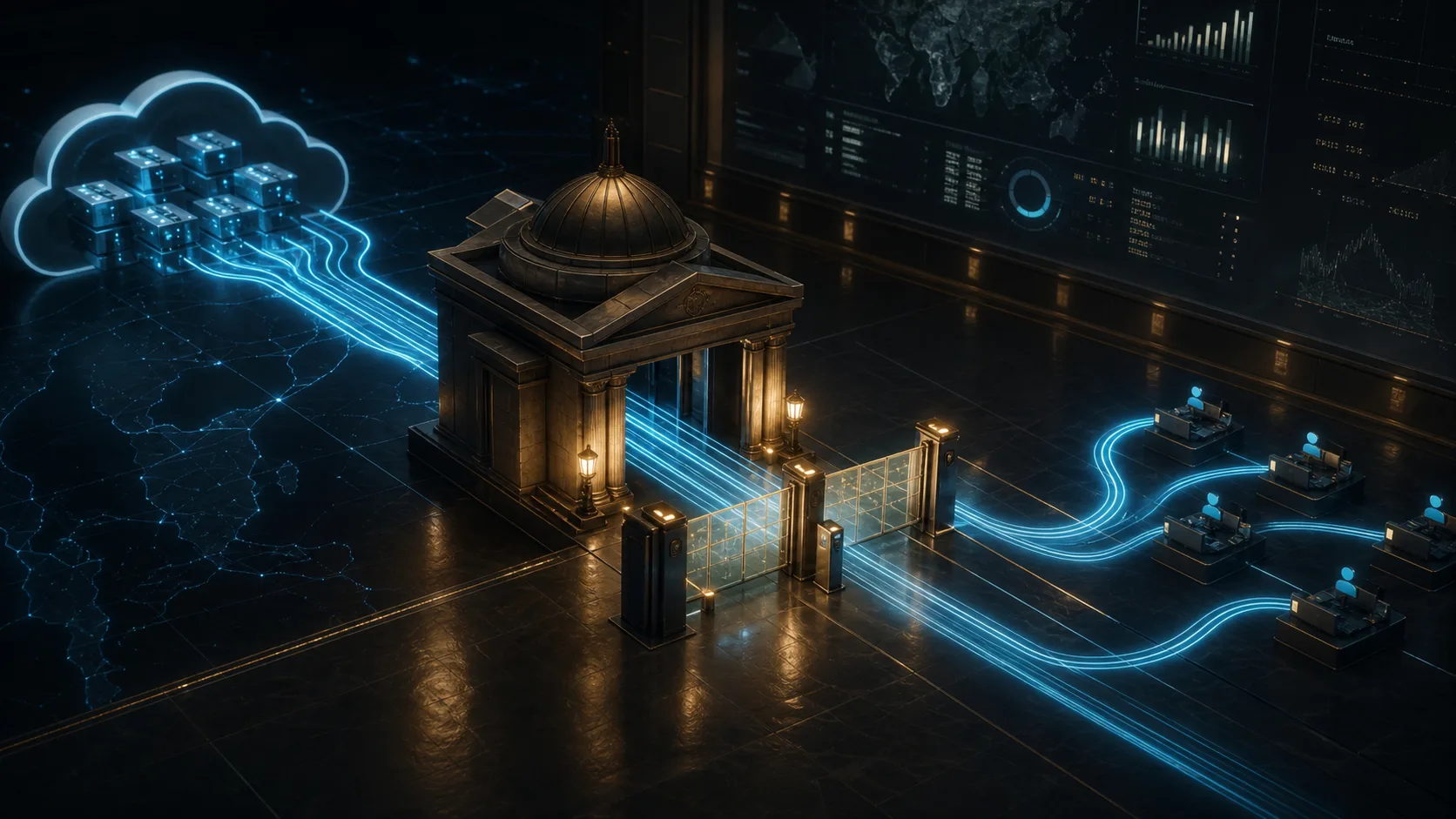
If those answers are increasingly determined by national-security directives, export-control licensing, classified evaluations, and government-approved access programs, then the United States does not need to nationalize frontier AI labs in the twentieth-century sense. It can steer the decisive layer of the market while private companies continue to own the stock certificates.
Call it the soft nationalization of AI: state-directed control over privately owned frontier systems.
Image note: AI-generated editorial image for Kingy AI: a private AI lab under the shadow of state power.
What Happened With Fable 5 and Mythos 5
Anthropic launched Claude Fable 5 and Claude Mythos 5 on June 9. Fable 5 was the broadly available Mythos-class model: the same family of capabilities, but with safeguards. Mythos 5 was the more restricted version, offered to approved cyber defenders and infrastructure partners through Project Glasswing, with some safeguards lifted.
The launch post described Fable 5 as Anthropic’s most capable generally released model and said Mythos 5 shared the same underlying capabilities. Anthropic also said the models carried meaningful dual-use risk, especially in cybersecurity, biology, chemistry, and distillation. That is why Fable 5 included classifiers that could redirect some requests to Claude Opus 4.8, while Mythos 5 remained limited to trusted access.
Three days later, access changed abruptly.
In its June 12 statement, Anthropic said the U.S. government, citing national-security authorities, directed it to suspend all access to Fable 5 and Mythos 5 by foreign nationals. The company said the letter did not provide specific details of the national-security concern. Anthropic said its understanding was that the government believed it had become aware of a way to bypass, or jailbreak, Fable 5.
Anthropic pushed back hard. The company said it had reviewed a demonstration and believed the findings involved previously known, minor vulnerabilities that other publicly available models could also identify. It said it was complying with the directive while disagreeing that a narrow potential jailbreak justified recalling a commercial model used by a large customer base.
AP reported that Anthropic had taken its latest AI models offline to comply with new export controls. Axios reported that the Trump administration had blocked foreign access to Anthropic’s most powerful AI models and that exports, re-exports, or domestic transfers involving the models would require a license. Reuters also covered the U.S. block and Anthropic disabling access.
The key fact is narrower than the online freakout and bigger than a normal product outage: a private AI lab says the U.S. government ordered access to two top models cut off for foreign nationals, and Anthropic disabled the models broadly to comply.
Why Model Access Is Different From Chip Controls
For years, the public story of AI export controls has been hardware: Nvidia GPUs, advanced computing chips, accelerator clusters, semiconductor manufacturing equipment, and the supply chain needed to train frontier models.
That mattered. Chip controls shaped who could train large models, where data centers could be built, and how rivals could scale. But chip controls are upstream. They regulate the furnace.
Model-access controls regulate the fire.
The Federal Register’s AI diffusion framework already moved the policy debate beyond chips by applying export-control logic to advanced AI model weights. That is still different from API access, because model weights are the underlying asset. If a foreign entity receives controlled weights, it may be able to run, copy, modify, or distill the model outside the original provider’s supervision.
API access is subtler. The customer never receives the weights. They send prompts and receive outputs. In ordinary software terms, that looks like a hosted service. In national-security terms, it can look like remote access to a capability.
That distinction is why the Fable 5 and Mythos 5 episode matters. It suggests that the policy perimeter can move from physical chips, to weights, to hosted model access, to the nationality of users and employees. The state does not have to take the model. It can define the class of people who may touch the model at all.

Why Foreign-National Access Makes This Bigger Than Geofencing
A country-level block is blunt but familiar. A company can geofence traffic, restrict billing addresses, decline accounts from sanctioned jurisdictions, and tell enterprise customers not to route traffic from certain regions.
The Anthropic statement describes something more invasive: a restriction based on foreign-national status, including foreign-national employees inside Anthropic. That is not simple geofencing. It is access control by person, nationality, employment status, and legal permission.
This logic is not new to export controls. BIS explains that a deemed export can occur when controlled technology or source code is released to a foreign person inside the United States. The concept exists because sensitive technical access does not become harmless just because the person is physically standing in San Francisco, Boston, Austin, or Seattle.
The leap is applying that style of concern to frontier model access. That creates a compliance problem that is far more complex than blocking IP addresses.
Frontier labs employ foreign nationals. Their enterprise customers employ foreign nationals. Their cloud partners employ foreign nationals. Their support, safety, red-team, policy, and infrastructure teams may include people across countries and citizenship categories. If a model-access rule applies at the foreign-national layer, the enforcement surface goes deep into identity systems, employment permissions, customer entitlements, internal tooling, audit logs, and vendor controls.
This is why the Fable 5 ban and Mythos 5 ban, if the shorthand must be used, are not just “AI model unavailable in some countries.” They are a preview of national-security access governance for frontier AI.
Cloud Providers Become Enforcement Chokepoints
Anthropic’s own developer documentation said Fable 5 was generally available on the Claude API, Claude Platform on AWS, Amazon Bedrock, Vertex AI, and Microsoft Foundry. It also said Mythos 5 access could involve Anthropic, AWS, or Google Cloud account teams for approved customers.
That distribution model is one reason frontier AI is economically powerful. It is also one reason it is controllable.
When a model runs through a cloud marketplace, API gateway, managed model catalog, enterprise identity layer, or hyperscaler region, the provider becomes an enforcement chokepoint. A lab can revoke a model. A cloud provider can hide an endpoint. A procurement account can lose entitlement. A region can disappear from the availability matrix. A customer’s API calls can return permission errors instead of tokens.
That does not make AWS, Google Cloud, Microsoft, or Anthropic the government. It makes them the machinery through which a government directive can become operational reality.
This is the quiet power of cloud-era AI regulation. You do not need police at the server-room door if the model is already mediated through identity, billing, region selection, logging, and API authorization.
Formal Nationalization vs. Soft Nationalization vs. Safety Regulation
Precision matters here. “Nationalization” is an inflammatory word. Sometimes it is also the wrong word.
Formal nationalization means the state takes ownership or effective corporate control. Think equity, seizure, statutory takeover, public corporation, government-appointed management, or direct command over production assets. That has not happened to Anthropic, OpenAI, Google DeepMind, xAI, Meta, or any other frontier lab based on the sources reviewed for this article.
Export controls are legal restrictions on exports, re-exports, transfers, or access involving controlled goods, software, technology, or capabilities. They can be used for national security, foreign policy, and nonproliferation. In AI, they began most visibly around chips and advanced computing, then expanded into model weights and now, in this episode, appear to have reached hosted access to specific frontier models.
Government-directed access control is the operational layer: a directive, license requirement, trusted-access program, pre-release test, or enforcement action that decides who may use a model, under what conditions, and through which provider. It can happen without the government owning the company.
Normal AI safety regulation is broader and usually less direct: safety evaluations, incident reporting, transparency obligations, risk management standards, model cards, red-team requirements, child-safety rules, privacy rules, and liability frameworks. Those can be heavy. But they do not necessarily decide, customer by customer, who can access a specific model tomorrow morning.
Soft nationalization is the gray zone. It is not ownership. It is not necessarily illegal or illegitimate. It is the condition where a private strategic technology remains privately owned but is steered by state access decisions, state security evaluations, state-approved customer classes, and state-defined foreign-national limits.
That is the zone frontier AI just entered more visibly.
Frontier AI Now Looks Like Strategic Infrastructure
The White House’s June 2 executive order on advanced AI innovation and security is useful context because it says the quiet part politely. It frames advanced AI as a national-security and cybersecurity asset. It calls for a classified benchmarking process to assess advanced cyber capabilities and determine when a model should be designated a “covered frontier model.” It also describes a voluntary framework where developers could give the federal government access to covered frontier models for up to 30 days before release to trusted partners.
The same order expressly says it should not be read to create a mandatory licensing, pre-clearance, or permitting requirement for the development, publication, release, or distribution of new AI models. The White House fact sheet repeats that point.
That caveat matters. It is the strongest evidence for the counterargument: the administration says it wants voluntary collaboration, not a model-licensing state.
But the Anthropic directive, as described by Anthropic and reported by AP, Axios, and Reuters, shows that other authorities may still bite. An executive order can say one thing about not creating mandatory licensing through that order. Export-control and national-security authorities can still create practical access restrictions through other channels.
This is how frontier AI becomes strategic infrastructure. Not by ceremony. By classification, benchmarking, licensing, trusted access, and dependence.
What This Means for Startups and Enterprise AI Buyers
For founders and enterprise AI buyers, the lesson is brutal: model access is now political infrastructure.
If your product depends on a single frontier model, your dependency is no longer only technical or commercial. It is regulatory. A model can be deprecated, rate-limited, repriced, safety-routed, removed from a cloud provider, restricted by geography, or restricted by user class.
That does not mean teams should abandon frontier models. It means serious buyers need continuity plans.
Build with abstraction layers. Maintain credible fallbacks. Track which features truly require frontier capability and which can run on cheaper or more available models. Understand whether your vendor supports multiple providers, regions, and identity controls. Ask whether your use case touches cyber, biology, chemistry, autonomy, infrastructure, or model distillation. Those are the domains where access restrictions are most likely to arrive first.
Kingy readers tracking model launches should pair this with our coverage of Claude Fable 5 and Claude Mythos 5, the deeper Fable 5 benchmark breakdown, the AI launch tracker, and our piece on Dario Amodei’s AI policy posture. The market story and the policy story are now the same story.
For teams leaning on open models, the lesson cuts the other way. Open-weight AI is not automatically safe from export control, compute limits, or hosting restrictions. But local or self-hosted deployment can reduce exposure to a single vendor’s API access decision. That is why the debate over open-source and open-weight AI is no longer just ideological. It is operational resilience.
The Counterargument: This Is National Security, Not Nationalization
The strongest counterargument is simple: the government did not nationalize anything. It used national-security and export-control tools to limit access to a potentially dangerous technology. That is not socialism, seizure, or industrial takeover. It is how governments have always handled dual-use technology.
On this view, Anthropic’s own launch post supports the government’s concern. Anthropic said Mythos-class models present significant risks, including cybersecurity uplift, biology and chemistry risk, and distillation risk. Anthropic also required 30-day retention for Mythos-class model traffic because monitoring is part of its defense-in-depth strategy. If the lab itself says the model class is exceptional, why is it shocking that the state treats it as exceptional?
There is also a democratic argument. The public did not elect Anthropic, OpenAI, Google DeepMind, Meta, or xAI to decide which capabilities should be globally available. If a private model can materially change cyber offense, biological design, critical infrastructure defense, or military planning, elected government has a legitimate role.
That counterargument is serious. It is why “soft nationalization” should be treated as an analytic warning, not a courtroom verdict.
The problem is opacity and precedent. Anthropic says it was given a legal directive without specific details of the national-security concern and with only verbal evidence of a narrow jailbreak. If a government can force the recall of a frontier model on that basis, the market needs a clearer standard. Otherwise, every model launch becomes a policy lottery.
The Next Phase: Licenses, Clearances, Trusted Access
The likely future is not one big nationalization bill. It is a stack of permissions.
Covered frontier models. Pre-release government testing. Classified cyber benchmarks. Trusted partner lists. Export licenses. Deemed-export reviews. Cloud marketplace eligibility. Customer attestations. Foreign-national restrictions. Data-retention requirements. Audit logs. Model-access incident reporting. Government-approved deployment for critical infrastructure.
Some of that will be good governance. Some of it will be necessary. Some of it will be clumsy, political, protectionist, or strategically convenient.
The frontier labs will still be private companies. They will raise money, sell subscriptions, sign enterprise contracts, court developers, and compete on benchmarks. But the highest layer of capability will increasingly look less like ordinary SaaS and more like a controlled strategic resource.
That is the real shift. AI companies may keep the upside of private ownership while losing part of the freedom that normally comes with private deployment.
Verdict
The U.S. has not formally nationalized AI. It has not taken over Anthropic. It has not put OpenAI, Google DeepMind, xAI, or Meta under direct state ownership.
But the Fable 5 and Mythos 5 episode is a warning shot. If the government can use export-control and national-security authorities to decide who may access a frontier model, including foreign nationals inside the United States, then the practical control point is not ownership. It is permission.
That is why “soft nationalization” is the right phrase, with all necessary caveats. It captures the emerging reality: private AI labs building systems that are increasingly treated as national assets, distributed through cloud chokepoints, governed by access licenses, and evaluated through security frameworks the public may never fully see.
For builders, investors, and enterprise buyers, the takeaway is not panic. It is architecture. Design for model discontinuity. Read the policy signals as carefully as the benchmark charts. Track the export-control layer, the cloud layer, and the foreign-national access layer.
The next frontier AI battle may not be who has the best model. It may be who is allowed to use it.
Sources and Further Reading
- Anthropic statement on the U.S. government directive to suspend access to Fable 5 and Mythos 5
- Anthropic launch post for Claude Fable 5 and Claude Mythos 5
- Anthropic developer documentation for Fable 5 and Mythos 5
- AP coverage of Anthropic taking Fable 5 and Mythos 5 offline
- Axios coverage of the Trump administration block
- Reuters coverage of the U.S. block and Anthropic disabling access
- White House executive order on advanced AI innovation and security
- White House fact sheet on the executive order
- Federal Register: Framework for Artificial Intelligence Diffusion
- BIS guidance on deemed exports
The Kingy Brief
Get the next Kingy Brief.
Source-checked AI changes, original tests and one practical thing to try.
Free · Choose your subjects · Double opt-in · Unsubscribe anytime