Last updated: June 13, 2026.
If they can turn off your model, you do not own your AI stack.
That is the blunt lesson from the sudden Fable 5 and Mythos 5 access crisis. According to Anthropic’s statement on the U.S. government directive, the U.S. government issued an export-control directive requiring Anthropic to suspend access to Claude Fable 5 and Claude Mythos 5 for foreign nationals, including foreign nationals inside the United States and foreign national Anthropic employees. Anthropic said the practical result was an abrupt disablement of Fable 5 and Mythos 5 for all customers while it works to comply.
Axios first reported that the Trump administration had moved to block foreign access to Anthropic’s most powerful models. AP reported that Anthropic had taken the models offline to comply with the directive, and Reuters covered the Axios report as a major technology-policy development.
The important point is not that open-source AI has suddenly won. It has not. The important point is narrower, sharper, and more useful: closed frontier models are no longer only a capability dependency. They are a political, legal, vendor, cloud, and continuity dependency.
For founders, developers, enterprise AI buyers, research teams, and sovereign AI planners, that changes the procurement question. The question is no longer, “Which model is smartest today?” It is also, “What happens to our product, our customers, our compliance posture, and our roadmap if this model becomes unavailable tomorrow morning?”
That is why open-weight AI just became the escape hatch.
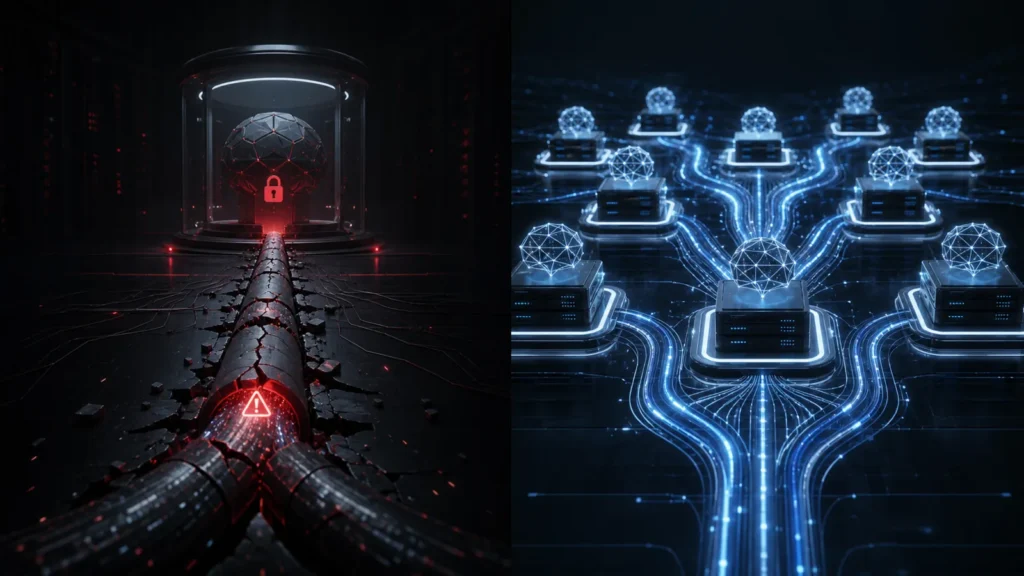
Image note: Closed frontier models can be powerful, but open-weight distribution gives AI teams a harder-to-switch-off fallback path.
What Happened With Anthropic, Fable 5, and Mythos 5
Anthropic launched Claude Fable 5 and Claude Mythos 5 on June 9, 2026. In its launch materials, Anthropic described Fable 5 as a Mythos-class model made safe for general use, and its Claude API documentation described Fable 5 as its most capable widely released model. Mythos 5 shared the same broad capability class but was restricted to approved Project Glasswing customers.
Only days later, Anthropic said access was being suspended because of a U.S. government directive. Anthropic’s statement says the directive applied to any foreign national, whether inside or outside the United States, and that the company would have to disable the models broadly to ensure compliance. Anthropic also said other Anthropic models were not affected.
This is exactly the kind of discontinuity that changes buyer behavior. Not because every detail is settled. Not because the public has seen the full legal rationale. Not because open models are immune from the same political forces. They are not.
It changes buyer behavior because the failure mode is now visible.
A customer can do everything “right”: choose a top provider, follow the API docs, pay the bill, build against approved endpoints, stay inside terms of service, and still lose access because a third party with legal authority orders the vendor to change who can touch the model.
That is not an engineering outage. It is an infrastructure sovereignty event.
Why This Is a Vendor-Risk Event, Not Just a Policy Story
Most coverage will frame this as an AI export-control story. That is true. But for AI companies, it is also a vendor-risk story.
Closed model dependency used to feel similar to cloud dependency. You accepted the platform risk because the capability was too good, the developer experience was too clean, and the time-to-market advantage was obvious. You could ship in weeks instead of quarters. You could outsource inference, safety tuning, eval tooling, model refreshes, scaling, and uptime to a frontier lab.
That was rational. It still is, in many cases.
But the Anthropic event reveals a different layer of risk. A closed model is not merely hosted software. It is a controlled strategic asset sitting at the intersection of national security, export law, compute supply chains, platform terms, and vendor policy. If the model is powerful enough, governments may treat access to it less like SaaS and more like access to advanced chips, cryptography, cyber tooling, or sensitive defense technology.
That matters because many modern AI startups are not “using AI” in a decorative way. The model is the product’s reasoning layer, support layer, coding layer, analyst layer, compliance layer, agent layer, or security layer. If the model vanishes, the product may not degrade gracefully. It may stop.
This is why the right analogy is not a website using a payment processor. It is a factory that depends on one supplier for the only component that makes the product work.

Closed APIs can fail for ordinary reasons: downtime, pricing changes, rate limits, deprecations, quota issues, abuse detection, policy enforcement, account review, cloud-region constraints, or contract disputes. Now add government action and nationality-based access constraints to the list.
That is a board-level risk, not a DevOps footnote.
Closed AI Is Powerful, but Politically Fragile
Closed frontier models are powerful because the labs that build them control the full stack. They control the training run, safety work, productization, serving infrastructure, evals, model cards, deployment channels, and policy layer. That control is why the best closed models often feel polished and reliable. It is also why access can be centrally changed.
When a company gives you an API key, it is not giving you the model. It is giving you a revocable permission to send inputs to a model the company controls. That permission can be limited by contract, geography, risk category, billing status, enterprise terms, safety policy, cloud provider routing, and law.
For many applications, that is fine. For others, it is a dangerous single point of failure.
The more your company depends on a closed model’s exact behavior, the more fragile your business becomes when access is interrupted. The risk grows when you use model-specific prompts, proprietary tool calling, provider-specific memory or agent frameworks, model-specific embeddings, unique output schemas, or safety behavior you cannot reproduce elsewhere.
This is not a reason to abandon closed AI. It is a reason to stop treating a closed model as infrastructure you own.
Why Open-Weight Models Become More Attractive
Open-weight models are not magic. They are not always truly open source. They are not always cheaper once you count engineering, hosting, evals, GPUs, monitoring, guardrails, and latency. They can be restricted by license, controlled by cloud chokepoints, removed from hosting platforms, or regulated directly.
But they have one enormous resilience advantage: once the weights are widely distributed, they are harder to switch off from one central console.
That is the escape hatch.
If a model’s weights are available to download, mirror, fine-tune, evaluate, and deploy in multiple environments, the model stops being only a vendor service. It becomes portable infrastructure. You can run it on your own GPUs, through a private cloud, in a regional data center, inside a regulated enterprise environment, or through multiple inference providers.
This is why the distinction between open-source AI and open-weight AI matters. The Open Source Initiative’s Open Source AI Definition frames open-source AI around the freedoms to use, study, modify, and share the system, with access to the preferred form for making modifications. Many models marketed as open are better described as open-weight: users can access model weights, but may not have full training data, training code, or unrestricted rights that satisfy the strictest open-source definition.
That distinction is not pedantic. It is the difference between resilience, inspectability, reproducibility, and marketing language.
The open-weight ecosystem is now broad enough that serious teams can no longer ignore it. Meta describes Llama 4 Scout and Maverick as open-weight multimodal models. Mistral says it develops open-weight and commercial models. Qwen’s official blog says Qwen3 includes multiple open-weight models. DeepSeek distributes major model weights through GitHub and Hugging Face. Moonshot AI’s Kimi models are also distributed through official pages such as Kimi K2.6 on Hugging Face. And Hugging Face remains a central distribution layer for the wider model ecosystem, with its docs describing the Model Hub as infrastructure for hosting, discovery, sharing, and production use.
Kingy has been tracking this shift across its own open-model coverage, including the AI Open-Weight Model Launches hub, the Llama tool profile, the Qwen tool profile, the DeepSeek-R1 profile, and the task-focused guide to choosing between frontier and open-weight models.
The point is not that any one open model can replace Fable 5 for every workload. The point is that the fallback set is no longer theoretical.
Startups Need Fallback Models Now
If your startup depends on a closed frontier model, your next infrastructure project should be model redundancy.
Not because open models are always better. They often are not. Not because you can easily swap a frontier model with a smaller open model and get identical behavior. You cannot. But because the cost of having no fallback has become too high.
A serious model-redundancy strategy has five layers.
First, model abstraction. Your app should not scatter one provider’s API shape across the codebase. Keep provider-specific calls behind a routing layer so switching models is operationally possible.
Second, eval-driven fallback selection. Do not pick backup models by leaderboard gossip. Build small, brutal evals for your actual workflows: support answers, code patches, invoice extraction, legal classification, incident triage, sales research, medical summarization, whatever the product truly does. Test closed and open alternatives on the same tasks.
Third, graceful degradation. If your flagship model is unavailable, the product should not simply die. It should degrade: smaller context, slower processing, human review, lower autonomy, narrower tool access, or cached outputs.
Fourth, deployment optionality. At minimum, know which models you can run through a second API provider. Better, know which open-weight model you can run in your own account, region, or private infrastructure if the primary provider becomes unavailable.
Fifth, contractual and compliance clarity. Enterprise buyers will increasingly ask whether your AI system relies on a single model vendor, a single geography, or a single nationality-controlled access path. Have an answer before procurement asks.
This is not glamour work. It is plumbing. But it is the plumbing that separates a serious AI company from a demo wrapped around someone else’s endpoint.
The Five Categories Every Buyer Needs to Understand
The Anthropic shutdown also exposes how muddy the language around AI access has become. Buyers need cleaner categories.
Closed API models are models accessed through a provider-controlled service. You send prompts and receive outputs. The provider controls the weights, deployment, safety policies, availability, routing, and access rules. This category includes many frontier AI products. It is often the easiest way to get high capability quickly, but it is the most centrally revocable.
Open-weight models make trained model weights available under some license. You may be able to download, host, fine-tune, quantize, or run them through third-party providers. The license may still contain restrictions. The release may not include training data or full training code. Open-weight does not always mean open-source.
Open-source AI is the stronger claim. Under the OSI framing, users should have meaningful freedoms to use, study, modify, and share the system, with access to the preferred form for modification. In practice, many AI releases sit somewhere between source-available, open-weight, research release, and true open source.
Private deployments are operational setups where a model runs inside infrastructure controlled by the customer, a dedicated cloud environment, or a trusted managed provider. The model can be closed, open-weight, or custom. Private deployment is about control of runtime, data, region, networking, and governance.
Sovereign AI infrastructure goes beyond one enterprise. It is national, regional, or sector-level infrastructure designed around local control of compute, data, models, rules, language coverage, and strategic dependency. Sovereign AI can use closed models, open models, or custom national models. The core concern is political and operational autonomy.
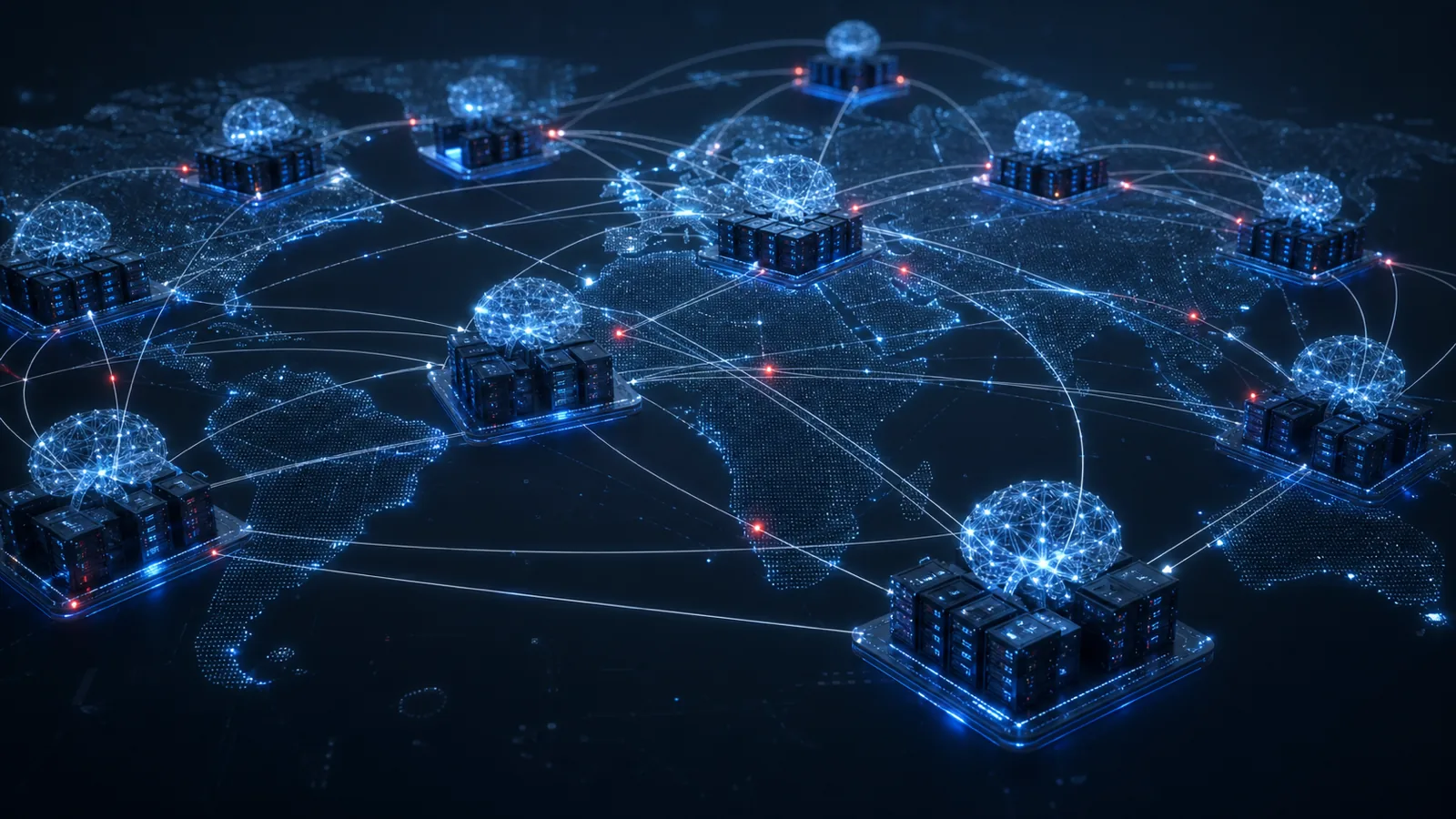
Once you separate these categories, the strategic picture gets clearer. Closed API models maximize convenience and capability. Open-weight models maximize portability. Open-source AI maximizes inspectability and modification rights when it is genuinely open. Private deployment maximizes operational control. Sovereign infrastructure maximizes jurisdictional control.
The right answer is usually a portfolio, not a purity test.
Why Sovereign AI Programs May Accelerate
The Fable 5 and Mythos 5 event is gasoline on the sovereign AI debate.
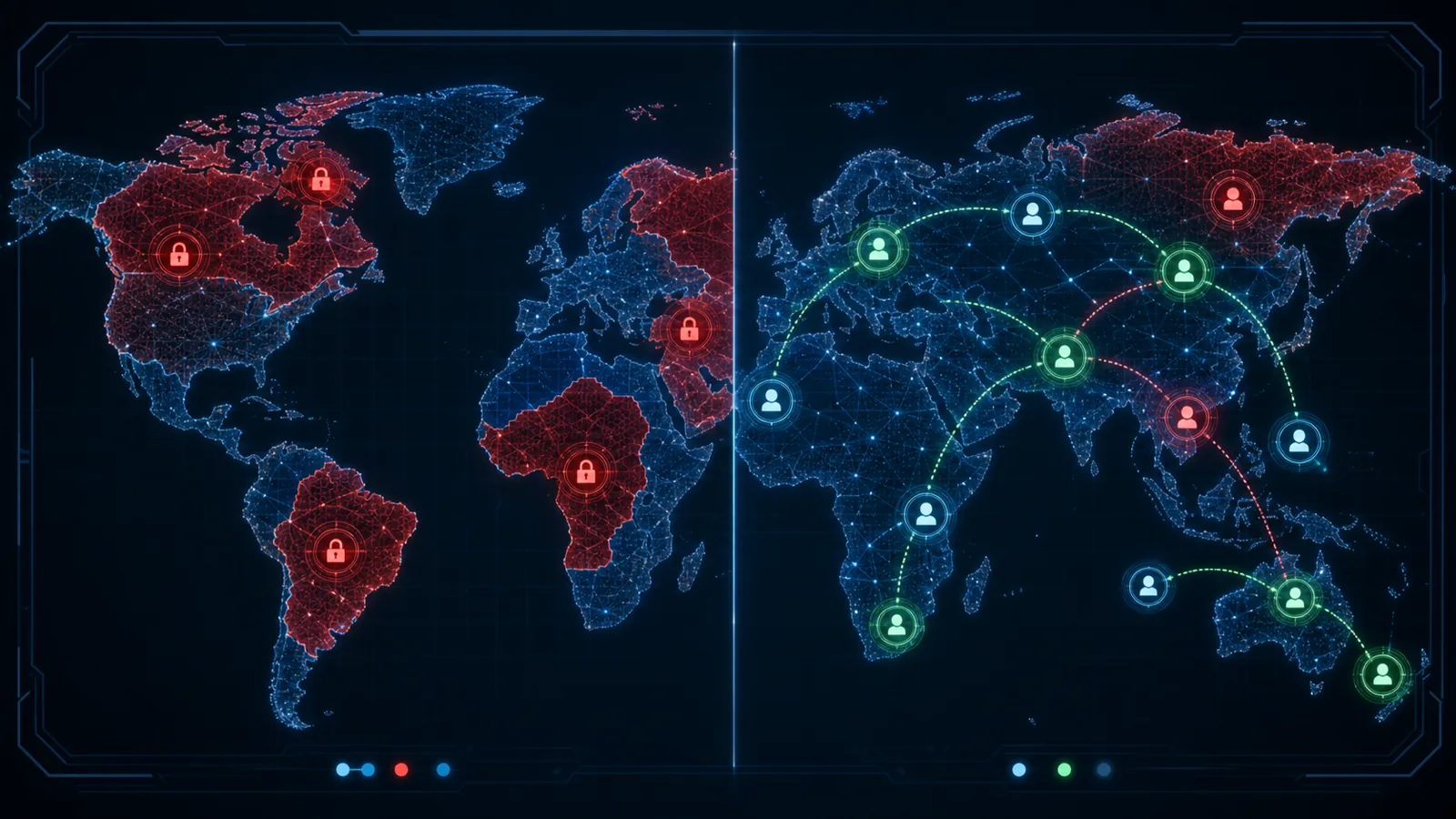
If a U.S. company can be ordered to restrict access to its most capable models based on nationality, every government and regulated enterprise outside the United States has to ask a hard question: are we building critical capability on infrastructure that another country can interrupt?
This is not anti-American paranoia. It is how states think. If AI becomes critical to defense, healthcare, finance, energy, education, cyber defense, law, logistics, and scientific research, model access becomes strategic infrastructure.
That is why sovereign AI programs are not just about national pride. They are about continuity, jurisdiction, auditability, data policy, language coverage, procurement independence, and crisis response.
Open-weight models fit naturally into this. They let a country, region, university network, or regulated industry deploy capable AI systems without total dependence on one foreign API provider. The systems may still depend on chips, cloud providers, software stacks, and talent. But the model layer becomes more portable.
That is also why Mistral matters in Europe, Qwen and DeepSeek matter in China, Llama matters globally, and Hugging Face matters as an ecosystem layer. The strategic value is not only benchmark performance. It is the existence of alternative distribution paths.
Kingy has already covered adjacent signals, including Mistral’s European AI infrastructure push and Moonshot AI’s Kimi K2.6 open-model strategy. The new twist is that U.S. export-control action makes those alternatives feel less like optional diversity and more like strategic insurance.
Open Source Is Not Regulation-Proof
Now the necessary caveat: open-source and open-weight AI are not immune from regulation.
Governments can still regulate the release of model weights, restrict exports, pressure hosting platforms, control cloud GPU access, enforce sanctions, regulate downstream use, require licensing for certain domains, impose liability on deployers, or target developers and distributors. They can also control the compute needed to train or serve large models.
The United States has already spent years building export controls around advanced chips and AI diffusion. The Bureau of Industry and Security has acted on AI-related export controls and chip-related controls, and the 2025 Federal Register AI diffusion framework explicitly addressed advanced AI models and advanced computing clusters. The current White House has also issued AI national-security actions, including an executive order on advanced AI innovation and security.
The logic is obvious: if governments believe model capability itself creates national-security risk, they will eventually look beyond closed APIs. They will look at open weights.
The control problem is harder, though. A closed API has a central operator. A widely distributed open-weight model has many copies, mirrors, quantizations, forks, fine-tunes, inference providers, local deployments, and offline archives. Governments can make distribution illegal. They can punish companies. They can pressure clouds. They can seize servers. But they cannot press one vendor button and reliably erase every copy already distributed around the world.
That does not make open models lawless. It makes them harder to centrally switch off.
That distinction is the whole argument.
The Counterargument: Closed Models May Still Be Better, Safer, and Easier
The strongest counterargument is simple: closed frontier models may remain the best choice for many serious teams.
They may be more capable on difficult reasoning, coding, multimodal understanding, long-context work, safety behavior, tool use, instruction following, and enterprise support. They may offer stronger managed security, better abuse monitoring, cleaner SLAs, easier procurement, lower upfront engineering cost, better documentation, and faster access to new capabilities.
They may also be safer for some deployments because the provider can patch behavior centrally, monitor abuse, block dangerous patterns, and manage rollout risk. An open-weight model deployed badly can be a compliance and security mess. Running your own inference stack is not automatically responsible. It can create new failure modes: stale models, weak monitoring, poor data handling, untested guardrails, sloppy access controls, and hidden operational costs.
So no, the Anthropic event does not prove open source will automatically win. It does not prove every startup should dump closed APIs. It does not prove open-weight models are good enough for every workflow. It does not prove regulators cannot touch open models.
It proves something more limited and more actionable: if your company cannot survive the loss of one closed model, your AI stack is under-engineered.
What Founders Should Do Now
Founders do not need a manifesto. They need a plan.
Inventory every model dependency. List which product features depend on which providers, models, regions, API features, embeddings, rerankers, image models, speech models, agents, and hosted tools.
Classify blast radius. Mark each dependency as cosmetic, degraded, serious, or existential. If your customer-facing workflow cannot operate without one closed model, treat it as existential.
Run fallback evals this month. Pick at least two fallback candidates: one closed alternative and one open-weight or privately deployable model. Test them on real tasks, not synthetic prompts.
Build a model router. Even a simple routing layer is better than hard-coding provider assumptions into every feature. Add retries, rate-limit handling, provider-specific prompt adapters, and structured-output validation.
Design degraded modes. A support bot can become a draft assistant. A coding agent can become a patch suggester. A research agent can become a source collector. A fully automated workflow can require human approval until the primary model returns.
Check contracts and jurisdictions. If you serve regulated customers, ask what happens if the model becomes restricted by country, nationality, sector, or use case. Procurement teams will increasingly care.
Track open-model releases continuously. Do not wait for a crisis to evaluate Llama, Mistral, Qwen, DeepSeek, Kimi, Cohere, or other candidates. The model you ignore today may be the fallback you need tomorrow.
Verdict: Smarter Today, More Resilient Tomorrow
Closed frontier AI may still be smarter today. For many jobs, it will remain the fastest path to the best user experience. It will keep winning high-end workflows where quality, tool use, support, latency, safety, and integration matter more than control.
But the Anthropic shutdown shows the weakness in building your entire company on one provider-controlled model. Access can change overnight. The trigger may be a government directive, an export-control interpretation, a vendor policy update, a cloud-provider restriction, a safety incident, an account review, or a geopolitical shock.
Open-weight AI does not eliminate those risks. It changes their shape. A downloadable model is not regulation-proof, but once it is widely distributed, it is harder to centrally revoke. That makes it strategically valuable even when it is not the best model on the leaderboard.
The winning AI stacks will not be closed-only or open-only. They will be redundant, evaluated, portable, and honest about tradeoffs.
The teams that understand this will keep using frontier APIs where they make sense. They will also build fallback paths, private deployments, open-weight options, and jurisdiction-aware infrastructure before they are forced to.
The escape hatch is not ideology. It is operational resilience.
The Kingy Brief
Get The Kingy Brief.
AI changes, original tests and one practical thing to try. Fridays at 09:00 Vancouver time.
Free · Double opt-in · Unsubscribe anytime
Sign up for The Kingy Brief on Beehiiv.
Signup help and newsletter schedule
Signup form provided by Beehiiv. After submitting, check your inbox for "Confirm your subscription to The Kingy Brief" and open its confirmation link. Check Spam or Promotions if you cannot find it.
Fridays at 09:00 Vancouver time: source-checked AI changes, original tests and one practical thing to try. We skip a week when there is not enough verified material. Free. Unsubscribe anytime.