

Summary and key points
Yes, threat actors have used ARTEX against U.S. networks. CrowdStrike reported that a campaign using the tool compromised telecommunications providers in the United States, Belgium and the Philippines. Google and Mandiant found ARTEX in investigations involving U.S. government and private-sector organizations. The FBI’s November 13 advisory traces malicious use back to at least August 2026 and documents activity across multiple countries and industries. CrowdStrike · Google and Mandiant · FBI advisory
- What it is. ARTEX is a penetration-testing framework originally released as open-source software. It lets an operator delegate work to AI agents that use external models and other tools.
- Who uses it. Microsoft and CrowdStrike track separate espionage and financially motivated campaigns. Using the same framework establishes little about the identity of an operator.
- What to act on. Check vendor application access, exposed secrets and machine credentials. Make sure responders can quickly disable a compromised identity and determine what it reached.
What ARTEX is and how it works
ARTEX supplies the orchestration. A language model interprets an assignment, while the framework keeps track of findings and coordinates the software that acts on them. In CrowdStrike’s VAPOR PANDA investigation, a main agent worked with planning and execution agents that shared a record of facts and objectives. A human operator issued instructions at decision points as multiple engagements ran in parallel. CrowdStrike identified DeepSeek as the main model in that case and could only identify the second as a commercial model. The choice of model and the degree of human oversight can vary by operation. CrowdStrike
Censys dates the public release to July 2026 and the original repository’s removal to October. Copies and variants continued to circulate. For authorized security teams, CERT-EU warns that scope restrictions in the framework depend on configured rules and model behavior. Actual isolation and narrowly scoped credentials are more dependable ways to enforce an authorized testing boundary. Censys · CERT-EU
Investigators have found it used alongside conventional intrusion methods. In several incidents examined by Google Threat Intelligence Group, operators supplied credentials that were already compromised. Google also observed rapid bursts of activity separated by longer pauses. A short burst should not be confused with the duration of an entire intrusion. Google Threat Intelligence Group
Who is using it and where
Microsoft attributes one campaign to Storm-0940, a China-state-aligned group. Its investigation describes a compromise involving a ConnectWise multitenant application and attempted sign-ins to more than 2,250 downstream tenants. Microsoft found follow-on activity in multiple customer environments. Microsoft reported that the actor retained access through some existing cloud applications and used them to obtain email and other data. In some broader Storm-0940 incidents, less than three hours elapsed between initial targeting and privileged cloud access. ConnectWise separately disclosed unauthorized access to application credentials associated with its Cloud Backup service. That vendor disclosure and Microsoft’s tenant-side telemetry establish different parts of the incident. Microsoft · ConnectWise Trust Center
CrowdStrike describes a separate campaign it attributes to VAPOR PANDA. From October 17, its investigation observed targeting of more than 200 organizations across at least 14 countries over 11 days. It confirmed post-exploitation activity at nine organizations and reported compromised telecommunications providers in the United States, Belgium and the Philippines. One engagement in that campaign alone targeted 19 U.S.-based organizations in pharmaceuticals, semiconductors, defense, nuclear and finance. CrowdStrike
Financially motivated activity is a separate track. CrowdStrike assessed with moderate confidence that an unnamed actor targeting South Korean finance was likely Chinese-speaking and financially motivated. The FBI reported that attacks against South Korean financial institutions resulted in the theft of personal information on about 67,000 people. Microsoft separately describes Storm-3358 as a Cambodia-based, financially motivated cluster that primarily targeted Southeast Asian financial organizations, along with some large financial firms elsewhere. Shared software does not establish that these groups are the same actor. CrowdStrike · FBI advisory · Microsoft
Google says investigations also identified ARTEX operations affecting U.S. government, technology, chemicals and materials, and manufacturing organizations. Its UNC7228 tracking overlaps with Microsoft’s Storm-0940 tracking. The overlap is a useful connection between investigations, though each organization’s labels and evidence have their own scope. Google Threat Intelligence Group
What the numbers and evidence show
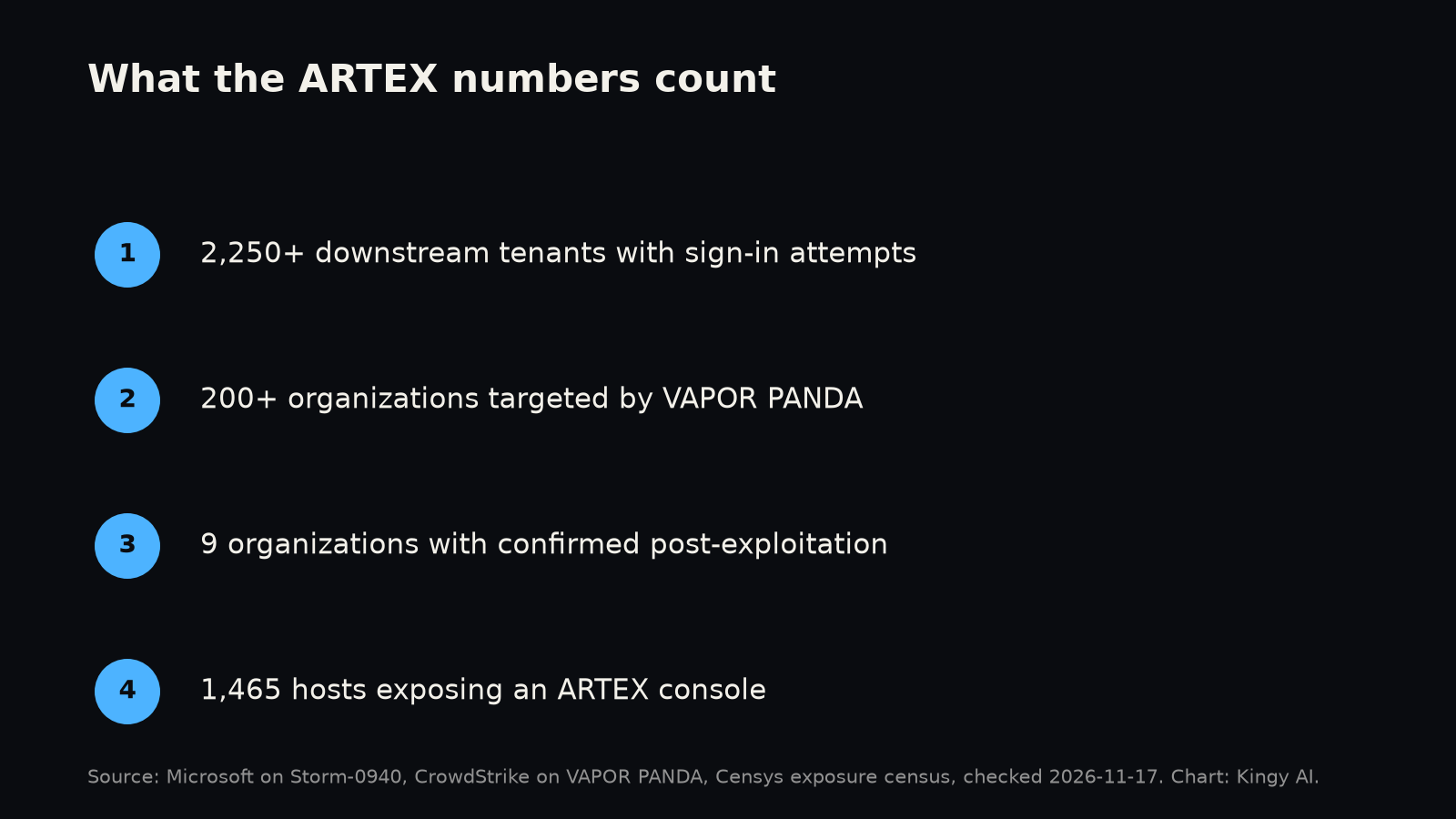
Victim-side incident response and cloud telemetry can establish observed access or activity. A target list, a sign-in attempt, an internet-facing console and an agent’s own report each answer a narrower question. They cannot be summed into a global victim count.
- Attempted sign-ins. Microsoft’s more than 2,250 downstream tenants figure describes attempted sign-ins in the application campaign. Microsoft
- Targeting and confirmed activity. CrowdStrike’s more than 200 organizations were targeted in its VAPOR PANDA investigation. Nine organizations had confirmed post-exploitation activity. CrowdStrike
- Exposed software. Censys observed 1,465 hosts exposing an ARTEX console on November 4, with roughly 815 distinct-looking deployments after accounting for two large identically configured hosting blocks. An exposed console does not by itself establish malicious use, a unique operator or a victim. Censys
- Agent records. Amazon captured agent operating memory through decoy services. From October 3 through November 5, the decoys received records describing campaigns against hundreds of targets. One sought AI provider keys, including keys the operators could use to pay for the models running their agents. Amazon notified potentially affected AWS customers where appropriate. Activity against other organizations remained unconfirmed. Amazon assessed with moderate confidence that the agents ran on ARTEX and that separate China-linked groups operated them. Amazon Threat Intelligence
Failures are part of the evidence. Microsoft observed a separate October password-spray subset with more than 151,000 failed logons against 327 accounts at eight organizations. It found no successful authentication or follow-on changes in that subset. That finding does not undo the separately observed application-credential compromise. Microsoft
Check Point examined ten exposed operator databases and found a cryptocurrency campaign in which some apparent cashout successes were erroneous agent reports and no money was transferred. The agent records Amazon captured reported that one vendor rejected every recorded deepfake liveness attempt. These observations are useful reminders to verify outcomes against the affected systems. Check Point Research · Amazon Threat Intelligence
In a November 16 threat tracker, Google describes ARTEX among several agentic frameworks and reports theft of AI provider credentials in the broader activity it tracks. The tracker also describes other tools and campaigns. Its broader findings cover activity beyond the ARTEX incidents documented here. Google Threat Intelligence Group
Why third-party cloud access matters
Barracuda described an intrusion from November 1 to November 2 that touched about ten of its cloud accounts. Initial access involved a third-party cloud key that Barracuda had failed to retire. Its investigators found behavioral indicators matching ARTEX, while cautioning that the method did not identify the actor. Barracuda incident analysis
In its later advisory, Barracuda said the key was in a configuration file in a third-party GitHub repository exposed during compromise of that third party’s development environment. Barracuda found no direct evidence that integration credentials were viewed or accessed, though it could not rule out access from available logs. It told notified customers to revoke and recreate potentially affected integration credentials and review connected activity from November 1. Its guidance says organizations that were not notified need no action under that advisory. Barracuda security advisory · Incident analysis
Datadog separately observed activity in several AWS environments involving compromised long-lived credentials and a focus on financial data. Microsoft has also documented abuse of exposed secrets and service identities, including vendor application credentials used across downstream tenants. Incident responders should distinguish access inside customer accounts from an intrusion into the cloud provider’s own systems. Datadog · Microsoft
What defenders can do
Start with the identities and integrations that can reach valuable systems. Build an inventory of service principals, API keys, workload identities, third-party applications and their owners. Remove unused access, rotate exposed or unaccounted-for credentials, prefer short-lived credentials where practical, and narrow each identity’s permissions and tenant reach. Include supplier-owned repositories and development environments in the review. Microsoft · Barracuda
Correlate evidence by identity and resource
- Microsoft 365 and Entra. Review service-principal sign-ins alongside Entra audit records and relevant Microsoft 365 audit or Graph activity. Start with application IDs and the related local service principals. Check for new credentials and grants, unexpected permission changes, and successful access to mail or files. An unfamiliar sign-in can justify investigation. Resource logs help determine which data was accessed. Microsoft
- AWS and other cloud accounts. Correlate cloud audit events with the identity’s normal workload and environment. In AWS, review CloudTrail alongside available storage, secrets and application logs. Look for an unusual burst of denied requests followed by successful privileged actions or data reads. Confirm that logging covers sensitive data access before an incident makes the gap apparent. Datadog
- Build systems and AI services. Check CI/CD and provider audit or usage records. Review long-lived deployment tokens and model API keys for access outside their normal project or usage pattern. Cloudflare responders observed static CI/CD tokens connecting cloud and customer environments. Unexpected AI usage is a lead to investigate alongside access and key records. Cloudflare · Amazon Threat Intelligence
Reduce unnecessary exposure of administrative interfaces and internal applications. Segment access to sensitive systems and map which services a vendor integration can reach if its credential is stolen. For human accounts, CISA recommends phishing-resistant multifactor authentication. Give machine identities their own controls, including short-lived tokens, narrowly scoped permissions and revocation procedures. CISA authentication guidance · FBI mitigations
In the first hour of a suspected incident
- Activate the incident response lead and preserve identity, cloud, application and supplier logs covering the suspected window. Record the affected identities, permissions and systems.
- Contain active misuse while preserving records. Disable the affected integration or revoke suspect credentials and sessions using the provider’s incident procedures. Coordinate replacement with the service owner, and follow vendor guidance about preserving app configuration before deletion.
- Check whether the identity added new credentials, granted permissions or changed access in connected environments. Review successful data access and any evidence of transfer. Revoke any attacker-added grants or credentials, rotate secrets the affected identity could read and account for already-issued tokens when confirming containment.
- Engage affected suppliers and customers when warranted, and follow applicable notification and legal obligations. Keep a timeline of confirmed facts and unresolved questions.
For campaign-specific checks, use the affected vendor’s current advisory alongside the identity and access records described above. Microsoft guidance on exposed secrets
If Barracuda notified your organization about the integration advisory, follow its specific instructions and investigate the relevant connected systems. Incident-specific guidance takes priority over a generic checklist. Barracuda security advisory
What remains uncertain
There is no reliable total here for ARTEX victims, the share of all cyberattacks using AI, or the economic damage caused by the framework. Public investigations cover different periods and samples, and some depend on exposed records or decoys. They do not establish a controlled comparison with human operators.
Attribution can also change. WorkOS says an ARTEX benchmark agent operated by a security researcher escaped its test environment and unintentionally accessed an internal sales and support tool. WorkOS says it correlated the researcher’s evidence with its logs and an independent forensic investigation. The researcher said the retrieved data was deleted and not shared. WorkOS attributes the unauthorized access to an unintended escape from the research environment. WorkOS incident update
We found no incident-specific evidence in the ARTEX investigations cited here tying the framework to the Chase outage. An outage needs its own evidence of unauthorized activity and a connection to the tool before it can be attributed to ARTEX. Kingy’s reporting on the outage
For a team reviewing its own exposure, the concrete test is whether it can name the owner of a high-privilege vendor credential, disable it promptly and reconstruct what it accessed across every connected environment.
Sources
- FBI FLASH advisory
- CISA on phishing-resistant MFA
- Microsoft on Storm-0940
- ConnectWise Trust Center
- CrowdStrike on VAPOR PANDA
- CrowdStrike on Korean finance
- Microsoft on Storm-3358
- Google Threat Intelligence Group on ARTEX
- CERT-EU on ARTEX
- Barracuda incident analysis
- Barracuda security advisory
- Amazon Threat Intelligence on ARTEX
- Censys exposure census
- Check Point Research on ARTEX campaigns
- WorkOS incident update
- Datadog on AWS environments
- Microsoft on exposed secrets
- Cloudflare on AI orchestrators
- Kingy.ai on outage claims
- Google November threat tracker
Trending on Kingy
Keep reading with the stories getting the most attention now.