
Developing story. Evidence checked November 16, 2026, at approximately 19:56 UTC.
Quick answer
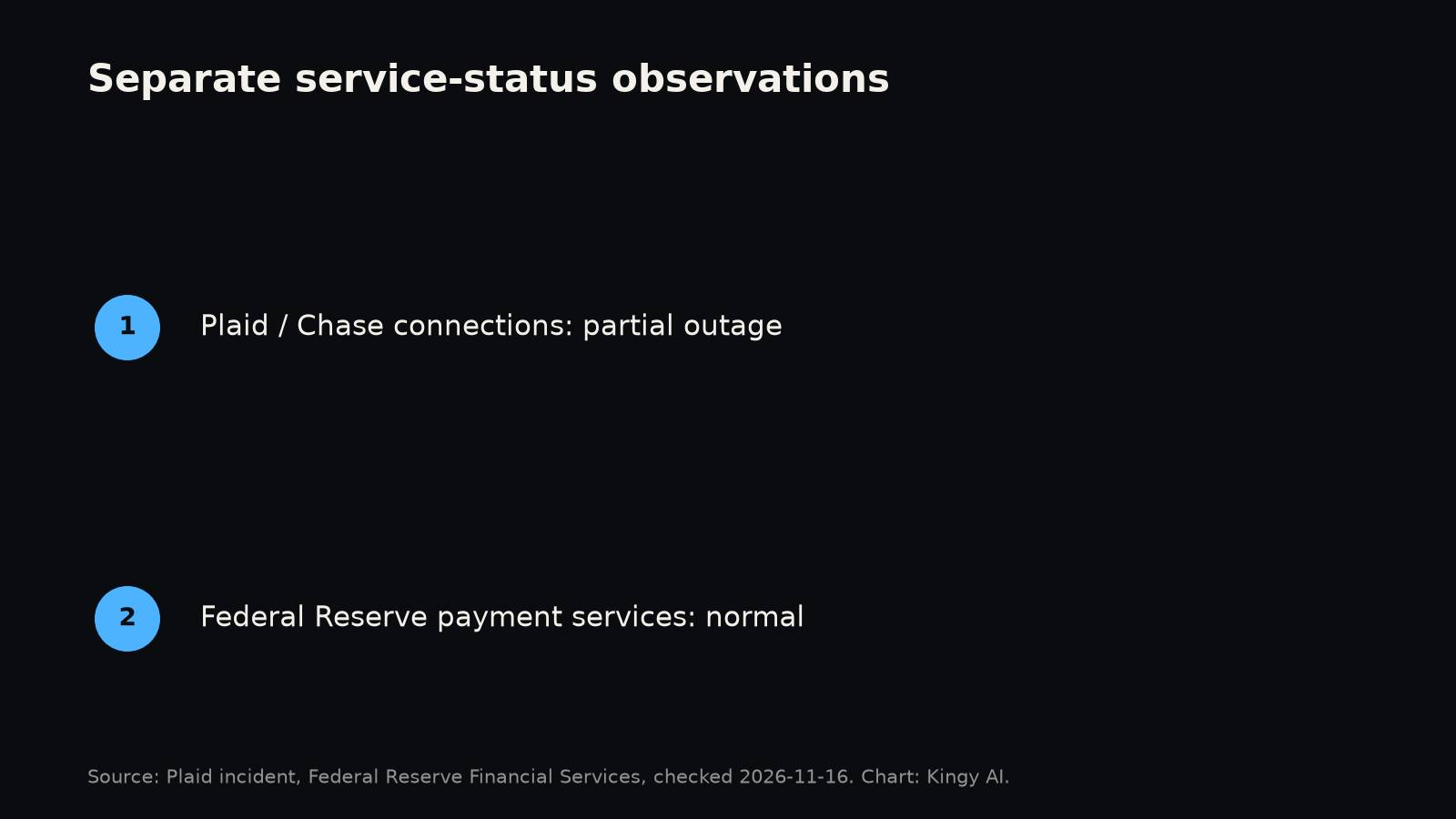
Chase-related disruption is confirmed, but the public evidence reviewed for this article does not establish an AI-agent attack or a coordinated cyberattack on American banks. Plaid’s incident notice documents a problem with Chase connections. Separately, the Federal Reserve’s payment-service status page showed normal operations when checked at 19:56 UTC. Those observations describe different parts of the banking system; neither provides a complete account of every customer’s experience. Plaid incident, Federal Reserve service status
The question now is how far the disruption extends and what caused it. Those questions need bank statements and incident evidence, not just a longer list of names appearing on an outage tracker.
What is confirmed about the November 16 bank outage?
The evidence available at this report’s cutoff falls into several distinct categories:
| Evidence checked | What it establishes | What it cannot establish |
|---|---|---|
| Plaid’s Chase incident notice | A documented disruption affecting Chase connections, classified as a partial outage under investigation. | The root cause, every affected banking function or a complete customer count. |
| Federal Reserve Financial Services status | FedACH, FedNow, Fedwire Funds, Fedwire Securities and National Settlement showed normal operations at the check. | That every bank app, account connection or individual payment works. |
| User reports and social posts | People are reporting problems worth investigating. | A common cause, an intrusion or AI involvement. |
The first two rows come from the providers’ own status pages. They should be read together without extending either beyond its scope. Plaid, Federal Reserve Financial Services
Chase attributed its disruption to a technical bug, not a cyber incident, AP reported. It said some transactions were delayed while customers retained account and fund access. AP listed user reports involving Bank of America, Wells Fargo, Truist and U.S. Bank. U.S. Bank told AP its systems were not directly affected, but customers exchanging Zelle payments with another institution could experience delays. Associated Press
What the Chase and Plaid notices tell us
Plaid’s incident notice describes Chase downtime affecting channels and data recipients, including new account connections and API calls. At the latest direct check, at 19:56 UTC, the incident remained under investigation and classified as a partial outage. The notice documents operational impact without identifying a technical cause. Plaid incident status
The wording matters. A provider describing the impact on its Chase connections is not publishing a census of every Chase service. We have not tested customer accounts, attempted transfers or inspected the bank’s internal systems. We cannot use that notice to declare every branch, card and account unavailable.
Restoration also needs its own evidence. A customer reporting a successful login would be useful information, but it would not establish that account linking, transfers and every other affected function had recovered. This report does not have a confirmed restoration time.
Why several bank names do not prove one shared failure
Banking problems can be described at different points in a transaction: the app someone opens, the account they connect, the institution sending money and the institution receiving it. An error visible to a customer does not automatically identify which component failed.
That is why outage lists need to be checked against provider statements. A customer’s report is evidence of their experience. It is not, by itself, a finding about a bank’s internal systems or proof that another bank has the same fault.
The same care applies to scale. The number of reports submitted to a tracker is not a verified count of affected account holders. Nor does a cluster of complaints show that the entire U.S. banking system has stopped. The Federal Reserve status snapshot provides a useful check on that broader claim, while leaving individual-bank problems unresolved. Federal Reserve service status
Is this a cyberattack or an AI-agent attack?
Our assessment separates three questions: did a service fail, was it deliberately compromised, and did an AI agent play a documented role?
There is evidence for a service disruption. Establishing malicious activity would require further evidence, such as an incident investigation identifying unauthorized access or deliberate interference. Establishing an AI role would require evidence explaining what a model or agent did and how that action connects to the incident.
Those are separate findings. An AI-assisted attacker, an autonomous agent acting beyond its instructions and a software defect involving AI-generated code would also be different explanations. Using “AI attack” for all three would obscure the very details an investigation should establish.
We have no access to internal logs or forensic findings. The reviewed sources do not establish an AI attribution, and this article should not imply that they do. That conclusion remains open to revision if specific evidence emerges.
What about the outage claims circulating online?
The InsiderWire post circulating on X names four banks and attributes the outages to user reports. It does not allege a cyberattack or mention AI agents. Its linked article cites CNBC reporting against a shared-bug or attacker explanation. We have not independently traced that attribution to CNBC’s original report, so it is not the foundation of our assessment.
An additional attack claim needs additional evidence. Sharing an outage report alongside speculation about AI does not make the report evidence for that speculation. Likewise, disruptions close together in time need a demonstrated connection before they can responsibly be described as one event.
Chase outage FAQ
Is Chase down today?
Plaid documented disruption to Chase connections on November 16. The precise effect depends on the service being used; that notice does not establish that every Chase function is unavailable. Plaid status
Are all U.S. banks down?
The reviewed evidence does not support that claim. Check the particular institution and service involved rather than treating every outage report as a nationwide shutdown.
Is this definitely a cyberattack?
No such finding is established in this reporting. An outage is an observation; an attack is a claim about its cause.
Did an AI agent cause the bank outage?
We have found no verified evidence connecting an AI agent to this incident. Uncertainty about the cause is not evidence for AI involvement.
Is Zelle affected?
Some customers may see cross-institution payment delays, according to the statement reported above. That does not establish a system-wide Zelle failure. AP
When will service return?
This report has no confirmed full-restoration time. A provider marking an incident resolved, with a clear description of the functions restored, would be stronger evidence than isolated reports that an app loads again.
The next useful disclosures are an affected-service list, restoration notices and a cause report. Any claim connecting institutions—or identifying malicious access or agent behavior—needs supporting evidence that readers can examine.
Sources and reporting limits
Not tested by Kingy: this is source-based reporting. No customer accounts, bank systems or transactions were tested. Official status notices describe their own services; company statements are attributed and have not been independently established by a forensic investigation.
- Plaid incident
- Federal Reserve Financial Services
- Associated Press
- InsiderWire post
- InsiderWire report
Trending on Kingy
Keep reading with the stories getting the most attention now.