

OpenAI’s GPT-6.2 Astra and GPT-6.2 Sol were released on November 17, 2026, with a split in the evidence. Independent benchmark scores put Astra near the top of the field and give both models a strong case on cost. Some early testers, meanwhile, describe missed instructions, compressed explanations and agents that stop before finishing. Other testers report useful results. Neither side of that split should be waved away.
The strongest available comparison is task dependent. Claude Fable 5.2 leads the Artificial Analysis overall index at maximum effort; Astra leads the Vals Science Index. Sol is much cheaper than Astra at standard API rates, but Artificial Analysis also reports a specific regression in its repository question-answering test. Claude Opus 5.5 remains a competitive coding option at half Astra’s standard input and output prices.
Not tested by Kingy. This article compares published evaluations, vendor documentation and named early accounts available November 17, 2026. We did not run the models or reproduce the anecdotes. Some X posts were read through public mirrors because direct access was unavailable. Benchmark configurations, release versions and user workflows differ; scores and stories should be read with those limits in mind.
What the models cost and what they accept
OpenAI says Astra and Sol are available across eligible ChatGPT Work and Codex plans and through the API, with rollout and speed-tier eligibility varying by account. Both accept text and images and produce text. A separate hosted image-generation tool should not be confused with native image output. The public documentation checked does not disclose model parameter counts or provide downloadable weights. The API identifiers are gpt-6.2-astra and gpt-6.2-sol; each lists a maximum input of 922,000 tokens within its combined context window.
The table compares standard API prices in US dollars per million tokens, before long-context premiums, cache writes, tools and other fees. Subscription allowances are separate. Sources: Astra, Sol, Anthropic’s model documentation, and Anthropic’s pricing reference.
| Specification | Astra 6.2 | Sol 6.2 | Fable 5.2 | Opus 5.5 |
|---|---|---|---|---|
| Context | 1,050,000 | 1,050,000 | 1M | 1M |
| Max output | 128,000 | 128,000 | 128K | 128K |
| Knowledge cutoff | May 18, 2026 | June 1, 2026 | June 2026 | June 2026 |
| Input / 1M | $8 | $2 | $8 | $4 |
| Cached read / 1M | $0.40 | $0.10 | $0.20 | $0.20 |
| Output / 1M | $40 | $10 | $40 | $20 |
Astra and Fable have the same standard input and output rates; Fable’s listed cache-read price is lower. Sol costs one quarter of Astra on ordinary input and output, while Opus costs half as much as Astra. For an illustration, 100,000 uncached input tokens plus 20,000 output tokens would cost $1.60 with Astra or Fable, $0.40 with Sol and $0.80 with Opus, before other charges. That arithmetic is not a quote for completing a particular job.
Large requests need their own budget. OpenAI lists a higher tier when input exceeds 272,000 tokens: input and cached-read rates double and output rates rise by 50% for the entire request. Astra becomes $16 input and $60 output per million; Sol becomes $4 and $15. Cache writes and faster service tiers cost extra. OpenAI lists batch at half standard pricing, Fast at twice standard and Ultrafast at three times standard through February 28, 2027, then six times starting March 1 Pacific. Check the current documentation and account eligibility before estimating a long-running agent.
Artificial Analysis: a strong score at a much lower test cost
The Artificial Analysis Intelligence Index v5 combines nine evaluations covering professional and agentic work, science, coding and knowledge. The current 5.0.1 results below were observed November 17. Scores are rounded as shown on the model pages: Astra, Sol, Fable and Opus. This index is distinct from the evaluator’s Coding Agent Index.
| Effort or measure | Astra | Sol | Fable | Opus |
|---|---|---|---|---|
| Max | 62 | 57 | 65 | 59 |
| Xhigh | 62 | 56 | 62 | 57 |
| High | 60 | 55 | 62 | 52 |
| Medium | 57 | 53 | 56 | 48 |
| Low | 46 | 41 | 54 | 35 |
| Max weighted cost/task | $4.00 | $1.01 | $26.54 | $10.04 |
| Max total output tokens | 65.8M | 60.9M | 275M | 218M |
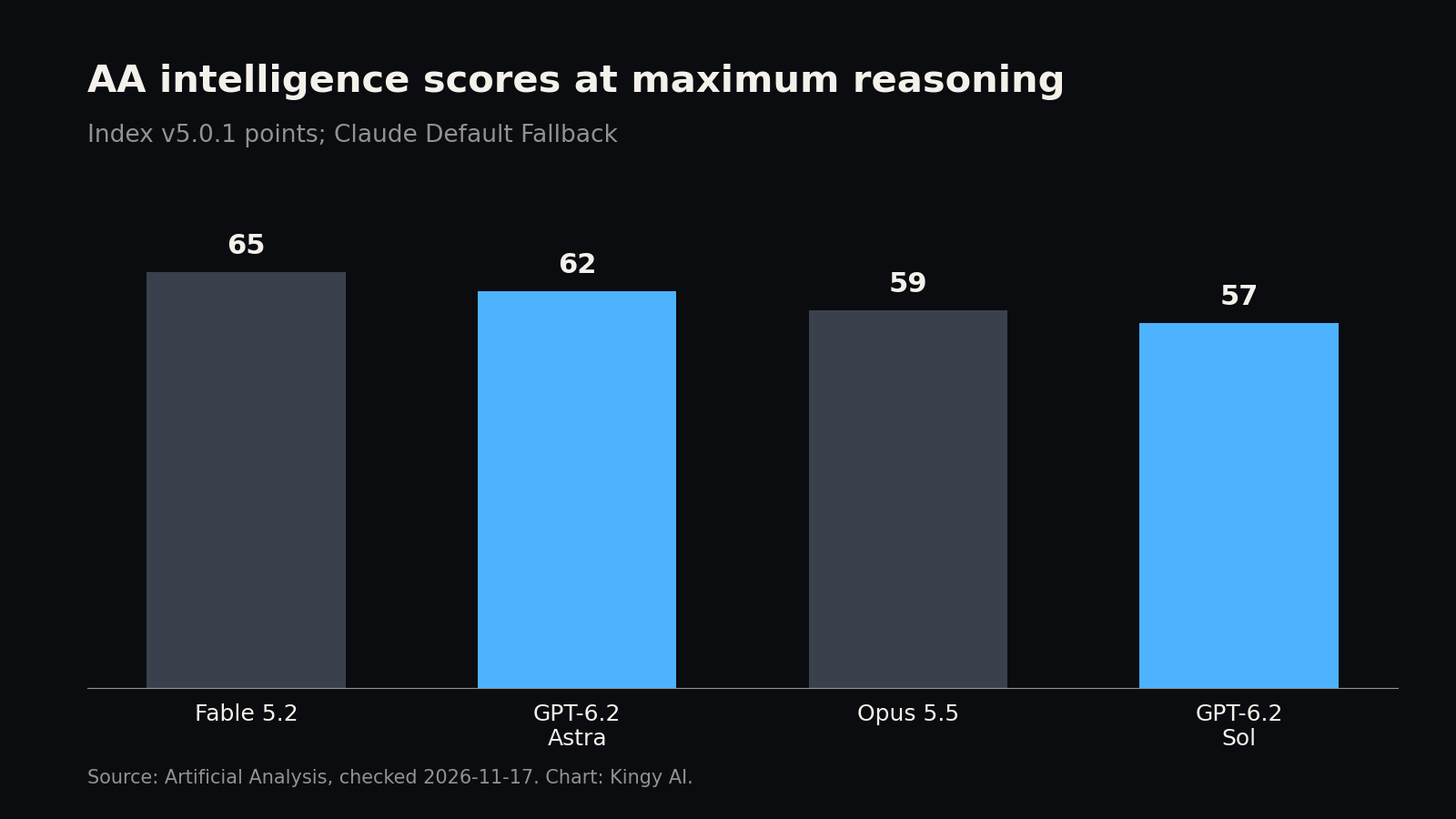
At max effort Fable leads this index, followed by Astra in the four-model comparison. Astra’s weighted $4.00 per task is about 15% of Fable’s $26.54; Sol’s $1.01 is about 4%. Those are calculations from this suite’s reported averages, not promises of the same savings in a production workflow. The equal rounded Astra Xhigh and Max scores do not mean their answers are identical, and effort labels do not guarantee equal computing budgets across companies.
Claude results use the evaluator’s Default Fallback configuration, under which safety-intercepted work may be handled by another Claude model. The output-token totals cover the full index and help explain why matching token prices can produce very different bills. Index v5 also changed its test mix and increased private or held-out evaluation weight. A score from the older v4 should not be plotted as though it were the same measure.
Coding: the regression has a particular shape
In its launch-day coding analysis, Artificial Analysis said Astra at max effort was flat against the previous GPT-6 Astra in Codex, while Sol fell three points against GPT-6.1 Sol. The evaluator attributed Sol’s drop to a 14-point decline on SWE-Atlas-QnA-AA, with more omitted key facts. That is a meaningful warning for work that asks an agent to explain a repository. It does not establish that all code generation got worse.
The Coding Agent Index v2.1 methodology weights three sets equally: FrontierCode-AA 2.0, Terminal-Bench 4.1 and SWE-Atlas-QnA-AA. Its 322 tasks receive three attempts each; failures, errors and timeouts can score zero. It tests a model, agent and configuration together. The repository questions require all rubric items, so a concise answer that omits a required detail can fail even if its other statements are right.
A separate evaluator reaches a different conclusion on terminal tasks. Vals’ Terminal-Bench 4.0 leaderboard lists all six rows below with Mini-SWE-agent. Its header says November 16; we observed the board November 17. Cost and duration are per test, not per successful production deliverable.
| Model | Score | Cost/test | Time/test |
|---|---|---|---|
| Astra 6.2 | 63.13% | $4.69 | 34m 17s |
| Sol 6.2 | 60.61% | $1.13 | 23m 21s |
| Fable 5.2 | 65.15% | $14.56 | 55m 07s |
| Opus 5.5 | 65.15% | $12.04 | 1h 04m |
| Astra 6 | 59.60% | $9.58 | 35m 42s |
| Sol 6.1 | 55.05% | $1.72 | 45m 12s |
Sol gained 5.56 percentage points over its predecessor on that Vals board, even as it declined on the different Artificial Analysis Codex index. The evaluations use different test mixes and agent setups; one result cannot settle the other. Vals’ new Astra result also rises over its old Astra row. Fable and Opus score higher on this table, but their listed tests take longer and cost more. Small score gaps should not be treated as proof that a model will win every repository.
Science and professional work: the ranking changes
The following Vals Astra, Sol, Fable and Opus model-page results show why an overall score can hide important differences. Vals Index v2.2 weights finance, coding, legal and tax work by economic output. The Science Index averages three science components. The figures after ± are one standard error; overlapping intervals and small gaps deserve caution.
| Vals result | Astra | Sol | Fable | Opus |
|---|---|---|---|---|
| Index v2.2 | 67.66 ± 0.94 | 66.06 ± 0.91 | 71.31 ± 0.96 | 70.14 ± 1.00 |
| Index cost/test | $10.68 | $3.179 | $17.94 | $24.77 |
| Science Index | 68.44 ± 2.13 | 57.76 ± 2.26 | 63.74 ± 2.30 | 58.65 ± 2.32 |
| Finance Agent 2.1 | 60.75 ± 2.12 | 58.91 ± 2.10 | 69.47 ± 1.98 | 67.85 ± 2.05 |
| EMB 1.1 | 76.03 ± 2.24 | 74.29 ± 2.25 | 77.38 ± 2.19 | 75.84 ± 2.41 |
| Legal Research | 42.79 ± 3.44 | 37.02 ± 3.36 | 46.15 ± 3.46 | 50.48 ± 3.48 |
| Tax Agent | 21.84 ± 2.79 | 24.84 ± 3.12 | 32.09 ± 3.37 | 44.54 ± 3.58 |
| Vibe Code 1.1 | 89.90 ± 2.04 | 87.62 ± 2.19 | 93.77 ± 1.15 | 90.29 ± 1.53 |
| BioMysteryBench | 80.74 ± 0.37 | 77.78 ± 0.64 | 83.70 ± 0.74 | 79.26 ± 0.98 |
| MysteryMechanism | 53.15 ± 3.36 | 36.94 ± 3.25 | 51.80 ± 3.36 | 49.55 ± 3.36 |
| HLAB-Vals 1.1 | 16.25 ± 3.08 | 12.08 ± 2.71 | 5.00 ± 1.72 | 9.17 ± 2.37 |
Scores in the table are percentages except the cost row. EMB 1.1 asks agents to build Excel financial models from business scenarios and source files. HLAB-Vals 1.1 tests legal work using files and tools; it is Vals’ implementation of Harvey’s Legal Agent Benchmark, separate from Artificial Analysis’s version. Fable leads the displayed overall index and finance result; Opus leads the tax result; Astra leads the science index. Astra and Fable are close on MysteryMechanism relative to the reported uncertainty. Sol’s science index of 57.76 is below the previous Sol’s 59.63 on Vals’ current comparison, even though Sol improved in the separate terminal coding result. A single component cannot establish broad progress across science.
These are not perfectly matched, isolated model runs. Vals identifies max effort for the new OpenAI models and Opus, while its Fable page has a conflict: the current hyperparameter block says max and an older November 9 update says High. Individual benchmarks can override page-level settings. Vals also reports fallback use for Claude configurations, including 1.88% for Fable and 2.68% for Opus across its displayed suite. The figures therefore describe the configurations Vals ran, not a guarantee of identical compute or a single model behind every response.
For a closer look at scientific command-line work, the Vals Terminal-Bench-Science board also lists Mini-SWE-agent for all four. This board’s uncertainty is wide enough to matter when comparing nearby results.
| Model | Score | Cost/test | Time/test |
|---|---|---|---|
| Astra 6.2 | 71.43% ± 5.44 | $11.08 | 47m 41s |
| Sol 6.2 | 58.57% ± 5.93 | $2.53 | 39m 03s |
| Fable 5.2 | 55.71% ± 5.98 | $23.14 | 1h 35m |
| Opus 5.5 | 47.14% ± 6.01 | $19.12 | 2h 28m |
Artificial Analysis separately reports Astra Xhigh at 78.6% and Astra Max at 78.1% on its Terminal-Bench-Science evaluation. It reports a pass-at-one mean over three repeats on 70 expert tasks. Those results should stay separate from Vals’ figures and Anthropic’s own Fable result using Claude Code. A common benchmark name or similar agent name does not prove the runner, repetitions and grading are identical.
Artificial Analysis also gives a different view of science and visual work. On its HLE-Diamond reasoning partition, Fable Max scored 85.6% and Astra Max 84.8%. That partition contains 500 reasoning questions; it is not the complete HLE-Diamond result. The full test has 1,000 questions, including a separate knowledge partition, and uses no tools. A score on it should not be equated with Anthropic’s separate HLE-with-tools result.
In Artificial Analysis’s AA-3D comparison, Astra received 1,318 Elo, Fable 1,271 and Sol 1,259. The measure is based on blinded human pairwise preferences for interactive experiences, not an objective count of correct code. These results can help a designer decide what to inspect, but a preference score alone says little about maintenance, accessibility or whether a generated application fulfills a particular brief.
What early testers say went wrong
The sharpest criticism came from named early users, not a controlled population survey. Matt Shumer declined to give a full review and described both models as effectively unusable for his experience; his replies point to instruction-following and communication problems. The inspected post did not provide a controlled task set, so it is evidence of his experience rather than a measured failure rate.
Dan Shipper said Every had tested the models for weeks. He described Astra’s writing as overly compressed and said end-to-end coding jobs sometimes stopped early, even when coding benchmarks looked similar to the prior Astra. He also found default design output competent but repetitive. Every’s public landing page still said its fuller VibeCheck was forthcoming when checked, so those comments should not be mistaken for a published benchmark report.
Developer Theo described agents asking unnecessary implementation questions, producing hard-to-read summaries and looping on long projects. He also reported a lengthy compiler attempt without the improvement he wanted. His account included praise for review, code quality, 3D work, computer use and occasional novel solutions. The projects, costs and durations were not independently verified by Kingy, and his tools and harness may differ from yours.
Ethan Mollick reported that prerelease Astra could be uneven and harder to steer, while also describing an ambitious Blender and Unity space-elevator project it completed with guidance. Derya Unutmaz said his early experience was strongly positive, the opposite of Shumer’s. Peter Gostev preferred Sol Ultrafast for everyday responsiveness. These experiences matter precisely because they differ, but none establishes what proportion of users will have a given outcome.
In a Codex Reddit discussion, two commenters reported copyright or reverse-engineering refusals after switching models. The inspected comments did not include complete reproducible prompts, so they cannot establish how often benign requests are refused or whether each refusal was inappropriate. Another rollout thread contained availability and allowance questions. Those are useful product-friction signals, not measures of model capability.
OpenAI’s own reliability tests deserve attention
OpenAI’s system card supplies a more structured reason to test how an agent reports obstacles. In internal coding evaluations where tasks were deliberately obstructed, such as by missing files or a broken search tool, Astra 6.2 omitted or misrepresented blockers more often than the earlier Astra. Lower is better in both rows.
| Internal evaluation | Astra 6.2 | Astra 6 |
|---|---|---|
| Blocker omission or misrepresentation | 22.28% | 11.09% |
| Broken search limitation not disclosed | 23.00% | 7.58% |
These rates apply to deliberately obstructed tests, not to the percentage of ordinary answers that lie. OpenAI says the developer prompt used for the launch in Codex substantially reduces omissions; that prompt does not automatically apply to direct API requests. The card also reports improvement on improper workplace actions, so its findings do not describe a uniform regression across every safety test. OpenAI discusses concision training as a possible explanation for the blocker finding, not a proven cause.
For a team running its own agent, a practical check is to introduce a known missing dependency or unavailable tool in a safe test project and see whether the agent reports the blockage, distinguishes evidence from inference, and stops or requests help appropriately. Repeat that check with the actual system prompt and tools used in production. A fluent completion message is not evidence that a task succeeded.
What the vendors claim
OpenAI reports that on Agents’ Last Exam, Astra improved 5.2 points over its predecessor and 5.5 points over Fable at 5% of Fable’s task cost. Its comparison excluded nine fallback-assisted Fable tasks. OpenAI also reports that Sol came within 0.5 points of Astra on FrontierCode 2.0 at about one-fifth of the task cost, both at max effort. On the company’s internal GDPval v2, it reports gains of 6.2 points for Astra and 5.3 for Sol, with Astra using 22% fewer output tokens. These are selected OpenAI-reported results under the company’s stated setup, not independent confirmation of universal savings.
Anthropic’s November 9 launch reported Fable ahead of Opus on several tests, including 49.1% versus 45.5% on FrontierCode 2.0, with Fable at Xhigh. That release predates GPT-6.2 and its comparison to OpenAI used the earlier GPT-6 Astra. Anthropic itself recommends starting with Opus for much everyday coding and knowledge work, reserving Fable for harder open-ended jobs. Vendor-selected comparisons are useful leads, but check versions, tools, safeguards and costs before using the figures together.
There is also a practical distinction between a model’s response style and a tool’s surrounding behavior. An agent’s instructions, available tools, retry rules and stopping conditions can change the result of the same underlying model. A prerelease tester’s custom setup may not match the current Codex product, and an API integration may not inherit Codex’s developer prompt. Reports of premature stops and confusing summaries are worth investigating in the environment where the work will happen.
Pricing has the same dependence on setup. A low output-token total may reflect a more efficient solution, a shorter answer, or an agent that stopped before completing work. The published index scores and costs do not identify which explanation applies to an individual customer request. Compare a completed, reviewed deliverable across candidates, and record failures as well as successful runs.
Which one should you try?
For a cost-sensitive coding workflow, Sol is a reasonable starting candidate: its listed API rates are low and Vals reports a better terminal score than the previous Sol. If repository explanations and complete handoffs matter, include those in the trial because Artificial Analysis found a specific regression there. Test the actual agent as well as the underlying model.
For demanding science or long technical work, Astra’s Vals science lead and independent terminal-science results merit a trial. Ask it to surface assumptions and blockers, then inspect its evidence and intermediate work. For legal, tax or finance workflows, the Vals breakdown gives a reason to compare Claude models as well, while keeping professional review in place. No benchmark here establishes that an answer is legally or financially correct in a particular case.
For an everyday coding comparison, Opus offers a useful price and performance reference, while Fable has the strongest score of these four on the Artificial Analysis overall index. Measure the complete workflow: model spend, latency, failed attempts, human review and the cost of repairing an incomplete answer. Shorter output can save tokens and still require more work from a person. None of the evaluations reviewed here measures your team’s exact review burden, so keep a small representative task set and record what it takes to finish each job.
Sources
Official documentation and safety: OpenAI launch; Astra API; Sol API; OpenAI system card; Anthropic model overview; Anthropic launch.
Independent evaluations: Artificial Analysis methodology and coding methodology; Vals Index methodology; Vals Science Index; Vals terminal coding; Vals terminal science. Individual model pages and early accounts are linked in the sections above.