

GPT-6.2 Sol gives developers a strong reason to question the premium for Claude Opus 5.5. At standard API rates for requests up to 272,000 input tokens, Sol costs half as much per input and output token. In Artificial Analysis’s Intelligence Index, Sol at maximum effort scores 57 against Opus’s 59, while its reported average task cost is $1.01 against $10.04. Artificial Analysis estimates task cost from observed token usage and provider pricing. The roughly tenfold gap applies to this evaluation. Source: Artificial Analysis comparison.
Opus leads on several difficult reasoning and knowledge evaluations, and its Claude Code configuration has an advantage on repository questions. Sol scores higher on the interactive 3D and scientific terminal tests. The decision depends on the work, the number of attempts needed and the cost of an error.
Start with Sol for high-volume workflows where cost and turnaround matter. Put Opus in the shortlist for difficult research, complex knowledge work or agent tasks if it catches errors your team would otherwise have to fix. Run both on your own examples before committing a consequential workflow.
Not tested by Kingy. This comparison uses published provider documentation and independent benchmark results available on November 17, 2026. Kingy did not run the models or independently reproduce the benchmarks. Scores apply to the named tests and settings.
GPT-6.2 Sol vs Claude Opus 5.5 at a glance
| Feature | GPT-6.2 Sol | Claude Opus 5.5 |
|---|---|---|
| API input / output | Text and images in, text out | Text and images in, text out |
| Context and output | 1,050,000 combined tokens, up to 922,000 input and 128,000 output | 1 million-token context, up to 128,000 output |
| Knowledge cutoff | June 1, 2026 | June 2026 |
| Standard input / output per million tokens | $2 / $10 up to 272,000 input tokens, $4 / $15 above that threshold | $4 / $20, global pricing |
| Reasoning | Configurable effort, with reasoning required | Always-on adaptive thinking, medium by default in the API |
| Access | OpenAI API, eligible ChatGPT Work and Codex rollout | Claude API, Claude products and supported cloud platforms |
A Sol request can send up to 922,000 input tokens. The larger combined context figure includes the model’s output. Opus’s 1 million-token window includes input and output, with a separate 128,000-token output maximum. If your work depends on a detail buried in a large file set, test whether the model finds and cites it. OpenAI model documentation · Anthropic context windows.
Which model leads on which benchmarks?
Artificial Analysis reports the following maximum-effort results in its direct comparison. Each benchmark measures a different set of tasks. Small gaps should be treated as directional, especially without a reported uncertainty interval for each comparison.
| Evaluation | GPT-6.2 Sol | Claude Opus 5.5 |
|---|---|---|
| AA-Briefcase v1.1 | 1,612 Elo | 1,800 Elo |
| AutomationBench-AA | 71.3% | 69.5% |
| Terminal-Bench 4.0 | 60.1% | 59.6% |
| FrontierCode-AA 2.0 | 44.4% | 46.4% |
| AA-Omniscience v1.1 net score | 40 | 48 |
| GDP.pdf | 30.0% | 26.2% |
| HLE-Diamond | 64.0% | 67.9% |
| CritPt v2 hard | 62.5% | 68.0% |
| Terminal-Bench-Science 0.1 | 67.6% | 59.0% |
Opus’s larger Briefcase and Omniscience leads make it worth evaluating for demanding knowledge work. Sol’s leads on GDP.pdf and the science terminal test are a reason to test it on those workflows too. Neither result proves a winner for a specific company’s documents or research questions. The modest FrontierCode and AutomationBench differences deserve particular caution.
For a visual, interactive task, Artificial Analysis’s AA-3D leaderboard reports Sol at 1,259 ± 28 Elo and Opus at 1,202 ± 28, with the displayed margins at 95% confidence. Human judges compare interactive 3D demos without seeing which model built them. Source: AA-3D.
Specialist evaluations can produce a different picture. On Harvey LAB-AA v1.1, a set of 120 private legal tasks across 24 areas, Sol max achieved 11.1% on the hallucination-gated all-pass measure against Opus max’s 4.2%. Criterion pass rates were 91.5% and 90.0%, respectively. The evaluator reported 0.05 and 0.59 material hallucinations per task. Both models miss the all-pass standard on most tasks in this benchmark, even though each clears at least 90% of individual criteria. Source: Harvey LAB-AA.
In ARC Prize’s abstract reasoning tests, both models score 97.5% on ARC-AGI-1 at max. On ARC-AGI-2 at max, Sol scores 85.8% and Opus 91.7%. Opus does better at high effort on the same test, at 93.3%. ARC Prize reports two incomplete v1 or v2 tasks and eight incomplete v3 games across Sol’s published configurations. Scores use the full dataset denominators. On ARC-AGI-3’s 25-environment public demo at max, Sol scores 54.9% with the standard harness and 98.2% with a provider adapter that carries forward reasoning state. ARC Prize lists ARC-AGI-3 results for Sol only among these two models. ARC Prize: Sol · ARC Prize: Opus.
Reasoning effort changes the price of the answer
Artificial Analysis runs its Intelligence Index v5.0.1 at multiple effort levels. Its weighted cost per task uses the token counts observed in the evaluation and accounts for cache hits. The reported time estimates inference duration from measured endpoint performance and output length. Those estimates apply to the evaluator’s setup. The Opus results allow another Claude model to handle work when safeguards intervene. The providers set their own compute budgets for each effort level. Artificial Analysis methodology.
| Effort | Sol: index / cost / time | Opus: index / cost / time |
|---|---|---|
| Low | 41 / $0.18 / 1.4 min | 35 / $0.98 / 3.0 min |
| Medium | 53 / $0.41 / 3.1 min | 48 / $2.45 / 6.8 min |
| High | 55 / $0.56 / 4.3 min | 52 / $3.46 / 9.3 min |
| Xhigh | 56 / $0.65 / 5.1 min | 57 / $6.05 / 15.8 min |
| Max | 57 / $1.01 / 7.9 min | 59 / $10.04 / 24.6 min |
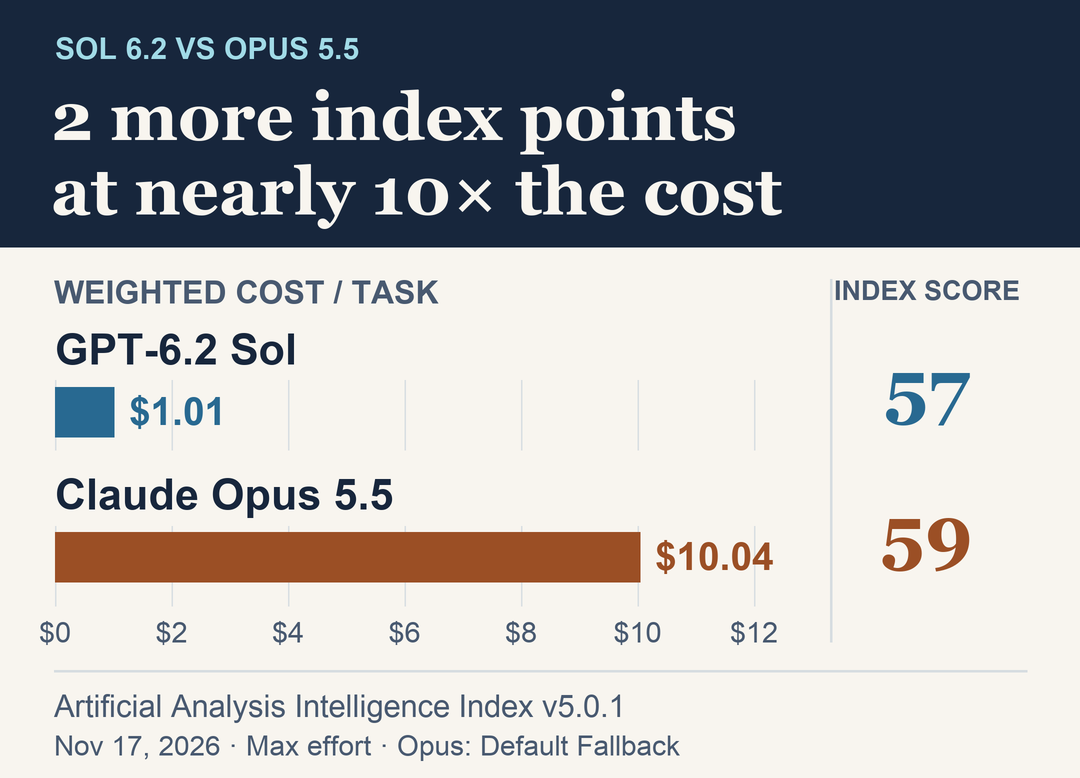
Sol at high scores 55 for $0.56 per task. Moving to max adds two index points and lifts the bill to $1.01. Sol max and Opus xhigh both round to 57, with estimated costs of $1.01 and $6.05 per task. Equal rounded scores can mask different strengths on individual evaluations.
How the models compare in Codex and Claude Code
Artificial Analysis puts the models close on Terminal-Bench 4.0, with Sol at 60.1% and Opus at 59.6%. Vals AI’s separate leaderboard using Mini-SWE-agent instead reports Opus at 65.15% and Sol at 60.61%. Vals lists average costs of $12.04 versus $1.13 per test and durations of 1 hour 4 minutes versus 23 minutes 21 seconds, respectively. The two leaderboards use separate evaluation setups, and the order changes between them. Source: Vals Terminal-Bench 4.0 · Artificial Analysis comparison.
The difference is larger when Artificial Analysis runs each model in its own coding agent. Repository question answering accounts for the widest gap in the table below.
| Measure | Sol in Codex | Opus in Claude Code |
|---|---|---|
| Coding Agent Index v2.1 | 49 | 58 |
| SWE-Atlas-QnA-AA | 46 | 66 |
| Terminal-Bench 4.1 | 58 | 65 |
| FrontierCode-AA 2.0 | 42 | 44 |
| API cost per task | $1.22 | $12.61 |
| Active agent time per task | 17.5 minutes | 1.1 hours |
For a ticket with clear tests and an easy rollback, Sol in Codex is a lower-cost starting point. On a cross-repository migration, try Opus in Claude Code if the critical work is finding dependencies and explaining why proposed changes are safe. The model, tools and agent instructions all contribute to these results.
For a coding team, the useful experiment is a set of representative issues with a fixed test suite, the same repository state and a clear acceptance rule. Record retries, human review time and failures alongside token cost. A higher-cost model can be cheaper to use if it cuts enough repair and review time.
There is also a warning against treating a new model name as an automatic upgrade. In its separate Coding Agent Index, Artificial Analysis reported Codex Sol max three points below its predecessor, with a 14-point decline on SWE-Atlas-QnA attributed to omissions. If repository explanations matter, check whether the agent reports all the facts a reviewer needs before upgrading. Source: Artificial Analysis launch analysis.
How longer prompts change API pricing
At standard rates, Sol charges $2 per million input tokens and $10 per million output tokens when the request contains at most 272,000 input tokens. Above that input threshold, OpenAI’s higher rates apply to the full request. $4 per million input and $15 per million output. Opus’s global standard rates are $4 input and $20 output per million, with no long-context premium. Rates and terms can change, so check the provider pages before forecasting a deployment. OpenAI model documentation · Anthropic pricing · Anthropic context windows.
| Uncached input + output | GPT-6.2 Sol | Claude Opus 5.5 |
|---|---|---|
| 100,000 + 20,000 tokens | $0.40 | $0.80 |
| 300,000 + 20,000 tokens | $1.50 | $1.60 |
| 500,000 + 20,000 tokens | $2.30 | $2.40 |
The threshold matters. A request just above it is billed at Sol’s higher rates for the full request, so estimate from actual input lengths rather than assuming every token gets the lower rate. In these examples Sol remains cheaper, but at 300,000 and 500,000 input tokens the difference is only ten cents because input pricing has converged.
Repeated prompts can change the calculation. At the short-context rate, Sol lists $0.10 per million cached input tokens, $2.50 for a 30-minute cache write and $5 for a 12-hour write. Above the threshold its listed cache hit is $0.20 and its 30-minute write is $5 per million. Opus lists $0.20 for cache reads, $5 for five-minute writes and $8 for one-hour writes. The retention periods differ, so compare cache hit rates and expiry against your traffic, not write prices alone. OpenAI model documentation · Anthropic pricing.
Both providers offer a 50% first-party batch discount on normal token rates. Both also list a Fast tier at twice standard pricing. OpenAI lists Sol Ultrafast at three times standard through February 28, 2027, rising to six times on March 1 Pacific time. Availability and usage rules depend on the processing tier and account. OpenAI model documentation · Anthropic pricing.
Availability and integration
OpenAI released GPT-6.2 Sol on November 17, 2026. Developers can call gpt-6.2-sol through OpenAI’s Responses API or Chat Completions. The Responses API also supports hosted tools. The rollout covers eligible Work and Codex accounts and can depend on administrator permissions. Regular Chat has a separate model lineup. OpenAI announcement · ChatGPT Work and Codex help.
Anthropic released Claude Opus 5.5 on September 22, 2026. Anthropic lists it in Claude Pro, Max, Team and Enterprise, and in Claude Code. The Claude API model ID is claude-opus-5-5. Its documentation also describes access through supported AWS, Google Cloud and Microsoft Foundry offerings. Cloud provider availability and pricing can differ from Anthropic’s global API rates. Anthropic also lists up to 300,000 output tokens in a Batch API beta. Anthropic announcement · Opus documentation.
For the wider launch and the relationship between Sol and its sibling Astra, see Kingy’s GPT-6.2 Astra and Sol benchmarks and pricing coverage.
Which should you choose?
Choose Sol first for volume and cost-sensitive agents. Its lower short-context token rates and the published cost-per-task results make it a sensible baseline for document processing, coding assistance and agent workflows. Start at an effort level that meets your acceptance criteria and raise it for failures.
Test Opus for difficult, high-value work. Its leads on Briefcase, Omniscience, HLE-Diamond and repository Q&A in Claude Code justify a trial where research quality, difficult reasoning or successful completion matters more than the first-request price. Check the output against trusted sources and existing tests.
Use a measured routing rule. Compare cost per accepted deliverable including failed runs, retries, tool use and reviewer time. A practical pilot can send the same representative tasks to both models, blind the reviewers to the model name and define acceptance before scoring. If Sol passes routine work reliably, reserve Opus for tasks where it demonstrably reduces failures or review effort.
Limits
These results are a November 17 snapshot of third-party tests and provider documentation. Benchmarks use particular prompts, tools, effort settings and grading rules. The task mix may differ from yours. Published API prices do not include every possible tool, platform or operating cost. If you run a comparison on private files, keep the inputs, scoring criteria and integration settings fixed across models.
Sources
Model specifications and API pricing. OpenAI model documentation · Anthropic model documentation · Anthropic rate card.
Benchmark methods and leaderboards. Artificial Analysis Intelligence Index methodology · Artificial Analysis coding-agent methodology · Vals Terminal-Bench 4.0 · ARC Prize Sol results · ARC Prize Opus results.