October 15, 2026. Kingy.ai’s comparison covers 516 images across 12 hosted configurations, with published benchmarks checked separately.
FLUX 3 Image Klein’s strongest result in our launch-day comparison was its price. The distilled model generated our 44-image batch for US$0.396. That batch included 32 images from text prompts and 12 edits. GPT Image 2.5 Flare cost $9.3854 for the same number of tasks.
The more expensive models generally followed our detailed instructions more reliably. Klein distilled passed all four scored checks on 24 of 32 text-to-image outputs. Klein Base passed 23. Nano Banana 2.1 and GPT Image 2.5 Flare each passed 31.
There is a significant qualification: we disabled Klein’s prompt expansion. Black Forest Labs recommends running the model with a prompt upsampler, which converts requests into detailed scene captions. Our results describe the hosted configurations we actually ran; they do not establish Klein’s performance with its recommended pipeline. That limitation belongs beside the scores, not buried beneath them. BFL reference implementation
The evidence still gives creators something practical: verified release specifications, an inexpensive model with measurable instruction-following weaknesses in this configuration, and a comparison against several leading alternatives. It also shows why a clean-looking diagram, a high preference rating and a technically correct image are different things.
What Black Forest Labs released
BFL announced FLUX 3 Image Klein on October 15. It is the smaller open-weight member of the FLUX 3 Image family. Our earlier FLUX 3 Image comparison covers the full model; the results here distinguish that model from both Klein checkpoints. Official release announcement
| Specification | FLUX 3 Image Klein |
|---|---|
| Image transformer | 5.6 billion parameters |
| Separate text encoder | Qwen3-VL-4B-Instruct |
| Main tasks | Text-to-image, image editing and multi-reference generation |
| Reference images | Up to 10 |
| Maximum advertised output | Native 4K |
| Distilled checkpoint | 16 steps, no classifier-free guidance |
| Base checkpoint | 50 steps, guidance scale 3.5 |
| Layout controls | Bounding boxes for placement and editing |
| Released quantization options | FP8, INT8 and NVFP4, with implementation-specific packages |
| Weight license | FLUX Kommunity License v1.0 |
Sources: BFL’s model overview, Base model card and BFL’s release statement. These are documented capabilities, not capabilities we independently tested in every mode.
The parameter count needs context. It counts the image transformer, excluding the separate text encoder. BFL positions the distilled checkpoint for generation and editing, and Base for fine-tuning, LoRA training and research. A larger step count does not guarantee a better result on every prompt. Base model card
The hardware story also depends on the implementation. BFL advertises an INT8 route for GPUs with 8GB of VRAM. Its distilled model card reports much higher peaks for the reference implementation on a B200 at 1024×1024: 31GB in BF16, 26GB in FP8 and 25GB in NVFP4, with the upsampler disabled. The upsampler adds about 28GB on an 80GB GPU. These describe different configurations; an 8GB claim is not a promise that every loader, precision and component combination fits. We did not measure local VRAM use. BFL release, distilled model card
The weights use a conditional community license. Its commercial-output exception applies to qualifying users whose gross annualized revenue, including affiliates, is below US$5 million, subject to the terms. That exception is not blanket permission for commercial fine-tuning or distribution. The inference repository’s Apache license should not be mistaken for the generator weights’ license. FLUX Kommunity License, reference-code license
What the official benchmarks establish
BFL reports gains of 91 Elo points in text-to-image and 70 in editing over FLUX.2 Klein 9B, using 38% fewer generator parameters. Its internal comparison places Klein ahead of the included open-weight rivals and of Ideogram 4.5 and FLUX.2 Pro. Those are vendor-run results within BFL’s comparison set. BFL’s launch evaluation
NVIDIA’s reported 16-step, 1024×1024 timings are approximately four seconds on an RTX 5090 and under nine on an RTX 4070. These are GPU-generation measurements. BFL’s cross-provider API latency chart also mixes server-side timing for Klein with client-side timing for competitors, including network and polling overhead. We did not reproduce those speed tests. Official performance notes
Neither those Elo improvements nor those timings establish that Klein beats every frontier model. Elo values from different evaluation pools cannot be combined into one ranking.
Independent benchmarks: where the competing models stand
Artificial Analysis provides a separate reference point based on pairwise human preferences. The table below is a dated snapshot of its AA-Image-T2I v2.1 and AA-Image-Editing v2.1 boards, retrieved October 15. The ± values are the boards’ reported 95% interval half-widths.
| Model configuration | Text-to-image Elo | Editing Elo |
|---|---|---|
| GPT Image 2.5 Sunburst, max | 1218 ±10 | 1199 ±11 |
| GPT Image 2.5 Flare, max | 1208 ±10 | 1180 ±11 |
| GPT Image 2, high | 1186 ±12 | 1136 ±13 |
| Nano Banana 2.1 | 1172 ±12 | 1152 ±13 |
| Grok Imagine Image 2.0 | 1167 ±13 | 1115 ±13 |
| Muse Image | 1127 ±12 | 1129 ±12 |
| FLUX 3 Image, full | 1115 ±13 | No entry found in the checked board |
| Seedream 5.0 Pro | 1098 ±11 | 1130 ±13 |
| Ideogram 4.5, High | 1017 ±16 | 1065 ±16 |
| FLUX 3 Image Klein | No entry found | No entry found |
Sources: Artificial Analysis text-to-image leaderboard and editing leaderboard. Scores can change as votes accumulate. The older FLUX.2 Klein entries are different models.
Sunburst led both checked boards. Our custom test below gives Flare more complete passes than Sunburst. That is not a contradiction: human preference across a broad prompt collection and four-item correctness checks on 16 prompts measure different things. We cannot use either result to fill in Klein’s missing independent Elo score.
How we tested: 516 images, with the evaluator checked first
Kingy’s revised comparison produced 384 text-to-image outputs and 132 edits through Fal. Twelve configurations received the same 16 generation prompts, with two draws per prompt. Eleven also received six editing tasks, again with two draws. Recraft was tested for generation only.
The generation suite covered text, counting, spatial relationships, diagrams, photographic scenes and illustration. Examples included a three-line poster, labeled bottles, five apples beside two pears, a clockwise water cycle, a three-bar chart and a two-floor house cutaway.
Each task had four predefined checks. An output earned a complete pass only when all four passed. This is a four-criterion pass rate, not a score for every clause in the prompt, visual quality or commercial usability. For example, the poster rubric checked three required phrases and an orange disk; it did not separately score every typographic and layout instruction.
Our six edits used just two sources: a synthetic graphic fixture and a generated barista photograph. Tasks included changing a square’s color, removing a triangle, replacing text, recoloring a divider, changing an apron and removing a towel. Both draws were retained; we did not select the prettiest output or rerun failures until they passed.
Most outputs were 1024×1024. Muse returned 1600×1600; Recraft used 2048×2048. GPT Image 2.5 ran at max quality, GPT Image 2 at high, Nano Banana 2.1 at 1K with medium thinking and web search disabled, and Ideogram at high quality. Seedream used its standard prompt enhancer. Klein’s expansion was disabled in both configurations, as was full FLUX’s.
These differences matter. Identical user prompts do not create identical pipelines, particularly when one service expands the prompt and another does not. We also used seeds only where the endpoint exposed them. This is a reproducible comparison of selected hosted settings, not a controlled comparison of model architectures or maximum achievable quality.
The evaluator was useful, but it was not a human panel
The final automated evaluator was GPT-6 Luna, with the candidate image and rubric but no model label. It matched assistant-assigned reference labels on 99 of 100 criterion checks across 25 images. Three fresh held-out images supplied 12 checks, all correct. That is a small validation result, not evidence of 99% accuracy on arbitrary images.
Earlier evaluator versions were rejected after errors involving source-image confusion, arrow direction and absence/counting logic. Their scores were discarded. Twelve images in the final comparison also appeared in evaluator calibration; their judgments were reused. The comparison therefore does not constitute a fully independent held-out evaluation.
We subsequently corrected two source-relative editing checks that a candidate-only judge could not reliably answer. Triangle removal used a fixed white-pixel test; towel removal used an assistant visual comparison against the source, applied to all 22 towel outputs. Across these amendments, six criterion decisions changed. Raw judgments and the amendments remain in the evidence record.
There was no independent human rating panel. The evaluator also shares a vendor with the three OpenAI image configurations. Hiding model names reduces an obvious source of bias but does not establish that the judge is unbiased. OCR and pixel measurements supplemented the review; OCR misses were not automatically counted as generation failures.
Our measured results and costs
The table reports the revised comparison only. The earlier 140-image pilot is included in project spending, but its quality scores are not pooled with these results.
| Tested configuration | Generation: all four checks passed | Pass rate | Edits: all four checks passed | Billed generation and editing batch |
|---|---|---|---|---|
| FLUX 3 Klein distilled | 24/32 | 75.0% | 12/12 | $0.3960 |
| FLUX 3 Klein Base | 23/32 | 71.9% | 12/12 | $1.1880 |
| FLUX 3 Image, full | 28/32 | 87.5% | 12/12 | $2.1120 |
| GPT Image 2.5 Sunburst | 29/32 | 90.6% | 12/12 | $9.3854 |
| GPT Image 2.5 Flare | 31/32 | 96.9% | 12/12 | $9.3854 |
| GPT Image 2 | 30/32 | 93.8% | 12/12 | $9.3850 |
| Nano Banana 2.1 | 31/32 | 96.9% | 12/12 | $2.0409 |
| Grok Imagine Image 2.0 | 30/32 | 93.8% | 12/12 | $2.7600 |
| Muse Image | 28/32 | 87.5% | 12/12 | $0.4400 |
| Seedream 5 Pro | 30/32 | 93.8% | 12/12 | $2.9700 |
| Ideogram 4.5 | 28/32 | 87.5% | 12/12 | $9.6800 |
| Recraft 4.1 Pro | 24/32 | 75.0% | Not run | $6.7200* |
Kingy measurements, October 15. Batch cost means 32 generations plus 12 edits, except Recraft’s 32 generations. These are reconciled Fal API credit charges, excluding evaluation. They are not a common-resolution unit-price comparison. Klein expansion was off; see the testing limitations above.
One additional passing output changes a model’s rate by 3.125 percentage points. We should not treat a 31/32 versus 30/32 result as proof of superiority. Prompt-cluster bootstrap intervals also remain broad: approximately 53.1–93.8% for Klein distilled, 50.0–90.6% for Base and 90.6–100% for Flare and Nano Banana. These descriptive intervals cannot correct systematic judge errors or the configuration differences.
The cost difference was substantial within this batch: Flare cost about 23.7 times as much as Klein distilled. But Muse’s $0.44 batch was also inexpensive and produced more complete generation passes. Klein was the cheapest tested configuration; the data does not justify calling it the only attractive budget option.
Across the pilot and revised comparison, the project generated 656 images. Reconciled API usage totaled $71.87, including automated evaluation, rejected evaluator runs and calibration. A further $1.71 remained conservatively reserved for interrupted requests, putting the accounted upper total at $73.58. No additional paid tests were run for this article.
Where Klein lost points
The clearest weakness in this suite was diagrams. Both Klein configurations passed all four checks on only two of six diagram outputs. Nano Banana 2.1 and Seedream passed six; full FLUX 3, Flare and GPT Image 2 passed five.
| Task group | Klein distilled | Klein Base | Full FLUX 3 | GPT Image 2 | Nano Banana 2.1 |
|---|---|---|---|---|---|
| Text: 6 outputs | 6/6 | 6/6 | 6/6 | 6/6 | 6/6 |
| Counting: 6 outputs | 4/6 | 4/6 | 6/6 | 6/6 | 6/6 |
| Spatial: 6 outputs | 5/6 | 4/6 | 4/6 | 5/6 | 5/6 |
| Diagrams: 6 outputs | 2/6 | 2/6 | 5/6 | 5/6 | 6/6 |
All-four-check passes from the custom Kingy suite. These subsets are too small to establish general category rankings.
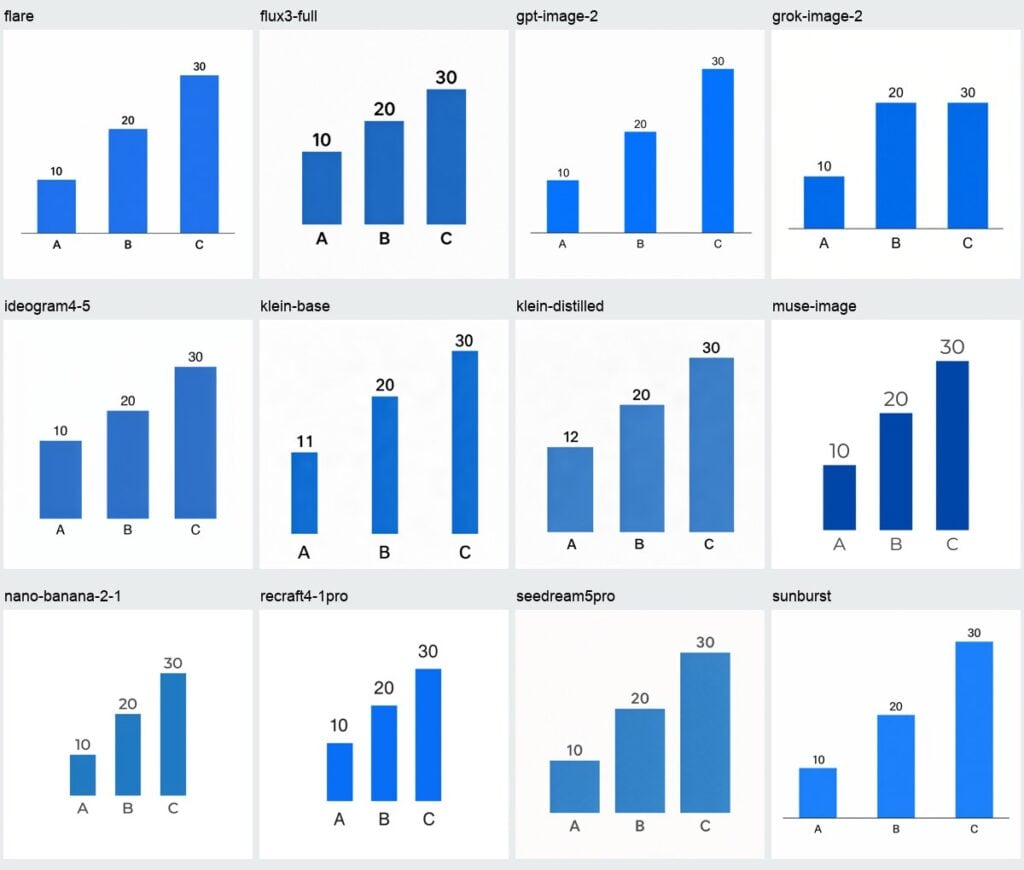
The bar-chart prompt requested A, B and C with values 10, 20 and 30, and heights in a 1:2:3 ratio. Klein distilled wrote 12 above the first bar in both draws. Base wrote 11 in its first draw and 12 in its second. The evaluated heights were also wrong.
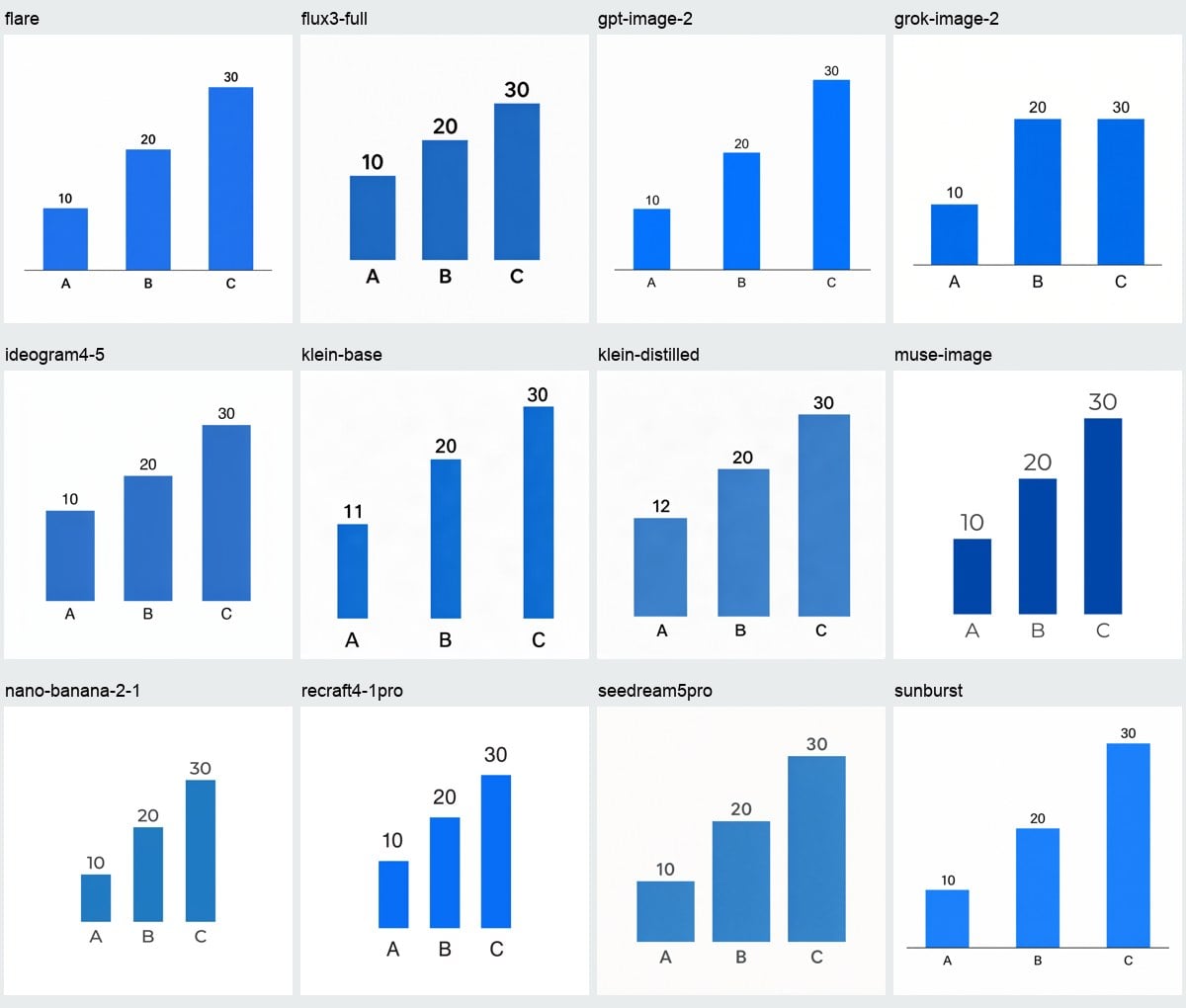
The first draw from every configuration, shown systematically rather than selected by quality. Labels use the run’s configuration IDs; “flare” and “sunburst” are GPT Image 2.5. Display sizes are normalized. A correct chart needed both the requested labels and the requested proportions.
Sunburst illustrates a subtler failure: its first chart had the right numbers but an overly tall C bar. Its four-check result failed on proportions. The water-cycle task exposed another issue: both Klein configurations produced incorrect arrow directions in both draws.
These are consequential errors for educational graphics and business diagrams. A reader can understand the intended picture while being shown the wrong quantity or relationship. Our practical recommendation is to render factual charts from data with plotting software, and to verify diagram arrows and labels individually before publication.
Conversely, both Klein versions passed the scored checks on all six text-task outputs. That supports their performance on these three short English text tasks. It does not establish long-document typography, multilingual accuracy or exact brand reproduction.
Why every editing model passed—and why that is not a tie
All eleven editing configurations ultimately passed the semantic rubric on all 12 outputs. The suite had reached a ceiling: its six edits and two source images did not separate the models on those four-check rubrics.
Changing the right object does not establish that everything else stayed unchanged. We therefore compared pixels outside fixed target regions on the four graphic edits. Across the ten configurations producing native 1024×1024 edits, none preserved every outside-region pixel in any of its eight graphic outputs. Muse’s different output size prevented that native-resolution comparison.
The degree of change varied. The mean share of outside-region pixels with any RGB channel changed by more than 8 on a 0–255 scale was 6.23% for Klein distilled, 5.66% for Base, 1.44% for Nano Banana and 0.26% for Ideogram. These are measurements of four simple graphic edits, not perceptual-quality scores or a general editing leaderboard.
BFL says its own API includes pixel restoration to preserve unedited regions exactly. Our Fal run did not explicitly test that restoration pipeline or bounding-box editing. Its pixel differences therefore do not refute that specific BFL API claim. The model card separately warns that boxes guide placement rather than impose a hard mask, and that edits can affect surrounding content. BFL API description, model limitations
We also did not test identity preservation across a long sequence, ten-reference compositions, complex product retouching or a diverse collection of real photographs. The photographic source was itself generated by full FLUX 3, another limitation on generalization.
Where you can run FLUX 3 Image Klein now
For an official hosted route, BFL documents the flux-3-image-klein API endpoint for generation and editing. Its dashboard provides a browser playground. BFL API documentation, BFL dashboard
Fal offers separate Klein distilled generation, Base generation and editing endpoints. These are the provider routes used in our comparison. Our measured distilled batch averaged $0.009 per output at the tested settings; prices for other resolutions, references and providers should be checked separately.
For local use, start with the official repository and the distilled or Base weights. The repository documents ComfyUI and Diffusers routes. Keep the prompt upsampler in the workflow and select an implementation appropriate to the available GPU memory. BFL also links an official Hugging Face Space. We verified its listing, not a new generation session or an availability guarantee.
MiniMax H3 and H3 Max were excluded because their documented task is video generation. They need a separate comparison covering motion, duration and temporal consistency. MiniMax H3 release, H3 Max product page
Our tested roster is also not exhaustive. MAI-Image-2.6, Qwen alternatives, Krea 3 and Reve 2.1 were not included in the completed scored run. Their absence should not be read as a performance judgment.
What we would choose from this evidence
For inexpensive hosted drafts, Klein distilled is worth considering: its 44-output batch cost under 40 cents and it passed our short-text checks. Muse also deserves attention at nearly the same batch cost. For work involving several simultaneous constraints, Nano Banana 2.1 was a strong candidate in this run, matching Flare’s 31/32 complete passes at a much lower batch charge.
GPT Image 2 remained competitive at 30/32. Full FLUX 3 improved on Klein’s total at 28/32, while Base’s additional expense did not improve this particular test result. That does not diminish Base’s intended role in fine-tuning; we did not test training or adaptation.
The defensible conclusion is limited but useful: Klein delivered very low generation costs, with visible counting and diagram failures under our unexpanded-prompt settings. Its recommended upsampled workflow, local hardware performance and more demanding editing abilities remain unmeasured here. The release gives developers an accessible set of weights and deployment options; this experiment gives buyers concrete outputs and costs to examine before deciding whether it fits their work.
The Kingy Brief
Get The Kingy Brief.
AI changes, original tests and one practical thing to try. Fridays at 09:00 Vancouver time.
Free · Double opt-in · Unsubscribe anytime
Sign up for The Kingy Brief on Beehiiv.
Signup help and newsletter schedule
Signup form provided by Beehiiv. After submitting, check your inbox for "Confirm your subscription to The Kingy Brief" and open its confirmation link. Check Spam or Promotions if you cannot find it.
Fridays at 09:00 Vancouver time: source-checked AI changes, original tests and one practical thing to try. We skip a week when there is not enough verified material. Free. Unsubscribe anytime.