AI Gets a Different Kind of Homework
Artificial intelligence has become remarkably good at producing words, pictures and computer code.
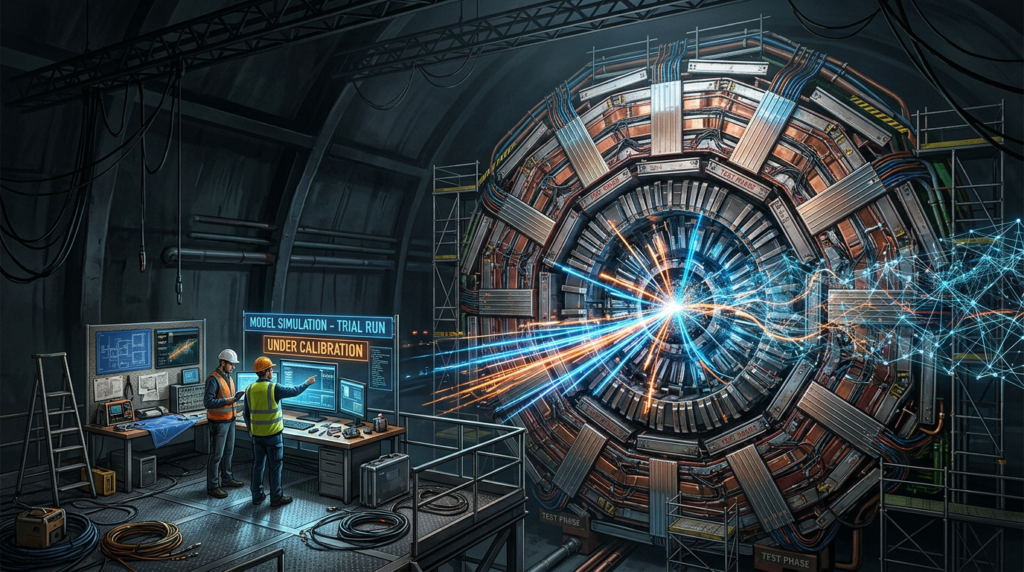
CERN and Mistral AI now want to explore what a foundation model can do with something considerably less chatty: particle collisions.
On 15 October, the European particle-physics laboratory announced a statement of intent with the French AI company to establish a long-term scientific partnership.
Their ambition centres on a pretrained “Large Physics Model” that could support several research tasks.
Reuters identifies the proposed model as Flare, although CERN’s announcement does not use that name.
The attraction is easy to understand.
Modern experiments generate intricate measurements, while researchers face practical limits on computing and analysis.
A useful model could help scientists extract more knowledge from those measurements.
That is an exciting prospect, even before anyone starts asking it to explain the universe over coffee.
What the Partnership Actually Establishes
The announcement marks an intention to build a sustained collaboration.
It does not announce a finished scientific instrument.
That distinction helps explain how readers should judge the news.
At this stage, the important development is the proposed combination of CERN’s scientific expertise and Mistral’s experience developing large AI models.
Whether that combination produces a better research tool will depend on subsequent engineering, testing and publication.
A productive partnership must translate broad ambitions into specific questions.
Which tasks should the model tackle first?
What will count as an improvement?
How will other researchers evaluate its results?
Those questions are the bridge between an impressive announcement and something scientists can confidently use.
For now, the project offers a direction of travel rather than a completed journey.
What a Large Physics Model Means
A foundation model learns reusable patterns that can support several downstream tasks.
In everyday AI, that might mean one model helping with summarisation, translation and writing.
In collider physics, the corresponding ambition is a shared starting point for different forms of experimental analysis.
Think of the difference between building a separate tool for every repair and developing a versatile workshop.
The workshop still needs appropriate equipment and skilled people.
Its value comes from making useful capabilities available across several jobs.
The analogy has limits, of course.
A physics model would need to represent relationships in scientific measurements rather than simply produce plausible descriptions.
Calling it a foundation model describes its intended role.
It does not establish that the system understands nature or can independently determine which scientific explanations are correct.
Why Collision Reconstruction Matters
A collision does not arrive on a researcher’s computer as a tidy list of everything that happened.
Detectors record signals.
Researchers then use reconstruction software to infer the particles and physical quantities associated with an event.
Imagine trying to understand a crowded celebration using overlapping photographs, sound recordings and scattered footprints.
Each source reveals something.
The challenge is combining them without counting one guest three times or overlooking someone behind the cake.
Collider reconstruction poses a far more technical version of that problem.
The resulting interpretation becomes an input to later scientific analysis.
Consequently, reconstruction quality matters enormously.
If software systematically mismeasures an event, later calculations can inherit that mistake.
Better reconstruction therefore offers a practical route to better science, even when the accelerator and detector hardware remain the same.
Why Simulated Collisions Are Useful
CERN says the proposed model would train on billions of simulated proton–proton collisions.
Simulation gives researchers a controlled environment in which the underlying event is known.
They can compare what a reconstruction system predicts with what the simulation generated.
That makes it useful for teaching and evaluating algorithms.
Consider a practice examination with a carefully prepared answer key.
Students can receive meaningful feedback because someone knows the expected answer.
Scientific simulation provides a much richer version of that arrangement.
However, the quality of the exercise depends on how faithfully it represents reality.
A system that excels in a simulated environment must still be assessed against experimental measurements.
Training success and scientific reliability are related, but they require different evidence.
Both deserve attention when researchers eventually present results from this partnership.
The Difficult Journey From Simulation to Reality
Real instruments introduce complications that a training dataset may represent imperfectly.
Measurements can reflect noise, changing operating conditions and limitations in the description of detector behaviour.
A responsible evaluation would examine how a model responds when those conditions shift.
For example, does its accuracy remain stable across different event types?
Can researchers identify situations in which its predictions become unreliable?
Does improving one measurement quietly worsen another?
These are proposed evaluation questions, not published findings about Flare.
They illustrate why scientific AI demands more than a strong average score.
A model could perform beautifully on familiar examples while struggling with less common conditions.
In experimental physics, those uncommon conditions may be precisely where researchers need the greatest care.
The awkward examples cannot simply be escorted out of the benchmark.
CERN Already Has Machine-Learning Experience
This project builds on an established scientific practice.
Machine learning already plays a role in particle-physics research, and CERN’s experiments have been investigating increasingly capable reconstruction methods.
Earlier this year, the CMS Collaboration described a machine-learning approach to particle-flow reconstruction.
Its reported tests showed performance comparable to conventional reconstruction, with improvements in some measurements and computing behaviour.
That work provides relevant background.
It demonstrates that learned reconstruction methods can be assessed against concrete experimental requirements.
However, it does not establish the performance of the proposed CERN–Mistral model.
Different systems can have different training procedures, objectives and limitations.
The useful lesson is methodological: compare the new approach with a strong existing baseline.
Scientific progress becomes easier to recognise when the comparison is explicit and the conditions are clear.
Why the High-Luminosity LHC Raises the Stakes
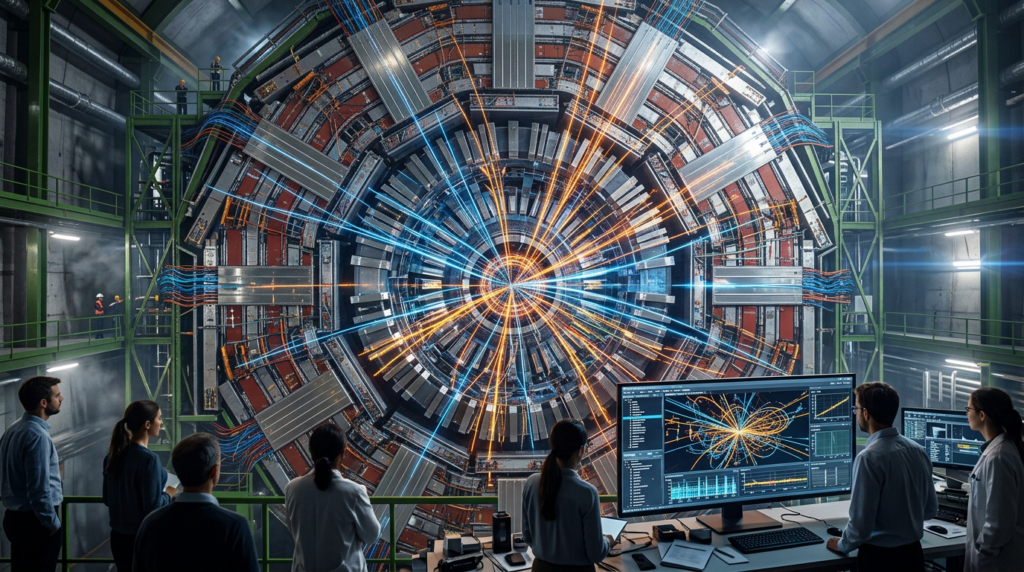
The High-Luminosity LHC upgrade is intended to expand opportunities for studying rare processes and examining known physics more precisely.
More collisions provide more chances to observe uncommon events.
They also create more demanding reconstruction and computing workloads.
CERN’s project information describes future conditions with substantially more overlapping collisions each time particle bunches meet.
Picture several conversations taking place simultaneously, then increase the crowd while asking the listener to become more accurate.
That captures part of the challenge.
Researchers need methods that can handle greater complexity without losing important information.
A model that scales effectively could therefore become valuable infrastructure.
But usefulness would depend on both scientific quality and operating requirements.
An accurate system that overwhelms available computing resources would present a different problem for experiment teams to solve.
What Better Performance Should Look Like
“Better AI” is a vague claim.
A meaningful scientific comparison needs named tasks, suitable datasets and clearly defined measurements.
For reconstruction, researchers might examine accuracy across particle types, energy ranges and event conditions.
They would also need to consider systematic effects.
For computing, relevant measures could include processing time, memory use and the hardware required to achieve a result.
These measurements should be interpreted together.
A speed improvement matters differently if it requires much more expensive equipment.
An accuracy gain also deserves scrutiny if it appears only in a narrow test sample.
The strongest result would explain where the model helps, where it struggles and what tradeoffs accompany its use.
That kind of account gives other scientists something they can evaluate and potentially reproduce.
Finding Something Unusual Takes More Than an Alert
CERN includes identifying unexpected signals among the model’s intended applications.
That possibility naturally attracts attention.
Unexpected patterns can provide clues that deserve further investigation.
Still, unusual does not automatically mean new physics.
A strange event might reflect an imperfect simulation, an instrumental issue or an ordinary process represented poorly in the training data.
An anomaly-detection system therefore helps organise questions.
It cannot settle every explanation on its own.
For any future model, researchers would need to understand how alerts are selected and how frequently familiar events trigger them.
They would also need independent checks.
The exciting possibility is a tool that helps scientists notice worthwhile patterns.
The discovery itself would still require evidence strong enough to survive alternative explanations and detailed scrutiny.
Shared Access Could Extend the Benefits
The partnership’s emphasis on capabilities that can be shared with the physics community is significant.
A reusable research model could allow multiple teams to investigate methods without independently rebuilding every component.
That could make comparisons easier and encourage experimentation.
For example, researchers might test alternative ways of adapting a common model to a particular scientific task.
However, meaningful access involves practical details.
Can users obtain the model’s parameters?
Are suitable examples, documentation and evaluation tools available?
What computing resources are needed?
What uses does the licence permit?
These questions remain important because a model can be publicly accessible without being straightforward to reproduce or modify.
CERN’s announcement expresses a sharing ambition, but it does not provide a complete release package or establish every future access condition.
Transparency Makes a Model More Useful
Scientific software becomes more valuable when researchers can understand its scope.
For an AI model, that includes knowing what training examples represent, which tests were performed and what limitations emerged.
Documentation should help a new team decide whether the system fits its problem.
It should also make unsuitable uses easier to spot.
A model evaluated for one detector configuration may require further work before someone applies it elsewhere.
Likewise, a successful benchmark does not guarantee reliable behaviour under every experimental condition.
Clear reporting turns these boundaries into useful information.
It also allows later improvements to be measured against a documented starting point.
Transparency therefore has a practical purpose.
It helps scientists spend less time guessing what a system can do and more time testing whether it answers their questions.
Europe’s Scientific and AI Capabilities Meet
The collaboration also brings together two different kinds of expertise.
A physics laboratory knows how experimental measurements connect to scientific questions.
An AI developer brings experience with training systems, model design and the engineering required to build large models.
Neither contribution automatically substitutes for the other.
A technically sophisticated model can still target the wrong scientific objective.
An excellent scientific objective can also prove difficult to implement efficiently.
The partnership creates an opportunity to work through those tensions jointly.
CERN frames the initiative partly around strengthening European scientific and technological capabilities.
Its potential scientific value, however, will be judged through the usefulness of the resulting tools.
Geography explains part of the strategy.
Reliable measurements and reproducible results will determine the research impact.
Could Other Sciences Benefit?
CERN says the collaboration could eventually contribute approaches useful to a wider scientific community.
That possibility deserves interest without assuming automatic transfer.
Different disciplines work with different measurements, constraints and definitions of success.
A model trained for collider data would not become a medical or climate research tool simply because all three fields use computers.
Methods may travel more readily than a specific trained model.
For example, experience with adapting a shared representation or evaluating behaviour under changing conditions could inform other projects.
That is a plausible avenue for future work, rather than an announced achievement.
The sensible approach is to solve a well-defined initial problem, document what worked and then investigate which lessons remain useful elsewhere.
Scientific spillovers are most convincing when somebody can demonstrate them.
What Researchers Should Watch Next
The next meaningful developments should make the project easier to assess.
A technical description could explain the architecture, training objectives and intended applications.
Evaluation results could show how it compares with established approaches.
Release information could clarify access, licensing and reproducibility.
Evidence from researchers beyond the development team would strengthen confidence further.
These milestones matter more than a dramatic demonstration alone.
A polished example can show that something is possible.
A thorough evaluation explains how consistently it works and under which conditions.
Readers should also watch whether researchers publish limitations alongside improvements.
Those details often reveal the maturity of a scientific tool.
The strongest announcement to follow this one would give the community enough information to investigate the model independently and ask difficult questions of its own.
A Practical Test for an Ambitious Idea
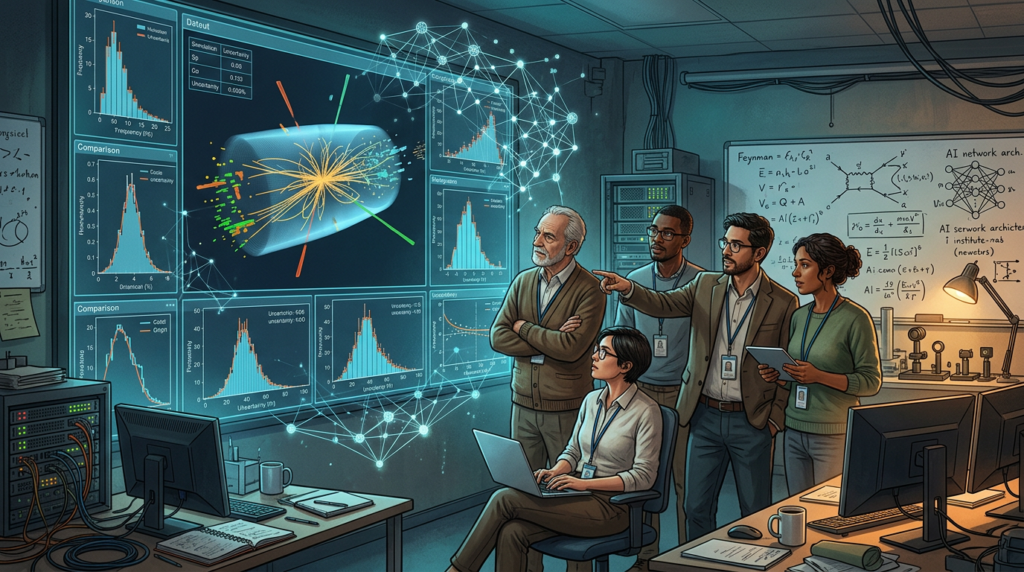
The CERN–Mistral partnership points toward a compelling use of AI: helping researchers interpret demanding scientific measurements.
Its promise comes from the possibility of combining reusable learning with the precision experimental physics requires.
Success could take several forms.
A useful system might improve particular measurements, reduce processing demands or give research teams a stronger starting point for specialised work.
Any of those outcomes would matter if demonstrated rigorously.
For now, the project remains an ambition that must earn its place in scientific workflows.
That makes the next stage especially interesting.
Researchers have a clear opportunity to test whether foundation-model methods can deliver practical value in collider physics.
The universe supplies challenging data.
CERN and Mistral now have to show that their proposed approach can help scientists read it more effectively.
SOURCES
- CERN — CERN and Mistral join forces to accelerate AI for science. (CERN)
- Reuters — CERN and Mistral partner to build Flare, a new AI model for physics. (reuters.com)
- CERN — Machine learning to reveal more about LHC particle collisions. (CERN)
- CMS Collaboration — Full event interpretation with machine-learning-based particle-flow reconstruction in the CMS detector. (cms-results.web.cern.ch)
- CERN — High-Luminosity LHC. (CERN)
The Kingy Brief
Get The Kingy Brief.
AI changes, original tests and one practical thing to try. Fridays at 09:00 Vancouver time.
Free · Double opt-in · Unsubscribe anytime
Sign up for The Kingy Brief on Beehiiv.
Signup help and newsletter schedule
Signup form provided by Beehiiv. After submitting, check your inbox for "Confirm your subscription to The Kingy Brief" and open its confirmation link. Check Spam or Promotions if you cannot find it.
Fridays at 09:00 Vancouver time: source-checked AI changes, original tests and one practical thing to try. We skip a week when there is not enough verified material. Free. Unsubscribe anytime.