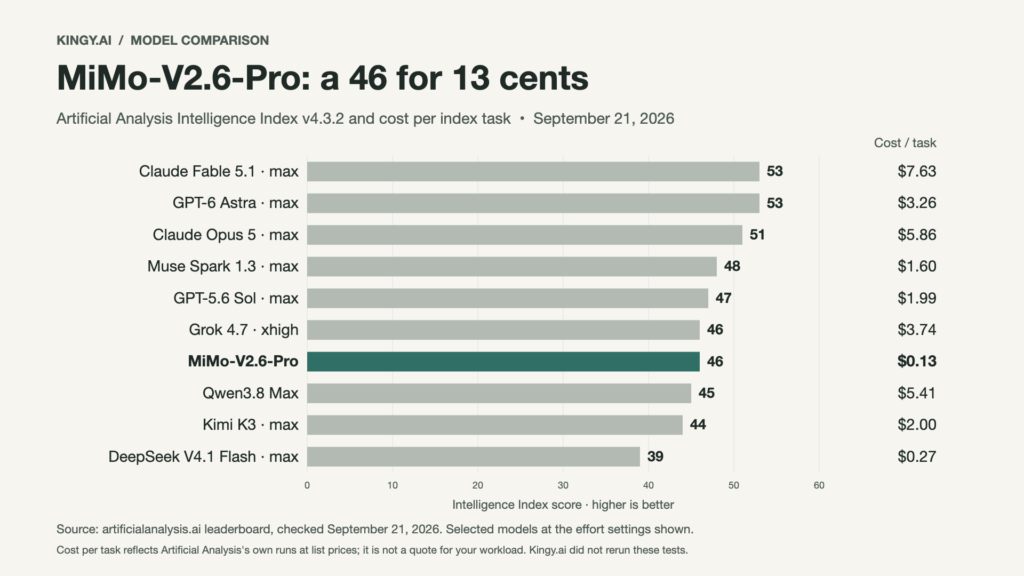
MiMo-V2.6-Pro is now the highest-scoring open-weights model on the Artificial Analysis Intelligence Index. Xiaomi’s new flagship scores 46, the same as Grok 4.7, and costs about $0.13 per index task. Claude Opus 5 at max effort scores 51 and costs $5.86 per task. The gap is five points, and the price difference is about 45 times.
The results do not show that MiMo-V2.6-Pro matches Claude or GPT across the board. Xiaomi’s own benchmark table has it trailing Claude Opus 5 on 10 of 14 shared evaluations. The widest gaps are on ExploitBench, Terminal-Bench 4.0 and ProgramBench. The fair summary is that it performs close to the frontier at a much lower price, and no open-weights model currently ranks higher.
Sources checked September 21, 2026. This article analyzes Artificial Analysis’s independent index, Xiaomi’s published benchmark table and official documentation. Kingy.ai also ran its own hands-on test of Pro, Flash and Claude Opus 5 in OpenCode, reported below. Vendor-reported results are labeled as such. Featured image: original Kingy.ai chart using Artificial Analysis data.
Looking for access instructions and free options? Read our MiMo-V2.6-Pro access, pricing and setup guide.
MiMo-V2.6-Pro specifications: what is confirmed
Xiaomi released three models together. MiMo-V2.6-Pro is the flagship. MiMo-V2.6-Flash is the smaller, cheaper model. MiMo-V2.6-Pro-UltraSpeed is a faster paid option for Pro. The table below separates confirmed specifications from items that remain unclear.
| Specification | Detail | Source / status |
|---|---|---|
| API model ID | mimo-v2.6-pro; OpenRouter xiaomi/mimo-v2.6-pro | Xiaomi docs, OpenRouter |
| Parameters | 1.02 trillion total, 42 billion active (mixture of experts) | Artificial Analysis; Xiaomi describes it as trillion-parameter |
| Context and output | 1,048,576-token context; 131,072-token max output | Xiaomi OpenCode config, OpenRouter |
| Inputs | Text, image, speech (audio) and video in; text out | Artificial Analysis. Xiaomi’s OpenCode sample config lists text and image only |
| Reasoning | Reasoning model; returns reasoning_content in thinking mode | Xiaomi API docs |
| Weights and license | Open weights on Hugging Face (MiMo-V2.6-Pro-RL), MIT | Hugging Face listing. The README was empty when we checked |
| Price | $0.435 input, $0.0036 cached input, $0.87 output per 1M tokens | Xiaomi pricing page; unchanged from V2.5-Pro |
| Predecessor | MiMo-V2.5-Pro scored 26 on the same index | Artificial Analysis |
The inputs row needs a caveat. Xiaomi calls the model “natively omnimodal” and demonstrates video, audio and multi-camera robotics. Its coding-tool configuration examples list only text and image input. Before you build an audio or video pipeline, check that your API route accepts those inputs.
Independent benchmark: where MiMo-V2.6-Pro ranks
Artificial Analysis scores models on ten evaluations, including Terminal-Bench 4.0, Humanity’s Last Exam, GDPval-AA, SciCode and AA-LCR. It runs these evaluations itself rather than repeating vendor numbers. That makes it the best outside check on Xiaomi’s launch claims currently available.
| Model and effort | AA Index | Cost / index task | List price in / out (1M) | Weights |
|---|---|---|---|---|
| Claude Fable 5.1 · max | 53 | $7.63 | $10 / $50 | Closed |
| GPT-6 Astra · max | 53 | $3.26 | $10 / $50 | Closed |
| Claude Opus 5 · max | 51 | $5.86 | $5 / $25 | Closed |
| Muse Spark 1.3 · max | 48 | $1.60 | $1.25 / $4.25 | Closed |
| GPT-5.6 Sol · max | 47 | $1.99 | $4 / $20 | Closed |
| Grok 4.7 · xhigh | 46 | $3.74 | $2 / $6 | Closed |
| GPT-6 Astra · low | 46 | $0.82 | $10 / $50 | Closed |
| MiMo-V2.6-Pro | 46 | $0.13 | $0.435 / $0.87 | Open (MIT) |
| Qwen3.8 Max (0902) | 45 | $5.41 | $2 / $6 | Closed |
| GLM-5.3 · max | 45 | $2.01 | $1.40 / $4.40 | Open |
| Kimi K3 · max | 44 | $2.00 | $3 / $15 | Open |
| DeepSeek V4.1 Flash · max | 39 | $0.27 | $0.30 / $1.20 | Open |
| DeepSeek V4 Pro 0813 · max | 36 | $0.67 | $1.32 / $3.96 | Open |
Source: Artificial Analysis Intelligence Index v4.3.2 leaderboard and model pages, checked September 21, 2026. This is a selection of rows, not the full leaderboard. Cost per task is Artificial Analysis’s measured spend at list prices. The DeepSeek V4 Pro list price comes from OrcaRouter’s comparison. Index versions change over time, so these scores are not comparable with figures from earlier versions in older articles.
Three results in this table matter.
It is the top open-weights model. MiMo-V2.6-Pro scores one point above GLM-5.3 and two above Kimi K3, and it costs much less to run than either. Xiaomi puts the exact score at 46.32.
Five to seven points still separate it from the frontier. Claude Opus 5, GPT-6 Astra and Claude Fable 5.1 all score higher. For work where a failed attempt is expensive, such as large refactors or unattended agents, that gap can matter more than the price.
The cost advantage over the frontier is large but has limits. Compared with each rival’s max-effort run, MiMo-V2.6-Pro is about 45 times cheaper per task than Opus 5, 25 times cheaper than GPT-6 Astra and 59 times cheaper than Fable 5.1. The fairer comparison is with GPT-6 Astra at low effort, which matches MiMo’s score of 46 for $0.82 per task. MiMo is still about six times cheaper, but not 25 times.
Artificial Analysis also reports that running its full index on MiMo-V2.6-Pro cost $206.66. The same run cost $7,274.74 for Claude Opus 5 at max effort and $13,128.86 for Claude Fable 5.1. It describes the model as fast, at about 130 to 134 output tokens per second, but “somewhat verbose”: it used 140 million output tokens across the evaluation. Low per-token prices save less when a model writes more tokens.
MiMo-V2.6-Pro vs Grok 4.7: same score, same launch day
Both models launched on September 21 and both score 46 on the index. Grok 4.7 is closed and costs $2 per million input tokens and $6 per million output tokens. Its cost per index task is $3.74 at xhigh and $2.73 at high. MiMo-V2.6-Pro costs $0.13 per task.
Speed also favors MiMo. Artificial Analysis measures Grok 4.7 xhigh at about 39 output tokens per second. MiMo-V2.6-Pro runs at more than three times that speed. Grok 4.7 has a 500,000-token context window; MiMo’s is 1 million.
A tied composite score does not make the models interchangeable. xAI’s own table, covered in our Grok 4.7 benchmark analysis, reports 38.0% on Terminal-Bench 4.0 for Grok 4.7 xhigh. Xiaomi reports 34.9% for MiMo-V2.6-Pro. Both are vendor numbers from each company’s own harness, so treat that difference as a hint, not a result. If you use Grok through Cursor or Grok Build, stay with the tool you already use until a side-by-side test on your own code shows a difference.
Xiaomi’s benchmark table: MiMo-V2.6-Pro vs Claude Opus 5, GPT-6 Astra and GPT-5.6 Sol
The results below come from the appendix of Xiaomi’s launch post. They are vendor-published results, not a Kingy.ai reproduction. Rows marked “in-house” are Xiaomi’s own benchmarks, which no outside group can run yet.
| Evaluation | MiMo-V2.6-Pro | Claude Opus 5 | GPT-6 Astra | GPT-5.6 Sol | Claude Fable 5.1 |
|---|---|---|---|---|---|
| DeepSWE v1.1 | 71.9 | 74.0 | 74.0 | – | – |
| ProgramBench | 26.5 | 37.0 | – | 25.0 | – |
| MiMo Code Bench (in-house) | 63.2 | 68.6 | 61.4 | 59.3 | – |
| GDPVal 2.1 (AA, Elo) | 1,673 | 1,708 | 1,542 | 1,588 | 1,735 |
| Toolathlon-verified | 76.9 | 80.6 | – | 74.9 | 77.8 |
| AutomationBench v1.0.6 | 53.1 | 50.3 | 52.0 | 45.8 | – |
| Agents’ Last Exam | 31.6 | 31.6 | 34.2 | 30.8 | – |
| Terminal-Bench 4.0 | 34.9 | 49.0 | 59.6 | 39.9 | 55.1 |
| Terminal-Bench 2.1 | 89.9 | 89.1 | 89.9 | 88.8 | 91.4 |
| OSWorld-Verified | 82.0 | 83.4 | – | 83.0 | – |
| JobBench | 62.0 | 65.7 | – | 45.4 | – |
| MiMo Visual Coding (in-house) | 72.3 | 70.0 | 82.2 | 73.4 | 74.4 |
| ExploitGym | 17.8 | 22.1 | 42.4 | 30.3 | 30.4 |
| ExploitBench | 47.9 | 70.0 | 100.0 | 78.5 | 83.0 |
| SEC Bench Pro | 66.3 | – | 85.4 | 79.1 | – |
Source: Xiaomi MiMo-V2.6 launch post appendix, checked September 21, 2026. Higher is better. A dash means Xiaomi published no result. Xiaomi does not list effort settings for competitor models in this table, and harnesses may differ between rows.
Where the “on par with Opus 5” claim holds, and where it does not
Xiaomi’s launch post on X says Pro “performs on par with Claude Opus 5 and GPT-5.6 Sol across most agent benchmarks.” Xiaomi’s own table supports that claim for GPT-5.6 Sol more than for Opus 5.
- Against Claude Opus 5: Opus 5 and MiMo-V2.6-Pro both have scores on 14 evaluations. MiMo leads on three (AutomationBench, Terminal-Bench 2.1 and Xiaomi’s in-house visual coding test), ties on Agents’ Last Exam and trails on the other ten. Several gaps are small, such as OSWorld-Verified (82.0 vs 83.4) and DeepSWE (71.9 vs 74.0). Others are large: ExploitBench trails by 22.1 points, Terminal-Bench 4.0 by 14.1 and ProgramBench by 10.5.
- Against GPT-5.6 Sol: MiMo leads on 8 of the 14 shared evaluations, including GDPVal, JobBench and AutomationBench. Sol leads on Terminal-Bench 4.0, OSWorld-Verified, visual coding and every exploitation-focused security test.
- Against GPT-6 Astra: Astra leads on seven of 11 shared rows, often by a wide margin, including Terminal-Bench 4.0 (59.6 vs 34.9) and ExploitBench (100.0 vs 47.9).
Terminal-Bench 4.0 is the most important result here. On the older, near-saturated Terminal-Bench 2.1, every current model in the table scores between 84 and 92, and MiMo ties GPT-6 Astra. On the newer and harder version 4.0, MiMo scores 14 points below Opus 5 and 25 below Astra. The harder test separates long-horizon agent reliability more clearly, and there the frontier models still lead.
MiMo-V2.6-Pro vs Kimi K3, DeepSeek and other open models
Among open-weights models, MiMo-V2.6-Pro has a stronger case. The comparison below also comes from Xiaomi’s table.
| Evaluation | MiMo-V2.6-Pro | MiMo-V2.6-Flash | Kimi K3 | DeepSeek V4.1 Flash | MiMo-V2.5-Pro |
|---|---|---|---|---|---|
| DeepSWE v1.1 | 71.9 | 67.9 | 69.0 | 74.2 | 19.0 |
| ProgramBench | 26.5 | 26.0 | 24.5 | 20.3 | 12.5 |
| GDPVal 2.1 (AA, Elo) | 1,673 | – | 1,524 | 1,600 | 1,107 |
| AutomationBench v1.0.6 | 53.1 | 52.3 | 46.7 | 54.8 | 16.0 |
| Terminal-Bench 4.0 | 34.9 | 28.8 | 12.6 | 26.8 | 1.5 |
| OSWorld-Verified | 82.0 | 80.8 | 84.8 | – | – |
| JobBench | 62.0 | 61.2 | 54.3 | 45.8 | 25.0 |
| CyberGym | 94.0 | 95.1 | 80.0 | 88.1 | 40.0 |
| MiMo Cyber Bench (in-house) | 81.7 | 77.2 | 56.3 | 62.7 | 0.0 |
Source: Xiaomi launch post appendix. Selected rows. Xiaomi’s CyberGym chart also shows GLM-5.3 at 84.5; the appendix has no GLM-5.3 results.
Across the 16 evaluations where Xiaomi reports both models, MiMo-V2.6-Pro beats Kimi K3 on 15. The exception is OSWorld-Verified. The independent index shows the same order: MiMo scores 46 and Kimi K3 44. Kimi costs $2.00 per task and MiMo $0.13. Our Kimi K3 benchmark review covers where Kimi remains competitive.
DeepSeek V4.1 Flash is closer than its index score of 39 suggests. In Xiaomi’s table it beats MiMo-V2.6-Pro on DeepSWE (74.2 vs 71.9), AutomationBench, Agents’ Last Exam and Terminal-Bench 2.1. It costs $0.27 per index task. For repository-level coding agents, it is worth testing alongside MiMo before you commit to either.
Compared with DeepSeek V4 Pro, MiMo-V2.6-Pro scores 10 points higher on the independent index (46 vs 36) with fewer active parameters (42B vs 49B). It is also cheaper per token and per task. For earlier open-model comparisons, see our GLM-5.3 vs Kimi K3 vs DeepSeek V4 Pro analysis.
The V2.5-Pro column also needs context. Xiaomi reports 19.0 for V2.5-Pro on DeepSWE and 1.5 on Terminal-Bench 4.0, but the index gain was 26 to 46. The newer benchmark versions are much harder, so the V2.5 column shows how difficult the current tests are as much as how much the model improved.
MiMo-V2.6-Pro vs Flash vs UltraSpeed
| Model | Size | Price in / out (1M) | Best fit |
|---|---|---|---|
| MiMo-V2.6-Pro | 1.02T / 42B active | $0.435 / $0.87 | Long-horizon agents, harder coding, research |
| MiMo-V2.6-Flash | 309B / 15B active | $0.14 / $0.28 | High-volume calls, most coding-assistant work |
| MiMo-V2.6-Pro-UltraSpeed | Same model as Pro, faster serving | $4.35 / $8.70 | Real-time and latency-sensitive use |
| Batch API (Pro) | Same model as Pro | $0.2175 / $0.435 | Asynchronous bulk jobs at 50% off |
Sources: Xiaomi API pricing page; Flash specifications from the Flash model card. UltraSpeed does not support the Batch API.
Flash is close to Pro on many of Xiaomi’s rows at about a third of the price. It scores 67.9 on DeepSWE against Pro’s 71.9, 52.3 on AutomationBench against 53.1, and slightly higher on CyberGym (95.1 against 94.0). Pro’s clearest advantages are on Terminal-Bench 4.0 (34.9 against 28.8) and the exploitation-focused security tests. For many teams, Flash is the model to try first.
UltraSpeed costs 10 times as much as Pro. Xiaomi says it delivers “up to 20x” faster output at the same quality. OpenRouter’s description says roughly 10 times faster, and at our check its launch-day statistics showed about 125 tokens per second for UltraSpeed. Artificial Analysis measures standard Pro at about 130 to 134 tokens per second on Xiaomi’s API. These early figures come from different measurements and do not disprove Xiaomi’s claim. Still, measure the speed yourself before paying 10 times the price for it.
Our hands-on test: MiMo-V2.6-Pro vs Flash vs Claude Opus 5 in OpenCode
To check the launch claims against real agent work, we gave MiMo-V2.6-Pro, MiMo-V2.6-Flash and Claude Opus 5 the same three tasks in the OpenCode coding agent. Each task came with a written brief. We scored the results with automated checks that the agent could not see, following the binary pass/fail approach we use for coding-model evaluations.
| Task | What it required | MiMo-V2.6-Pro | MiMo-V2.6-Flash Free | Claude Opus 5 |
|---|---|---|---|---|
| 1. Bug fix | Fix five spec violations in an inventory module; only three were covered by the visible tests | 8/8 | 8/8 | 8/8 |
| 2. Multi-file feature | Parse accounting-style amounts, add a model property, a report function and a new CLI across four files | 8/8 | 6/8: its CLI left out the required summary subcommand, although its own tests passed | 8/8 |
| 3. Data analysis | Deduplicate a sales export, handle refunds and write seven exact answers plus a manager summary | 7/7 | 7/7 | 7/7 |
| Total | 23 hidden automated checks | 23/23, about $0.03 | 21/23, $0 (free promotion) | 23/23, about $1.03 |
Kingy.ai test, September 21, 2026. OpenCode desktop app on macOS. MiMo-V2.6-Pro and Claude Opus 5 ran through OpenCode’s OpenRouter provider at the default setting; Flash ran as “MiMo-V2.6-Flash Free” in OpenCode Zen. One run per model per task, with identical prompts. Kingy.ai wrote the tasks; the scoring checks were kept outside the agent’s working folder and were not visible to it. Costs are OpenCode’s session totals, rounded to the cent. Each task took roughly one to two minutes.
All three models finished every task without help, and each wrote extra tests of its own. MiMo-V2.6-Pro and Claude Opus 5 both passed all 23 hidden checks. Opus 5 cost about $1.03 across the three tasks; Pro cost about $0.03, roughly 30 times less for the same result. Flash, which was free, matched them on the bug fix and the data task but missed a requirement in the multi-file feature. Its command-line tool worked without the summary subcommand the brief asked for, and the tests Flash wrote for itself did not catch the mistake.
Opus 5 stood out in one way the checks do not score. On the data task it added two unprompted caveats: the Pro product earned about two-thirds of revenue even though Basic sold the most units, and the export may not cover complete months. MiMo-V2.6-Pro’s summary was accurate and noted the July dip, but it did not raise those points.
These are small, well-specified tasks with one run per model, so they say nothing about consistency or about long, unattended sessions, where the benchmark gap to Opus 5 is widest. They do show that on everyday coding and analysis work, MiMo-V2.6-Pro matched Opus 5’s pass rate for a small fraction of the cost.
Speed, verbosity and what a request costs
These examples use Xiaomi’s published standard API rates. Output means total billed output, including reasoning tokens.
| Scenario | MiMo-V2.6-Pro | Claude Opus 5 (list) | GPT-6 Astra (list) |
|---|---|---|---|
| 50K input (no cache) + 5K output | $0.026 | $0.375 | $0.75 |
| Agent session: 2M input (90% cached) + 100K output | $0.18 | Depends on each vendor’s cache and long-context rules | |
| Same session on UltraSpeed | $1.80 | – | |
| 10,000 docs × 3K in + 500 out, Batch API | $8.70 (vs $17.40 real-time) | – | |
Kingy.ai calculations from list prices, September 21, 2026. They are estimates, not quotes, and they ignore retries, tool calls and web search, which Xiaomi bills separately at $5 per 1,000 calls outside China.
Price per token is only part of the cost. A model that needs two attempts, or writes twice as many reasoning tokens, can lose much of its advantage. Artificial Analysis’s cost-per-task figure accounts for verbosity on its own tasks, which is why it is a better guide than price per token. Your own workloads may still differ.
What Xiaomi disclosed about training
Xiaomi disclosed more about training than most model makers do. It streamed the reinforcement-learning production run publicly and published the costs. Pro and Flash each ran 30 RL steps in under six days, over about 750,000 trajectories. The runs cost about $2.62 million for Pro and $0.85 million for Flash.
During that run, Pro’s DeepSWE score rose from 58.4 to 72.57, and Flash’s from 48.8 to 65.68, according to Xiaomi. Xiaomi says it froze the model’s router to reduce training drift and built several layers of defense against reward hacking. It says it is releasing the technical report, training environments and RL code so others can reproduce the results.
The published figures come from Xiaomi. They cover the RL stage only, not pretraining. They show that the RL stage cost about $3.5 million for both models combined.
Open weights, license and self-hosting
The weights are published under the MIT license. Artificial Analysis also lists MiMo-V2.6-Pro as open weights with commercial use allowed. That is a more permissive release than several other leading models’ custom licenses. Before production use, confirm the terms in the repository itself. When we checked, the Pro repository’s README was empty.
Self-hosting Pro requires data-center hardware. At 1.02 trillion parameters, the weights alone need roughly a terabyte of memory at 8-bit precision, before the key-value cache for long contexts. Xiaomi’s Flash model card recommends SGLang with tensor parallelism across eight GPUs. Xiaomi also released MiMo-V2.6-Distill-Qwen-9B, a 9B model fine-tuned from Qwen3.5-9B. It is the realistic option for a local machine, but it is not a small version of Pro.
What the evaluations can and cannot tell you
- Most detailed rows are Xiaomi’s own numbers. Apart from GDPVal, which Xiaomi attributes to Artificial Analysis, the rows in Xiaomi’s table come from Xiaomi’s own runs. Three are Xiaomi in-house benchmarks. The Intelligence Index is the main independent check.
- Xiaomi publishes slightly different figures in different places. The appendix gives 71.9 on DeepSWE; the RL section reports 72.57 at the end of training. Coverage citing Xiaomi’s technical report lists 80.2 on MiMo Cyber Bench, while the launch page shows 81.7. The differences are small, but they show how much vendor-reported numbers can vary.
- Competitor settings are not listed. Xiaomi does not say which effort level or harness it used for Claude and GPT, so rows are not controlled head-to-head comparisons.
- The security results cut both ways. A CyberGym score of 94.0 in an MIT-licensed open-weights model means strong vulnerability-analysis capability is available without API-level safeguards. That is useful for defenders and a real concern for everyone else.
- Launch-day serving is volatile. At one check, OpenRouter’s launch-day statistics showed Pro at about 7 tokens per second, far below Artificial Analysis’s measurement on Xiaomi’s API. Test during your own working hours before you rely on it in production.
For a buying decision, run a small set of tasks you already know how to judge. Record whether each task passes, how much correction it needs, how long it takes and the full bill, including failures. That will tell you more than one composite score.
Verdict: who should test MiMo-V2.6-Pro
If you run high-volume agents, document pipelines or coding assistants on a budget, MiMo-V2.6-Pro should be on your shortlist now. No other model with a score of 46 or above costs close to $0.13 per index task. The MIT license also gives you the option to self-host later.
If your work depends on long, unattended terminal and repository tasks, keep Claude Opus 5, Fable 5.1 or GPT-6 Astra as your baseline. Even Xiaomi’s own numbers show a large gap on Terminal-Bench 4.0. A practical approach is to send routine tasks to MiMo or Flash, send the hardest tasks to a frontier model, and check the results on your own work. In our OpenCode test, Pro matched Claude Opus 5 with 23 of 23 checks on three realistic tasks at about a thirtieth of the cost, which supports using it for that routine tier.
Frequently asked questions
Did Kingy.ai test MiMo-V2.6-Pro?
Yes. In our hands-on test in OpenCode, Pro passed all 23 hidden checks across a bug fix, a multi-file feature and a data-analysis task for about $0.03 in total. Claude Opus 5 also passed 23 of 23, for about $1.03. The free Flash model passed 21 of 23. This was one run per task, not a full benchmark.
Is MiMo-V2.6-Pro better than Claude Opus 5?
Not on most published results. Opus 5 scores 51 on the Artificial Analysis index against MiMo’s 46, and it leads 10 of the 14 shared rows in Xiaomi’s own table. MiMo is about 45 times cheaper per index task. In our small OpenCode test, both passed all 23 checks, and Pro cost about $0.03 against $1.03 for Opus 5.
Is MiMo-V2.6-Pro the best open-source model?
It is the highest-scoring open-weights model on the Artificial Analysis Intelligence Index as of September 21, 2026. It scores 46, against 45 for GLM-5.3 and 44 for Kimi K3. The weights are released under the MIT license.
How does MiMo-V2.6-Pro compare with Grok 4.7?
Both score 46 on the index and launched the same day. MiMo is open-weights, faster in Artificial Analysis’s measurements and much cheaper per task. Grok 4.7 reports a slightly higher Terminal-Bench 4.0 score in its own launch table.
How much does MiMo-V2.6-Pro cost?
Xiaomi charges $0.435 per million input tokens, $0.0036 per million cached input tokens and $0.87 per million output tokens. The Batch API costs half that. UltraSpeed costs 10 times the standard rate.
Can I run MiMo-V2.6-Pro locally?
Not on consumer hardware. The 1.02-trillion-parameter weights need a multi-GPU server. The 9B distilled model is the practical local option.
Is MiMo-V2.6-Pro free?
The API is paid, but there are free and low-cost ways to try the V2.6 series. Our access and pricing guide covers them.
Trending on Kingy
Keep reading with the stories getting the most attention now.