Research checked September 15, 2026 · Category: Blog · No M5 Ultra review unit tested by Kingy
Verdict: The M5 Ultra is real, unusually well specified, and already the fastest Apple CPU in one public Geekbench 7 result. But the headline is not yet a review: the result is a single user-uploaded run, Apple’s performance numbers come from selected internal tests on preproduction systems, and there are no independent M5 Ultra GPU, AI, application, thermal, or power measurements yet. Buy it for memory capacity, Apple’s integrated media stack, and Mac-native workflows—not because one score proves it beats every PC.
Apple’s new Mac Studio with M5 Ultra arrives on September 22, with the 512GB memory configuration following in late October. That makes September 15 a useful moment to draw a hard line between three different things: specifications Apple has published, claims Apple has made from its own test lab, and evidence that exists only as an early public benchmark upload. This article keeps those categories separate.
At a glance: the M5 Ultra we can verify today
| Item | Verified information | Confidence / limitation |
|---|---|---|
| Chip options | 30-core CPU / 64-core GPU, or 36-core CPU / 80-core GPU; both have a 32-core Neural Engine. | Apple’s published Mac Studio specifications. |
| CPU layout | 30-core: 10 super cores + 20 performance cores. 36-core: 12 super cores + 24 performance cores. | Official architecture description; no independent sustained-frequency test yet. |
| Unified memory | 96GB standard; configurable to 256GB or 512GB on the 36/80 configuration. | 512GB is scheduled for late October; usable capacity depends on macOS, runtime buffers, model context, and workload. |
| Memory bandwidth | 1.2TB/s. | Apple specification; not a measured Kingy result. |
| UltraFusion | Apple describes a quad-die design: two dual-die M5 Max chips connected as one SoC. Apple’s U.K. newsroom says inter-die bandwidth is above 4.4TB/s. | Official description; Apple has not published a transistor count or a complete interconnect latency analysis. |
| Media engine | Hardware H.264, HEVC, ProRes, ProRes RAW, and AV1 decode; two video-decode engines, four video-encode engines, and four ProRes encode/decode engines. | Official specification; no independent stream-saturation test yet. |
| Video throughput | Apple says up to 33 simultaneous streams of 8K ProRes 422 at 30fps. | An Apple workflow claim, not an independent stress test; source media and software settings matter. |
| Connectivity | Six Thunderbolt 5 ports, up to 120Gb/s; HDMI 2.1; 10Gb Ethernet; SDXC UHS-II; two USB-A ports; Wi-Fi 7; Bluetooth 6. | Port and wireless support are documented. Actual throughput depends on peripherals and software. |
| Displays | Up to eight external displays, with Apple’s specified combinations reaching 8K, 6K, 5K, or high-refresh 4K modes. | Apple’s support matrix, not a Kingy multi-display test. |
| Storage | 1TB standard on the M5 Ultra; configurable to 2TB, 4TB, 8TB, or 16TB. | Apple lists faster storage on the new Mac Studio, but does not publish a raw sequential read/write figure in the launch release. |
| Mac Studio price | M5 Ultra starts at $5,499 in the U.S. The 36-core CPU / 80-core GPU upgrade adds $1,300, making the 36/80 entry configuration $6,799 before memory or storage upgrades. | Apple retail pricing checked September 15, 2026; regional pricing and configurations differ. |
| Physical machine | Mac Studio: 7.7in square, 3.7in high; the M5 Ultra model weighs 8lb / 3.6kg. Apple lists 480W maximum continuous power. | Manufacturer figures. Maximum continuous power is not the same as typical wall draw. |
Confirmed, official-but-selective, and still unverified
| Status | What we can responsibly say | What we cannot say yet |
|---|---|---|
| Confirmed | The M5 Ultra is an announced Apple chip shipping in a Mac Studio. Its published configurations, memory ceiling, bandwidth, ports, display support, price floor, and availability dates are documented by Apple. | We cannot turn a specification into a measured result. “1.2TB/s” does not tell us application throughput, and “up to eight displays” does not prove every cable and display combination is trouble-free. |
| Official, but selective | Apple reports up to 1.25x single-threaded and 1.3x multithreaded CPU performance versus M3 Ultra, plus large gains in selected AI, rendering, and media workflows. | Apple has not released the raw scores, complete test scripts, power traces, or independent replication needed to generalize those ratios to every workload. |
| Public, but unverified | One Geekbench 7 result exists for a 36-core M5 Ultra: 3,774 single-core and 52,516 multi-core. | One user-uploaded result does not establish repeatability, cooling behavior, retail-firmware behavior, or that the machine is representative. |
| Missing | There is no independent M5 Ultra GPU result, Geekbench AI result, Cinebench result, Blender render, video-export run, local-LLM tokens-per-second test, sustained power trace, or thermal noise measurement in the evidence reviewed here. | Any article presenting those numbers as measured M5 Ultra facts before a real test should be treated cautiously. |
What the M5 Ultra actually is
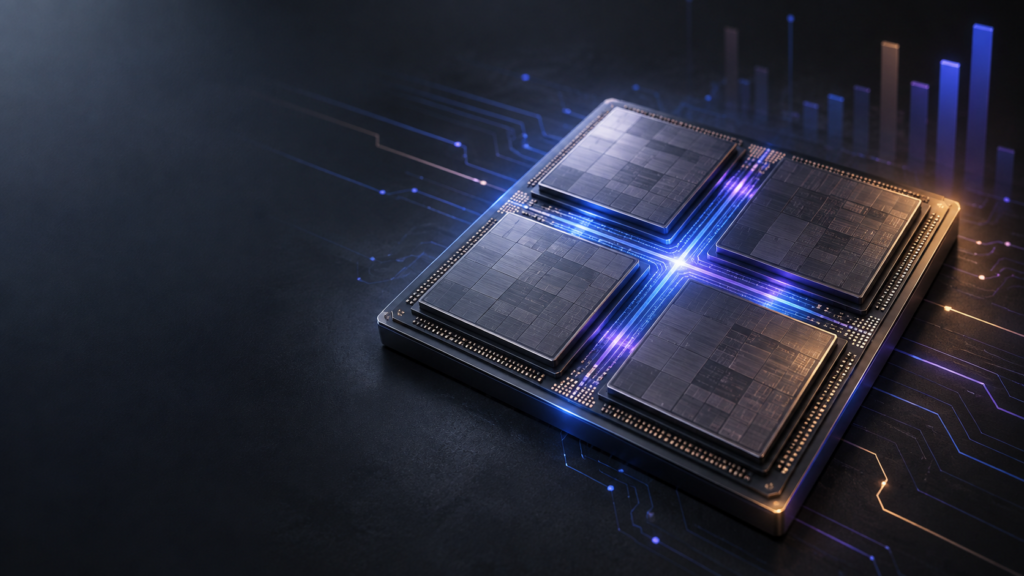
The important design change is scale. Apple says the M5 Ultra is its first four-die Apple Silicon design: two dual-die M5 Max chips are connected through the company’s UltraFusion interconnect and exposed as one system-on-chip. That is a different construction from the M3 Ultra, which Apple described as two M3 Max dies joined with more than 10,000 high-speed connections.
The result is not simply “more cores.” It is a large shared memory pool, a large GPU, a 32-core Neural Engine, and media hardware in one compact Mac. The top version reaches 36 CPU cores, 80 GPU cores, 512GB of unified memory, and 1.2TB/s of memory bandwidth. CPU and GPU share that pool, which is the reason the Ultra is interesting for local AI and large media projects: the memory ceiling is not split into a small system-RAM pool and a separate, smaller VRAM pool.
Apple has not published an M5 Ultra process node or transistor count. The base M5 announcement says the M5 family uses a third-generation 3nm process, but that is not a substitute for an Ultra-specific process disclosure. The same discipline applies to power: Apple publishes a 480W maximum continuous-power figure for the Mac Studio, not a typical consumption number or a performance-per-watt result.
The benchmark headline: 52,516 multi-core
The result that triggered the story is a Geekbench 7.0.0 macOS AArch64 upload for a machine identified as Mac17,15. The submission reports an Apple M5 Ultra with 36 cores at a 4.61GHz base frequency, 256GB of memory, macOS 27.0 build 26A428, a single-core score of 3,774, and a multi-core score of 52,516.
That result is real as a public database entry. It is not yet a verified independent review result. Geekbench’s own chart is a collection of user-submitted results, and a database entry does not prove the hardware’s provenance, the machine’s cooling conditions, or repeatability. MacRumors correctly calls it a first, unverified result.
| Comparison | Numbers | What the arithmetic says | Important caveat |
|---|---|---|---|
| M5 Ultra 36-core vs highest-end M3 Ultra | 3,774 / 52,516 vs 2,920 / 39,059 | About 29% higher single-core and 34% higher multi-core. | M5 is one upload; M3 figures are Geekbench averages cited by MacRumors, not a matched test session. |
| M5 Ultra vs M5 Max | 52,516 vs 35,119 multi-core | About 50% higher than the current M5 Max average shown in Geekbench’s Mac chart. | Different core counts and result populations; this is not a scaling law for every app. |
| M5 Ultra vs M1 Ultra | 52,516 vs 23,328 multi-core | About 2.25x the M1 Ultra average cited in the MacRumors table. | Generational comparison, not a constant real-world speedup. |
| M5 Ultra vs Threadripper Pro 9985WX | 52,516 vs 56,118 in Geekbench’s visible top multi-core list | The M5 result is about 6.4% below that particular Threadripper result. | Both are individual uploads, with different operating systems, thermals, memory, and core counts. This is not a platform victory or defeat. |
At the time of checking, the M5 Ultra upload sat fifth in Geekbench’s visible top multi-core list, behind four AMD Threadripper Pro or EPYC submissions and ahead of the next listed Threadripper Pro 9995WX result. That is a striking placement for a 36-core desktop SoC. It is also exactly the kind of ranking that can mislead when readers mistake a leaderboard of submissions for a controlled computer comparison.
The sensible conclusion is narrower: the M5 Ultra has one public CPU run that is substantially ahead of Apple’s previous Ultra generation and competitive with very large workstation CPUs in this benchmark. We need several retail systems and several applications before “fastest computer” means anything useful.
Apple’s own performance claims
Apple’s August 25 newsroom release reports up to 1.25x faster single-threaded CPU performance and 1.3x faster multithreaded CPU performance than M3 Ultra. Those figures are directionally consistent with the early Geekbench comparison, but they are not the same evidence: Apple’s figures are ratios from selected internal tests, while Geekbench is one public submission.
| Apple claim | Stated comparison | How to read it |
|---|---|---|
| CPU | Up to 1.25x single-threaded and 1.3x multithreaded CPU performance vs M3 Ultra. | Official, selective, and “up to.” No raw workload scores or power-normalized result published. |
| GPU AI compute | Up to 4.3x peak GPU AI compute vs M3 Ultra in Apple’s U.S. release. | Peak compute is not a model-evaluation score. Precision, sparsity, kernel, software, and memory behavior matter. |
| CopyCat in Foundry Nuke | Up to 3.3x faster ML training vs M3 Ultra. | Useful workflow evidence if reproduced; Apple provides a ratio, not the training dataset, steps, or raw elapsed times. |
| LM Studio | Up to 4x faster prompt processing vs M3 Ultra. | Prompt processing is not generation speed. Context length, model, quantization, backend, and batch size would change the result. |
| Text-to-image | Up to 4.3x faster vs M3 Ultra. | Apple’s workload claim; the model, sampler, resolution, and software build are not fully specified in the release. |
| Redshift | Up to 1.7x faster rendering vs M3 Ultra. | A targeted renderer result, not a general GPU benchmark. |
| Four-Mac cluster | Up to 3x faster distributed AI inference with four Mac Studios connected over Thunderbolt 5/RDMA vs one system. | A cluster result. It does not turn four shared systems into one 512GB machine, and it has networking and software overhead. |
There is an additional editorial wrinkle: Apple’s product page and its U.S. and U.K. newsroom pages do not show identical ratios in every marketing panel. The dated U.S. release is the cleanest reference for the claims above; even so, readers should treat Apple’s numbers as official but workload-specific until raw test details or independent measurements appear.
AI evals: what exists, and what does not
The M5 Ultra’s 512GB ceiling invites an AI question more interesting than a synthetic score: how large a model can it actually run, and at what speed? As of this research check, there is no M5 Ultra entry in Geekbench’s public AI chart and no independent M5 Ultra token-per-second test in the evidence reviewed. The llama.cpp community’s M5 data-collection discussion had not yet filled in M5 Ultra measurements either.
Memory capacity can give us a useful estimate, but it is not an eval. Model weights are only one part of the footprint. The KV cache grows with context, runtime buffers consume memory, quantization metadata adds overhead, and CPU/GPU scheduling changes the usable ceiling. A model that loads is not necessarily a model that generates quickly.
| Model size | BF16 weights only, rough math | Q4 practical estimate | What the estimate means |
|---|---|---|---|
| 70B | About 140GB | About 35–45GB | Fits on paper in 96GB when context and runtime overhead are modest. |
| 120B | About 240GB | About 60–75GB | 256GB gives more room for context and buffers; 96GB may be restrictive depending on format. |
| 200B | About 400GB | About 100–125GB | 256GB is the more credible target for a quantized load, not a guarantee of useful speed. |
| 300B | About 600GB | About 150–190GB | Needs 256GB or 512GB after overhead, depending on quantization and context. |
| 500B | About 1TB | About 250–320GB | 512GB may make a quantized load possible; it does not promise a responsive local assistant. |
These are calculations, not measurements. The honest answer to “how fast will a 200B model run?” is currently: we do not know. Apple’s hardware should have a strong memory-capacity story, but the speed story depends on the model, backend, quantization, context, and kernels. NVIDIA’s CUDA and Tensor ecosystem may still win for users who need mature GPU tooling even when the Mac has enough unified memory.
How it compares with other computers
The comparison below is deliberately heterogeneous. A Mac Studio, a workstation CPU, a discrete GPU, and an AI appliance do not solve the same problem. The point is to show where the M5 Ultra is unusually strong and where a different machine remains the more rational choice.
| Computer / platform | Published hardware | Evidence available now | Best fit / trade-off |
|---|---|---|---|
| Mac Studio with M5 Ultra | Up to 36 CPU cores, 80 GPU cores, 512GB unified memory, 1.2TB/s bandwidth, 32-core Neural Engine, six TB5 ports. | One Geekbench 7 upload: 3,774 single / 52,516 multi. Apple also publishes selected ratios. | Best fit: compact macOS workstation, large shared-memory media and local-AI workflows. Trade-off: closed hardware, limited CUDA compatibility, and independent results not yet available. |
| Mac Studio with M3 Ultra | Up to 32 CPU cores, 80 GPU cores, 512GB unified memory, 819GB/s bandwidth. | Geekbench averages cited by MacRumors: about 2,920 single / 39,059 multi for the high-end chip. | Best fit: discounted or already-owned Mac workflows. Trade-off: less CPU headroom and lower memory bandwidth; M5 also adds newer media and AI hardware. |
| Mac Studio with M5 Max | Up to 18 CPU cores and 40 GPU cores; lower memory ceiling than M5 Ultra. | Geekbench Mac chart average around 35,119 multi-core for the listed M5 Max configurations. | Best fit: most pro Mac work at a much lower entry price. Trade-off: less memory and compute for giant models, extreme multi-core jobs, and eight-display setups. |
| AMD Threadripper Pro 9985WX workstation | 64 cores / 128 threads, up to 5.4GHz, 350W default TDP, eight-channel DDR5 RDIMM, 148 PCIe lanes. AMD lists a $7,999 CPU SEP. | Geekbench’s visible top list included a 56,118 multi-core user submission. | Best fit: CPU-heavy Windows/Linux work, PCIe expansion, workstation memory and I/O. Trade-off: a complete system is larger, hotter, and not directly comparable to a Mac Studio’s integrated GPU and media engines. |
| Desktop with GeForce RTX 5090 | 32GB GDDR7, 21,760 CUDA cores, 575W total graphics power, 3,352 AI TOPS as NVIDIA states. | No directly comparable M5 Ultra system benchmark in the evidence reviewed. | Best fit: CUDA, Tensor, ray tracing, and PC gaming. Trade-off: it is a GPU card, not a complete computer; TOPS and Apple’s peak AI figures use different contexts and are not interchangeable. |
| NVIDIA DGX Spark | 20-core Grace Blackwell CPU, 128GB unified memory at 273GB/s, Blackwell GPU, up to 1 PFLOP FP4 sparse / 1,000 TOPS, 140W GB10 TDP. | NVIDIA publishes hardware specs; no matched M5 Ultra workload result. | Best fit: small CUDA/Tensor local-AI appliance. Trade-off: less memory and bandwidth than M5 Ultra, but a purpose-built NVIDIA software ecosystem. |
| NVIDIA DGX Station class system | Grace CPU plus Blackwell Ultra GPU, 748GB coherent memory, 252GB HBM3e at 7.1TB/s GPU bandwidth, up to 20 PFLOPS sparse FP4 in NVIDIA’s documentation. | NVIDIA and system vendors publish specifications; no fair head-to-head M5 Ultra eval. | Best fit: serious local AI development and large-model experimentation. Trade-off: a different class of machine, with workstation/server power, price, noise, and software assumptions. |
What will matter in a real review
The missing tests are not cosmetic. A useful M5 Ultra review needs at least:
- Repeated Geekbench 7 CPU runs across retail systems, with variance reported.
- GPU tests in Metal, Blender, Redshift, and a real game, including sustained performance.
- Video exports and simultaneous ProRes streams with source codecs and elapsed times recorded.
- Local AI runs that state model, quantization, context length, backend, prompt tokens, generated tokens, and warm-up behavior separately.
- Wall power, package temperature, fan noise, and performance after a long run—not just peak scores.
- Price-per-result against M5 Max, M3 Ultra, Threadripper workstations, and CUDA systems at comparable memory and storage levels.
Until those tests exist, the most defensible reading is that Apple has built a very capable high-memory Mac, not that it has demonstrated a universal workstation lead.
Who should buy the M5 Ultra?
Buy it when the workflow is already Mac-native and memory is the constraint. The case is strongest for editors, 3D artists, developers, and researchers who benefit from a compact machine with up to 512GB of shared memory, very high bandwidth, multiple Thunderbolt 5 links, and Apple’s media stack. The base $5,499 configuration is expensive, but the cost can be rational if it replaces a more complex multi-machine workflow.
Wait for independent tests when the decision is about speed per dollar. If you need CUDA, a discrete GPU, PCIe expansion, PC gaming, upgradeable memory, or a verified local-LLM throughput number, the M5 Ultra’s current evidence is incomplete. The early Geekbench result is promising; it is not enough to choose a platform by itself.
M5 Ultra FAQ
Is the 52,516 Geekbench score verified?
It is verified as a public Geekbench submission, not as an independently reviewed or replicated result. It identifies a 36-core M5 Ultra Mac17,15 with 256GB of memory, but one upload cannot establish hardware provenance, sustained behavior, or retail-system repeatability.
Is the M5 Ultra faster than Threadripper?
One M5 Ultra multi-core upload scored 52,516, while the visible Geekbench list included a Threadripper Pro 9985WX result at 56,118. That makes the M5 run competitive in this one test, not a universal winner. Threadripper offers far more CPU cores, PCIe lanes, and workstation expansion; the Mac offers integrated GPU, media hardware, compactness, and shared memory.
How much memory does the M5 Ultra support?
Apple lists 96GB, 256GB, or 512GB of unified memory for the M5 Ultra Mac Studio. The 512GB option is scheduled for late October. The 30/64 base configuration and 36/80 configuration do not have identical upgrade paths, so confirm the exact build before buying.
Can it run a 200B or 500B local model?
Possibly in a suitable quantized format, on paper. A rough Q4 estimate puts 200B weights around 100–125GB and 500B weights around 250–320GB before context and runtime overhead. That does not predict tokens per second, context capacity, or whether the chosen backend supports the model.
Does Apple’s 4.3x AI claim mean 4.3x faster ChatGPT-like output?
No. Apple’s 4.3x figure is a peak GPU AI-compute claim in the U.S. release, while its application examples are separate selected workloads. It is not a general ChatGPT or local-LLM generation benchmark.
What has not been disclosed?
Apple has not published an M5 Ultra-specific process node or transistor count, typical power draw, sustained thermal behavior, independent application benchmarks, or a complete raw-data package for its internal comparisons. Those omissions matter when comparing a compact Mac with a workstation or AI appliance.
Final verdict: impressive architecture, unfinished benchmark story
The M5 Ultra is a serious new Mac workstation. Its official 36-core/80-core/512GB ceiling, 1.2TB/s memory bandwidth, quad-die design, media engines, and six Thunderbolt 5 ports make it unusually well suited to high-memory, high-throughput Mac workflows. The one public Geekbench result strengthens that case: it is far above M3 Ultra averages and competitive with the fastest workstation submissions in the same database.
But the public evidence stops short of a full performance verdict. The headline benchmark is a single unverified upload; Apple’s ratios are selected internal claims; and independent GPU, AI, thermal, power, and real-application results are still missing. Buy the M5 Ultra for a known workflow that benefits from unified memory and Apple’s integrated stack. Wait if you need a measured answer about local-LLM speed, CUDA performance, sustained power, or price-per-frame.
Bottom line: the M5 Ultra looks like a major Apple Silicon step. It is not yet proven to be the best computer for every workload.
Sources and evidence notes
Primary product facts come from Apple’s Mac Studio with M5 Max and M5 Ultra newsroom release, Mac Studio technical specifications, Mac Studio product page, and Apple’s retail configurator. The inter-die description is cross-checked against Apple’s U.K. newsroom release.
The benchmark record is the Geekbench 7 M5 Ultra submission. Comparison averages and the launch context are reported in MacRumors’ first-benchmark report. Geekbench explains its user-submitted chart methodology on its Mac benchmark page and AI benchmark page.
Hardware comparisons use the AMD Threadripper Pro 9985WX specification, NVIDIA RTX 5090 specification, NVIDIA DGX Spark documentation, and NVIDIA’s DGX Station development guide. AI fit estimates in this article are explicitly labeled calculations, not benchmark results.
Editorial note: This article does not claim hands-on testing, ownership, or independent measurement of an M5 Ultra. It will be updated when retail hardware and reproducible third-party results are available.