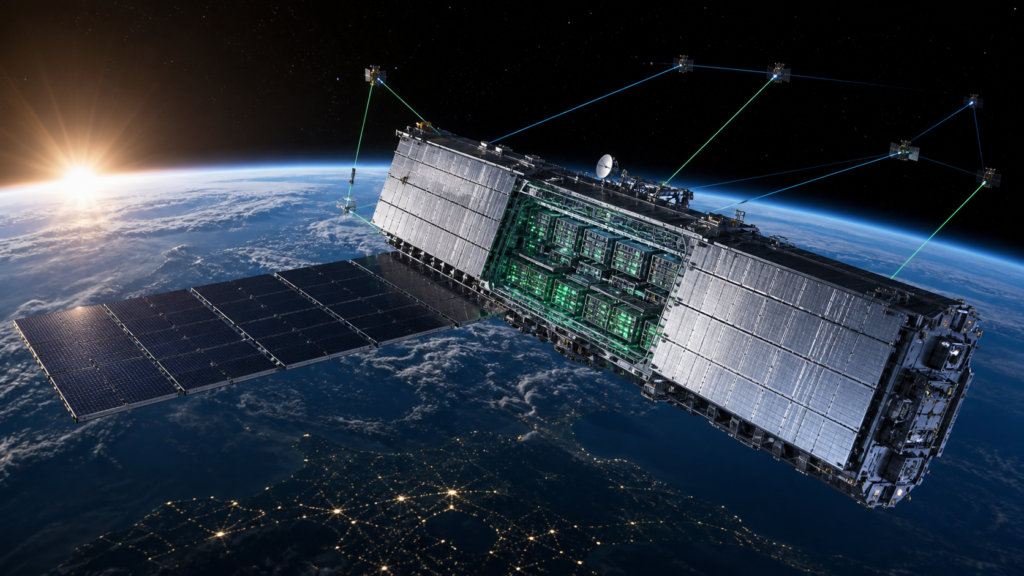
SpaceX and NVIDIA have announced a plan to put a space-optimized NVIDIA Vera Rubin NVL72 system aboard SpaceX’s first-generation Starmind AI satellite. Elon Musk has set a target of the fourth quarter of 2027 for the first launch, followed by “significant scale” in 2028, according to SpaceX’s announcement. Those dates are targets, not a launch booking or evidence of flight-ready hardware.
The important part is not the headline-friendly idea of “GPUs in space.” It is SpaceXAI’s attempt to standardize on one computing architecture across two radically different environments: gigawatt-scale AI factories on Earth and compute platforms in orbit. NVIDIA says SpaceXAI will deploy Vera CPUs for the CPU-intensive work behind its next generation of agentic AI applications and the infrastructure supporting Grok, while extending an optimized Vera Rubin NVL72 design to Starmind. In other words, the strategic bet is on a common CPU-GPU, networking and software model—not on lifting an ordinary data-center rack into a rocket. NVIDIA announced the SpaceXAI adoption on August 24, 2026, and SpaceX describes AI1 as a localized-compute satellite.
That distinction also defines the burden of proof. Vera is real silicon: NVIDIA said on March 16, 2026 that it was in full production, and the company documented deliveries to SpaceXAI and other AI labs in May. Vera Rubin NVL72 is a terrestrial rack-scale platform with published, preliminary specifications. But the orbital Starmind implementation is an announced design, not an operational system. Its detailed power, cooling, radiation and reliability architecture has not been disclosed.
Why an AI system can be CPU-bound
NVIDIA calls Vera the first CPU purpose-built for AI agents. That is NVIDIA’s description, not an independent industry designation. The reasoning behind it is nevertheless sound: an AI agent does much more than run a neural network.
Rubin GPUs are designed to accelerate the dense mathematics used to train models and generate model outputs. Around that work, CPUs compile and execute generated code, run Python tools, manage sandboxes, query databases, transform data, coordinate storage and networking, schedule jobs and evaluate results. Reinforcement-learning systems also create and reset large numbers of simulated environments and feed their results back into training. If those surrounding steps stall, expensive GPUs wait.
Vera is NVIDIA’s answer to that bottleneck. Each CPU has 88 NVIDIA-designed, Arm-compatible Olympus cores. Spatial Multithreading gives each core two partitioned execution contexts, producing 176 threads intended to remain predictable under load. LPDDR5X memory provides up to 1.2TB/s of bandwidth and up to 1.5TB of capacity. NVLink-C2C supplies up to 1.8TB/s of coherent CPU-GPU bandwidth. NVIDIA’s Vera technical page lists those specifications; the company’s March 16 launch announcement also says the memory subsystem delivers twice the bandwidth at half the power of general-purpose CPU memory.
NVIDIA claims Vera completes selected agentic-AI, reinforcement-learning and data-processing tasks up to 1.8 times faster than x86 CPUs. The company’s more specific agent benchmark compares Vera with a “latest generation” x86 baseline and reports roughly 1.7x for compilation, 1.7x for code analysis and 1.9x for Python. NVIDIA says the figures use measured data, but also labels them subject to change. Without full system configurations, software versions, power limits and reproducible tests, “1.8x” should be read as a vendor performance claim, not a universal speedup. Workload details matter.
Vera and Rubin divide the work
A terrestrial Vera Rubin NVL72 joins 36 Vera CPUs and 72 Rubin GPUs through NVLink 6. It also incorporates ConnectX-9 network interfaces and BlueField-4 data-processing units for storage, networking and security. NVIDIA lists 20.7TB of HBM4 GPU memory and 54TB of CPU memory for the rack, while noting that all specifications are preliminary and subject to change. NVIDIA’s NVL72 product page provides the configuration and caveats.
The functional split is straightforward. Vera runs control-heavy, branch-heavy and latency-sensitive jobs: orchestration, tools, code, simulations and data preparation. Rubin executes the massively parallel matrix operations central to model training and inference. NVLink moves data between them; ConnectX and BlueField handle scale-out traffic, storage and infrastructure services.
| Component | Confirmed terrestrial role/specification | Status in Starmind AI1 |
|---|---|---|
| Vera CPU | 88 Olympus cores, 176 threads via Spatial Multithreading; up to 1.2TB/s LPDDR5X bandwidth; agent orchestration, code, simulations and data processing | NVIDIA and SpaceX say Vera CPUs are part of the planned payload; quantity, packaging and flight qualification are undisclosed |
| Rubin GPU | HBM4 accelerator for AI training, inference and scientific computing | Rubin GPUs are planned, but count, clocks, power limits and memory configuration are undisclosed |
| Terrestrial Vera Rubin NVL72 | 72 Rubin GPUs, 36 Vera CPUs, NVLink 6, ConnectX-9 and BlueField-4 in a liquid-cooled rack-scale system | A reference architecture, not evidence that an intact rack will fly |
| Space-optimized Starmind implementation | Not applicable | Jointly designed, optimized Vera Rubin NVL72 system for first-generation AI1; flight hardware and final architecture not yet demonstrated publicly |
NVIDIA separately promotes a Space-1 Vera Rubin module for size, weight and power-constrained orbital platforms, alongside Jetson Orin and IGX Thor. The company says Space-1 can provide “up to 25x” more AI compute per GPU, but does not publish enough benchmark context on its overview page to treat that as a general comparison. More usefully, the page confirms NVIDIA’s broader strategy: adapt one accelerated-computing stack to ground stations, spacecraft edge systems and orbital data centers. NVIDIA’s space-computing overview describes that portfolio.
“Space-optimized” is the hard part
A conventional NVL72 rack assumes gravity, technicians, stable grid power, a building-scale liquid loop and frequent replacement of failed parts. Orbit removes every one of those assumptions.
The compute payload must survive launch vibration and acoustic loads, then operate through vacuum, radiation and thermal cycling. Radiation can flip bits, corrupt state or permanently damage electronics. NASA distinguishes immediate single-event effects from cumulative total-dose degradation and tests components against the radiation environment of a specific orbit. Mitigation can combine shielding, error-correcting memory, watchdogs, redundant processors, voting and software recovery; it does not necessarily require every chip to be radiation-hardened. NASA’s radiation guidance explains the failure modes, while its small-spacecraft engineering review describes those mitigation techniques.
Cooling is equally unforgiving. Space is cold, but vacuum does not carry heat away through convection. Heat must travel from chips into radiator surfaces and then leave as infrared radiation. SpaceX says AI1 can avoid chillers, cooling towers and fans and reduce cooling overhead by an order of magnitude. That may lower auxiliary power, but it does not make heat rejection free. Radiator area, orientation, working fluids, pumps, shadowing and peak-versus-average compute loads become central design constraints. The European Space Agency notes that spacecraft temperature is a balance among solar input, Earth albedo, internal electronics and radiator rejection to deep space. ESA’s thermal-control primer explains that balance.
SpaceX currently lists AI1 at 150kW peak and 120kW average compute payload, with a deployed height of 20 metres and a 70-metre wingspan. The same page says high-bandwidth lasers will connect AI1 through Starlink and calls the architecture modular and chip-vendor agnostic. Those are official design statements, not achieved operating results. They also imply that the NVIDIA payload is one implementation within a broader Starmind platform rather than a permanent exclusive architecture.
Autonomous fault detection matters because a technician cannot replace a failed tray. The system will need graceful degradation, workload checkpointing, remote reimaging, secure boot, isolation between tenants or missions, and recovery when radiation or network interruptions corrupt a job. None of those implementation details has been published for the Vera Rubin payload.
Why compute data where it is created?
The strongest case for orbital AI is not training a frontier model above Earth. It is processing satellite data at its source.
Earth-observation cameras, infrared sensors, synthetic-aperture radar and radio-frequency payloads can create far more raw data than a satellite can continuously downlink. Onboard models could filter cloudy images, compress useful regions, detect fires or ships, fuse multiple sensors and send an alert or compact result instead of the entire raw stream. That reduces downlink demand and can shorten the interval between observation and action. NVIDIA explicitly identifies geospatial intelligence, sensor fusion and autonomous spacecraft operation as target uses for its orbital platforms.
Local compute could also help satellites plan observations, route traffic, manage formations and respond to faults without waiting for a ground station. Laser links through Starlink could distribute work or relay results. These are plausible applications supported by the announced architecture; SpaceX and NVIDIA have not said which models or customer workloads will run on the first AI1.
The common architecture matters operationally. SpaceXAI could develop and test agent software in terrestrial Vera Rubin factories, then move selected workloads to a smaller orbital target using the same Arm, CUDA, networking and orchestration environment. Grok infrastructure provides demand and software; SpaceX provides satellite manufacturing, Starlink connectivity and launch capability; NVIDIA supplies the compute architecture. Starmind is the proposed orbital platform. These roles overlap inside SpaceXAI’s strategy, but they are not interchangeable product names.
The unanswered questions decide the economics
The first question is how much of NVL72 survives. Does “optimized” preserve 72 GPUs and 36 CPUs, or mainly the Vera-Rubin-NVLink topology? SpaceX’s published 120kW average payload figure makes aggressive power management likely, but neither company has disclosed the orbital bill of materials.
The second is the complete energy and thermal budget. Solar-array output varies with incidence, degradation and eclipses; batteries add mass; radiators compete with arrays and antennas for area. SpaceX claims a low-latency sun-synchronous orbit and near-continuous solar power, but has not published the orbit, radiator capacity or duty cycle needed to validate sustained AI throughput.
Third are radiation strategy, launch vehicle, payload mass and service life. SpaceX says Starship’s payload capacity is critical, yet the NVIDIA announcement does not amount to a launch manifest. There is no public flight-qualification report for the optimized payload.
Fourth is regulation. Satellite communications require spectrum authorization, and operators face orbital-debris mitigation obligations. A U.S. launch also requires FAA authorization and payload review; the FAA asks for dimensions, weight, composition and orbital parameters and coordinates with other agencies. The FAA lists those payload-review requirements, while the FCC explains the connection between spectrum licensing and debris mitigation. Large, high-power compute satellites also raise cybersecurity questions: who can submit workloads, how models and data are isolated, and how compromised nodes are contained across laser links?
Finally, economic competitiveness is unproven. Orbit can offer abundant solar exposure and avoid land and grid constraints, but it adds launch cost, spacecraft mass, radiation failures, inaccessible hardware and finite service life. Terrestrial data centers can repair equipment, upgrade frequently and connect directly to data sources. Orbital compute wins only if lower power and downlink costs plus unique low-latency applications outweigh those penalties.
Verdict
This announcement is a meaningful architectural and strategic signal. SpaceXAI is not merely reserving GPUs; it is proposing a shared Vera-Rubin foundation for Grok, terrestrial AI factories and orbital infrastructure. Vera’s emphasis on the CPU work around models also reflects where agentic systems increasingly spend time.
But the Q4 2027 launch and 2028 scale-up remain forward-looking. Treat Starmind AI1 as credible intent backed by unusually capable partners—not as a finished orbital data center. The plan will become materially more convincing when SpaceX and NVIDIA show flight hardware, radiation and thermal-vacuum results, detailed regulatory filings, a launch manifest and sustained on-orbit workloads. Until then, the architecture is the news; execution is the unanswered story.
FAQs
Is a Vera Rubin NVL72 already operating in space?
No. SpaceX and NVIDIA have announced a space-optimized system for Starmind AI1, targeted by Musk for Q4 2027.
Will SpaceX launch a normal NVIDIA rack?
That is not established. The companies say the NVL72 design will be optimized for space; packaging, cooling, power and redundancy must differ substantially.
What does Vera do that Rubin does not?
Vera handles CPU-heavy orchestration, tools, code, simulation and data work. Rubin accelerates model training and inference.
Why process AI workloads in orbit?
Onboard processing can reduce raw-data downlinks, produce faster alerts and support autonomous spacecraft operations.
Is orbital AI cheaper than a terrestrial data center?
Not yet proven. Solar power and reduced cooling overhead must offset launch, radiation protection, limited repairability and shorter hardware life.
The Kingy Brief
Get The Kingy Brief.
AI changes, original tests and one practical thing to try. Fridays at 09:00 Vancouver time.
Free · Double opt-in · Unsubscribe anytime
Signup help and newsletter schedule
Signup form provided by Beehiiv. After submitting, check your inbox for "Confirm your subscription to The Kingy Brief" and open its confirmation link. Check Spam or Promotions if you cannot find it.
Fridays at 09:00 Vancouver time: source-checked AI changes, original tests and one practical thing to try. The weekly restart begins October 9, 2026. We skip a week when there is not enough verified material. Free. Unsubscribe anytime.