
TL;DR: The July 23 Radar covers Humalike with Hermes, box by ASCII, an OpenAI Presence announcement, Buzzy, and Kastra.
Today’s list is unusually focused on the infrastructure around AI agents. The July 23 roundup included an item on OpenAI Presence and linked its official announcement. We could not independently verify the product details in a later check on October 10, so this review keeps its description within the available evidence. Kastra checks an agent’s proposed actions before they run, while box by ASCII supplies persistent virtual machines where coding agents can work. Humalike approaches the problem from the social side, and Buzzy applies agentic control to multi-scene video production.
These entries address different questions, so the scores below are editorial priorities rather than a head-to-head ranking. Buyer diligence may include operational ownership for enterprise agent offerings, policy coverage for Kastra, isolation and workload cost for box, consent and memory for Humalike, and sequence consistency plus rights terms for Buzzy.
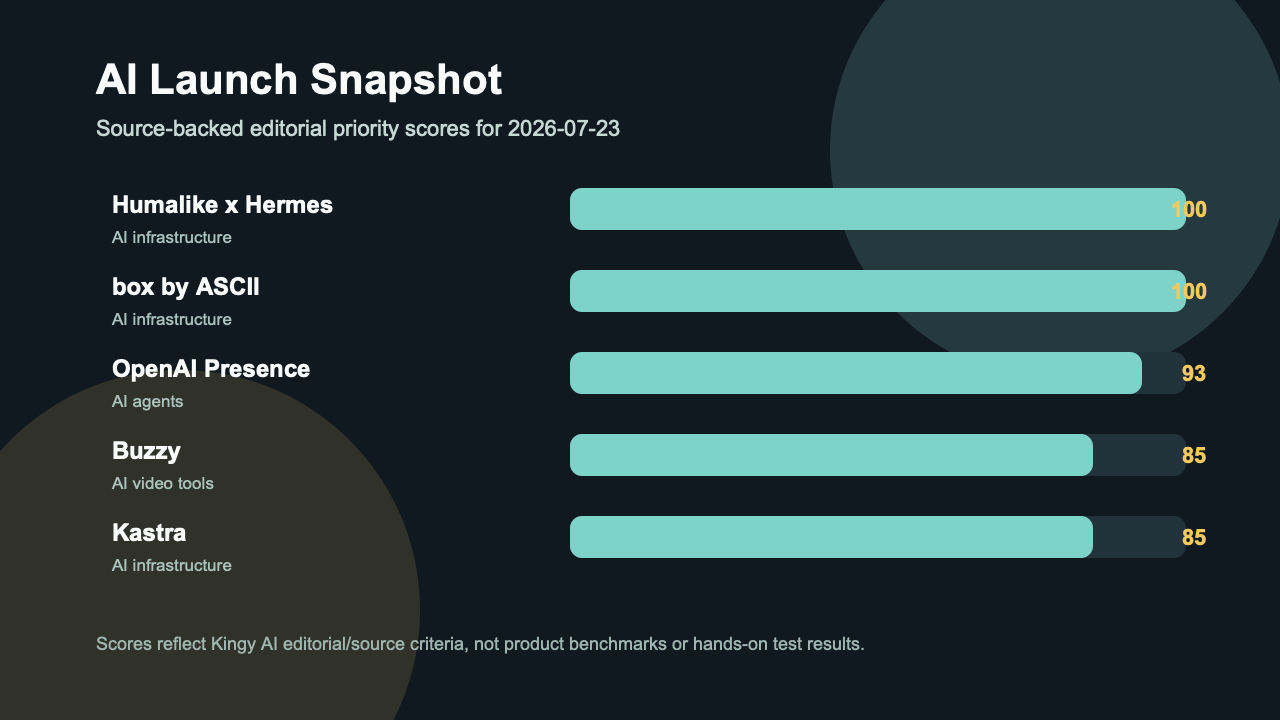
Launch Snapshot
The July 23 chart shows Kingy’s editorial priority after checking the available sources for five launches. The scores do not claim common testing, benchmark parity, or verified customer outcomes.
Strongest Launches
Humalike x Hermes
Humalike launched a one-command Hermes Agent plugin that adds turn-taking, group-tone adaptation, and social memory.
Sources: Product Hunt launch and GitHub repository. The official documentation was unavailable on October 10.
What it does: The open plugin connects Hermes to Humalike’s behavioral APIs. It can decide when the agent should join a conversation, rewrite replies to match a group’s style, build a persona, track how messages may land, and learn recurring social conventions. The repository documents setup for Slack, Telegram, and WhatsApp and warns that group permissions need deliberate configuration.
How to evaluate it: Start in a disclosed test group with no sensitive history. Watch for interruptions, unwanted replies, overfamiliar language, and memory that persists longer than participants expect. The most useful result is an agent that knows when to stay silent.
Why it matters: Agent quality in group settings depends on timing, restraint, and social context as well as answer quality. This launch makes those behaviors a separate infrastructure layer that builders can integrate.
Who should care: AI App Builders, AI Engineers, Developers, Creators
Pricing: Humalike’s July 24 archived site offered $20 in starter credits without a card. As checked October 10, 2026, its current landing page does not state that offer or a numeric rate card; confirm the current terms before budgeting a deployment.
What remains unproven: Humalike says SOC 2 Type II and ISO 27001 work is in progress and describes itself as GDPR compliant; that GDPR statement is vendor-reported, not an independent audit. Social memory can contain sensitive context, so builders should examine consent, retention, moderation, and failure behavior before use in private or vulnerable communities.
Verified tracker record: Open the verified Humalike social behavior plugin for Hermes Agent record.
box by ASCII
ASCII launched box, a CLI and API service for starting persistent Ubuntu virtual machines for coding agents and software factories.
Sources checked: launch source, docs.
What it does: A box is a persistent Ubuntu machine with SSH and SCP access, Docker, a dedicated IPv4 address, a virtual desktop, snapshots, and disk-level forking. The official docs provide CLI, HTTP API, Python SDK, and TypeScript SDK paths. Stopping a box snapshots its state and pauses billing, while a fork creates another machine from that saved state.
How to evaluate it: Create a disposable machine without production credentials, install a small project, stop it, resume it, and fork it. Measure startup time, snapshot reliability, outbound-network controls, and the cost of the actual agent workload rather than comparing only the advertised hourly rate.
Why it matters: Long-running and parallel coding agents need isolated computers with persistent state. box packages that infrastructure into a self-serve service aimed specifically at agent workloads.
Who should care: AI Platform Teams, AI Engineers, Developers, Founders
Pricing: The July launch was branded box by ASCII. As checked October 10, 2026, the original site redirects to boat.dev. The current page still lists per-second billing with a $20 monthly account minimum covering 2,000,000 VM-seconds, about 555 hours of dedicated 4-vCPU and 8-GB VM time across one or more machines; ASCII’s comparison page redirects to the current account terms.
What remains unproven: The official site currently lists EU regions only and an account minimum. Builders should test network isolation, secret handling, snapshot retention, concurrency limits, data residency, and total workload cost before production use.
Verified tracker record: Open the verified box by ASCII persistent virtual machines for coding agents record.
OpenAI Presence
The July 23 roundup listed OpenAI Presence and linked the official announcement. Its product details could not be independently verified in a later check on October 10.
Sources checked: OpenAI’s official launch and availability announcement.
What it does: The sources reviewed do not establish Presence’s deployment controls, policies, approved actions, evaluation process, or post-launch operations. Those details are not asserted here. The Codex link is a related resource and does not establish a Presence integration.
How to evaluate it: For any enterprise agent offering, buyers can ask who owns deployment, which actions are permitted, how outputs are evaluated, what escalation path exists, and how outcomes are measured. This is a buyer-diligence checklist, not a verified description of Presence.
Why it matters: This roundup recorded the Presence announcement as a launch to follow. The product-specific operational details could not be independently verified in the October 10 check, so no further significance is asserted here.
Who should care: AI Product Teams, Enterprises, Operators
Pricing: An earlier review of the official announcement described limited availability for eligible enterprise customers, no published numeric price, and contact through an OpenAI account team. A later check on October 10 could not independently confirm those access details. Confirm availability and pricing with OpenAI before planning a purchase. Official availability section.
What remains unproven: The sources reviewed do not establish whether Presence is self-serve, the scope of current availability, product features, deployment results, or design-partner outcomes. No customer result was independently verified. Confirm access, pricing, permissions, evaluation, escalation, data handling, and operational ownership directly with OpenAI before relying on them.
Tracker record: Open the verified OpenAI Presence managed enterprise agents record.
Buzzy
Buzzy’s makers describe an agentic infinite canvas for video creation, with moodboards and editing controls in one workspace.
Sources checked: Product Hunt launch and Buzzy’s official product site.
What it does: The Product Hunt description advertises moodboards, lighting and camera-angle controls, consistent subjects, and Photoshop-like video editing for films and commercial ads. Those are maker claims, not independently tested results. The official site checked October 10 showed Seedance and MiniMax video workflows; the sources reviewed did not establish model switching, reference reuse, or preservation of project context.
How to evaluate it: Try a five-shot sequence with one character, one location, and one prop. Check subject consistency and editability, confirm whether your account supports model switching or reference reuse, and inspect export quality, generation cost, and the terms for uploaded references and generated footage.
Why it matters: The launch focuses on continuity and shot-level control, two practical constraints that become more important when AI video work expands beyond isolated short clips.
Who should care: Creators, YouTubers, Marketers, Designers
Pricing: The official site checked October 10 offered a start flow and a short-lived promotion, but no stable public numeric price table or free-plan entitlement was verified. Inspect current plan limits before committing to a long project.
What remains unproven: Public numeric pricing, free-plan entitlements, export limits, rights terms, model switching, and independent long-sequence consistency tests were not verified. The maker’s claims about film length and consistent subjects remain untested.
Verified tracker record: Open the verified Buzzy agentic canvas for multi-scene AI video record.
Kastra
Kastra launched a runtime authorization layer that checks agent, model, and tool actions against policies before execution.
Sources checked: Product Hunt launch, Kastra’s official product page, and its pricing page.
What it does: Kastra applies policies to tools, prompts, inputs, and outputs across several agent environments. Its product pages describe local enforcement, centralized policy management, audit trails, and integrations spanning coding agents and model SDKs. The design goal is to reject an unauthorized action before the underlying tool receives it.
How to evaluate it: Write a small policy set for one coding agent, then test allowed actions, denied actions, malformed tool calls, prompt-injection attempts, and loss of the control-plane connection. Policy coverage and predictable failure behavior matter more than the vendor’s latency claim.
Why it matters: As agents gain access to files, credentials, and operational systems, authorization must happen at action time. Kastra aims to supply that enforcement layer independently of the agent or model.
Who should care: AI Platform Teams, AI Engineers, Developers, Enterprises
Pricing: An August 25 archived Kastra pricing page said users could start free. As checked October 10, 2026, the current page instead advertises a 15-day Pro trial, then Team or Enterprise tiers; it still shows no public numeric price table.
What remains unproven: The sub-millisecond decision claim comes from Kastra and was not independently benchmarked. Teams should test policy coverage, bypass resistance, offline behavior, logging, and failure modes before treating the layer as a complete security boundary.
Verified tracker record: Open the verified Kastra runtime authorization for AI agents record.
Related Kingy AI Links
Track these July 23 entries through AI Launches, compare their categories in AI Tools, and review later corrections in the AI News archive. Creator-campaign estimates remain available through the AI Sponsored Video ROI Calculator.
Sponsor path
Sponsor Kingy AI launch coverage
Launching an AI product that needs clear demos, creator education, and buyer trust? Sponsor a Kingy AI video or launch feature.
The Kingy Brief
Get The Kingy Brief.
AI changes, original tests and one practical thing to try. Fridays at 09:00 Vancouver time.
Free · Double opt-in · Unsubscribe anytime
Sign up for The Kingy Brief on Beehiiv.
Signup help and newsletter schedule
Signup form provided by Beehiiv. After submitting, check your inbox for "Confirm your subscription to The Kingy Brief" and open its confirmation link. Check Spam or Promotions if you cannot find it.
Fridays at 09:00 Vancouver time: source-checked AI changes, original tests and one practical thing to try. We skip a week when there is not enough verified material. Free. Unsubscribe anytime.