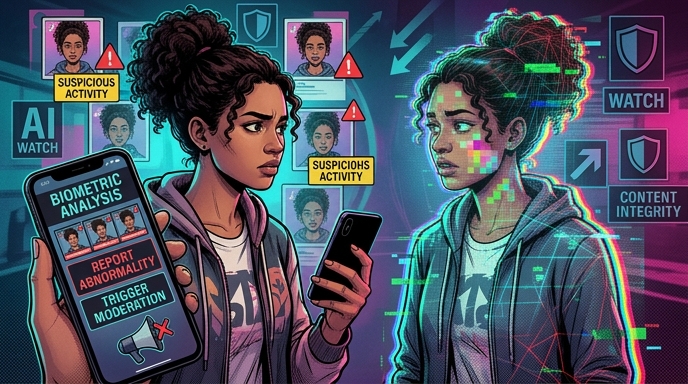
The Deepfake Hunt Is Coming to TikTok
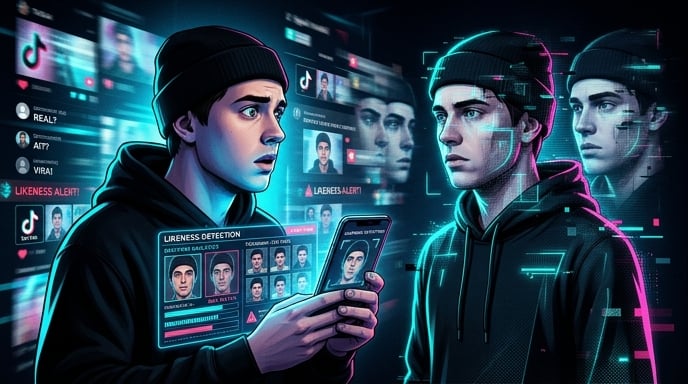
Someone who looks exactly like you appears in a TikTok video. They have your face, your expressions and perhaps even your mannerisms. There is only one inconvenient detail: you never recorded it.
TikTok now wants to help creators find these synthetic impostors.
The company has begun testing an opt-in system that scans its platform for AI-generated content resembling participating creators. According to The Verge, TikTok is initially offering the experimental tool to “some” creators in the United States.
Once enrolled, creators can review potential matches and report unauthorized posts or accounts directly to TikTok.
The feature represents a significant change in the platform’s AI strategy. TikTok has already introduced labels, educational programs and automated moderation. Those tools generally focus on identifying synthetic content as a category.
Likeness detection gets personal.
Instead of merely asking whether AI produced a video, TikTok is asking a more pointed question: Did someone use a real person’s identity without permission?
Welcome to social media’s latest game of digital hide-and-seek. Unfortunately, the person hiding may be wearing your face.
How the Likeness Detector Works
TikTok’s proposed system follows a relatively simple sequence.
First, an eligible creator chooses to participate. The tool is voluntary, at least during the current test.
Next comes identity verification. Participants must complete a real-time selfie scan and submit an identity document through Jumio, a third-party identity-verification company.
TikTok spokesperson Zachary Kizer told The Verge that TikTok does not retain creators’ identity documents. According to the company, facial information is used only to compare likenesses and help locate potentially unauthorized representations.
After verification, TikTok scans content for possible AI-generated copies of the creator. Suspected matches then appear for review. The creator decides whether a video or account appears to misuse their identity and can submit a report.
That final distinction matters. Detection does not automatically equal removal.
The system identifies possible matches, while the creator supplies context and initiates the complaint. TikTok must still evaluate the report and determine what action its rules support.
In other words, the detector is less like an automatic deepfake shredder and more like a very attentive digital bloodhound. It points toward suspicious material. Someone still has to inspect what it found.
Why TikTok Needs More Than AI Labels
AI labels answer one question: Was this content generated or significantly altered by artificial intelligence?
They do not necessarily answer another: Was it authorized?
A creator may willingly use AI to change a background, translate a video or generate a stylized version of themselves. Meanwhile, another account might construct a synthetic endorsement, fabricated confession or bogus financial pitch using that creator’s face.
Both videos could receive an AI label. Only one involves identity abuse.
This gap explains why likeness protection has become a separate product category. A general AI notice may give viewers useful context, but it cannot establish consent, ownership or intent.
Labels also depend on reliable detection or intact provenance information. Metadata can disappear during editing, downloading or re-uploading. Users may also ignore a small disclosure while concentrating on the person speaking.
A convincing face still carries psychological weight. People recognize it before they inspect the fine print.
TikTok’s test therefore shifts some attention from the nature of the media to the rights of the individual depicted. That is a more difficult moderation problem, but it is also the problem creators increasingly need platforms to solve.
Creators Have Become Valuable Raw Material
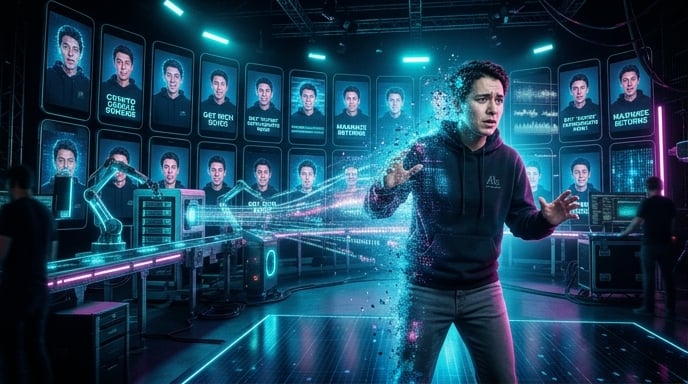
TikTok runs on recognizable personalities. A creator’s face, voice and style help audiences decide whom to trust, follow and buy from.
That familiarity has commercial value. It also makes successful creators attractive targets.
An AI double could advertise a questionable product, promote a fraudulent investment or place a creator inside a fabricated controversy. It could also imitate someone merely to siphon attention toward a copycat account.
The fake does not need Hollywood-grade visual effects. It only needs to look convincing for a few seconds on a small screen.
TikTok’s fast-moving format may amplify that problem. Users frequently encounter videos without knowing who uploaded them. They watch, react and swipe. By the time someone discovers that a clip was synthetic, thousands of people may already have absorbed its message.
As WeRSM reported, a fake video does not have to become an enormous viral hit to cause damage. It only needs to confuse enough viewers or attach a creator’s identity to something they never said.
The creator economy turned personal identity into a business asset. AI has now made that asset remarkably easy to counterfeit.
Verification Creates a Privacy Trade-Off
There is an unavoidable paradox inside likeness detection.
To help TikTok find unauthorized copies of your face, you must first provide the system with highly sensitive information about your face.
TikTok says participating creators will verify themselves through Jumio using an ID check and live selfie scan. It also says it will not retain the identity documents and will restrict the use of facial information to likeness matching and identifying potential misuse.
Those safeguards are relevant, but creators will still have to make a calculated decision. They must compare the risk of deepfake impersonation with the risk involved in supplying biometric information for automated matching.
The opt-in design gives creators a choice. It also limits the tool’s reach. Anyone who declines verification will apparently remain outside the detection program, at least in its current form.
TikTok has not publicly provided detailed performance figures for the test. We do not yet know its match accuracy, false-positive rate or ability to recognize heavily edited videos.
Those unknowns are substantial. Facial matching under ideal lighting is one challenge. Finding a distorted, stylized or partially obscured AI imitation in TikTok’s roaring content firehose is another beast entirely.
Detection Is Not the Same as Enforcement
Finding a suspected digital double solves only the first part of the problem.
TikTok must then decide what qualifies as unauthorized misuse. Some cases should be relatively clear, such as a deceptive advertisement featuring a fabricated endorsement. Other cases will be far messier.
What happens when the video is obvious satire? What if it is political criticism, fan-made fiction or an AI-assisted remix? What if the creator approved the original use but disputes a later edit?
A likeness match cannot answer those questions. Algorithms measure visual similarity. They do not reliably determine permission, purpose or context.
Creators may also encounter false positives, including their own clips, legitimate collaborations or people who naturally resemble them. Too many irrelevant alerts could turn a useful dashboard into a digital junk drawer.
TikTok will need a careful reporting and review process. Fast removals would help victims, but careless removals could erase legitimate expression. Slow investigations would protect context, but a fraudulent video could continue spreading while everyone studies the paperwork.
The technology may find the smoke. TikTok’s policies and reviewers must still determine whether there is a fire—and who started it.
TikTok Is Not Alone in This Race
Likeness detection is quickly becoming platform infrastructure rather than an exotic celebrity service.
YouTube has developed a comparable system and expanded its availability to adult users. That service searches for AI-generated facial likenesses and allows users to submit removal requests under YouTube’s privacy process.
TikTok’s test follows the same broad logic: verify a person, search for possible synthetic matches, let the individual review them and provide a path for reporting.
This resembles the evolution of copyright enforcement. Platforms once relied heavily on rights holders to discover stolen material independently. They later introduced systems that automatically compared uploads against registered works.
Human likenesses, however, are not ordinary video files. A platform cannot simply compare every face against a single authoritative master copy. People age, change hairstyles, wear costumes, move through different lighting and appear from countless angles.
AI generators add further variation. They can produce an imitation that is recognizable to an audience without being a pixel-perfect copy.
The race between TikTok and YouTube is therefore not merely about launching a feature first. It is about building a dependable system for managing identity in an era when appearance itself has become editable media.
TikTok Is Also Targeting AI Spam

The likeness tool arrives alongside a broader campaign against low-quality, mass-produced AI content.
In a separate announcement, TikTok said it would test improved detection systems for accounts dedicated to publishing AI-generated spam. The company is concentrating on sensitive subjects that could affect public trust or well-being, including politics, current events, financial advice and medical information.
That scope is narrower than banning AI-generated content. TikTok continues to promote AI as a creative tool. Its stated target is mass-produced, low-quality material posted without meaningful human participation.
The difference is important.
A carefully constructed AI-assisted short film would not automatically fall into the same category as an account pumping out hundreds of fabricated medical tips. One uses AI as part of a creative process. The other uses automation to overwhelm the feed.
TikTok said it removed more than 86 million fake accounts during the first three months of 2026. The figure illustrates the scale of the existing spam battle, although it does not mean all those accounts posted AI-generated content.
Generative tools simply make the economics of spam even cheaper. The machines do not need lunch breaks, sleep or creative dignity. Spam operators consider all three unnecessary overhead.
The Feed Has a Quantity Problem
Traditional spam often relied on copied captions, recycled clips and armies of fake accounts. Generative AI can now produce endless variations of images, narration, scripts and synthetic presenters.
That makes repetitive material look superficially different.
A spam network can change a character’s face, reword a dubious claim and generate a new voice-over within minutes. Each video may appear unique to a conventional duplicate-detection system, even when the underlying operation is repeating the same scheme.
The result is not merely annoying. High-volume synthetic content can crowd out original creators who spend time researching, recording and editing their work.
It can also create an illusion of consensus. If dozens of apparently independent accounts repeat the same investment tip or political narrative, viewers may assume the claim has broad support. In reality, one operator may control the entire chorus.
TikTok’s planned detection improvements appear aimed at behavioral patterns as well as individual videos. Accounts dedicated to automated publishing may reveal themselves through posting frequency, content similarity, coordination or other signals.
TikTok has not disclosed the technical details, which is unsurprising. Publishing an exact detection recipe would also provide spammers with a complimentary evasion manual.
Education Joins the Moderation Toolkit
TikTok is not relying solely on machines to clean up what other machines produce.
The company has worked with the National Association for Media Literacy Education and synthetic-media specialist Henry Ajder to develop a guide for using AI tools and interpreting AI-generated content.
TikTok is also launching an in-app educational hub in supported markets. When users search for AI-related terms, the hub will offer practical guidance for recognizing synthetic material.
This approach acknowledges an uncomfortable reality: no detection system will catch everything.
Automated classifiers can make mistakes. Labels may vanish. A convincing fake may travel through several apps before reaching TikTok. Even accurate detection can arrive after a video has already attracted attention.
Users therefore need basic verification habits. They should inspect the uploader, seek corroborating evidence and treat emotionally explosive clips with suspicion—particularly when a video conveniently confirms everything they already believe.
The education push will not magically turn every viewer into a forensic analyst. People visit TikTok for entertainment, not a surprise final examination in synthetic-media detection.
Still, platform defenses work better when users understand why labels appear, what those labels mean and when an apparently authentic video deserves another look.
TikTok Has Put More Than $4 Million Behind AI Literacy
TikTok says it has committed more than $4 million to its AI-literacy program and intends to continue investing.
The initiative supports expert organizations, including NoFiltr and the Raspberry Pi Foundation, in producing educational TikTok content. According to TikTok’s official announcement, the program has generated more than 200 million views since its launch in November 2025.
That is substantial reach. It does not automatically prove that users became better at identifying AI media, however.
Views measure exposure. They do not measure comprehension, retention or changed behavior.
TikTok will eventually need stronger evidence if it wants to demonstrate that the program works. Useful indicators could include whether viewers identify synthetic content more accurately, understand platform labels or become less likely to share deceptive material.
Education also faces the same attention problem as every other message on social media. A careful explainer about provenance must compete against dancing animals, celebrity drama and a synthetic grandmother performing professional wrestling moves.
The grandmother may win. She usually does.
Nevertheless, education remains necessary because platform safety cannot depend entirely on invisible technical systems. Users need enough knowledge to recognize when a feed is trying to fool them.
C2PA Provides a Digital Paper Trail

TikTok is also expanding its work with the Coalition for Content Provenance and Authenticity, or C2PA.
The C2PA standard supports Content Credentials, which can attach information about a media file’s origin and editing history. TikTok began implementing the technology in 2024 and says it was the first video platform to do so.
The company has now joined the C2PA Steering Committee, giving it a larger role in encouraging industry adoption.
Content Credentials can help a participating platform recognize that an image or video was generated or significantly altered by AI. In principle, they create something resembling a digital nutrition label: not a judgment about whether content is good or bad, but information about how it was made.
The system works best when editing tools, generators and distribution platforms all preserve and display the credentials. That makes cooperation essential.
It is not foolproof. Metadata can be stripped, and malicious actors do not politely preserve evidence of manipulation. Provenance also cannot prove that an unmarked video is authentic.
Still, it gives platforms an additional signal. Modern content verification will require several overlapping methods: provenance data, automated detection, account analysis, user education and direct reports from the people being impersonated.
Brands Should Pay Attention Too
Unauthorized likenesses create an obvious danger for creators, but brands also have plenty to lose.
Influencer marketing depends on the audience believing that a recognizable person genuinely supports a product. A convincing AI imitation can scramble that relationship.
A synthetic video might promote a competing service, advertise a scam or make statements that damage an active campaign. Even after a correction, viewers may struggle to remember which clip was real.
Brands will therefore need better verification procedures. Publishing partnerships through official accounts, preserving approval records and clearly identifying authorized advertisements can help establish a reliable trail.
Contracts may also need more precise rules covering synthetic likenesses. Permission to use someone’s image in one advertisement should not automatically become permission to generate unlimited variations of that person forever.
TikTok’s test does not resolve those commercial questions. It does, however, create a possible discovery mechanism.
If creators can find unauthorized copies earlier, they and their business partners can respond before a fake endorsement gathers serious momentum.
The underlying issue is trust. A creator’s identity functions like a signature. Once anyone can reproduce that signature at scale, platforms must provide a way to distinguish the original from the forgery.
The Tool’s Real Test Will Be Accuracy
TikTok’s announcement sounds promising, but the difficult work begins after the press release.
The detector must identify meaningful impersonations without burying creators beneath irrelevant matches. It must operate across lighting conditions, camera angles, filters and visual styles. It must also keep up as generation models improve.
Creators will judge the feature by practical outcomes.
Does it find deepfakes they did not already know about? Are the results delivered quickly? Can they report a violation without navigating an administrative maze? Does TikTok respond before the damage spreads?
Privacy will remain another test. Participants need clear information about how facial information is stored, processed, secured and deleted. TikTok’s statement that it does not retain ID documents answers one question, but a mature system will require continuing transparency.
TikTok has not announced a broad rollout date. It has not said how many creators are participating or released accuracy statistics. The feature should therefore be described as a limited experiment, not a completed shield against deepfakes.
Its value will depend less on how futuristic the interface looks and more on whether it produces fast, accurate and enforceable results.
A Three-Layer Defense Against Synthetic Chaos
Taken together, TikTok’s initiatives form a three-layer strategy.
The likeness detector focuses on identity. It gives participating creators a way to locate possible AI doubles and report them.
The spam-detection test focuses on behavior. It targets accounts that use automation to flood sensitive areas of the platform with low-value synthetic material.
The literacy and C2PA programs focus on context. They aim to help users recognize AI-generated media and give platforms better information about where content originated.
None of these layers can solve the problem alone.
A label cannot establish consent. Facial matching cannot determine satire or intent. Education cannot inspect every video. Provenance credentials cannot help when someone strips them away. Account detection may stop a spam network, but another network can take its place.
Combined defenses make more sense because synthetic-media abuse is not one problem. It is a collection of related problems involving fraud, impersonation, manipulation, commercial rights and industrial-scale clutter.
TikTok appears to understand that distinction. Now it must prove that its systems can operate at the speed and scale of its feed.
The Era of Identity Management Has Arrived
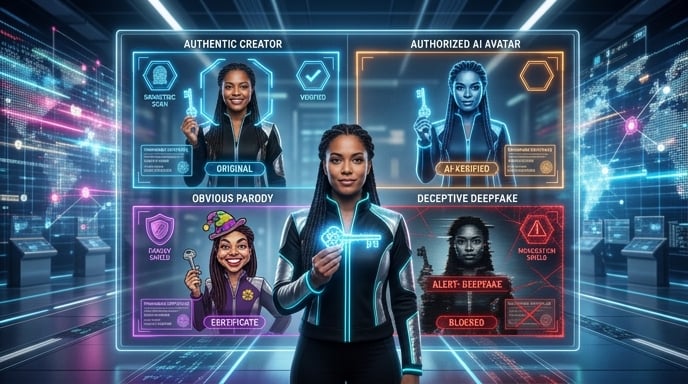
Social platforms once treated a person’s image mainly as content. AI is forcing them to treat it as identity data.
That change has consequences.
Creators need tools for discovering unauthorized copies. Users need reliable context about synthetic videos. Brands need confidence that endorsements are genuine. Platforms need moderation systems that distinguish creative experimentation from deceptive automation.
TikTok’s likeness-detection test is still small. It is opt-in, limited to selected US creators and surrounded by unanswered questions about performance and enforcement.
Yet the direction is clear.
The next phase of AI moderation will not revolve solely around spotting machine-generated pixels. It will revolve around determining who authorized those pixels, what they are trying to accomplish and whether the person on screen is a participant or an unwilling digital puppet.
AI has made it possible for anyone to acquire a tireless synthetic double. TikTok is betting that creators would prefer to meet theirs before it starts selling cryptocurrency, rewriting history or recommending homemade medical treatments.
That seems like a sensible introduction.
Sources
- The Verge — TikTok is testing an AI likeness detection tool
- WeRSM — TikTok Is Testing a Way for Creators to Protect Their Likeness
- DISA — TikTok measures addressing AI-generated misinformation
- Seoul Economic Daily — TikTok Expands AI Literacy Education, Steps Up Spam Response
- TikTok Newsroom — Helping People Spot and Understand AI-Generated Content
The Kingy Brief
Get The Kingy Brief.
AI changes, original tests and one practical thing to try. Fridays at 09:00 Vancouver time.
Free · Double opt-in · Unsubscribe anytime
Sign up for The Kingy Brief on Beehiiv.
Signup help and newsletter schedule
Signup form provided by Beehiiv. After submitting, check your inbox for "Confirm your subscription to The Kingy Brief" and open its confirmation link. Check Spam or Promotions if you cannot find it.
Fridays at 09:00 Vancouver time: source-checked AI changes, original tests and one practical thing to try. We skip a week when there is not enough verified material. Free. Unsubscribe anytime.