Earlier recorded update: 2026-07-10
Earlier recorded verification: 2026-07-10
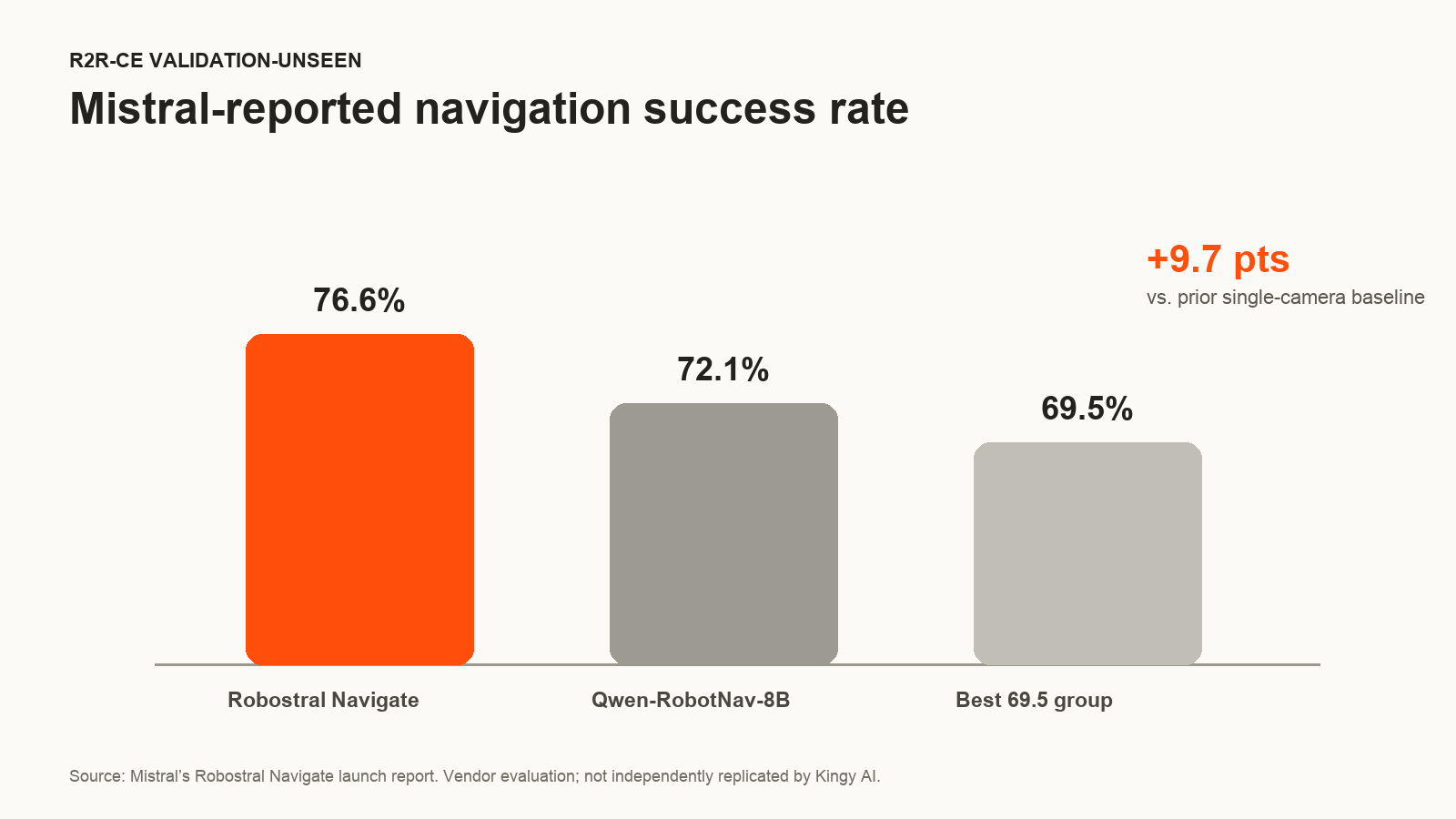
TL;DR: Robostral Navigate is Mistral’s 8-billion-parameter robot-navigation model. It follows plain-language route instructions using a single RGB camera rather than a LiDAR sensor, depth camera, or multicamera rig. Mistral’s launch page reports a 76.6% success rate on R2R-CE validation unseen; its later technical report gives 77.4%, as detailed below. Neither result was independently replicated for this article. The announcement and linked report reviewed here do not provide public model weights, an API, an integration SDK, or pricing. They describe research and demonstrations rather than a generally available product package.
What Mistral announced
Mistral’s official news index dates Robostral Navigate to July 7, 2026. The company calls it its first model built for embodied navigation: the task of turning visual observations and a route instruction into physical movement through an environment.
The model has 8 billion parameters and was trained entirely in simulation. Mistral says it can run on wheeled, legged, and flying robots and can generalize across different robot sizes and camera configurations. Its demonstrations include navigation through an occupied office using one long instruction rather than a sequence of manually issued waypoints.
The central claim is hardware simplicity. Many navigation systems combine RGB cameras with depth sensors, LiDAR, or several camera views. Robostral Navigate uses one ordinary RGB camera and no depth sensor, while still posting the benchmark results Mistral reports in its launch material.
How Robostral Navigate chooses where to move
The model receives a natural-language task and a history of camera observations. Its primary action representation is pointing: Robostral predicts the image coordinates of the next target location in the current camera view, along with the robot’s desired orientation when it arrives.
Mistral argues that this image-based target is naturally robust to changes in camera intrinsics and world scale. The model does not need to translate every instruction into a fixed metric movement when the destination is visible.
Pointing cannot represent a destination outside the current field of view. In that case, the model falls back to a displacement in the robot’s local coordinate frame, such as moving forward and left by specified distances and rotating by a specified angle. That hybrid action design lets the system handle both visible targets and route segments that require turning toward an unseen destination.
The launch benchmark results Mistral reported
Mistral evaluates Robostral Navigate on R2R-CE, or Room-to-Room in Continuous Environments. The benchmark tests whether an agent can follow language instructions through continuous 3D environments. “Validation unseen” refers to environments held out from training.
| Mistral-reported measure | Result | What it means |
|---|---|---|
| Validation seen success rate | 79.4% | Success in validation environments represented in the training distribution. |
| Validation unseen success rate | 76.6% | Success in held-out validation environments. |
| Lead over the cited single-camera approach | 9.7 percentage points | Mistral’s comparison with the strongest single-camera baseline in its launch material. |
| Lead over the cited depth or multicamera system | 4.5 percentage points | Mistral’s comparison despite Robostral using neither depth nor multiple cameras. |
These figures and the chart above preserve Mistral’s launch-announcement results. Kingy AI did not run the benchmark or test a robot with the model.
The technical report, version 3 dated July 31, 2026, later reports 77.4% success on R2R-CE validation unseen, with leads of 10.5 percentage points over its cited single-camera baseline and 5.3 points over its cited depth or multicamera baseline. It also reports 75.1% success on English-only RxR-CE validation unseen. These are the authors’ later results, not an independent replication or a replacement for the launch measurements above.
How the model was trained
Mistral says it built Robostral Navigate in-house rather than adapting an existing open-source vision-language model. The starting point was a model specialized in visual grounding tasks such as pointing, counting, and object localization.
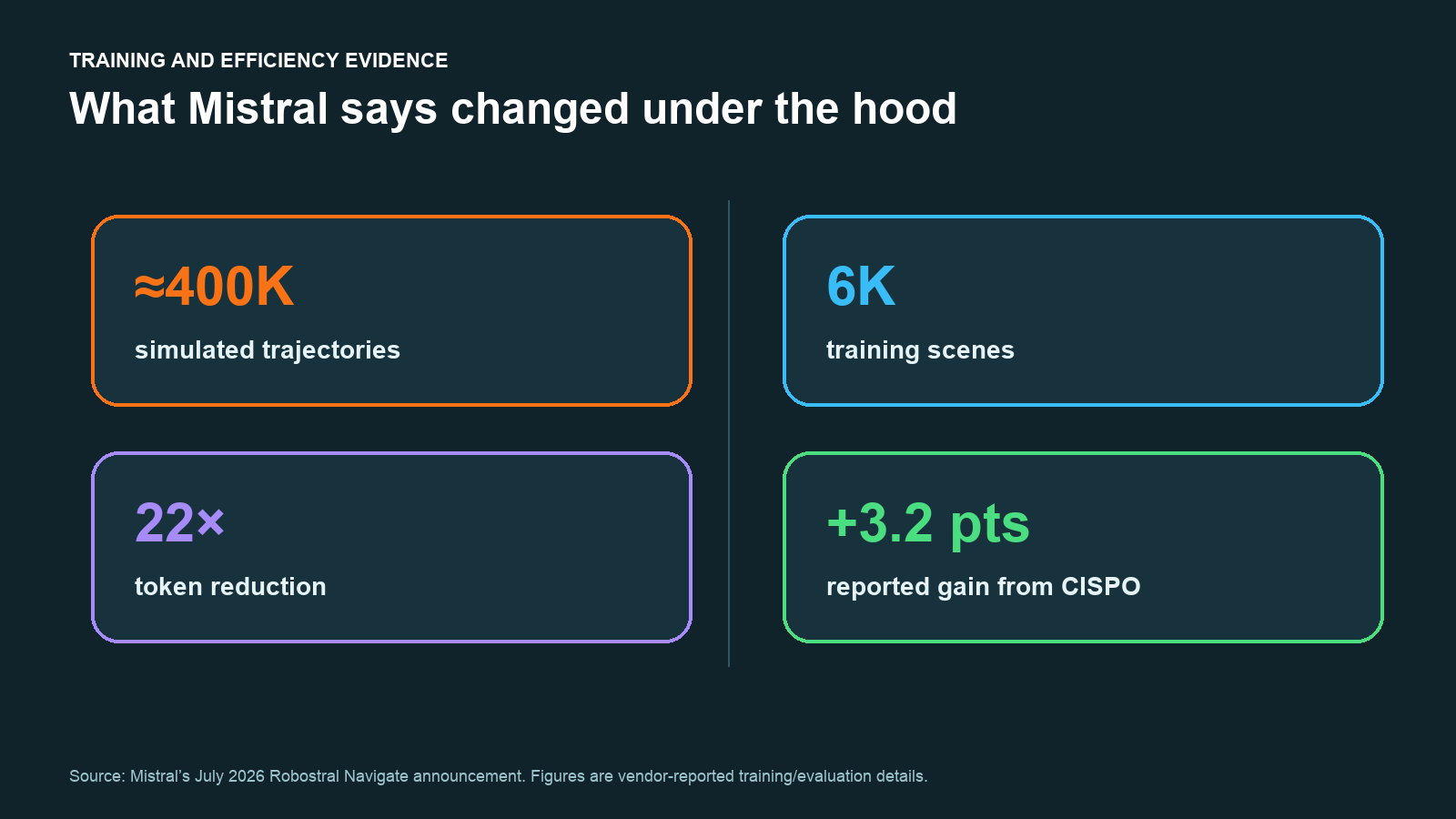
Mistral’s official page, captured October 8, 2026, describes training data generated entirely in simulation: approximately 2.4 million trajectories across 350,000 scenes. A prefix-caching method compresses an episode into one sequence and trains on all time steps in a single forward pass while using attention masks to prevent information from leaking between steps. Mistral says this reduces training-token requirements by 22 times compared with treating every time step as a separate sample.
After supervised training, Mistral applied CISPO, an online reinforcement-learning method. The launch announcement describes the resulting success-rate improvement as 3.2%, without specifying percentage points, and attributes it to recovery from mistakes and exploration. The later report discusses its own reinforcement-learning results; the launch figure should not be silently treated as the same measurement.
Why a single-camera model matters
If the approach transfers reliably from benchmarks to deployments, a single RGB camera could reduce sensor cost, calibration work, and integration complexity. It could also make the same high-level navigation policy easier to adapt across robots with different bodies.
Mistral points to manufacturing, delivery, logistics, and hospitality as potential application areas. Examples include guiding a service robot through a hotel, moving materials through a facility, or navigating an office delivery route. Those are proposed applications, not confirmed customer deployments in the launch announcement.
The model also addresses only part of an operational robotics stack. A deployed system still needs low-level motion control, obstacle handling, safety logic, mapping or localization decisions where required, fleet management, hardware monitoring, and an escalation path when the navigation policy is uncertain.
Access and pricing
The announcement and linked technical report reviewed here do not supply downloadable model weights, a public hosted API, an integration SDK, or a product price. The report documents the architecture and evaluation; that is distinct from a released integration package. The launch page directs interested organizations to speak with Mistral’s team. The company also published an official Robostral Navigate demonstration on its YouTube channel.
Mistral’s general model-token pricing is not a quoted price for Robostral Navigate. Prospective customers still need deployment hardware, end-to-end latency, model licensing and support terms. The report describes demonstrations on Galaxea R1 and Hiwonder JetAuto robots, with a vision-language model, diffusion policy and robot-specific motion controller; those demonstrations are not a general supported-hardware matrix.
What the benchmark does not establish
- Production reliability: a navigation benchmark does not reproduce every lighting condition, floor plan, crowd pattern, moving obstacle, or camera failure.
- Safety certification: the announcement does not describe a certified safety system or the controls required around the model.
- Simulation-to-real robustness: Mistral shows real-world demonstrations, but the training data was generated in simulation and broad deployment evidence is not public.
- Compute requirements: the report identifies demonstration robots and control stages, but does not supply a general deployment-compute specification, power budget or end-to-end latency guarantee.
- Ease of integration: the report describes waypoint prediction and motion control, but the reviewed sources do not supply a public integration SDK or a supported-hardware matrix.
- Independent comparison: the launch page and technical report present Mistral’s evaluations; this article does not establish outside replication.
Who should pay attention
Robotics research groups, robot manufacturers, and teams evaluating embodied-AI navigation should watch the model closely. The combination of a compact parameter count, one-camera input, language instructions, and cross-form-factor claims makes it a technically meaningful launch.
The reviewed sources offer a technical report and demonstrations, but no public API, model-weight download or integration SDK. They therefore do not establish a straightforward supported implementation path for a general application developer. Organizations that need a deployable system now should evaluate complete navigation stacks and safety requirements rather than assume that a promising model announcement is a finished robotics product.
Verdict
Robostral Navigate is worth covering because it proposes a simpler sensing approach to a difficult robotics problem and supports that proposal with concrete, if vendor-reported, benchmark results. Its most important test comes next: whether Mistral can turn the research into a documented, supportable product that performs reliably outside selected demonstrations.
For now, the sensible action is to review the official evidence and request a technical briefing if robot navigation is central to your work. It would be premature to describe Robostral Navigate as a generally available tool or to make a purchasing decision without hardware, safety, licensing, and integration details.
FAQ
What is Robostral Navigate?
It is Mistral’s 8B robot-navigation model. It takes RGB camera observations and a natural-language route instruction and predicts where a robot should move next.
Does it require LiDAR or a depth camera?
Mistral says Robostral Navigate operates with one RGB camera and no LiDAR or depth sensor.
Can I download or call the model through an API?
No public download, model weights, or hosted API were available in Mistral’s launch materials as of July 10, 2026. The announcement and linked technical report reviewed for this update also do not provide a model download or public API endpoint; an enterprise offering would require confirmation with Mistral.
Is Robostral Navigate independently benchmarked?
The results discussed here are reported by Mistral. Kingy AI did not reproduce them, and independent evaluation remains an important next step.
Which robot types does Mistral say it supports?
Mistral says the model can run on wheeled, legged, and flying robots and can generalize across robot sizes.
Official sources
- Mistral’s Robostral Navigate announcement and evaluation
- Robostral Navigate technical report, version 3, July 31, 2026
- Official Robostral Navigate demonstration from Mistral