Last updated: 2026-07-11
Last verified: 2026-07-11
TL;DR: Claude Reflect is a beta dashboard that summarizes how an individual uses Claude, shows activity patterns over several time windows, maps collaboration habits to Anthropic’s 4D AI Fluency Framework, and adds optional quiet hours and break reminders. Anthropic says it is available to Free, Pro, and Max users who have memory turned on. Its most useful idea is not measuring productivity; it is helping a person decide which work to delegate to AI and which work to keep human-led.
What Claude Reflect is
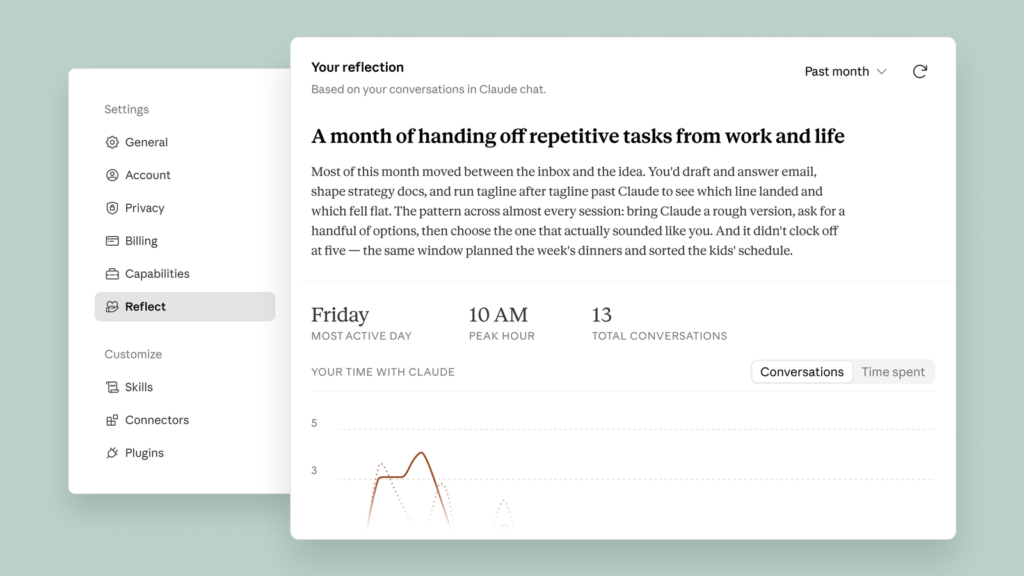
Anthropic introduced Claude Reflect on July 9 as a way to review and refine personal AI habits. The dashboard lives in Claude’s Settings on the web and desktop apps. It builds a report from eligible conversation history and summarizes the topics, patterns, and kinds of tasks a user has worked through with Claude.
A user can look back over one, three, six, or twelve months. The report highlights when Claude is used most often and what that activity involved. Anthropic says a separate view of total time spent with Claude is coming later, so the beta should not yet be described as a complete time-tracking product.
Reflect also asks users to examine the boundary between assistance and substitution. One of Anthropic’s example prompts asks what a person wants to keep doing themselves even if Claude could do it faster. That framing makes the feature more interesting than a conventional usage chart: the goal is to make AI use more deliberate, not simply more frequent.
What appears in the dashboard
- A narrative usage summary: Claude describes recurring topics, common tasks, and broad collaboration patterns found in the selected period.
- Activity patterns: the dashboard shows measures such as the most active day, peak hour, and number of conversations.
- Task categories: example screens group activity into areas such as drafting strategy documents, email, testing copy, planning, and scheduling.
- Reflection prompts: the report periodically asks questions intended to help users decide where AI supports or weakens their goals.
- Quiet hours and break nudges: users can schedule times when they prefer not to use Claude or request a reminder after a session runs for a chosen duration. Anthropic says these reminders are dismissible.
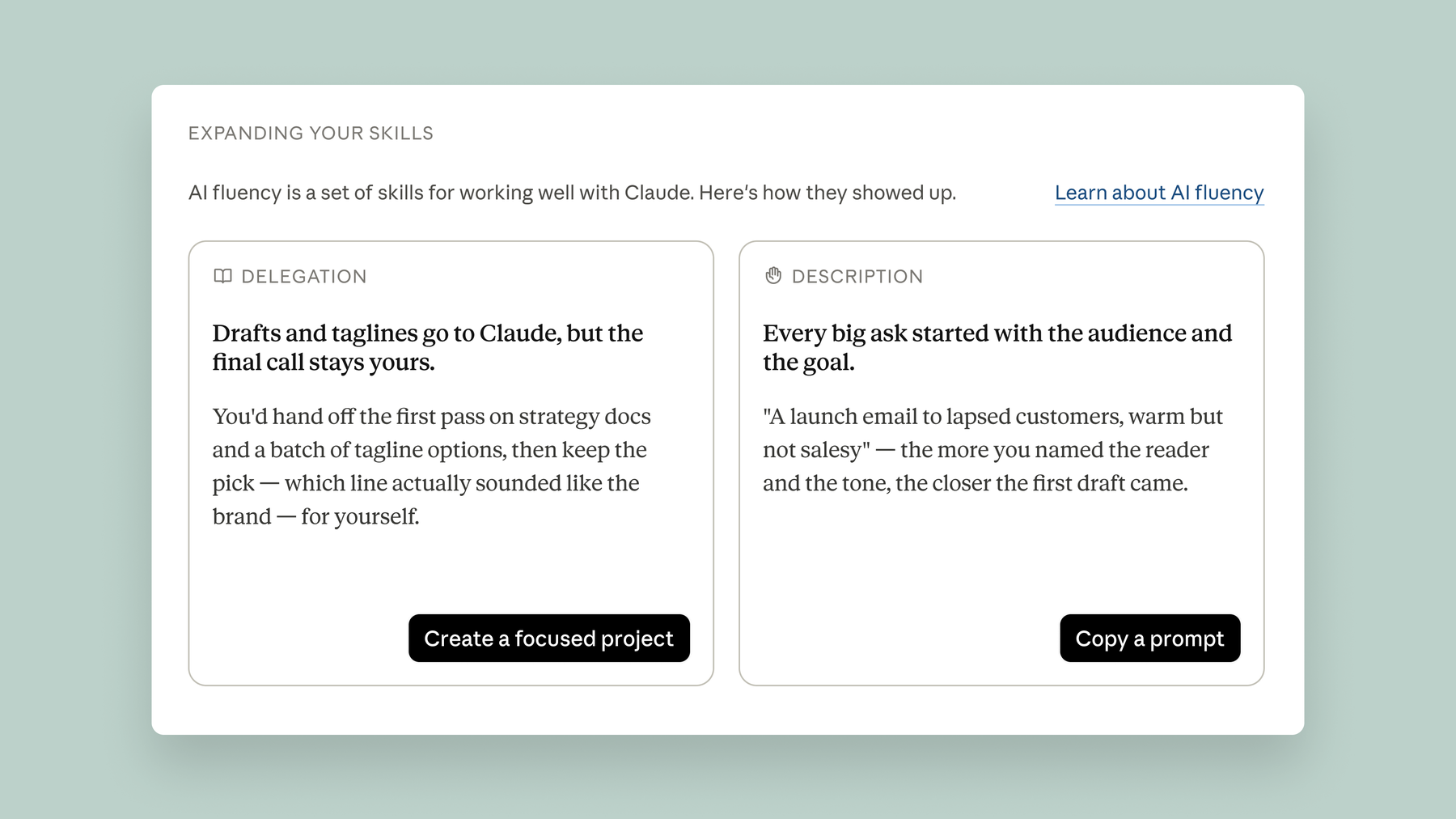
- AI-fluency guidance: the dashboard describes how a person works with Claude across four skills and offers suggestions for improving that collaboration.
How the 4D AI Fluency Framework is used
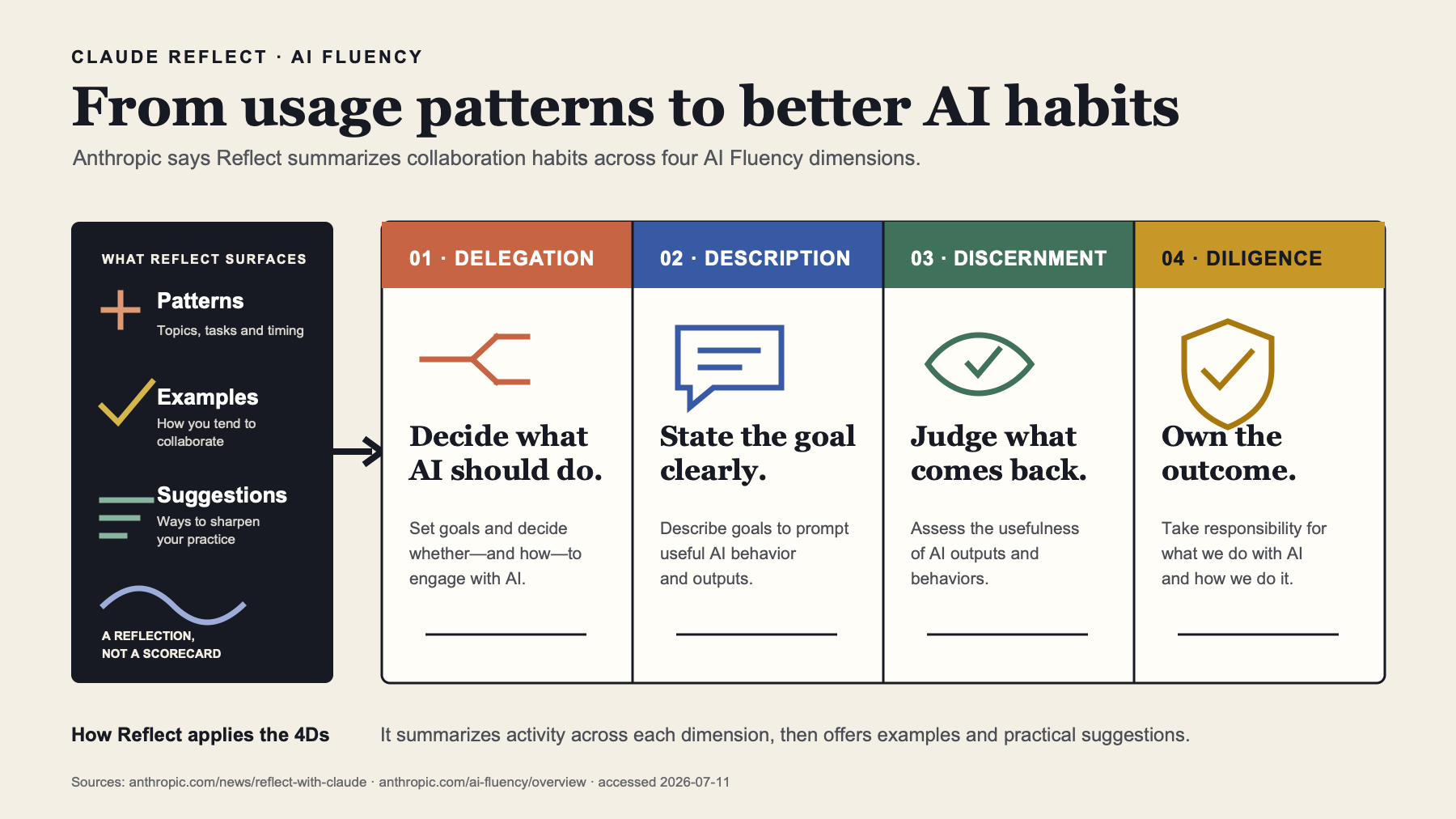
Reflect organizes part of its guidance around the four dimensions Anthropic lists in its announcement:
- Delegation: setting a goal and deciding whether and how AI should be involved.
- Description: explaining a goal clearly enough to produce useful behavior and output.
- Discernment: judging whether the result is useful, accurate, and appropriate.
- Diligence: taking responsibility for how AI is used and what happens with its output.
The dashboard may illustrate these dimensions with examples from a user’s patterns. Anthropic’s sample explains that someone often delegates a first draft but keeps the final editorial choice. It may then suggest a practical change, such as creating a Project instead of repeatedly supplying the same background.
These are coaching suggestions, not a standardized score of competence. Anthropic does not present Reflect as an employee ranking system, a productivity benchmark, or an evaluation of output quality.
What Anthropic says about privacy
Reflect depends on access to conversation history, which makes privacy central to the feature. Anthropic says the report does not draw from incognito chats. It also says Reflect does not pull the underlying files from connected tools. If Claude summarized an inbox, for example, the resulting conversation may influence the reflection, but the source emails themselves are not pulled into the dashboard.
Anthropic further states that conversations connected to a health integration are excluded from Reflect insights. Sensitive or personal conversations can still affect a report, but the company says they appear only at a high level. According to the launch announcement, the information and insights in the reflection remain there and are not used for another purpose.
Those are Anthropic’s descriptions of the beta, not an independent privacy audit. Users should still review their memory settings, conversation-retention choices, and employer policies before enabling a summary of work-related chats. Anthropic’s memory documentation explains that memory is synthesized from chat history, can be paused or reset, and follows existing retention and export rules.
Availability and price
Anthropic says Claude Reflect is currently available in beta to Free, Pro, and Max users who have memory turned on. It is available through Claude on the web and desktop. Reflect support for Claude Cowork conversations is described as coming soon.
The company’s individual plan guide lists Free at $0, Pro at $20 per month or $200 per year, Max 5x at $100 per month, and Max 20x at $200 per month. Anthropic does not list a separate Reflect charge. The launch announcement does not name Team or Enterprise plans as part of the current beta, so organizations should not assume availability from the individual-plan rollout.
How to generate a reflection
- Open Claude on the web or in the desktop app.
- Confirm that memory is enabled in Settings under Capabilities.
- Open Settings and select Reflect.
- Choose the option to reflect on your usage and generate the report.
- Review the summary, activity window, AI-fluency observations, and any suggestions before deciding whether to change a habit.
If the report cannot be generated, Anthropic says memory may not be turned on. Availability can also depend on whether the beta has reached the account.
Who may find it useful
Reflect is best understood as an individual review tool. It may help a frequent Claude user notice that most sessions involve one category of work, recognize that a task is being delegated without enough review, or establish a boundary around late-night use. Students and researchers may find the delegation and discernment prompts useful when deciding what thinking must remain their own.
Creators and knowledge workers may also benefit from seeing whether Claude is being used for exploration, revision, or final decisions. The value comes from the conversation that follows the report, not from treating a chart as an objective measure of performance.
It is a weaker fit for someone who does not use Claude memory, needs auditable organization-wide analytics, or wants precise time tracking across applications. Reflect is not a substitute for a company’s security controls, learning program, or workforce analytics.
Limits to keep in mind
- The feature is in beta, and its summaries may simplify or misinterpret a user’s intent.
- The time-spent view shown in product imagery is described as coming soon.
- The report depends on eligible chat history and memory; it is not a complete record of all AI use.
- A high-level summary can still feel sensitive even when source files and excluded conversations are not pulled into the dashboard.
- The 4D observations are reflective guidance, not a validated productivity or skill score.
Is Claude Reflect worth using?
For an individual who already uses Claude memory, yes—the beta offers a useful pause to examine habits that are otherwise easy to ignore. Quiet hours and break nudges are simple controls, while the 4D prompts encourage a more important question: whether AI is supporting a person’s judgment or quietly replacing it.
Users should read the privacy explanation first and treat the report as a conversation starter, not a verdict. The dashboard can reveal a pattern, but only the user can decide whether that pattern is healthy, effective, or aligned with the work they want to keep doing themselves.
FAQ
Is Claude Reflect available on the free plan?
Yes. Anthropic says the beta is available to Free, Pro, and Max users who have memory enabled.
Where do I find Claude Reflect?
Open Settings in Claude on the web or desktop app and select Reflect. If the option cannot generate a report, check whether memory is enabled.
Does Reflect read files from connected tools?
Anthropic says it does not pull the underlying files. A summary discussed in a Claude conversation may influence the reflection, but the source file itself is not imported into the report.
Does Reflect include incognito or health-integration chats?
Anthropic says incognito chats are excluded and conversations connected to a health integration are left out of Reflect insights.
Is the dashboard a productivity score?
No. It summarizes patterns and offers reflective guidance; Anthropic does not describe it as a performance benchmark.
Official sources
- Anthropic’s Claude Reflect announcement
- Claude memory, retention, and privacy documentation
- Claude individual-plan pricing
Related Kingy AI coverage
The Kingy Brief
Get The Kingy Brief.
AI changes, original tests and one practical thing to try. Fridays at 09:00 Vancouver time.
Free · Double opt-in · Unsubscribe anytime
Sign up for The Kingy Brief on Beehiiv.
Signup help and newsletter schedule
Signup form provided by Beehiiv. After submitting, check your inbox for "Confirm your subscription to The Kingy Brief" and open its confirmation link. Check Spam or Promotions if you cannot find it.
Fridays at 09:00 Vancouver time: source-checked AI changes, original tests and one practical thing to try. The weekly restart begins October 9, 2026. We skip a week when there is not enough verified material. Free. Unsubscribe anytime.