
TL;DR: The July 10 Radar examines Mistral Studio governance, Meta’s Muse Spark and Model API, Claude reflect, GPT-Live, and the GPT-5.6 family, with Robostral Navigate held as a tracker-only mention.
Launch Snapshot
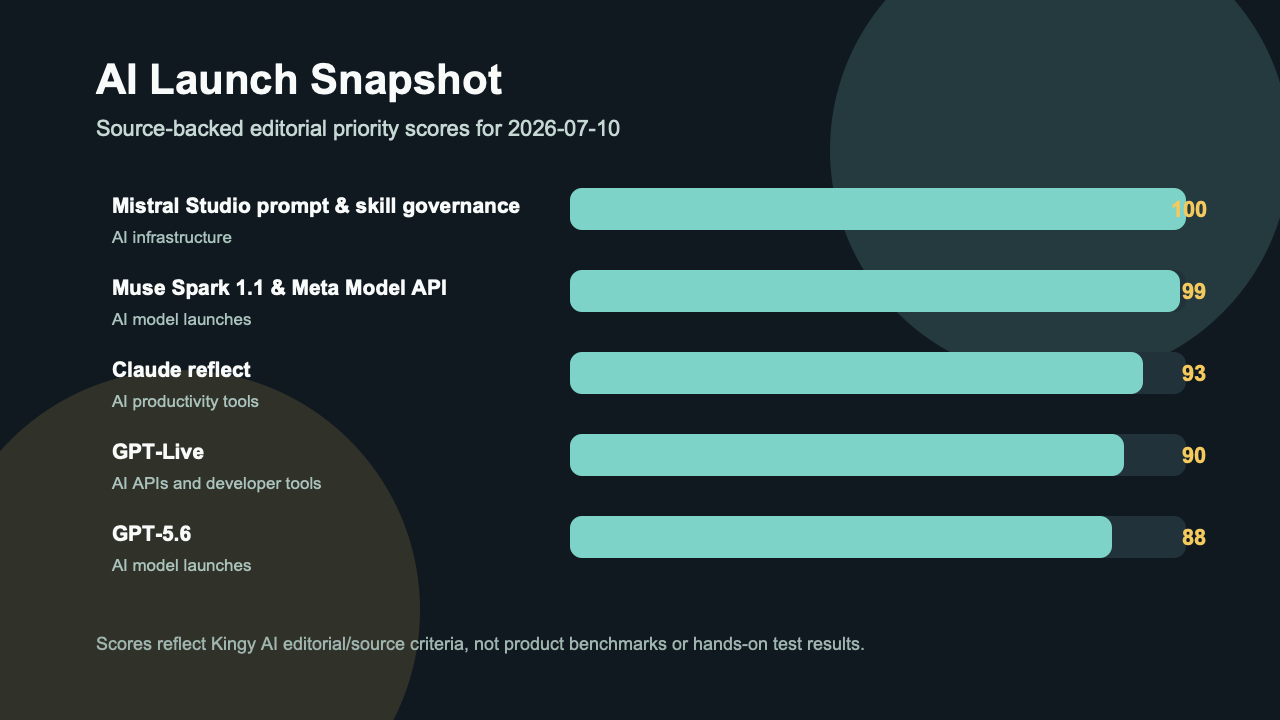
The July 10 chart records Kingy’s editorial priority for five source-checked entries. The scores guide coverage order and should not be read as independent model benchmarks or hands-on product ratings.
Strongest Launches
Mistral Studio Prompts and Skills System of Record
Mistral added prompt and skill versioning, ownership, lineage, and auditability to Studio for enterprises managing production AI behavior.
Sources checked: launch source, docs.
Why it matters: As prompts and skills become production assets, enterprises need governance, audit trails, rollback, and visibility so business owners can safely iterate without losing control of what shipped.
Who should care: AI Product Teams, AI Platform Teams, Enterprises, Operators
Pricing: Mistral pricing for models is usage-based per million tokens; Studio customer plan/pricing specifics for prompt and skill governance were not separately verified from the launch page. Confirm current pricing on the official pricing/source page.
What remains unproven: pricing and plan packaging need confirmation for each customer; teams still need release discipline and test coverage around prompt changes; migration from existing prompt repos may require governance work.
Muse Spark 1.1 and Meta Model API
Meta introduced Muse Spark 1.1 and opened a public preview of the Meta Model API for developers to build with the model.
Sources checked: launch source, docs.
Why it matters: The launch marks Meta’s move toward a developer-facing frontier API for an agentic model, adding another major option for builders comparing OpenAI, Anthropic, Google, and Mistral model stacks.
Who should care: AI Product Teams, AI Platform Teams, AI Engineers, Developers
Pricing: Official Meta developer materials verified $20 in free credits for new Meta Model API accounts; public official per-token pricing was not verified from a Meta pricing page during this run. Confirm current pricing on the official pricing/source page.
What remains unproven: official per-token pricing needs confirmation on Meta’s own pricing surface; API availability may vary by geography or account approval; Meta’s evaluation report includes important safety and deployment caveats for agentic/cyber use.
Claude reflect
Anthropic introduced a beta reflection dashboard that helps Claude users review patterns, goals, and habits in how they use Claude.
Sources checked: launch source, docs.
Why it matters: It treats AI usage as a habit and workflow to audit, not just a chat history, giving teams and individuals a way to examine whether AI use supports goals and original thinking.
Who should care: AI Product Teams, Researchers, Students, Operators
Pricing: Claude reflect is described as a beta feature in Claude; official plan pricing lists Free at $0, Pro at $20/month or $200/year, Max 5x at $100/month, and Max 20x at $200/month, but reflect-specific paid gating was not fully verified from Anthropic’s launch page. Confirm current pricing on the official pricing/source page.
What remains unproven: beta availability may vary by plan, region, and memory settings; sensitive usage summaries require careful privacy review; the feature is reflective rather than a productivity benchmark.
GPT-Live
OpenAI introduced GPT-Live, a full-duplex voice model powering a more natural ChatGPT Voice experience and planned for API access.
Sources checked: launch source, docs.
Why it matters: The launch shifts voice AI from turn-by-turn speech chains toward realtime collaborative interaction, which matters for assistants, tutoring, support, accessibility, and voice-agent interfaces.
Who should care: AI Product Teams, Small Business Owners, Developers, Creators
Pricing: ChatGPT Voice access depends on the user’s ChatGPT plan; OpenAI says API access is planned but GPT-Live-specific API pricing was not verified in official public docs. Current Realtime API pricing remains separate. Confirm current pricing on the official pricing/source page.
What remains unproven: API timing and GPT-Live-specific pricing were not publicly finalized in official docs; voice model quality should be tested with real accents, noise, latency, and interruption patterns; background delegation model may affect latency and cost once API access launches.
GPT-5.6
OpenAI launched the GPT-5.6 model family, including Sol, Terra, and Luna, for general availability across complex reasoning, coding, science, cybersecurity, and cost-sensitive workloads.
Sources checked: launch source, docs.
Why it matters: The launch gives developers and AI teams a new flagship model plus lower-cost variants, making model routing, prompt caching, and reasoning-effort choices more central to production AI economics.
Who should care: AI Platform Teams, AI App Builders, AI Engineers, Developers
Pricing: Official API pricing lists gpt-5.6-sol at $5.00 input and $30.00 output per 1M short-context tokens, gpt-5.6-terra at $2.50 input and $15.00 output, and gpt-5.6-luna at $1.00 input and $6.00 output; long-context, batch, flex, priority, cache-write, and cached-input rates differ. Confirm current pricing on the official pricing/source page.
What remains unproven: real cost depends on reasoning effort, context length, cache writes, and workflow design; safeguards may block or slow some dual-use requests; independent benchmark replication should be reviewed before relying on launch claims.
Tracker-Only Mentions
- Robostral Navigate: Mistral introduced Robostral Navigate, an 8B vision-language-action model for robot navigation using a single RGB camera and plain-language instructions.
Related Kingy AI Links
Follow the model and agent entries through AI Launches, compare products in AI Tools, and use the AI News archive to confirm later access changes. The AI Sponsored Video ROI Calculator supports separate campaign planning.
Sponsor path
Sponsor Kingy AI launch coverage
Launching an AI product that needs clear demos, creator education, and buyer trust? Sponsor a Kingy AI video or launch feature.
The Kingy Brief
Get The Kingy Brief.
AI changes, original tests and one practical thing to try. Fridays at 09:00 Vancouver time.
Free · Double opt-in · Unsubscribe anytime
Sign up for The Kingy Brief on Beehiiv.
Signup help and newsletter schedule
Signup form provided by Beehiiv. After submitting, check your inbox for "Confirm your subscription to The Kingy Brief" and open its confirmation link. Check Spam or Promotions if you cannot find it.
Fridays at 09:00 Vancouver time: source-checked AI changes, original tests and one practical thing to try. The weekly restart begins October 9, 2026. We skip a week when there is not enough verified material. Free. Unsubscribe anytime.