AI mathematics • proof audit
OpenAI says GPT-5.6 Sol, running in Ultra mode, used 64 subagents to produce a complete proof of the Cycle Double Cover Conjecture in just under one hour. OpenAI-hosted PDFs described as the prompt and the three-page proof note are public. Since the original release, a public Lean formalization and two independent specialist expositions have appeared. A raw execution trace and enough operational detail for a controlled reproduction are still unavailable.
Status update — checked July 29, 2026: A public Lean formalization and independent expositions by Jim Geelen and Sang-il Oum are now available. The claim is formally verified and strongly expert-supported; no peer-reviewed journal publication was located.
Documented: the announcement by OpenAI researcher Ethan Knight; two OpenAI-hosted release PDFs; the attribution to GPT-5.6 Sol in Ultra mode; and Knight’s claim that the run used 64 subagents and returned in just under one hour.
Not independently established by those materials: mathematical correctness, peer-reviewed acceptance, formal verification, the run’s exact agent tree, concurrency, timing boundaries, compute, token usage, cost, or reproducibility.
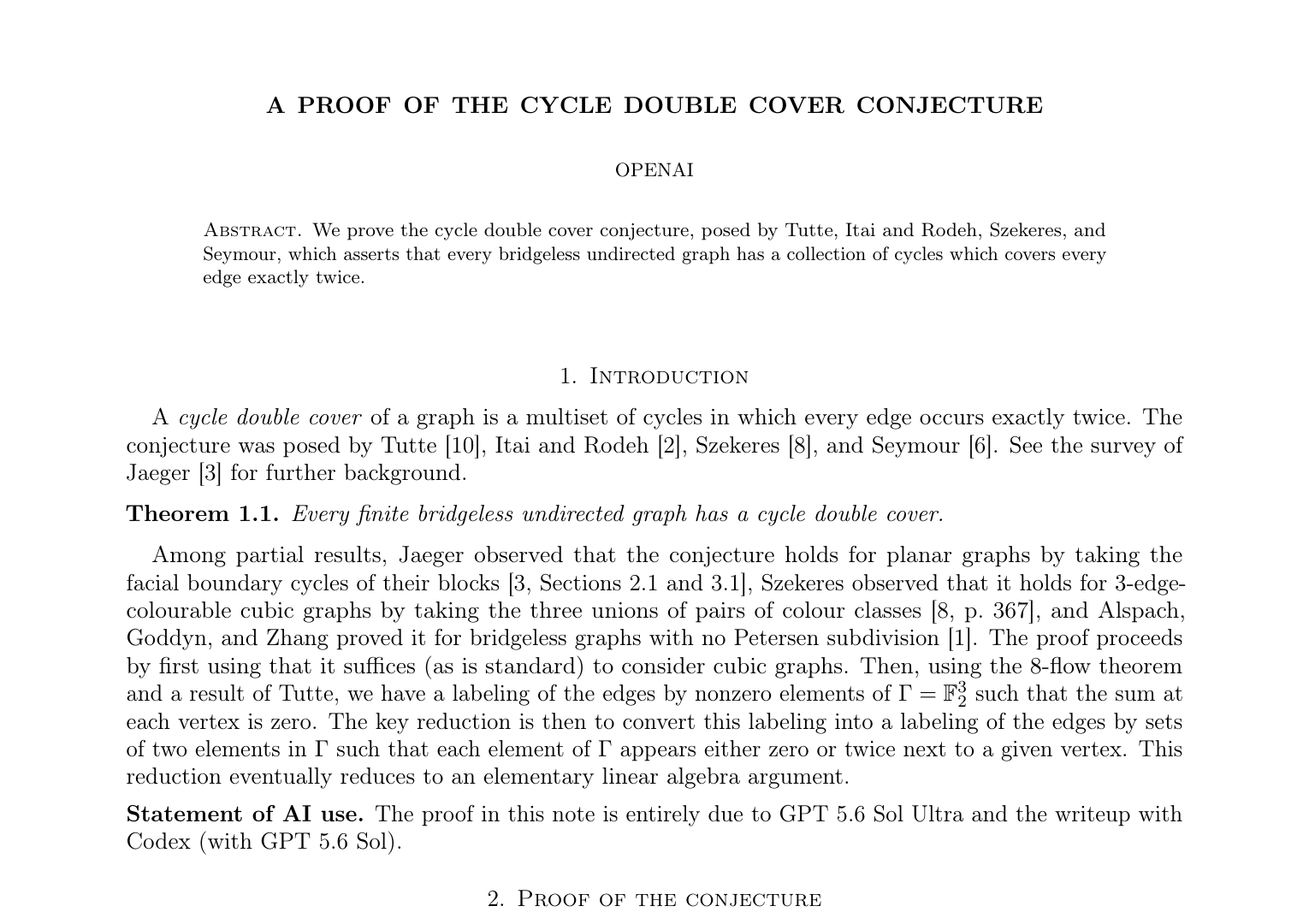
On July 10, 2026, OpenAI researcher Ethan Knight announced that GPT-5.6 Sol in Ultra mode had produced a proof of a graph-theory conjecture first published in 1973. A follow-up post linked two unusually direct artifacts: a three-page proof manuscript and a PDF described as the prompt. These are release documents, not raw execution artifacts.
The claim merits attention for three reasons. The conjecture is old, easy to state and notoriously resistant to proof. The released argument is only three pages. And OpenAI attributes the mathematical content to GPT-5.6 Sol in Ultra mode. The released materials do not disclose whether the run used web search, code execution, a theorem prover, a proof assistant or other tools.
Those facts justify attention. They do not justify skipping verification. Mathematics has a simple rule that survives every technology cycle: a proof becomes trusted because other people can reconstruct it, test its critical steps and fail to break it—not because its author, human or machine, labels it a proof.
What the Cycle Double Cover Conjecture says
A graph is a collection of vertices—the points—and edges joining them. Under the convention fixed by OpenAI’s prompt, a cycle is a connected 2-regular submultigraph: every vertex used by the subgraph has degree two. In a loopless multigraph, two parallel edges can therefore form a cycle of length two.
A bridge, also called a cut-edge, is an edge whose removal increases the number of connected components. Informally, it is the only road between two parts of a network. No cycle can contain a bridge: if a cycle used that edge, the remainder of the cycle would provide another route between its endpoints after the edge was removed.
A graph is bridgeless when it has no bridge. A cycle double cover is a finite multiset of cycles in which every edge of the graph appears exactly twice, counting multiplicity. Different cycles are allowed to overlap. A cycle may also be repeated. The requirement is neither “at least twice” nor “on average twice.” It is exactly twice for every edge.
The formulation in the released task: Every finite loopless bridgeless undirected multigraph has a cycle double cover.
This is a global existence claim, including disconnected graphs and multigraphs with parallel edges.
The distinction between cycle and circuit varies across the literature. Some authors use “cycle” for any even subgraph—one in which every vertex has even degree. Such a subgraph may be disconnected or may have vertices of degree greater than two, but its edges can be decomposed into edge-disjoint connected circuits. That is why the two formulations of the basic conjecture are equivalent. They are not interchangeable when someone claims a bound on the number of connected cycles.
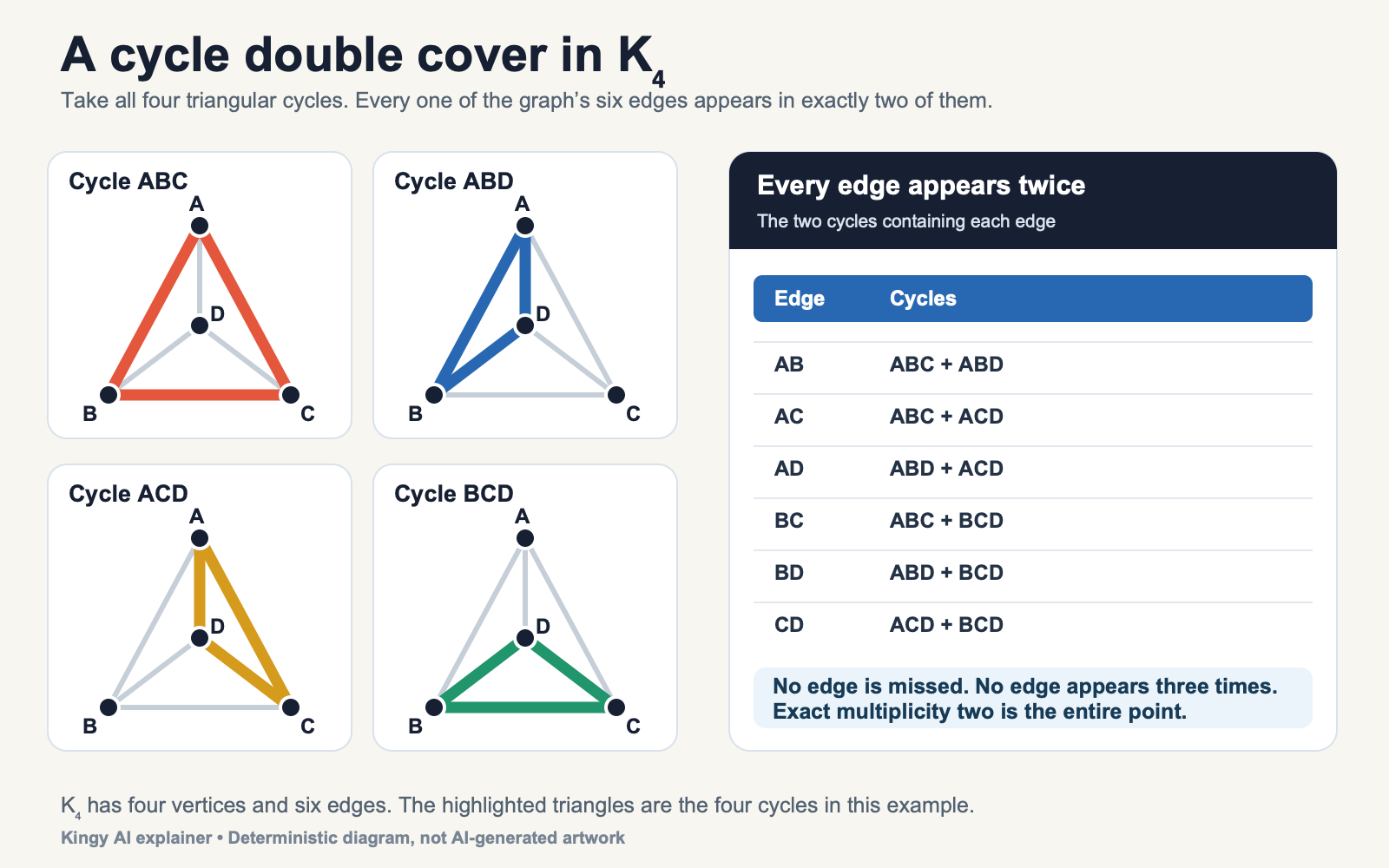
A small example: four triangles cover K4
Take the complete graph on four vertices, K4. It has six edges and four triangular cycles: ABC, ABD, ACD and BCD. Every edge belongs to exactly two of those triangles. For example, AB lies in ABC and ABD; CD lies in ACD and BCD. The four triangles therefore form a cycle double cover.
Why a simple-looking problem lasted more than 50 years
The conjecture is generally traced to George Szekeres’s 1973 paper for cubic graphs and Paul Seymour’s independent general formulation around 1979. Itai and Rodeh posed an equivalent variant in 1978. Cun-Quan Zhang’s monograph, Circuit Double Cover of Graphs, notes that the conjecture’s informal origin is older and somewhat uncertain. “Roughly half-century-old” is therefore more accurate than pretending there was one immaculate birthday.
Many graph classes are easy. For a planar bridgeless graph, the facial boundaries of its blocks give the required double coverage: every edge borders two faces. For a cubic graph with a proper three-edge-colouring, take the three pairwise unions of colour classes. Each edge colour appears in exactly two unions, and each union decomposes into cycles.
The difficulty remains after mathematicians remove all those friendly cases. As summarized in Zhang’s monograph, a smallest counterexample, if one exists, can be taken to be simple, 3-connected, cubic, nonplanar and not three-edge-colourable, with no nontrivial 2- or 3-edge-cut. Later reducibility and computational results push its girth to at least 12; related structure theorems require oddness—the minimum number of odd circuits in any 2-factor—of at least six and a subdivision of the Petersen graph. The Petersen graph itself is not a counterexample.
That leaves the central obstacle: local cycle choices must agree globally while covering every edge with exact multiplicity two. It is easy to produce closed walks, higher-multiplicity covers, fractional decompositions or constructions that work on a restricted graph family. Converting those into connected cycles with exact integral coverage everywhere is where attractive arguments tend to break.
Flows, surfaces and snarks: the map around the conjecture
Cycle double covers sit at an intersection of several major graph-theory viewpoints. The first is nowhere-zero flow. A flow assigns values to oriented edges while conserving the total at each vertex. It is nowhere-zero when no edge receives zero. A nowhere-zero 4-flow provides a particularly structured even-subgraph cover and therefore implies a cycle double cover; the converse is not generally true. More importantly for the new manuscript, a universal 8-flow theorem was already known, but it did not automatically yield exact double coverage. That gap is why OpenAI’s proposed conversion is potentially consequential.
The second viewpoint is surface embedding. If a graph is embedded on a surface so that every face boundary is a genuine cycle, the face boundaries cover every edge twice, once from each side. For connected cubic graphs, the implication also runs back: glue a disc along every cycle in a double cover and the local cubic structure produces a surface. This connection, discussed in Jaeger’s survey, relates the conjecture to circular or strong embedding questions. For vertices of higher degree, the same gluing can create pinch points rather than a true surface, so the general embedding statement is stronger.
The third viewpoint is the theory of snarks. In broad usage, a snark is a cubic graph that cannot be properly edge-coloured with three colours; stricter definitions also require simplicity, connectivity and girth conditions. Snarks are not counterexamples. They are the part of the search space left after easy constructions and reductions have been removed. Szekeres gave a cycle double cover for the Petersen graph, the most famous snark. A hypothetical smallest counterexample would have to be far more structurally constrained than “looks like the Petersen graph.”
There is also a historical connection to the Four-Colour Theorem through Tait colourings of planar cubic graphs. That connection is easy to overstate. The ordinary cycle double cover statement for planar bridgeless graphs follows by taking facial boundary cycles block by block—or, equivalently, by decomposing any facial even subgraph into circuits—and does not require the Four-Colour Theorem. The four-colour relationship concerns stronger colouring and embedding structures.
What OpenAI’s three-page proof tries to do
The new note does not attack arbitrary graphs directly. It begins with a standard reduction: it is enough to prove the result for bridgeless loopless cubic multigraphs. A cubic graph has exactly three edges incident to each vertex, making the local algebra rigid enough to exploit.
The proof then imports a classical flow theorem. Let Γ be the three-dimensional vector space over the two-element field, written Γ = F23. It has eight elements. A Γ-flow labels the oriented edges so that flow is conserved at every vertex. “Nowhere-zero” means no edge receives the zero vector. The note invokes established work of Kilpatrick and Jaeger, together with Tutte’s group-flow theorem, to obtain such a Γ-flow for every bridgeless graph.
This is the crucial setup, not yet the conclusion. A nowhere-zero 8-flow does not automatically give a cycle double cover. The conversion from a higher-order flow to exact double coverage is precisely the kind of step that must not be waved away.
- Reduce to cubic graphs. Every vertex now has three incident edges.
- Choose a nowhere-zero Γ-flow. Because every element is its own negative in F23, the orientation signs disappear and flow conservation at a cubic vertex becomes x + y + z = 0. Thus z = x + y, and the three nonzero labels are distinct.
- Seek a two-element label set Pe for every edge. The goal is that, for every vertex and every group element s, s occurs in either zero or two of the three incident edge-sets.
- Turn each group element into an even subgraph. Define Ms as the set of edges whose Pe contains s. The local zero-or-two condition makes every vertex have degree zero or two in Ms, so Ms is a disjoint union of cycles.
- Use the two-element sets to get double coverage. Every edge belongs to exactly two Ms because Pe contains exactly two group elements. Decompose all Ms into connected components, and every edge appears in exactly two cycles.
The first lemma is almost immediate once those Pe sets exist. The entire proof therefore turns on constructing them consistently across both ends of every edge.
The local construction and the global compatibility problem
At each cubic vertex, order the incident edges as a, b and c, with flow labels x, y and z = x + y. The note assigns local offsets 0, x and 0. After adding an arbitrary vertex translation t, the three local two-element sets become {t, t + x}, {t + x, t + z} and {t, t + z}. Every vector appears locally either zero times or twice.
That solves the problem at one vertex. An edge has two endpoints, however, and the two endpoints may initially assign different sets to it. The manuscript introduces one vertex variable tv in Γ and one bit εe for every edge. Endpoint agreement becomes a linear system over F2:
tu + tv + εe f(e) = de for each edge e = uv.
The de term records the mismatch between the two local offset choices.
Lemma 2.2 says this system always has a solution. The proof uses linear duality: assume a family of dual vectors annihilates every possible left-hand side. The edge variables force each dual vector to vanish on its flow label, while the vertex variables force the three incident dual vectors to sum to zero. A local parity calculation then shows that the purported obstruction also annihilates the mismatch vector d. Summed over all vertices, each nonzero edge contribution is counted twice and vanishes in F2. Therefore d lies in the image of the linear map, the system is solvable, and the local sets can be made globally consistent.
If every stated hypothesis and duality step survives specialist review, this is the manuscript’s conceptual hinge: an 8-flow is converted into exact double coverage through two-element group labels and a parity argument. The proof is short because the hard global constraint is compressed into one linear system and one obstruction calculation.
A precision point: the argument produces eight labelled even subgraphs Ms, one for each element of Γ. An Ms may have several disconnected cycle components. The note therefore does not establish “eight connected cycles are enough” in the ordinary connected-cycle sense.
Our technical sanity check—and its strict limits
For this article, Kingy AI ran a saved audit on the three connected bridgeless cubic simple graphs in NetworkX’s graph atlas, sampling 25 nowhere-zero F23-flows on each. It also generated 3-regular simple graph instances with seeds 0–24 at orders 8, 10, 12 and 14, retained 24, 25, 25 and 24 connected bridgeless instances respectively, and sampled ten flows on each. The linear compatibility system and resulting local multiplicities passed all 1,055 sampled-flow checks.
Reproducibility protocol for the bounded check
The saved Python/NetworkX script builds a cycle-space basis, samples each of the flow’s three binary coordinates as a seeded random combination of basis cycles, rejects any flow with a zero edge label, solves the manuscript’s equation (4) by Gaussian elimination over F2, then verifies endpoint agreement, two distinct labels per edge and the zero-or-two incidence condition at every vertex. Atlas-flow seeds are 10,000 × graph index + sample; random-graph flow seeds are 1,000,000 × order + 1,000 × graph seed + sample. The program did not test the reduction from arbitrary graphs, multigraphs with parallel edges or any universal case beyond those finite samples.
That is useful evidence that the displayed construction behaves as described. It is not an independent proof of the theorem. Finite experiments cannot establish a universal statement, and a program can faithfully implement the same mistaken assumption as a manuscript. The meaningful next step is reconstruction by graph theorists who know the flow theorems, reductions and cycle conventions in their original settings.
The parts specialists should audit most aggressively are:
Reduction
Does the cited cubic reduction cover disconnected loopless multigraphs and lift the resulting cycles exactly as required?
Flow theorem
Are the group-flow equivalence and nowhere-zero Γ-flow invoked with the correct hypotheses and multigraph conventions?
Duality lemma
Does every possible obstruction to the linear system satisfy the local parity identity used to eliminate it?
Cycle meaning
Are 2-cycles, disconnected even subgraphs and component decompositions handled consistently throughout?
Multiplicity
Does every original edge appear in exactly two connected cycle components after all decompositions?
Circularity
Does any cited reduction or flow result quietly assume a statement equivalent to the conjecture being proved?
What “64 subagents in under one hour” means—and does not mean
OpenAI’s GPT-5.6 release page and model documentation identify gpt-5.6-sol as the model and Ultra as a multi-agent setting, not a separate model ID. OpenAI says Ultra coordinates four agents in parallel by default; its release evaluations also show 16-agent configurations. Separately, the Cycle Double Cover prompt says up to 64 concurrent agents were available and instructs the root to use multiagent v2 aggressively and dynamically.
The prompt is far more revealing than a generic “solve this conjecture” instruction. It asks for a diverse portfolio of proof strategies, maintains an explicit registry of approach families, preserves independence between early branches, blocks routes that end at theorem-strength missing lemmas, and assigns adversarial agents to test exact multiplicity, false cycles, parallel edges, disconnected graphs and circular reasoning. The root is told to synthesize, challenge, redirect and launch new rounds.
The prompt permits public search for ordinary mathematical background and standard named theorems, forbids searching for a solution to this exact conjecture or merely checking whether it is open, and lists computational sanity checks among possible strategies. No released trace shows which tools were actually used.
There are two important caveats.
First, the documents describe three different quantities. OpenAI says Ultra coordinates four agents by default. The prompt makes up to 64 concurrent agents available. Knight’s announcement says the run used 64 subagents. No released agent tree, transcript or concurrency chart reveals whether all 64 subagents were simultaneously active, how many were created in total, whether the root counts toward the prompt’s ceiling, what each attempted or how the root selected the winning route.
Second, the published prompt says, “Spend at least 8 hours on this before even thinking of returning or giving up,” while Knight reports that the proof was produced in just under one hour. OpenAI has not reconciled that contradiction or defined whether the shorter interval means wall-clock time, model execution time, time to first proof, or whether auditing and write-up time were included.
The prompt also tells the system to assume that an affirmative proof exists and not to answer merely that the problem is open. That is a powerful search prior. It can prevent premature surrender, but it can also encourage a system to rationalize an attractive route. The adversarial-agent instructions are intended to counter that pressure. Only independent checking can tell us whether they succeeded.
| Claim or artifact | Public evidence | Current confidence |
|---|---|---|
| GPT-5.6 Sol and the Ultra configuration are documented | OpenAI release and model documentation | Confirmed |
| A run used 64 subagents | Knight’s announcement; the prompt permits up to 64 concurrent agents | Company claim, no trace |
| Reported elapsed time was just under one hour | Knight’s announcement | Company claim, timing undefined |
| Two OpenAI-hosted release PDFs are public | OpenAI CDN PDFs linked by an OpenAI researcher | Public, but not an execution trace |
| The proof is correct | Three-page manuscript, public Lean formalization and independent expositions by Jim Geelen and Sang-il Oum | Strong formal and specialist support; peer-reviewed journal acceptance remains pending |
| The result was formally verified | A public Lean formalization is now available | The encoded theorem and proof are machine checked; peer-reviewed acceptance remains separate |
| The reported run is reproducible | Released materials omit the model snapshot, full instructions, agent trace, settings, tool activity, timing boundaries, compute and human interventions | Insufficient for controlled reproduction |
Why the release is not yet comparable to OpenAI’s unit-distance result
OpenAI has already announced a different major mathematical result in 2026: an AI-generated disproof of a central conjecture in the planar unit-distance problem. In that case, OpenAI published external mathematicians’ assessments and companion remarks. The company explicitly said a group of outside mathematicians had checked the proof.
The announcement and linked documents name no comparable outside reviewer or companion assessment. A three-page proof can be perfectly correct; brevity is not a defect. But brevity also concentrates the risk: one misapplied reduction or one unnoticed exception can carry most of the theorem.
What acceptance would look like
Mathematics has no single authority that flips a conjecture from open to solved. Acceptance accumulates through scrutiny:
- A public manuscript. OpenAI has cleared this first step.
- Independent specialist reconstruction. Experts must check the cited theorems, conventions and critical lemma without relying on the model’s confidence.
- Revision and versioning. Questions, corrections and clearer treatments of reductions should produce a dated manuscript history.
- Peer review and publication. Journal acceptance would materially increase confidence, although no review process guarantees perfection.
- Community use. The result becomes a theorem in practice when specialists teach it, cite it and build new work on it without recurring foundational objections.
- Optional formal verification. A proof-assistant development would offer unusually strong machine-checkable assurance, provided it states the exact theorem and exposes its dependencies.
For an AI-generated result, reproducibility should become part of that norm. A controlled reconstruction would require the exact model snapshot; system and developer instructions; multiagent-v2 build, configuration and concurrency semantics; sampling settings; raw agent tree and messages; tool and search activity; timing boundaries; token, compute and cost totals; human interventions; the raw final response; and the write-up’s revision history. The public prompt permits an approximate rerun, but not a faithful reproduction. Structured summaries and auditable artifacts could expose much of this without publishing private chain-of-thought.
If the proof survives, the implications are substantial
For graph theory
The result would settle one of the central long-running questions about cycle structure in bridgeless graphs. The most reusable contribution may be the conversion mechanism itself: a nowhere-zero F23-flow, two-element edge labels and a global compatibility system. Researchers would immediately ask whether the method strengthens related cover conjectures, yields constructive algorithms, controls the number or length of cycles, preserves prescribed cycles, or extends to oriented and five-cycle variants.
For AI-assisted mathematics
The experiment would be evidence that parallel search is becoming scientifically useful, not merely faster. The public prompt is designed to fight a known failure mode of multi-agent systems: dozens of agents converging on the same elegant mistake. It deliberately protects incompatible approaches, tracks bottlenecks and gives adversarial reviewers concrete failure conditions.
That does not make 64 the magic number. The interesting variable is the quality of orchestration: how independence is preserved, how failed branches are pruned, how critics are assigned and how the root decides that a proof has actually closed every gap. Without the trace, we can evaluate the design philosophy but not the run dynamics.
For research credit and publishing
The PDF lists “OpenAI” rather than named human authors. Its AI-use statement attributes the proof to GPT-5.6 Sol in Ultra mode and the write-up to Codex. The documents do not identify who selected the problem or authored or edited the prompt, nor disclose what human supervision, filtering, mathematical review or editing occurred before release. The AI-use statement is attribution, not an operational account. If AI systems begin producing publishable mathematics, institutions will need clearer norms for authorship, accountability and correction.
The likely near-term bottleneck is not generation alone. It is verification capacity. A system that produces candidate proofs faster than experts can review them changes the economics of research, but it does not remove expert judgment. It may make expert attention more valuable.
What this result does not establish
Even if the manuscript is correct, it would not show that GPT-5.6 can reliably solve arbitrary open problems. It would not show that the system’s internal adversarial agents constitute independent verification. It would not prove that the model originated every idea rather than recombining concepts from its training data and public background sources. It would not make peer review obsolete. And it would not tell us the success rate across all conjectures attempted with the same setup.
One successful run can be historically important without being a complete capability evaluation. To assess the system, researchers would need a preregistered problem set, unsuccessful runs, cost and timing distributions, contamination checks, stable scoring rules and independent graders. OpenAI’s earlier First Proof work was explicit about the difficulty of evaluating research-level proofs. The same caution should apply here.
Follow the live record: The Mathematics & Science Breakthrough Tracker preserves the proof’s formal-verification status, independent sources, limits and correction history.
Bottom line
OpenAI has released a concise, public and technically specific proposed proof of a major graph-theory conjecture, attributed to GPT-5.6 Sol in Ultra mode and to a run that OpenAI says used 64 subagents.
The argument has a clear spine. Reduce to cubic graphs. Start from a nowhere-zero flow over an eight-element vector space. Replace each edge label with a two-element set. Use linear duality to make the local choices agree globally. Read off eight even subgraphs whose connected components cover every edge exactly twice.
That is enough to warrant immediate expert attention. It is not enough to write “case closed.” The honest headline on July 10, 2026 is that OpenAI has produced a serious proof claim with an unusually compact argument and unusually incomplete experiment reporting. The next chapter belongs to the graph theorists trying to break it.
FAQ
Did GPT-5.6 Sol in Ultra mode solve the Cycle Double Cover Conjecture?
OpenAI says it produced a complete proof. The manuscript, public Lean formalization and two independent specialist expositions now provide substantially stronger evidence than the original release. Peer-reviewed journal acceptance has not been located.
Were 64 subagents definitely running at the same time?
The announcement says the result used 64 subagents, and the prompt says up to 64 concurrent agents were available. No public trace shows the exact concurrency pattern, total agent turns or division of work.
Why must the graph be bridgeless?
A bridge lies on no cycle. If removing an edge disconnects the graph, there cannot be another path between its endpoints, so no cycle can contain that edge. It therefore cannot be covered even once by cycles, let alone twice.
Does the proof say every graph needs only eight cycles?
No. It constructs eight labelled even subgraphs, each of which may be a disjoint union of several connected cycles. Their connected components form the cycle double cover.
Was the result formally checked in Lean or another proof assistant?
Yes. A public Lean formalization is now available. It checks the encoded theorem and proof; specialists must still assess correspondence with the accepted conjecture and the surrounding exposition.
Why can’t the three-page proof be accepted immediately?
Length is not the issue. Specialists must verify the cubic reduction, the flow theorem’s hypotheses, the endpoint-compatibility lemma, the graph conventions and the exact-two multiplicity conclusion. Mathematical acceptance comes from reconstruction and sustained scrutiny.
Primary sources and methodology
- Ethan Knight’s original announcement, July 10, 2026.
- OpenAI’s three-page proposed proof.
- The published prompt allowing up to 64 concurrent agents.
- OpenAI’s GPT-5.6 launch and Ultra description.
- Cun-Quan Zhang’s Cycle Double Cover overview.
- Szekeres’s 1973 paper and Itai and Rodeh’s 1978 formulation.
- Jaeger’s 1985 survey.
- Alspach, Goddyn and Zhang’s Petersen-subdivision-free result.
- Huck’s reducible-configuration result.
- The 2013 exhaustive small-snark study and the 2025 counting paper.
Method note: Kingy AI reviewed the OpenAI announcement, proof and prompt; checked current OpenAI model documentation; compared the theorem statement and historical claims with scholarly sources; searched the reviewed materials for independent expert verification; and ran the documented bounded computational check of the paper’s F23 edge-set construction. The test is not presented as a proof. The featured image is an AI-generated editorial metaphor; all mathematical diagrams are deterministic, source-backed graphics.
The Kingy Brief
Get The Kingy Brief.
AI changes, original tests and one practical thing to try. Fridays at 09:00 Vancouver time.
Free · Double opt-in · Unsubscribe anytime
Sign up for The Kingy Brief on Beehiiv.
Signup help and newsletter schedule
Signup form provided by Beehiiv. After submitting, check your inbox for "Confirm your subscription to The Kingy Brief" and open its confirmation link. Check Spam or Promotions if you cannot find it.
Fridays at 09:00 Vancouver time: source-checked AI changes, original tests and one practical thing to try. The weekly restart begins October 9, 2026. We skip a week when there is not enough verified material. Free. Unsubscribe anytime.