Daily AI Launch Radar: June 12, 2026
Source context, October 4, 2026 (UTC): This is the June 12 launch roundup. The current notes below reflect public official sources checked on October 4; they do not establish what was available at every point on June 12. The featured image is an editorial illustration. No authenticated integration, model run, or hands-on product test was performed for this source check.
TL;DR: This daily Radar summarizes source-checked AI launch candidates for Kingy AI readers, with pricing notes, use cases, and human-review caveats where details are still emerging.
Launch Snapshot
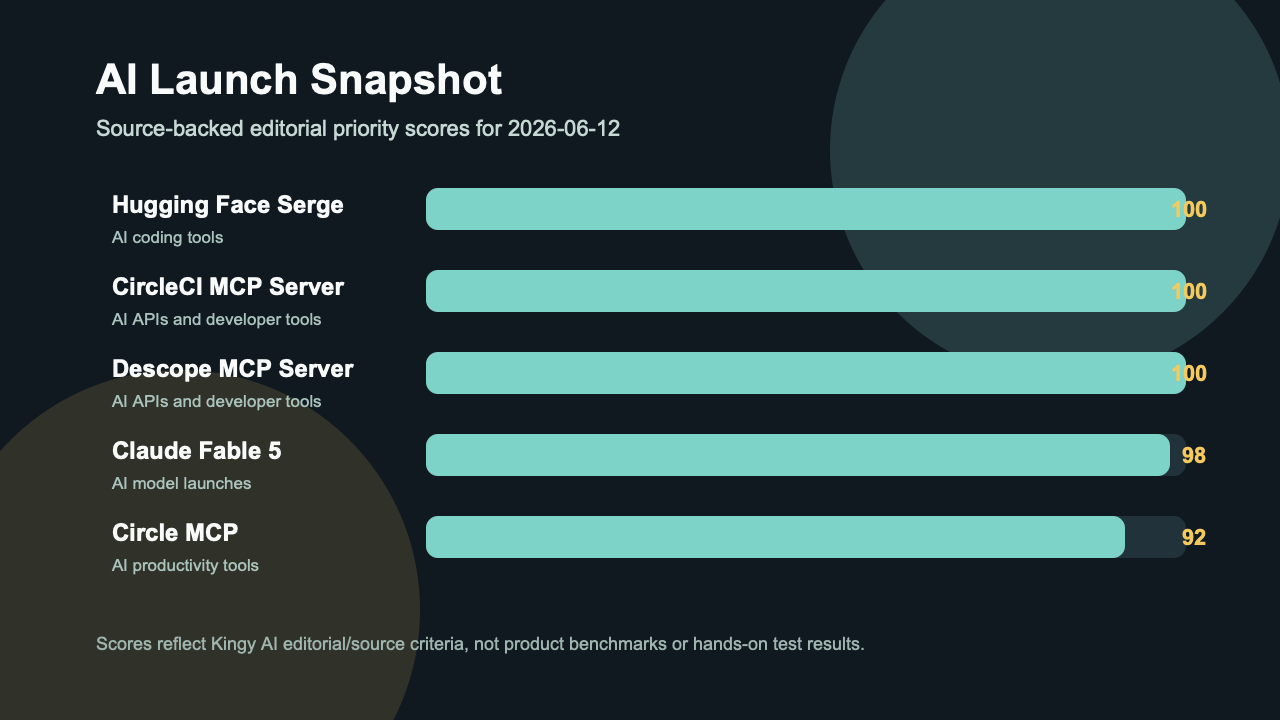
The snapshot below preserves Kingy AI’s June 12, 2026 editorial research-priority scores. It is not a current ranking, product benchmark, hands-on test result, or measure of current availability. The scores have not been recalculated for this source check.
Strongest Launches
Hugging Face Serge
Hugging Face Serge is an open-source GitHub-native AI code reviewer that reviews pull requests with OpenAI-compatible language models and repository-owned review policies.
Sources for this June 12 Radar entry: launch source, docs, GitHub repo, Hugging Face page.
Why it matters: AI code review tools often fail when they create a separate review surface or ignore existing maintainer rules. Serge matters because it keeps review policy in the repository, works inside GitHub’s normal pull request process, and gives maintainers deployment choices ranging from a quick GitHub Action to a hosted app with human-in-the-loop review.
Who should care: AI Platform Teams, AI Engineers, Developers
Pricing: Serge is open source under the Apache-2.0 license. No separate Serge SaaS price was verified. Teams still need an OpenAI-compatible model endpoint or provider API key, which may carry separate provider costs; the webhook and web app modes run on your server and may also incur hosting costs. Confirm the license on the official license/source page.
What launched: Hugging Face published Serge on June 12, 2026 as an open-source GitHub-native code review system with GitHub Action, GitHub App webhook, and staged web app modes. See the official launch source.
What feels promising: AI code review tools often fail when they create a separate review surface or ignore existing maintainer rules. Serge matters because it keeps review policy in the repository, works inside GitHub’s normal pull request process, and gives maintainers deployment choices ranging from a quick GitHub Action to a hosted app with human-in-the-loop review.
What feels unproven: Review quality depends on the selected model and repository policy quality; forked pull request workflows need careful secret-handling and permission review; no hosted commercial pricing was verified. Current docs also describe an optional write-capable CI tasks flow that can open fix PRs or follow-up commits. It is off by default and gated by GitHub Actions OIDC; review those write permissions separately from the reviewer’s read-only repository context tools.
CircleCI MCP Server
CircleCI MCP Server connects AI coding assistants to CircleCI pipeline, build, log, test, and workflow data through the Model Context Protocol.
Current deployment note: The original local npm server linked below is deprecated and no longer maintained; its repository says it will be archived. CircleCI now recommends its hosted MCP server or CLI MCP. The hosted server supports OAuth2 or a personal API token; the CLI uses existing CircleCI login credentials or CIRCLE_TOKEN.
Sources for this June 12 Radar entry: launch source, docs, GitHub repo.
Why it matters: Coding agents can generate code faster than many teams can validate it. CircleCI MCP Server gives those agents CI context, making build failures, flaky tests, and pipeline inefficiencies available in the same assistant workflow developers use to write and review code.
Who should care: AI Platform Teams, AI Engineers, Developers, Operators
Pricing: At the October 4, 2026 source check, CircleCI lists a Free cloud plan at $0/month with up to 6,000 build minutes on the small Docker resource class and up to 5 active users/month. Other resource classes and usage consume credits differently. The original MCP server code is open source; current MCP connections still require a CircleCI account and remain subject to normal CircleCI usage limits and billing. Confirm current pricing on the official pricing/source page.
What launched: CircleCI published an official MCP Server product page for connecting AI assistants to CircleCI data. The product page captured for this source check names Cursor, Claude Code, and Windsurf, among its examples. See the official launch source.
What feels promising: Coding agents can generate code faster than many teams can validate it. CircleCI MCP Server gives those agents CI context, making build failures, flaky tests, and pipeline inefficiencies available in the same assistant workflow developers use to write and review code.
What feels unproven: Review OAuth grants, personal API tokens, or local CLI credentials for the deployment you choose. The value depends on MCP client support and the quality of prompts used by the coding assistant. The hosted server can rerun or cancel workflows; the CLI exposes broader administrative commands. Review client approvals and tool scope before allowing automated changes.
Descope MCP Server
Descope MCP Server is a hosted remote MCP server that lets AI assistants inspect and manage Descope identity projects with read-first controls and human-approved write elevation.
Sources for this June 12 Radar entry: launch source, docs, GitHub repo.
Implementation note: The docs link now redirects to the hosted project-management MCP documentation. The GitHub link redirects to a separate local stdio sample using a project ID and management key; it is not evidence that the sample shares the hosted service’s read-first session and write-elevation controls.
Why it matters: Identity is becoming a core problem for AI agents and MCP servers. Descope MCP Server matters because it lets developers and identity teams operate auth infrastructure from an AI assistant while preserving a human approval layer for changes that could affect users, tenants, credentials, or production authentication flows.
Who should care: AI Platform Teams, AI Engineers, Developers, Enterprises
Pricing: At the October 4, 2026 source check, Descope lists a Free Forever plan at $0 with usage limits, Pro starting at $249/month billed annually, Growth starting at $799/month billed annually, and Enterprise by contact. Paid plans can incur usage-based overages. Specific MCP Server limits by plan should be confirmed in the Descope console or with Descope sales. Confirm current pricing on the official pricing/source page.
What launched: Descope announced the Descope MCP Server on June 8, 2026 as part of its AI Launch Week, with natural-language access to documentation, project configuration, users, tenants, auth flows, audit logs, and agentic identity objects. See the official launch source.
What feels promising: Identity is becoming a core problem for AI agents and MCP servers. Descope MCP Server matters because it lets developers and identity teams operate auth infrastructure from an AI assistant while preserving a human approval layer for changes that could affect users, tenants, credentials, or production authentication flows.
What feels unproven: Write access can affect production identity infrastructure and should require policy, audit, and approval review; Plan-specific availability and limits for the MCP Server were not fully verified outside the public pricing page; Teams with multiple Descope companies need separate authenticated sessions; Security depends on proper session handling, elevation review, and least-privilege project permissions.
Claude Fable 5
Anthropic launched Claude Fable 5 for general use on June 9, 2026 alongside the more restricted Claude Mythos 5.
Availability history and current status: Anthropic suspended access on June 12; its July 1 update reports access restored. At the October 4 source check, the Fable 5 overview labels the model Legacy / Active (legacy) and recommends Fable 5.1. The lifecycle table lists it Active. Neither source says Fable 5 is retired. Mythos 5 remains invitation-only for defensive cybersecurity workflows through Project Glasswing.
Sources for this June 12 Radar entry: launch source, docs.
Why it matters: The model is a major frontier AI release.
Who should care: AI Product Teams, Developers, Enterprises, Researchers
Pricing: The June launch announcement listed Claude Fable 5 and Claude Mythos 5 at $10 per million input tokens and $50 per million output tokens. The Fable 5 overview still lists those base API rates at the October 4, 2026 source check and says Mythos 5 shares its pricing; invitation-only access is a separate restriction. The original subscription access window through June 22 is historical, not a current entitlement. Current plan guidance distinguishes plan and seat types: some include limited Fable usage, while others require usage credits from the start. Confirm current pricing on the official pricing/source page and the current model and plan documentation above.
What launched: On June 9, 2026, Anthropic launched Claude Fable 5 for general use and Claude Mythos 5 initially for a small group of cyberdefenders and infrastructure providers through Project Glasswing. The announcement described access for select biology researchers as coming soon, rather than already available at launch. See the official launch source.
What feels promising: The model is a major frontier AI release.
What feels unproven: Higher-risk capabilities are gated by safeguards or restricted access. Availability and included usage depend on the model, platform, plan, seat type, and organizational settings. These are vendor-documented claims, not Kingy AI benchmark or deployment results.
Circle MCP
Circle MCP connects a Circle community to AI tools such as Claude, ChatGPT, and Gemini so admins can query community data and perform operations allowed by their chosen access level. Per-action approval depends on the AI client’s settings.
Sources for this June 12 Radar entry: launch source, docs.
Why it matters: Community operators increasingly manage work inside AI assistants. Circle MCP matters because it lets those assistants use live community context instead of generic advice through an admin-authorized connection. The chosen server access level limits available tools; AI client settings control any additional per-action approvals.
Who should care: Small Business Owners, Creators, Marketers, Operators
Pricing: Circle states Circle MCP is available on Business plans and above. The public pricing page should be checked for current plan pricing before purchase; a 14-day free trial is promoted for Circle generally. Confirm current pricing on the official pricing/source page.
What launched: Circle published a June 12, 2026 use-case guide for Circle MCP, a connector that links Circle community data and actions into external AI assistants through the Model Context Protocol. See the official launch source.
What feels promising: Community operators increasingly manage work inside AI assistants. Circle MCP matters because it lets those assistants use live community context instead of generic advice through an admin-authorized connection. The chosen server access level limits available tools; AI client settings control any additional per-action approvals.
What feels unproven: Circle MCP appears strongest for existing Circle admins, not as a standalone AI product. Current docs offer Read only access, which hides all write tools, and Full access, which enables changes; client approval settings are an additional control when writes are available. Check your AI client’s supported plan and workspace policy. MCP calls count against the community’s Admin API quota, so verify current account limits and billing before purchase.
Related Kingy AI Links
For more launch tracking and founder resources, see AI Launches, AI Tools, and the AI Sponsored Video ROI Calculator.
Sponsor path
Sponsor Kingy AI launch coverage
Launching an AI product that needs clear demos, creator education, and buyer trust? Sponsor a Kingy AI video or launch feature.
The Kingy Brief
Get The Kingy Brief.
AI changes, original tests and one practical thing to try. Fridays at 09:00 Vancouver time.
Free · Double opt-in · Unsubscribe anytime
Sign up for The Kingy Brief on Beehiiv.
Signup help and newsletter schedule
Signup form provided by Beehiiv. After submitting, check your inbox for "Confirm your subscription to The Kingy Brief" and open its confirmation link. Check Spam or Promotions if you cannot find it.
Fridays at 09:00 Vancouver time: source-checked AI changes, original tests and one practical thing to try. We skip a week when there is not enough verified material. Free. Unsubscribe anytime.