Earlier version last updated: 2026-07-23
Earlier version last verified: 2026-07-23. Public documentation checked: October 4, 2026 (UTC). This guide uses official source descriptions; Kingy.ai did not install Serge, connect a provider, run a pull-request review, or execute a fix task for this update.
TL;DR: Hugging Face Serge is an open-source, GitHub-native AI reviewer. Its strongest fit is a team that wants repository-owned review rules, a choice of OpenAI-compatible model providers, and the option to edit or discard model comments before they reach a pull request.
What launched?
Hugging Face introduced Serge on June 12, 2026. The official launch post, documentation, and Apache-2.0 repository are the primary sources for this review.
AI review is most useful when it fits the pull-request workflow maintainers already use. Serge keeps its policy on the repository’s default branch, works inside GitHub review threads, and offers three deployment modes: a GitHub Action, a GitHub App webhook, and a staged web app with human review.
What is Hugging Face Serge?
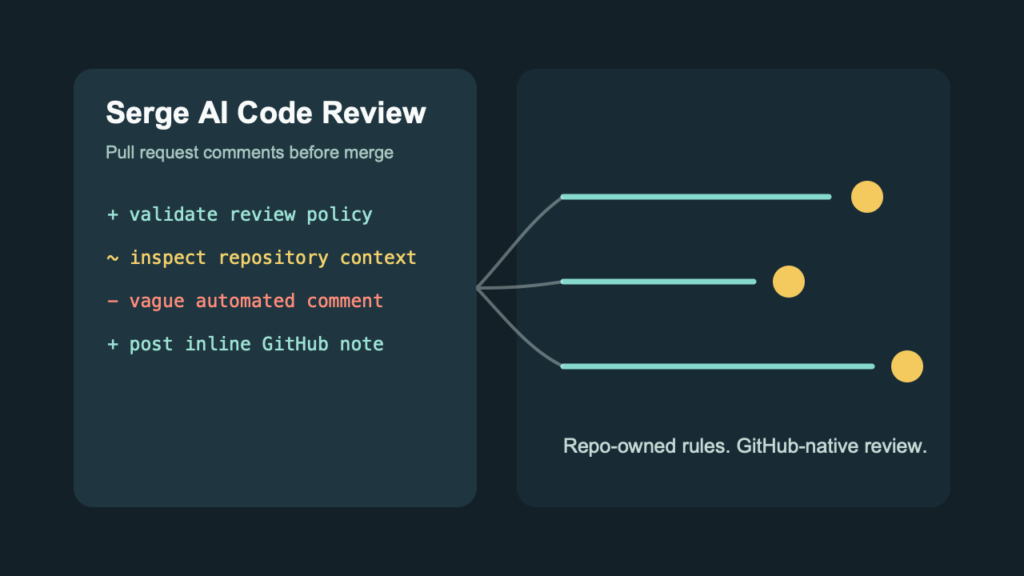
Serge reads pull requests, applies repository-owned instructions, checks that proposed inline comments match valid diff positions, and publishes through GitHub’s review flow. Position validation does not establish that a finding is correct. It can use OpenAI, the Hugging Face Router, local vLLM, TGI or LM Studio endpoints, and other OpenAI-compatible providers. Its App and web deployments run on your server.
Key capabilities and questions
- Repository policy: review rules and context come from the default branch, keeping pull-request authors from replacing the review policy.
- Inline feedback: proposed comments are checked against diff positions before publication; maintainers still need to judge their accuracy.
- Publishing mode: the manual staged UI lets a reviewer edit, discard, and publish drafts. Action and webhook reviews can publish directly; the web server also exposes that webhook path.
- Provider choice: use an OpenAI-compatible endpoint and choose the model explicitly. Configure token and tool-loop limits for the workload.
- Optional fixes: the current CI tasks flow can open fix pull requests or add follow-up commits. It is off by default and requires the server switch, per-repository opt-in, GitHub Actions OIDC authentication, and write permissions.
Real use cases
- Review pull requests inside GitHub without creating a separate AI review inbox
- Apply repository-specific review rules from the default branch
- Stage AI-generated review comments for maintainer editing before publication
- Run AI review with an OpenAI-compatible provider selected by the team
What teams should review
For maintainers: the GitHub Action is the documented quickest trial for a repository where trusted members can trigger reviews. Forked pull requests can lack secrets or a writable token. Current App documentation also says forked heads are not fully supported and reviews may fail or be skipped. It recommends a maintainer-controlled web-app review loop for fork-heavy projects; confirm your repository workflow before relying on it.
For platform and security teams: review provider-key storage, GitHub permissions, default-branch policy, and the model’s access to repository context. The built-in repository context tools are documented as read-only; the optional tasks flow can write code and needs a separate permissions assessment. Use the manual staged UI while assessing comment quality. That publication choice does not automatically gate Action or webhook reviews.
Pricing and free plan
Pricing: Serge’s code is available under Apache-2.0. No separate Serge subscription price is listed in the reviewed official sources. Model usage, your server or local compute, and GitHub Actions usage may carry costs; check the services and limits you choose.
Free plan: the open-source license covers the code, rather than a hosted service allowance. The reviewed sources do not list a separate Serge SaaS free-plan tier. Provider, hosting, and Actions allowances must be checked separately.
How to try it
For the documented Action trial, add LLM_API_KEY as a repository secret, install the official workflow, and select the provider base URL and model. Pin the Action to a tag or commit SHA for reproducibility. An authorized MEMBER, OWNER, or COLLABORATOR can trigger a review on an open pull request with a comment beginning @askserge please review. Start on a non-critical repository with default-branch rules in .ai/review-rules.md and explicit usage limits. These are documentation-based steps, not a workflow Kingy.ai executed.
Comparison snapshot
| Question | Documentation summary (October 4, 2026 UTC) |
|---|---|
| Primary job | GitHub-native review with default-branch rules and configurable providers. Manual staged reviews allow editing before publication; webhook reviews can publish directly. Optional CI tasks can write fixes. |
| Best fit | Maintainers who want repository-controlled policy and teams able to operate a model-backed review service |
| Pricing status | Serge’s code is available under Apache-2.0. No separate Serge subscription price is listed in the reviewed official sources. Model usage, your server or local compute, and GitHub Actions usage may carry costs; check the services and limits you choose. |
| Free plan | Apache-2.0 code; no inference, hosting, or Actions allowance is established by the license |
| Access | Action: configure the secret, provider/model, pinned workflow and trusted comment trigger. App/web: operate your own server and credentials. Check fork limitations; manual staging and auto-publishing webhooks are distinct. |
| Main alternatives | GitHub Copilot code review, CodeRabbit, Sourcery, Graphite Agent AI reviews, and Qodo Git (formerly Qodo Merge) |
Alternatives
Compare deployment control, provider choice, repository policy, publication controls, and the usefulness of comments on your own pull requests. The alternatives below have official code-review documentation; their access requirements and deployment options differ. This is a source-based shortlist, not a comparative benchmark.
- GitHub Copilot code review: GitHub-integrated feedback and suggested fixes; check your plan, organization policy, and usage settings.
- CodeRabbit: automatic pull-request reviews, incremental review of new commits, and comment-based interaction.
- Sourcery: pull-request comments and summaries alongside repository security scanning.
- Graphite Agent AI reviews: enable reviews for selected GitHub repositories through Graphite’s settings.
- Qodo Git (formerly Qodo Merge): pull-request review within Qodo’s platform; deployment availability varies by Git platform.
Risks and unknowns
Serge processes untrusted pull-request content and can send repository context to the selected model provider. Review GitHub permissions, provider data handling, fork strategy, and prompt-injection boundaries before production use. The current security documentation also describes task pods that hold scoped GitHub and model credentials while executing repository build code; it acknowledges residual DNS and GitHub-token exfiltration risks despite network restrictions. These are vendor-described controls and limits, not a Kingy.ai security audit. Review quality still depends on the model and repository rules.
Should you try it?
Test Serge if GitHub-native review, repository-owned policy, and provider choice justify operating the service. Evaluate representative pull requests for actionable findings and false positives. Use the manual staged review path to inspect comments before publishing; do not assume the Action or webhook path waits for human approval. Assess optional write tasks separately.
FAQ
What does Hugging Face Serge do?
Serge reviews GitHub pull requests using repository policy and a chosen model. It checks inline comment positions, supports manually staged reviews, and also has auto-publishing webhook paths. An optional, separately enabled CI tasks flow can propose and commit fixes.
Is Hugging Face Serge free?
Serge’s code is available under Apache-2.0. No separate Serge subscription price is listed in the reviewed official sources. Model usage, your server or local compute, and GitHub Actions usage may carry costs; check the services and limits you choose.
Who is Hugging Face Serge for?
Maintainers who want repository-controlled review policy and teams prepared to manage providers, credentials, permissions, and deployment.
What are alternatives to Hugging Face Serge?
GitHub Copilot code review, CodeRabbit, Sourcery, Graphite Agent AI reviews, and Qodo Git (formerly Qodo Merge). See the official links above for their respective review workflows and access requirements.
Official links
Related Kingy AI links
The Kingy Brief
Get The Kingy Brief.
AI changes, original tests and one practical thing to try. Fridays at 09:00 Vancouver time.
Free · Double opt-in · Unsubscribe anytime
Sign up for The Kingy Brief on Beehiiv.
Signup help and newsletter schedule
Signup form provided by Beehiiv. After submitting, check your inbox for "Confirm your subscription to The Kingy Brief" and open its confirmation link. Check Spam or Promotions if you cannot find it.
Fridays at 09:00 Vancouver time: source-checked AI changes, original tests and one practical thing to try. We skip a week when there is not enough verified material. Free. Unsubscribe anytime.